Showing posts with label Catholicism. Show all posts

Monday, July 6, 2015

Some old time religion: the lives of ex-Episcopal refugees on the Main Line


It so happens that the nearest sane place for us to go to church on Sundays in our new home is with a tiny new Ordinariate community named after Blessed John Henry Newman. In 2012, following the publication of Pope Benedict XVI's Anglicanorum Coetibus, the Catholic Church established a nationwide entity throughout the United States called the "Ordinariate of the Chair of Saint Peter" for the purpose of allowing former Episcopalians and Anglicans to convert to the Catholic faith while keeping their congregations intact and ordaining their clergymen, even if they are married men, as Catholic priests. This little fellowship on the Main Line (a collection of small townships west of Philadelphia, where we now live), numbering maybe 25 souls or so, is one of the first fruits of Benedict's labors. More on that in a moment.


Assisting at Mass

We arrived late, so I can only recount my experience at Mass from the Gospel onward. Mass was celebrated at the church of Our Lady of the Assumption, a standard Roman Catholic parish borrowed by the Newman Fellowship for evening worship. Assumption, with its handsome Gothic exterior of stone, was built in the 1920's to serve the immigrant Italian railroad workers of the time. (I also spotted an Italian-American newsletter in the narthex.) The interior is a bit too Continental for my taste, what with the rosy-cheeked frescoes, though I feel bad even mentioning it since, given the state of Catholic architecture elsewhere in this area, it's like complaining about one's steak being overcooked in the midst of a famine.

When I walked in, a greeter handed me a service order, an insert for the Sunday's readings and prayer intentions, and an ominous red hardcover book titled only "The Hymnal". This was the first sign that I was walking into a slightly different world than I was used to. Though a Protestant convert myself and a member, on and off, of an Anglican Use Catholic parish for nearly ten years, I've never been a member of the Episcopal Church. My former parish draws heavily from this hymnal, but they print the verse texts directly onto disposable bulletins, so this was the first time I've ever had the Hymnal of 1940 in hand. The book's reputation did precede it, though. I knew it was the definitive hymnal in Episcopal-dom for forty years until political correctness struck in the '80s and the Hymnal of 1982 was issued. Flipping through its pages, I saw many hymns I had never heard of and probably never will. 


The homily was quite solid. The priest, who I understand was only ordained in the Catholic Church a few years ago himself, had the air of a learned divine of the Scriptures. (I have never once gone to Mass at a mainstream Catholic parish and heard words like "concomitant" used in a homily, as it was yesterday.) His puffy white beard reminded me of the time I met Dr. Rowan Williams, the previous "archbishop" of Canterbury. I hope to one day learn why Anglican ministers have an affinity for facial hair.

We recited the Creed in the sacral English I grew used to at my old Anglican Use parish in San Antonio, Texas. The whole order of Mass was almost entirely the same as Our Lady of the Atonement's use of Rite I in the Book of Divine Worship, but I'm not sure what the Ordinariate's variant is properly called. It's essentially an adaptation of the 1928 Book of Common Prayer, re-ordered to more closely follow the Roman Mass and with the Roman Canon. In other words, you respond to "The Lord be with you" with "and with thy spirit", say that the Son "shall come again with glory to judge both the quick and the dead" in the Creed, and begin the confession with "Almighty God, Father of our Lord Jesus Christ, Maker of all things, Judge of all men, we acknowledge and bewail our manifold sins and wickedness, which we, from time to time, most grievously have committed, by thought, word, and deed, against Thy Divine Majesty, provoking most justly Thy wrath and indignation against us". 

About half of the liturgy was recited and half sung. I was told later that it would be fully sung if the choir were not out for summer break. There was still an organist to accompany the hymns. During the Offertory rite, everyone in the paltry congregation of 15 or 20 dutifully whipped out their The Hymnals and turned to the page noted on the signboard without any prompting whatsoever, singing every verse (a few also attempting harmony, it seemed). For Madame, who says she has managed to never attend a Protestant service her entire life, this must surely have been a bizarre sight. You see, elsewhere in American Catholic-dom, including most traditional Latin Mass communities I've visited, hymnody is foisted upon an uninterested and unwilling congregation with predictable results: either a cantor must stand in the sanctuary to whip a few dedicated parishioners into action with exaggerated hand gestures Mussolini would be proud of, or else the hymnals are used only by the choir and otherwise left to collect dust in the pew racks as a testament to the sentiment, "at least we tried". For most cradle Catholics, to see more than a handful of the most devout in the pews actually sing from the hymnals is unfathomable.

On the right, the hymn chosen for the Offertory rite. On the left, Chesterton's "O God of Earth and Altar", which, though a spectacular hymn written by one our most celebrated convert authors, I've never actually seen in a Catholic hymnal.

The priest sung the Preface and the people sang the Sanctus to a tune I was unfamiliar with. The priest proceeded with consecrating the sacred species using the Roman Canon, and Mass proceeded almost entirely the same as at Our Lady of the Atonement back in Texas. Communion was distributed to all while kneeling along an altar rail. The priest left the sanctuary only to bring the Sacrament to an elderly lady in the pew before me, and the young man assisting her (a dutiful grandson, perhaps) knelt in adoration as the priest approached. Madame commented to me later at how odd it was to see people receiving in the hand even while kneeling, since in Catholic churches, it's usually entirely one way (standing and in the hand) or the other (kneeling and on the tongue). I don't know how prevalent hand Communion is among the Piskies, but in my very limited experience at Episcopal churches, it seems the idea of queueing up in a single file line to receive Communion while standing never caught on, even among those who don't even pretend to have any belief in the Real Presence. I still don't understand how or why it was adopted universally almost overnight in Catholic-dom after Vatican II.

During the recessional hymn, I felt a great disturbance in the Force, as if millions of traddies cried out in terror and were suddenly silenced. Since it was the day after Independence, we turned to page 100-something to sing The Star Spangled Banner; and not just the usual ballgame anthem, but even the second verse that no one below the age of 80 ever knew existed. Despite being a member of the Sons of the American Revolution, I'm of the camp that singing the national anthem at church is a major faux pas at the least, though I concede that it never sounded better in my whole life than with an organ accompaniment. I'm not sure if this was a glimpse into the remnant of the old northeastern WASP establishment; the Main Line is an area with a venerable old Episcopal or Presbyterian church every mile, and you don't have to drive far from here to see posh prep schools on every corner; or if I just live in a bubble and singing the national anthem after Mass is normal in the rest of the American Catholic world, too. 


After-Mass refreshments

Like any other proper church, there were refreshments in the form of lemonade and pastries waiting for us in the hall after Mass. The priest was among the first to talk to us, and from there, we ended up gabbing with most of the congregants for an hour or more. They were exceedingly friendly and even started offering to help me find a job in the area. Mostly, I asked about the members' conversion stories or how the community came to be. Merely mentioning having come from Our Lady of the Atonement in San Antonio seemed to confer instant street cred. It turned out that my old pastor had visited them some time ago, was something of a minor celebrity among their ranks. Being former parishioners of his was probably akin to saying we once had dinner with Peter O'Toole.


It slowly dawned on me that we were likely the most senior Catholics in the room, priest not excepted. Nearly everyone was a new convert from the Church of the Good Shepherd, a property of the Episcopal Diocese of Pennsylvania (Philadelphia). The following recap of their story, as gleamed in these after-Mass chats, is sure to be lacking and may err in one or two small points, but here is how I understand it: Good Shepherd was once a crown jewel of the Anglo-Catholic sphere of Episcopalianism in the Main Line. Relations between this parish and the Diocese began straining since the '70s when the Episcopal Church at large began ordaining women into the clergy, and have only gotten worse since then. A few of the members pointed to the Episcopal Church's latest moves in favor of same-sex unions as a shining example of why they're glad they left. At any rate, their rector, after a decade-long lawsuit and loss against the Diocese, eventually came to the conclusion that the only way forward was to seek union with the (Roman) Catholic Church under the provisions given by Pope Benedict XVI.

It must have been a humbling experience for the rector since I learned that, though he been conferred the status of bishop by the TAC (Traditional Anglican Communion, a breakaway group), Rome decided neither to recognize any of his orders as valid nor place him as a candidate for ordination as a Catholic priest (at least at present); he decided to proceed with his conversion to the Catholic faith as a layman, anyway. The priest who celebrated Mass when I visited had been ordained for another Ordinariate community in Philadelphia, Saint Michael the Archangel's, just a few years ago, and was doing double-duty for Blessed John Henry Newman as well on Sunday evenings.

I was even more inspired when listening to the lay faithful here, who were mostly older folks, about their conversions. It was easy for me to decide to join the Catholic faith at 18, when one naturally begins to question the boundaries placed before them their whole lives. To be a lifelong Episcopalian since the Eisenhower Administration and then, in the latter years of one's life, decide to pack up and move to Catholicism without even a church building to call your own, must be a wrenching experience. Most seemed to believe that, even though the congregation that stayed behind at Good Shepherd was even smaller than they were and are doomed to bankruptcy and closure in a matter of years, the Newman Community's chances of buying their old property back were slim to none. "The Diocese would sooner sell the church to Muslims or turn it into apartment space!", one exclaimed. I hope I didn't discourage that gentleman when I remarked that most Catholic dioceses are prone to doing the same thing when faced with offers by groups like the Society of Saint Pius X.


On the way out, I mused that, despite the bleakness of the situation, it could just be the beginning of a bright new future for them. I wasn't alive yet during my old parish's foundation in the early '80s, but I imagine Our Lady of the Atonement wasn't much different when it first started, either. Today, that parish is not a ragtag band of ex-Anglican refugees, but rather has four very well-attended Masses every Sunday in a splendid church building, a full K-12 parochial school, a wide range of spiritual and musical events throughout the year, and all sorts of active ministries in the larger Catholic community.

I look forward to visiting other churches in the Philadelphia area, such as Saint Michael's (the other Ordinariate community), the traditional Latin Mass communities, perhaps a few Eastern-rite churches, and posting my thoughts on those as I see fit.


Monday, August 19, 2013

My Sunday at a Russian Orthodox church


My girlfriend has been struggling for some time with the Catholic Church's current situation as a haven for banal liturgy, pedophilic clergy, and effeminacy (or so it would seem when one is frustrated). It's hard to blame her, as I sometimes feel embarrassed to be associated with the Roman church myself. The easy solution, you may think, is to recommend her to the local Latin Mass community, but her "brand" of medievalism shares Orthodoxy's consternation against the angel-on-a-pinhead-counting type of rationalization and legalism that has pervaded the Catholic world's intellectual circles since the age of scholasticism. True that these words don't mean anything to your average Catholic in the pew, but Latin Mass communities are practically built by eggheads whose idea of a good time is reading a commentary on Aquinas. Being an egghead herself, she does what most disaffected, liturgy-loving Catholics in her situation do: turn to the East.

This past Sunday morning, we visited a Russian Orthodox church in the outskirts of the city. "Tiny" would be an understatement, as it was established in a converted house well within a residential neighborhood. I don't think the congregation numbered above 20. And why the Russian church, as opposed to a larger Greek church in the city? Lauren is a bit of a Russophile and has some Russian ancestry. We both spent the summer reading Dostoevsky's The Brothers Karamazov too, a tome chock-full of Russian Orthodox themes. I also knew that the celebrating priest was an expert on the Sarum Use of the Roman Rite (which I've blogged about extensively last year) with many articles about it on the web, so I wanted to see him in person.


Modern Medievalism and Orthodoxy

First, what does this have to do with the theme of "modern medievalism"? The answer is simple: as much as the Roman church embodies the word "medieval" as we think of it today, the Orthodox do a much better job of bringing medievalism to the modern world than we westerners do. Every Latin Mass is "compromised", if you will, by the newfangled Gregorian calendar and its artificial Easter dating. Most are celebrated in the trappings of Rococo barbarism branded as traditional because, in the literal sense, they were still fashionable in the 1950's. Baroque music is at least as likely to be heard as plainchant. If the Roman liturgy is truly older than that of Saint John Chrysostom, as certain apologists claim, it's only by accident on the part of westerners. The Orthodox, on the contrary, seem hellbent on giving their believers the impression that they've stepped into a time warp peering back to the apex of Byzantium's hold on the Christian world.

Now that I've set the story, I'll narrate to you my thoughts as I entered the church and pondered what made our eastern brethren different from us.


Attending Divine Liturgy, step by step

We were ten minutes late, but the Divine Liturgy being as long as it is, they were just getting started. A lot of regulars showed up much later than we did. I'm told that the Orthodox are not given to punctuality, and many come in and out of the church throughout the Liturgy without batting an eye; already one point in their favor, in my book. Ten minutes in, and the congregation was only a little more than half what it would become later in the day. Also of note: when we entered, I observed that women and men had segregated themselves into opposing sides of the church. I split off from Lauren after that, but when some families came in, they stayed together on what I understood to be the "men's side", so perhaps I made up that rule in my head entirely based off of a coincidence. Moving on....

Aside from what I perceived to be sex segregation, the first thing that struck me when I walked in was that the entire nave and sanctuary of the church, all in what was perhaps some guy's living room once upon a time, still looked "churchier" than most Catholic churches I've been to. Icons decked out all sides, and the sanctuary was sectioned off by an impressive iconostasis (considering the surroundings). These were definitely not a people who were concerned about offending their Protestant neighbors' sensibilities. They would probably not think whitewashing their walls or getting rid of their fine vestments would make them any more humble than they already are. (After all, they were worshipping in a house like the early Christians, or like underground Catholics in China. I doubt they need any more reminders about their position in society.)

After what felt like something six times longer than our fore-Mass (here I mean the preparatory prayers, Kyrie, Gloria), a lector in cassock stepped from the choir in the back to the center of the nave to chant the Epistle in English. Another gentleman stood beside him, following the English version immediately with a re-chanting in Russian. The church didn't have a deacon, so the priest chanted the Gospel. This was the first time I got a good look at him. He was a hieromonk (the word easterners use to describe a monastic priest), and appeared in the flesh as I imagined all priests should: clad in the finest vestments a church can afford, with a great beard and unclipped hair, just as virtually all our depictions of Christ have it. I've never bought the idea that a western priest should shave just because that was the fashion during the late Roman Empire. Do we want a priest to be an alter Christus, or a mock Roman senator? Another argument I've heard is that a priest with long hair and a big beard would scandalize people. (Who, your grandmother?) But then, why wear a cassock outside of the church? Indeed, why bother with the Roman collar at all? In the first world of the 21st century, a Roman collar is going to scandalize a lot more people than a beard if for no other reason than because the collar has become the universal sign of the pedophile.

Bishop Nikon
After the gospel, the priest gave his sermon. A kind middle-aged guy who knew I was visiting and helped me follow along in a service book invited me to sit on a bench resting against the wall. As there were no pews and only a couple other benches beside the one I was sitting on, everyone else sat on the floor, Woodstock-style while the priest spoke. He wanted to expound upon a sermon of Bishop Nikon (Rklitsky's) on the Transfiguration and passed out printouts of that sermon to everyone (the following day was to be the feast of the Transfiguration in the old Julian calendar, which this church observes). The priest was very engaging and personable without having to resort to lame jokes, as one Latin Mass priest I know does. For a moment, I imagined I was really there with Peter, James, and John as Jesus revealed His divine nature to them. Most of the time, I can't wait for a sermon to be over, but I was sad when this priest ran out of things to say. 

Following the sermon, the priest began the "Litany of Fervent Supplication", which corresponds to the prayers of the faithful in the Novus Ordo Mass. Latin Mass purists may get irritated when I say that I believe restoring the prayers of the faithful was one of the (very few) legitimate improvements of the Novus Ordo. I use the word "improvement" loosely because intercessions used to exist in the Roman liturgy (and continue to exist in the famous intercessions of Good Friday), but I can't go so far as to say "restoration" because I don't think the early medieval West had middle-aged women in pantsuits rasp the prayers out from the lectern. A handful of western churches, such as my Anglican Use parish, pray them in a sensible manner with a deacon, but it's a needle-in-haystack situation. (For further reference, I posted an example of the intercessions, or "bidding prayers", that existed in pre-Reformation England near the end of this article.)

Anyway, I smirked when the litany used charmingly old-fashioned phrases like "again we pray for our great lord and father, His Holiness Patriarch Kirill" and for "pious kings and right-believing queens" as though any still existed. After that, the priest said "as many as are catechumens, depart". The Eucharistic portion of the liturgy hadn't even started yet, but if I had gone to a Roman Mass, it would already be well into coffee hour by now. I had gotten a little tired of standing and contemplated taking the liturgy's cue to leave, but I then resolved to restrain by pathetically short westerner's attention span and see it through to the end. I also concluded that as a validly baptized Christian, I wasn't really a catechumen by Orthodox reckoning, just a schismatic. And so I stuck around.

A word on the music: one of Lauren's beefs with the western church, which I heartily agree with, is what some call the "low Mass mentality". Don't get me wrong, I like low Mass... in its proper context. But when it was developed in the later Middle Ages, it was supposed to allow a monastic priest to celebrate an additional Mass for his own and other intentions, beside the conventual solemn Mass that he and his brothers all attended. Later on, during the Church's great missionary age, the low Mass was very useful for priests stuck by themselves in strange lands without the resources to recreate Notre-Dame in the middle of Indian territory, or say in Ireland when priests were on the lam during the penal days. And even today, low Mass is great for weekdays when the pious faithful want to get in and get out for a boost of holiness before the start of the work day. I get it, truly. But at no point was the low Mass ever supposed to replace the solemn Sunday liturgy. Every Sunday is a feast, and a feast implies singing. Somewhere down the line, we in the west have supplanted "festivity" with "obligation", so it's no wonder we want to punch our timecards at church as quickly as possible and get back to football season. 

So I was struck that at this tiny Divine Liturgy I was observing, attended more sparsely than even some weekday low Masses, everything was still sung from beginning to end. I'll hasten to add that the Divine Liturgy would probably take a long time even if it ever occurred to a priest to just recite the entire thing in the spoken tone. The choir was a mix of men and women singing the responses and other liturgical texts in harmony, but by no means dragging them out. They went through the Nicene Creed much faster than it would take us westerners to chant Credo I or III. I don't know if the Divine Liturgy has anything analogous to our long, melismatic Proper chants like the Gradual, but I didn't hear anything like that here. In truth, I was disappointed that I didn't hear anything like the deep all-male Russian chants you might find on YouTube with the droning, but I'm told those sorts of choirs are rare outside of Russia itself. Or perhaps it's just beyond this tiny parish's resources. Either way, the choir here seemed to exist just to lead the congregational singing. In America, though the schola I belong to actively tries to foster as much congregational singing as possible, sung Latin Masses tend to be showpieces for the choir as the congregation listens in admiration. (I've actually heard the line, "if you were at a symphony, you wouldn't climb into the orchestra pit to perform with the musicians, would you?")  

An iconostasis
The priest withdrew behind the iconostasis for the anaphora/Eucharistic prayer, and for at least part of it, he closed an additional screen so that you couldn't see even the top of his head. My mind wandered for a while so I don't recall all the details, but I think the entire anaphora was sung aloud. There was no silent Canon as we have in the old Mass. Later, Lauren remarked to me that in the west, after the Counter-Reformation, we seem to have discarded visual veiling in favor of verbal veiling. We got rid of the rood screens to appease Protestant objections, but retained the silence, and the Latin language, to preserve a sense of mystery. The east, I would venture to guess, didn't see the need for a silent Canon or any problem with the common tongue because they already had the iconostasis. In my opinion, it'd be great for the Mass to make use of all of the above, but according to Cardinal Newman, you might as well celebrate Mass in the sacristy if no one can see the action. Apparently, most traditional Catholics agree with the sentiment, so rood screens won't make a comeback anytime soon.

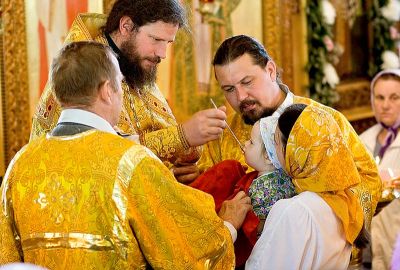
Communion eastern-style
Naturally, just being a visitor, I refrained from Communion. Many people in attendance, who I assume are regulars, also refrained from receiving. I'm not sure if it's because this is normal for Orthodox churches the world over, or because the congregation is made up of "trads". (Nearly all the women also wore headcoverings like in trad Catholic churches, but not a mantilla in sight.) Again to the consternation of my friends who are 1962 purists, I admired the Divine Liturgy's use of both species and wished I could receive both in the context of the old Mass. The priest addressed the communicants by name, saying "the servant/handmaid of God, N., partaketh of the precious and holy Body and Blood of Our Lord and God and Savior Jesus Christ, for remission of sins and for life everlasting." 

An aeon later, after the dismissal, the priest informally spoke to the congregation about things like Russian traditions regarding Communion, the vigil for the Transfiguration to be held that evening, and about the current attacks on Christian churches in the Middle East. Finally, he asked if anyone had any birthdays or name days coming up. One guy did, so the whole church sang "God Grant You Many Years" or something similar. When that was done, everyone dispersed to either the "parish hall" (another room in the house) or to receive a blessing from the priest. The guy who helped me follow along in the service book invited me to receive a blessing from the priest along with everyone else, but for the same reason I decided not to make signs of the cross Eastern-style, I decided not to go up for fear of mucking things up. 

The fellow who had a birthday was, I think, also the choir director. He warmly welcomed me to the church and asked if I was a musician. I don't know what prompted him to ask since I didn't even sing the congregational parts, but I said I was, and he responded along the lines of, "if I had known, I would've invited you to join us in sightreading some of the parts." To which I replied, "thanks, but I'm not Orthodox." He continued, saying, "that's okay, I wasn't Orthodox when I began singing here, either." He then invited me to stay and eat lunch with the other parishioners. I would've taken him up on it if I didn't feel so awkward, but instead, Lauren and I left.


The ride home

Lauren enjoyed the Liturgy quite a bit, and I had a very positive experience about it and the community myself. In fact, if you've read up to this point, you might be wondering if I've thought of "going Dox" by the end of it all. In a word, no. And although I mused that I unwittingly tossed Lauren headfirst into Patriarch Kirill's clutches by indulging her with this visit, she actually came through it more comfortable with her Catholic identity. Although our proverbial pilgrimage to Moscow affirmed in both us everything we disliked about western spirituality, there was still something missing. Lauren iterated the four marks of the Church (one, holy, catholic, and apostolic) and said she believed the Orthodox came up short on the "catholic" part. After all, we visited a Russian Orthodox church, as distinct from a Greek or Serbian one. While it's true that the Roman Church also has eastern rites, and in the not-too-distant past also had ethnic Irish, Italian, Polish, and Korean parishes in America, these are all window dressing by comparison to the distinct ethnic character of the various Orthodox churches out there.

An Orthodox reading this will quickly object by saying that there's no ethnic requirement to joining the church. Indeed, I believe the priest at the church I visited was of Irish descent (just based on name and appearance; I didn't talk to him), and I'm led to believe that it's quite normal for Orthodox clergy in America to be of Anglo, Irish, German, or otherwise non-Eastern European origin. But still, just speaking personally as a non-Slav, I feel like even if I did have the urge to convert to Orthodoxy, I wouldn't feel completely integrated into the Orthodox world unless I went above and beyond, and became a cleric in the faith. Otherwise, I'd perpetually be a hanger-on, a token half-Anglo, half-Indonesian guy (if not the only half-Anglo, half-Indonesian guy in all of Orthodoxy). As a convert to the Roman church, while I do still feel like a bit of an outsider, this is more because I'm just a single person going to church without any family ties or little ones trailing behind me, rather than because of ethnicity. 

In spite of all the eye-rolling induced whenever I read about the latest media stunt or soundbite surrounding Pope Francis, or my general cynicism about anything related to Vatican politics, I have to admit that the bishop of Rome somehow still supports a unity and catholicity you just can't find anywhere else in Christianity. I can look at photos of Japanese people attending Mass in Nagasaki after the bombs fell and think it makes sense, but think it would be bizarre if it were a Divine Liturgy instead. I can be irritated as hell looking over photos of the Eucharist being tossed like candy at World Youth Day in Brazil, but still feel the event is somehow relevant to me because I'm Catholic. I can have absolutely nothing in common with the average pew-warmer at the Catholic parish down the street, but what happens at his Novus Ordo Mass still matters to me more than what happens at an aesthetically perfect solemn Mass at Saint Clement's Episcopal in downtown Philly (though they are more Tridentine than Puginesque, but I digress). Much as I'd like to ignore the daily doings of Francis, his office somehow ties the ordinary Joe Catholic pew-warmer's fate to mine more than that of the most zealous Anglo-Catholic medievalist.


A Western Orthodox world

If I could build my own church, it would look like the Sainte-Chapelle and have daily solemn Mass and Office in the Sarum Use with a rood screen, choir stalls in the sanctuary, Communion under both species, less scholasticism and legalism, and some odd combination of both married secular clergy and celibate canons; and somehow still have a very active role in social justice and ministering to the poor of the area. As a young male convert to Catholicism with just enough education to enjoy armchair pontificating and not enough to be wise and content with what I have, I have the bizarre daily temptation to re-imagine the Church as I want it to be. Lauren, being a more masculine thinker than most women (don't tell her I said that, but honestly, when was the last time you heard of a single young female who thought of converting to Orthodoxy because Catholicism is too effeminate?), sought solace in the East but came through with a reassurance of Catholicism's catholicity, despite itself.

My imaginary church will never exist under the auspices of Pope Francis or (probably) any of his successors in my lifetime. The closest it's ever come would be under the extremely niche communities of Anglo-Catholics (such as Saint Clement's, as I mentioned above) or in so-called Western Orthodox communities. The priest of the Russian Orthodox parish I visited is an expert on the Sarum Use and, I imagine, has celebrated it many times before if he doesn't now. These communities are havens for thinkers such as Lauren and myself, and I'm sure some of them even read my blog. 

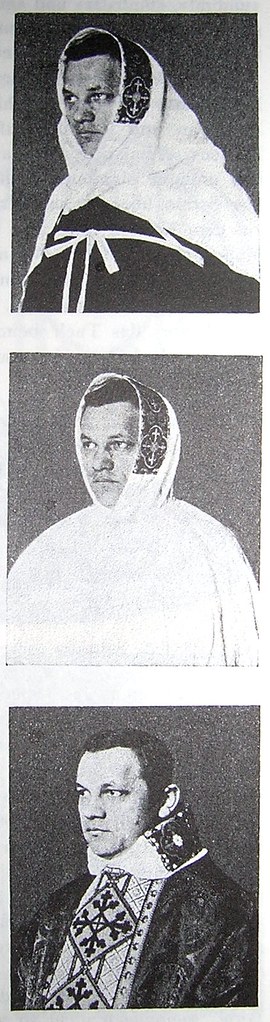
This Western Orthodox bishop (?) is precisely what I imagine all western churchmen ought to look like

My last thought for this entry: if reincarnation were true, I'm pretty certain I would have been Henry VIII in a past life. No other historical figure so embodies the "if I could build my own church" sentence I wrote better than he. Contrary to popular belief, Henry didn't create the Church of England just because he was randy. Any other king in his position would have just taken Anne Boleyn as a mistress and carried on with life. But before Henry became king, he was a young man groomed for a career in the clergy while his older brother, Prince Arthur, was set to be king. Indeed, his father named his firstborn "Arthur" out of a belief that he, the first of a union between the feuding houses of York and Lancaster, would lead England to a new golden age just like the king of myth. Young Henry, some said, would serve the realm as Archbishop of Canterbury beside his elder brother. 

Henry VIII before he was fat
So when Arthur died and Henry became heir, it's no surprise that his background as a potential churchman shaped his approach to the kingship. Henry's piety led him to come to the Papal States' defense during the Italian Wars. With the aid of Saint Thomas More, he published the Defense of the Seven Sacraments against Luther and was named by the Pope a "defender of the faith". When the continuation of the Tudor line came into question, it wasn't enough for Henry to just take a mistress as any other king would have done. He had to have his union validated by the Church, and if the Church wouldn't acquiesce (and honestly, if Katherine weren't the Holy Roman Emperor's aunt, the annulment probably would have gone through), he would have to take matters into his own hands.

Still, for the average Englishman, nothing changed under Henry's Church of England at all. At most, he introduced the "for thine is the kingdom" doxology to the Lord's Prayer, but that was already in Eastern usage, not a Protestant innovation. Lutheranism was still condemned in Henry's church. So ironically, I don't see Henry VIII as a Protestant at all. He was instead, perhaps, the first Western Orthodox; for if every king had followed his example, the West would have broken into national churches while otherwise remaining completely apostolic. The Pope would have remained "patriarch of the west" but with no real power outside the see of Rome.

And therefore, every day in between brushing my teeth and flossing, I look into the mirror and ask myself, "have I become Henry VIII?" The answer remains no, and it's not just because I decided to lay off the enchiladas. No, friends. Lauren and I will remain where we are, loving the Roman church despite Her best efforts to eject medievalists to the dustbin of history. Apologies if I offended anyone in the process.


Saturday, August 10, 2013

A look into the medieval parish church's vestry: on vestments

This article is written by request of a good friend (a seminarian) who wanted to read more about church vestments in the Middle Ages.

In truth, my title is misleading because from what little I've gleamed on such an obscure subject, medieval parish churches didn't have vestries (or sacristies); or at least, they were uncommon outside of cathedrals and abbeys. Perhaps the idea to partition a space to hold vestments and vessels didn't seem necessary until the Renaissance. At any rate, without a vestry, a priest dressed for holy rites within the sanctuary, or perhaps his vestments were laid upon a side altar as when a bishop vests.


Why have vestments?

Before we begin, it's worth asking: why should priests or their assistants wear any special kind of clothing in the first place? I've spent a long enough time in the evangelical faith to think a pastor's service dress was a power suit, perhaps also a cross lapel pin. If we to ask your average Catholic in the pew today why a priest wears vestments, I'd bet he wouldn't have really thought about it at all. "That's just the way it's done." It's true, insofar as that a priest is required by liturgical laws to wear vestments.

A more savvy sort of Catholic (the EWTN-watching kind who likes to read apologetic works) might say, "it's to obliterate the priest's personal identity because he acts not a man, but in the person of Christ Himself. The vestments are blessed and set apart for sacred services only, because the Mass is an otherworldly experience." Also not wrong, but that doesn't appear to have been the idea all along. Vestments arose from the street dress of the ancient Church, as fashions evolved but the clergy stubbornly insisted upon wearing the same old styles of clothing for liturgy. This would be like if Christ founded the Church in the 1920's, and a hundred years from now, only priests ever wore neckties and fedoras, but only at Mass, and only in very stylized or "Hollywood" forms.

The medieval liturgist might have said, "our clergy wear vestments because they were handed down to us from the clothing worn by the priests of the Old Testament, who in turn wore them by the express command of God in the law of Moses." This is a tall tale or at least a mistake because ancient Jewish and Christian vestments have only superficial similarities; and by the time the Church made use of vestments (after the end of Roman persecutions and the rise of Constantine, say) Jews and Christians had near zero cultural exchange. Indeed, it was more likely that a Christian would change his habits solely not appear like a Jew, and vice versa.


If we could synthesize all these strains of thought into a greater idea, then, I'd say that a priest wears vestments to: 1.) conform to the rule of the Church (liturgical law), 2.) symbolically erase his own identity by taking up the cloak of Christ, and 3.) emphasize continuity between the religion of the Old Testament and of the New. Each reason may seem questionable on its own, but together, they refute the idea held by cynical nonbelievers that vestments are worn for priests to vainly adorn themselves in rich fabric sewn by the blood, sweat, and tears of a peasant class kept in ignorant darkness by their ecclesiastic overlords. No, friends, it's just the opposite: the priest wears vestments as an act of obedience, to conform himself to the will of God. In theory, at least. This is true for the medieval priest just as much as for the modern one.


The alb

The alb (from the Latin word alba for "white") may not necessarily be the first thing a cleric reached for, but it's the foundation of all the other vestments and must be mentioned before all else. The big white gown evokes all sorts of negative emotions from the modern man: to the skeptic, it ranges from the uniform of fools being baptized in the river after a euphoria of preacher-induced excitement, down to the image of hundreds of robed believers drinking cyanide-laced Kool-Aid in the anticipation of a better world (even if, at such cult suicides as the one in 1978, no robes were actually involved). Traditional Catholics likewise often deride the alb simply because they see it worn on altar servers, perhaps with ugly sneakers peaking from the bottom, at their local temple of banality (your average Catholic parish) instead of the usual pre-Vatican II practice of wearing a surplice.

In my experience, it's a small matter to say the alb represents purity. It's another thing to stress that an all-white garment in the ancient or medieval world was a challenging thing to make, and even more difficult to maintain. Like teeth in the age before modern dentistry, clothes were most likely to range from shades of yellow to brown. The Roman citizen's toga candida ("bright toga") was only bright white because it was powdered in chalk, in order to draw attention to him while he sought political office; hence he was a candidate for office. Queen Victoria kickstarted the fashion of the white wedding dress, but at that time it was a garment fit for royalty precisely because of its purity, thus any cinematic depictions of medieval peasants or even lesser noblewomen marrying in a white dress are very unlikely.

The alb is also unique in that it's not a vestment for clerics alone, but the uniform of all Christians. Every Christian earns the alb in baptism. I don't know if the Church provided them or if believers had to bring their own, but at least since the time of Saint Augustine, who mentions the custom in a sermon, converts who were baptized on Easter were supposed to wear the albs until the following Sunday. This is why you'll see, in some missals, the Sunday after Easter called Dominica in albis depositis ("the Sunday in which the white is put away").

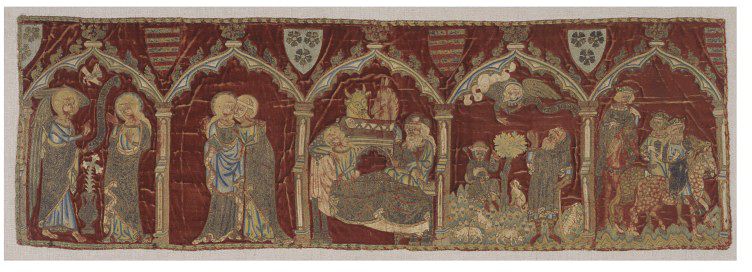
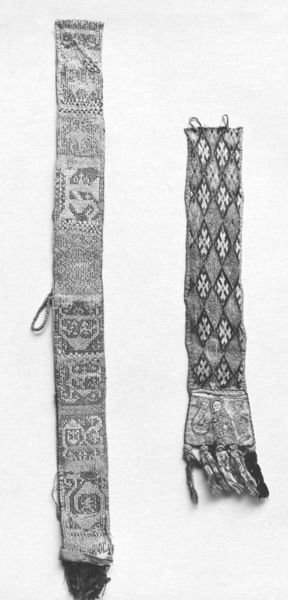
The alb's form in the Middle Ages was mostly the same as it was in Roman times, from the common tunic worn by men of the old Empire. Lacemaking techniques were very primitive before the Renaissance and unknown in ecclesiastic arts, so don't expect to find any medieval vestments resembling anything like the sheer "liturgerie" of the later centuries. Any decoration was made in the form of embroidery around the cuffs or head opening, or from the 13th century onward, in apparels. The first form, embroidery, can be seen below, dated to the 13th century:


Apparels are strips of fabric that are pinned to the alb's cuffs or the bottom, and can be exchanged with others. This is one very fine example from the Victoria & Albert Museum, London, made between 1320 and 1340:


I can't post an image directly, but this model shows how apparels would be worn on the alb today.


Another apparel is shown on the back of this alb.

The amice

The amice (from the Latin amictus for "covering" or "dressing") is a rectangular cloth that the priest and his ministers put on before anything else. The idea is to completely cover any sign of the priest's street clothes, including the Roman collar; again, fitting with the idea of obliterating the priest's identity. But since medieval clergy didn't wear anything resembling collars as we know them today, the question of where the amice came from is trickier. A pre-Vatican II rubric had the priest wrap the amice around his head for a moment before pulling it back over the shoulders. The prayer he had to recite while putting it on called the amice "the helmet of salvation". Was this some vestige of when clerics used them as a hood to protect their ears against the cold, like the white hood you might see on a portrait of Dante? But again in the old rites, when a subdeacon was ordained, the bishop would say, "Receive the amice, by which is signified the discipline of the voice". Was it supposed to protect the throat? The Catholic Encyclopedia presents a whole host of theories: 

"Early liturgical writers, such, e.g. as Rabanus Maurus, were inclined to regard the amice as derived from the ephod of the Jewish priesthood, but modern authorities are unanimous in rejecting this theory. They trace the origin of the amice to some utilitarian purpose, though there is considerable difference of opinion whether it was in the beginning a neck cloth introduced for reasons of seemliness, to hide the bare throat; or again a kerchief which protected the richer vestment from the perspiration so apt in southern climates to stream from the face and neck, or perhaps a winter muffler protecting the throat of those who, in the interests of church music, had to take care of their voices. Something may be said in favour of each of these views, but no certain conclusion seems to be possible (see Braun, Die priesterlichen Gewänder, p. 5). The variant names, humerale (i.e. "shoulder cloth", Germ. Schultertuch), superhumerale anagologium, etc., by which it was known in early times do not help us much in tracing, its history."
We can take that as a sign that the Encyclopedia had no idea precisely where the amice came from, either, though the medieval belief that the vestment came from Old Testament times resurges once again. My own bet is that the amice protected the alb and other vestments from getting stained by sweat, and was a lot easier to launder. Anyone with experience in laundering vestments could probably back me up. Nonetheless, by the ninth century, it was considered an essential garment for the liturgy.

The medieval amice was the same as it is today, except that it, like the alb, was frequently apparelled. I was unable to find pictures of surviving examples from the era, but here are some reconstructed forms today:


Vesting Priest with Apparelled Amice by Charles Blamey. Remarkable that an artist would bother to paint this subject in the first place, and even more remarkable that this painting dates only to 1991. Blamey, however, was an altar server for Saint Pancras Old Church in London and liked to paint what he called "ecclesiastical" (as opposed to religious) art.

All these representations admittedly look silly until you see the apparelled amice in its final form, pulled back over the chasuble. Then it looks quite splendid.


The cincture

The cincture (from the Latin word cingulum for "girdle", also often just called a girdle) is a cord with knotted or tassled ends that the minister uses to keep his alb and stole together. Over time this has come to represent chastity, but cinctures were probably used from very early times onward for no other reason than to keep the priest from stepping on and tripping over his own alb. All medievals wore belts over their long tunics or dresses for the same reason.


The stole

The stole (from the Latin word stola for "garment", as in the Roman woman's counterpart to the toga) is the sash that deacons, priests, and bishops wear as a sign of their authority. Outside of the strictly liturgical context, even most Catholic priests today will put on the stole during confession to represent their authority to absolve sin. In older times, there was also the concept of a "preaching stole" for priests who gave sermons outside of Mass, or for priests at Mass who were visiting or simply attending in choir. Since it's hard enough these days for priests to get people to come even to Sunday Mass, and since visiting priests now pretty much always concelebrate rather than attend in choir (and thus are already wearing a stole under the chasuble), the idea of a "preaching stole" has now vanished from the Church. Ironically, it may live on in Protestant denominations which formerly condemned the stole as vain popery, but now see it as a useful symbol.

Deacons wear the stole diagonally across the chest. It seems that in the earlier Middle Ages, deacons wore the stole over the dalmatic, as Eastern deacons do today. From the later Middle Ages until Vatican II, priests wore the stole with the ends crossed one over the other. At other times, they wore it with the ends hanging straight down, as bishops do.

The stole seems to have been used in Rome since the sixth century, possibly earlier. Even then, it was conferred upon someone to show that he had entered the ranks of the clergy. In many places, particularly the Frankish lands, priests were supposed to wear the stole not just in the liturgy, but as part of daily dress (that may be why in the movie Becket, you see Thomas wearing the stole even over his usual robes). Indeed, it was the Franks who gave the stole its current name. Before, it was called the orarium, and the Eastern clergy know their form of it as the orarion even today. Later on, some medievals stated that it had a common origin with the Jewish prayer shawl, but as with other theories relating to vestments' origins in Judaism, this one isn't true, either.

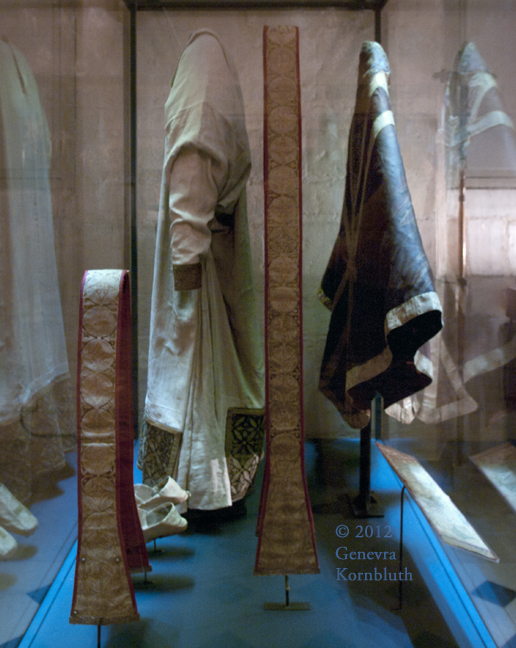
Returning to Becket, we're very fortunate to have some of the saint's own vestments preserved at the cathedral of Sens, France. You can see how the stoles from his age were very long, narrow, and generally of uniform width except for a little widening out at the ends. No medieval stoles ever fattened out like spades at the ends as Rococo stoles do, however.

The photo also shows an alb with apparels as I described before, a maniple, and a conical chasuble which I'll bring up again in a bit. Photo courtesy of Genevra Kornbluth.


The maniple

The maniple (from the Latin word manipulum for "handful" or "bundle") is a strip of fabric, often made out of the same material as the stole, that hangs over the cleric's left forearm. This one will be strange to anyone not familiar with the traditional Latin Mass, because it's hardly ever seen outside of that context. After Vatican II, the maniple was no longer required by the rubrics for Mass, and with no practical purpose to justify it, that meant it was as good as abolished for the post-conciliar Church.

Saint Alphonsus Liguori, in language typical of the 18th century pious, wrote: 
"It is well known that the maniple was introduced for the purpose of wiping away the tears of devotion that flowed from the eyes of the priest; for in former times priests wept continually during the celebration of Mass."
I'm not so sure about that. The maniple was also referred to as the sudarium, which literally means a sweat cloth. The liturgical maniple, then, probably descended from ornamental handkerchiefs that upper-class people in Roman times used to wipe off their sweat. Before it took its current form as a strip of cloth around the forearm, it was folded and carried in-hand. One can easily imagine Cassius, the fat games announcer from Gladiator, using it to wipe his brow in between bouts. 

The oldest surviving example I know, the maniple of Saint Cuthbert on display at Durham Cathedral, is of the folded handkerchief kind. Predatng the Norman Conquest, it was a gift from Queen Aethelflaed to the bishop of Winchester. 

The world's finest sweat rag ever made depicts Saint Sixtus II. I'm not sure how Sixtus feels about that.

A 14th century German maniple at the Victoria & Albert Museum. By this time, the maniple has been worn as a band around the forearm.

Considering the maniple's aristocratic origins, I can see why the maniple, which in its earliest days was used even by acolytes, gradually became restricted to subdeacons and higher. What I still don't know is how the maniple came to be used strictly for Mass and no other liturgical function.


The tunicle and dalmatic

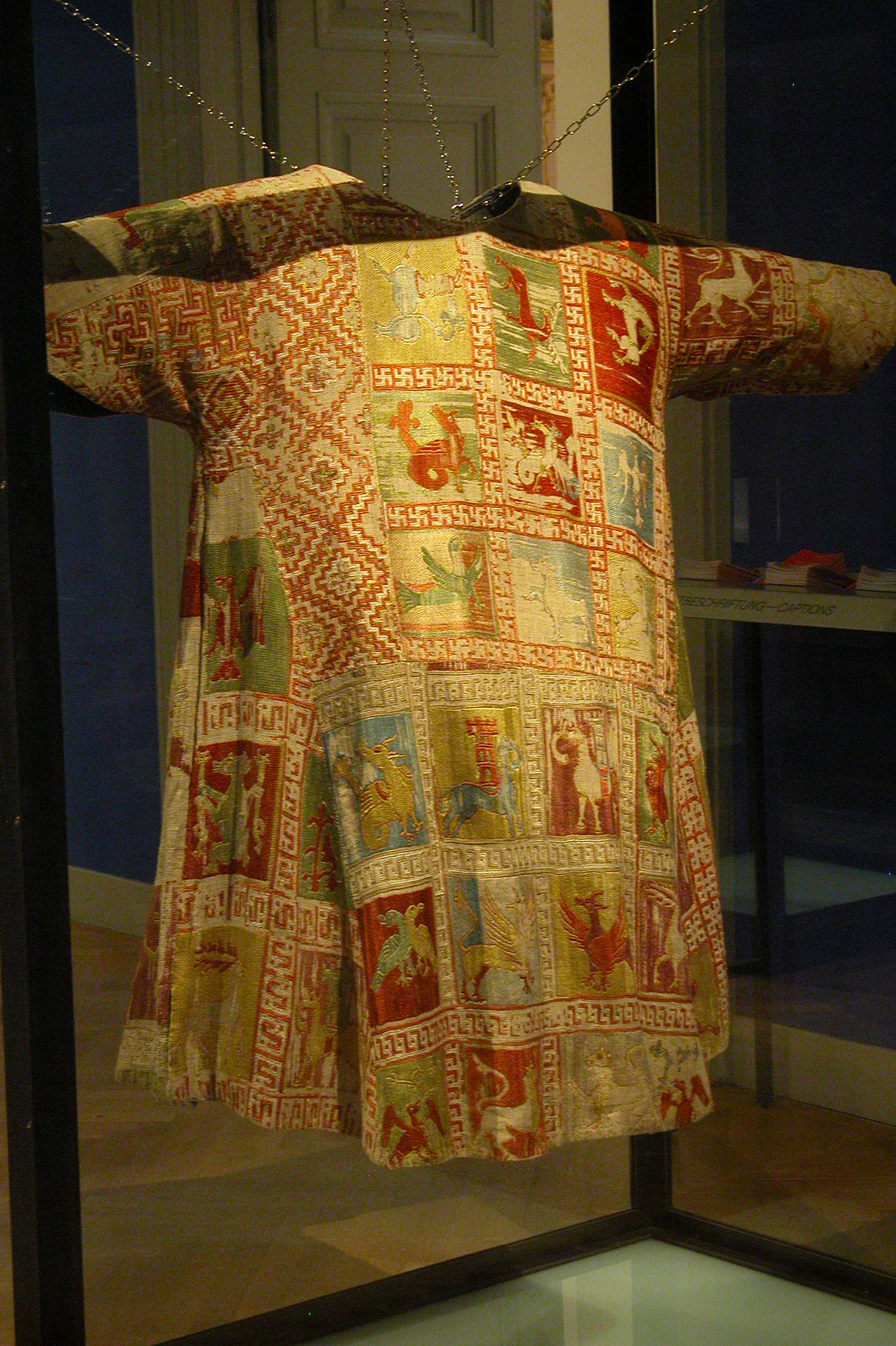
The tunicle (from the Latin word tunicula for "little tunic") and the dalmatic (literally "Dalmatian", as in a robe made of Dalmatian wool) are the outer vestments for the subdeacon and deacon respectively. I group them together because in traditional Latin Mass communities today, they're basically interchangeable garments. This is because the medievals wanted the subdeacon and deacon to appear more symmetrical when assisting the priest. In theory, the subdeacon's tunicle is supposed to appear shorter and plainer, but I can't say I've ever seen any meaningful distinction in practice.

The tunicle, in Roman times, was a fine gown to be worn around the villa like a lounge suit. Subdeacons were already wearing tunicles by the time of Pope Gregory the Great, who wrote in a letter that he abolished the custom and had them wearing chasubles as before. (For those of you who are really in-the-know, you may remember that subdeacons and deacons wore folded chasubles during Advent and Lent until 1960. Perhaps this was an attempt to honor Gregory's rule halfway.) But that likewise was overturned, and subdeacons were wearing tunicles again until Vatican II, when the order was abolished entirely.

The dalmatic likewise was a garment worn by the late Roman aristocracy, only even more richly adorned. Deacons began wearing them in Rome as an honorific at the time of Pope Sylvester I, who was contemporary to Emperor Constantine. Both the tunicle and the dalmatic have luxurious, festive origins which help to explain why they were put away during the penitential seasons of Advent and Lent, as I mentioned before. The noble connotations remain today in the secular world because the British monarch still wears a dalmatic during the coronation rite.

In the early Middle Ages, dalmatics reached nearly to the floor and were always white. In the succeeding centuries, the length shortened a bit and colors were introduced at the same time that the system of prescribed colors for the chasuble came into play. 

In this famous mosaic of Emperor Justinian, I believe those two on the right of Bishop Maximianus are deacons in white dalmatics. They don't wear the chasuble (which was very cumbersome in early medieval times) as the bishop does because the deacons, being the bishop's servants, need their hands free to work.

A southern German dalmatic dating to c.1260, part of a set called the Göss Vestments. By this time the sleeves are shorter, but the sides are not yet cut with high slits like the Baroque dalmatics.

This dalmatic was a gift from the Byzantine emperor to Pope Eugene IV in the 15th century. It's the only medieval vestment left in the treasury of Saint Peter's Basilica. Sad. Perhaps the gentlemen in the Vatican thought "LOL, where's the lace?"

Left: how the dalmatic should look on a person.


The chasuble

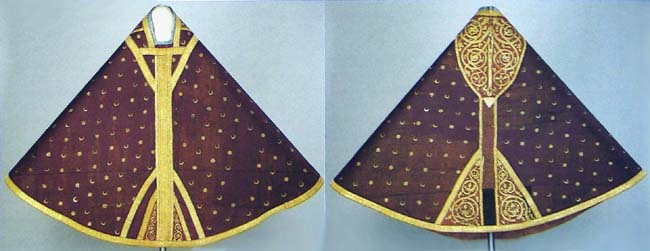
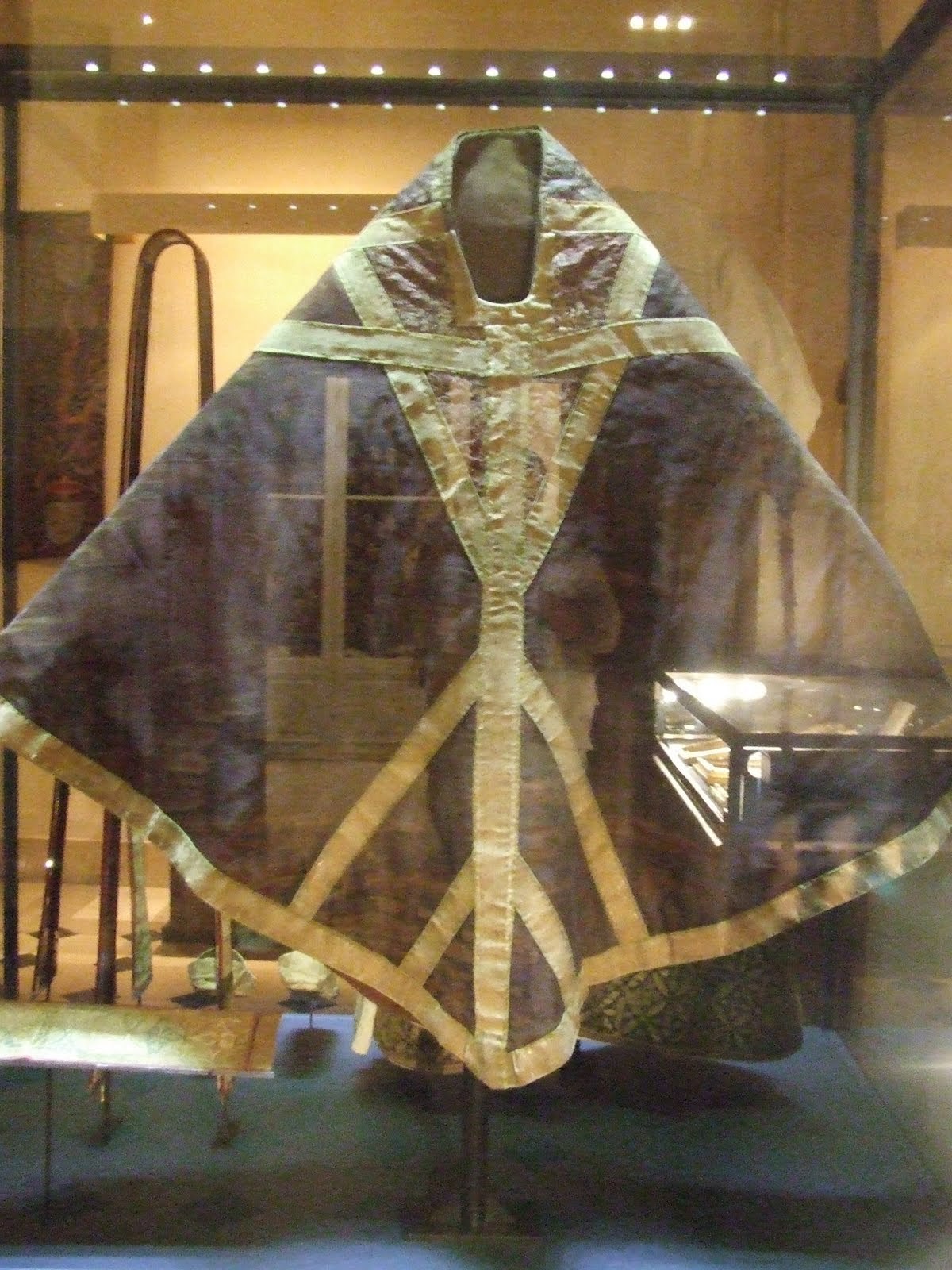
Though this article could go on for nearly twice the length by just talking about copes and episcopal vestments, I'd like to end here with the priest's outer vestment, the chasuble. Called in Latin the casula ("little house"), it descends from a much humbler garment than the tunicle or dalmatic, despite the priest being higher in rank. The chasuble's ancestor in Roman times was a traveling poncho, serving the same purpose as the modern trenchcoat. The chasuble "housed" its wearer completely because the fabric extended from the neck all the way down to the ankle in the shape of a cone; in other words, basically a cope that's sewn shut in the middle.

Many details about the chasuble's evolution can be found elsewhere in plenty, so it suffices to say here that the medieval chasuble was very bulky, encumbering vestment that virtually required the deacon's and subdeacon's assistance to help the priest move around. This is why in the Latin Mass, the deacon and subdeacon are required to hold up the edges of the priest's chasuble when he ascends the altar steps, moves from side to side while incensing, or when he elevates the Eucharist. Without their help in lifting the material, it would have very difficult, if not impossible, for an elderly priest to elevate the Chalice without making an unholy mess.

All these inconveniences caused liturgical "fashion" to cut down the chasuble's length, inch by inch, until eventually, in the 18th century, we were left with the absurdity known as the fiddleback. Such chasubles are like the sleeveless t-shirt, or perhaps the g-string of vestments, and makes the gesture of the deacon pinching the sides of the priest's chasuble pointless, if not ridiculous. That is not to say that a priest's chasuble must be of the full conical form, but the vestment should at least be long and voluminous enough to suggest nobility, dignity, gravitas. The Gothic style attempts to do that while still allowing the priest some mobility. The fiddleback style does none.


The Wolfgangskasel (chasuble of Saint Wolfgang) dates c.1050. It's currently displayed in Regensburg. One of the oldest surviving chasubles out there, but much of the fabric is also reconstructed.

The chasuble of Bishop Bernulf, c.1150.

Another view of Saint Thomas Becket's chasuble at Sens.

An illustration by Augustus Welby Pugin of chasubles and copes as depicted on real effigies (such as on tombs). These are mostly from the later Middle Ages or the Renaissance.

Tuesday, October 30, 2012

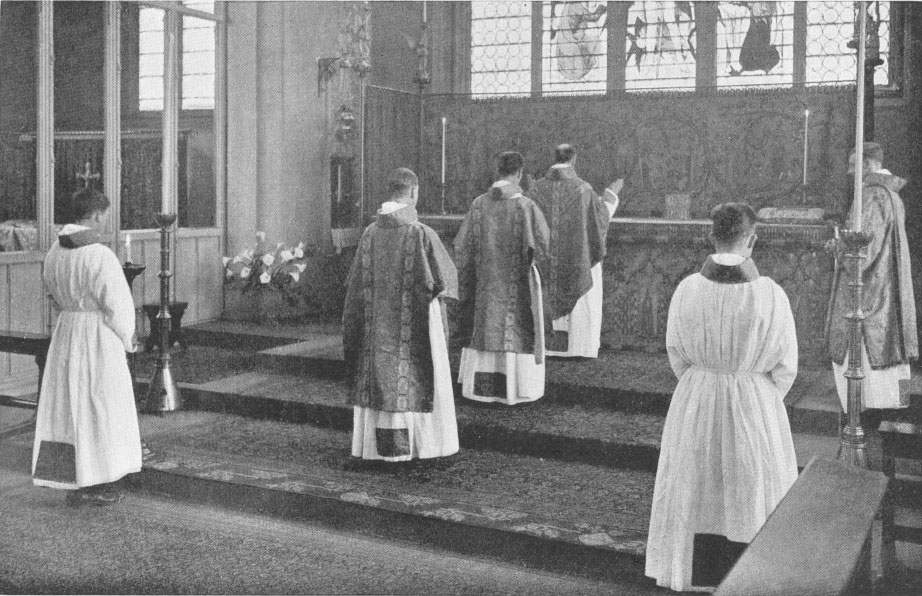
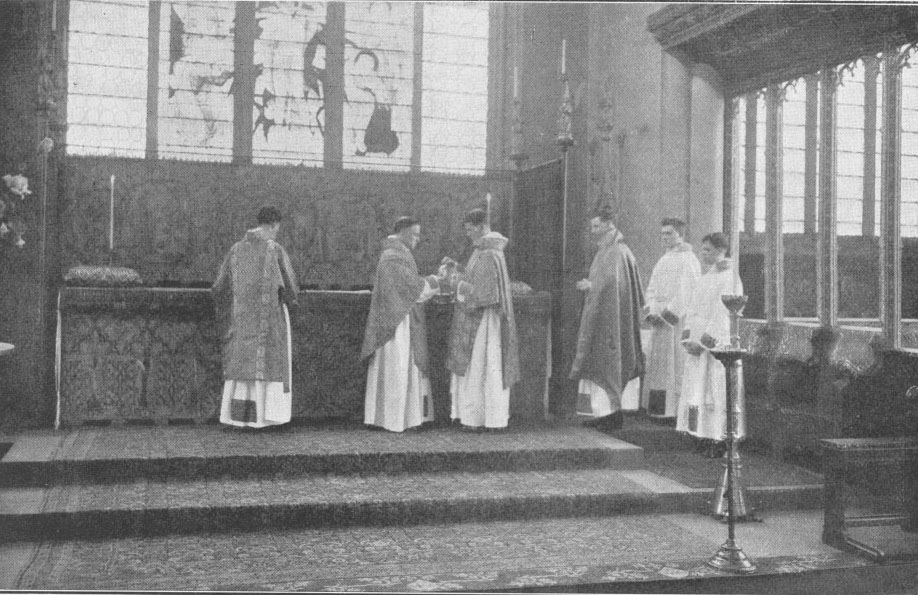
The Sarum High Mass: Mass of the Faithful

The previous articles in this series:

-The Use of Sarum: A Brief History, and Why It Matters
-The Sarum Low Mass: Mass of the Catechumens
-The Sarum Low Mass: Mass of the Faithful
-The Sarum High Mass: Mass of the Catechumens

At last, we come to the Sarum's summit: the Eucharistic sacrifice as seen in high Mass. This last comparison is short, though, because the rubrics for the Mass of the Faithful concern mostly the celebrant himself, and there are few differences between high and low Mass for him from the Offertory onward. The deacon and subdeacon, who may be said to be the "stars" of the Mass of the Catechumens, now step aside to humbly assist the priest as he fulfills his vocation upon the high altar.


The Offertory

As in the Mass of Trent, the Offertory begins after the celebrant says Dominus vobiscum, then Oremus. I said before that in a parish Mass, the Sarum rubrics place the bidding prayers "after the Gospel or Offertory". I placed my account of them after the Gospel, or after the Creed when the Creed is said. "After the Offertory" is a very awkward place for bidding prayers, but on closer thought, I offer the possibility that the rubric means after the Oremus. The reason? Because this was the place where the oratio fidelium, the prayers of the faithful, were made in Rome prior to the reforms of Pope Gregory the Great. This, at least, is the argument made by the Rev. Father Adrian Fortescue which can be found in the Catholic Encyclopedia's article on 'Liturgy of the Mass':

'The "Oremus" said just before the Offertory is the fragment of quite another thing, the old prayers of the faithful, of which we still have a specimen in the series of collects on Good Friday.'
And:
'At Rome the prayers of the faithful after the expulsion of the catechumens and the Intercession at the end of the Canon have gone. Both no doubt were considered superfluous since there is a series of petitions of the same nature in the Canon. But both have left traces. We still say Oremus before the Offertory, where the prayers of the faithful once stood, and still have these prayers on Good Friday in the collects. And the "Hanc Igitur" is a fragment of the Intercession.'
It may have been the case, then, that Sarum preserved this ordering, or at least the option of it.

Now, as the celebrant reads the Offertory sentence privately, the choir sings it. There are some days (ferial days in Advent and from Septuagesima to Easter) in which the Offertory has a verse and response, like in the Tridentine's Requiem Offertory or in the Offertoriale Triplex. However, the rubrics state these are not to be said outside of these days. (I see no reason why the verses can't be sung by the choir ad libitum to cover additional time, however, if they can be found in the Offertoriale or elsewhere.)

The usual position of the ministers when the celebrant reads from the middle, though I'm unsure about the northward-facing acolyte there.
The deacon presents the chalice and the paten with the Host to be consecrated to the celebrant, "kissing his hand each time". As in low Mass, the celebrant offers the Host and chalice at the same time with the prayer Suscipe, sancta Trinitas. After placing the gifts properly upon the altar, he receives the thurible from the deacon and censes the gifts "thrice, making the sign of the cross over it; then thrice round and on either side: then thrice between himself and the Altar". While doing so, he recites the prayer:

Dirigatur, Domine, ad te oratio mea, sicut incensum in conspectu tuo.
Let me prayer, O Lord, be set forth in Thy sight as the incense.

He then returns the thurible to the deacon, who, if the Creed has been said, censes him. The subdeacon brings the celebrant "the Text" to kiss, but I'm not sure what text is being referred to here; perhaps the Missal. While the celebrant steps to the right of the altar to wash his hands as at low Mass, the deacon is incensing the left of the altar "and the relics in order". The rubrics don't specify if the deacon ever censes the altar's right.

One of the acolytes is tasked with incensing the choir, differing with the practice of Trent which has the deacon do so. The order prescribed is for the acolyte to first cense the rulers, then the dean, then those on the "upper grade" of his stall on the north side. Then he censes the precentor and the upper grade on the south side. He then goes back and forth to cense the middle and lower grades of the stalls in what must have been a lengthy ritual. The subdeacon, meanwhile, follows the acolyte and presents the Text for each member of the choir to kiss after they've been censed. If the Creed has not been said, then the incensing of anything but the gifts upon the altar is omitted.

After the handwashing, the celebrant returns to the middle of the altar and continues as he would at low Mass, while his ministers assume their places behind him. As in Trent, he sings per omnia saecula saeculorum aloud at the end of the Secret and continues with the Preface.

The Canon

During the versicles of the Preface, the deacon gives the paten and humeral veil to the subdeacon, who holds the paten with the veil until the Lord's Prayer. At the Sanctus, if there are rulers, the rubrics instruct the choir to exit their stalls at the ringing of the bell and stand outside the first stalls in the center of the quire. They do not kneel, except on ferial days.

There are no instructions throughout the Canon which differ from low Mass, except that after the consecration, the cerofers assist the deacon with washing his hands, and toward the end, at per ipsum et cum ipso, "let the Deacon stand at the right of the Priest, having first washed his hands, and assist him in raising the corporals; and as he retires let him kiss the Altar and the right shoulder of the Priest."

As at low Mass, the priest extends his arms in a cross after the consecration of the wine.

From the Lord's Prayer to Communion

As the celebrant begins the Lord's Prayer with Præceptis salutaribus moniti, the deacon takes the paten from the subdeacon and stands to the celebrant's right, holding the paten uncovered with both hands, arms extended out. At Libera nos, the deacon hands the paten to the celebrant, kissing his hand. The celebrant makes a curious gesture here which I neglected to mention in the low Mass article. Taking the paten from the deacon, he kisses it, then holds it over his left, then his right eye before signing himself with it.

At the Kiss of Peace, the deacon receives the peace from the celebrant and gives it to the subdeacon. The deacon also gives it to the rulers of the choir, who then give it to their respective sides.

As with low Mass, there are no instructions in the Missals for the people's Communion. I've done a bit more research into this subject, and it seems that there are no surviving rubrics for administering Communion to the people in any book whatsoever; largely because by the end of the Middle Ages, it seems the common practice was for the laity to receive Communion only a few times a year, and in those cases, usually outside of Mass.

The Rev. Seán Finnegan, who was involved with the Sarum Candlemas liturgy at Oxford in 1997, wrote of their difficulties in handling precisely how to approach the people's Communion "accurately". I'll quote from his series of posts on this:
"This was one part of the ceremony where we really had to wing it. We had gleaned that the confiteor was said before Communion, because there is a record of one king of England saying it on his own before his coronation. So we gave the Sarum Confiteor to the Deacon to recite, as in the Roman Use. There was a lot of agonizing about whether we should have Ecce Agnus Dei and Domine non sum dignus, but we could find no evidence for either (which is not the same as it never existing) so in the end, though we printed it in the booklets, we omitted it in the ceremony, probably correctly, I think. The formula for Communion we had, from the order for the visitation of the sick: Corpus Domini nostri Jesu Christi custodiat corpus tuum et animam tuam in vitam æternam, it goes. We knew that there was the custom of the 'houselling cloth' —the long cloth you can see being used — in many places, and that unconsecrated wine was given after the host to cleanse the mouth. We had no formula for administering that, so the acolyte simply presented a chalice with the wine, saying nothing."
The houseling cloth, which is held under the communicant's chin to prevent dropping the Host, is still used at some Tridentine Masses I've attended in the past. Father Finnegan also mentions the interesting custom of administering unconsecrated wine to "wash down" the Eucharist. This may have been a remnant of the late medieval Church's transitional period, when it withdrew Communion via the Chalice from the people. Perhaps unconsecrated wine was still administered as a matter of habit. Other reasons given were that it made swallowing the Host easier, and that it prevented anyone from spitting out any small particle of the Host later on.

Illustration of Communion from the Coronation Book of King Charles V of France, c.1365. (I believe the Tridentine form doesn't allow a bishop to distribute Communion with the mitre on.)

From the ablutions to the end of Mass

At the ablutions, the rubrics have the subdeacon pour the water and wine into the chalice (a few sources contradict and have the deacon here). At the third and last ablution, all sources have the deacon pour the water. The subdeacon ministers to the celebrant in washing his hands, while the deacon folds up the corporals, places them in the burse, the burse over the chalice, and gives them to the acolyte (wearing the humeral veil), who returns them to the credence or shelf.

The subdeacon assisting with the ablutions.
All else follows as in the Mass of Trent, but after the dismissal, the Mass is truly ended. As with low Mass, there is no final blessing, and the Last Gospel is recited privately by the celebrant on his way back to the sacristy. (The medieval priest may have recited it at the altar, though, if he were in one of those churches that had no sacristy to speak of.) The choir remain in their places and proceed with None, or the appropriate Divine Hour, immediately after Deo gratias.