[Update Oct. 6: I just wrote a commentary on the Earnest Appeal which may can read here. That being said, I still want this tract to stand on its own merits, apart from my pontifications.]
[Update Oct. 10: You can now download an easy-to-read .pdf version of the Earnest Appeal here. The format is very nearly similar to the original pamphlet.]
Friends, I'm quite pleased to announce that after an edifying visit to Fisher-More College in Fort Worth, I made a quick stop at the Bowld Music Library of the Southwestern Baptist Theological Seminary. The reason: their library, with its vast collection of books and other resources on religious music, happens to have one of the few surviving copies of Augustus Welby Pugin's Earnest Appeal for the Revival of the Ancient Plain Song in the entire country. With only half an hour until closing time, I got permission to go into their treasures room and photograph every page of Pugin's pamphlet. The pamphlet fell apart in my hands due to its age, but I've carefully transcribed every word as it appears in Pugin's tract onto my computer, and posted it below. I've scoured the Internet in vain for digitized versions of this work anywhere, and could find nothing more than short excerpts from this or that Victorian digest. Therefore, I can safely declare that I've published Pugin's Earnest Appeal on the world wide web for the first time ever.
[Update Oct. 10: You can now download an easy-to-read .pdf version of the Earnest Appeal here. The format is very nearly similar to the original pamphlet.]
Friends, I'm quite pleased to announce that after an edifying visit to Fisher-More College in Fort Worth, I made a quick stop at the Bowld Music Library of the Southwestern Baptist Theological Seminary. The reason: their library, with its vast collection of books and other resources on religious music, happens to have one of the few surviving copies of Augustus Welby Pugin's Earnest Appeal for the Revival of the Ancient Plain Song in the entire country. With only half an hour until closing time, I got permission to go into their treasures room and photograph every page of Pugin's pamphlet. The pamphlet fell apart in my hands due to its age, but I've carefully transcribed every word as it appears in Pugin's tract onto my computer, and posted it below. I've scoured the Internet in vain for digitized versions of this work anywhere, and could find nothing more than short excerpts from this or that Victorian digest. Therefore, I can safely declare that I've published Pugin's Earnest Appeal on the world wide web for the first time ever.
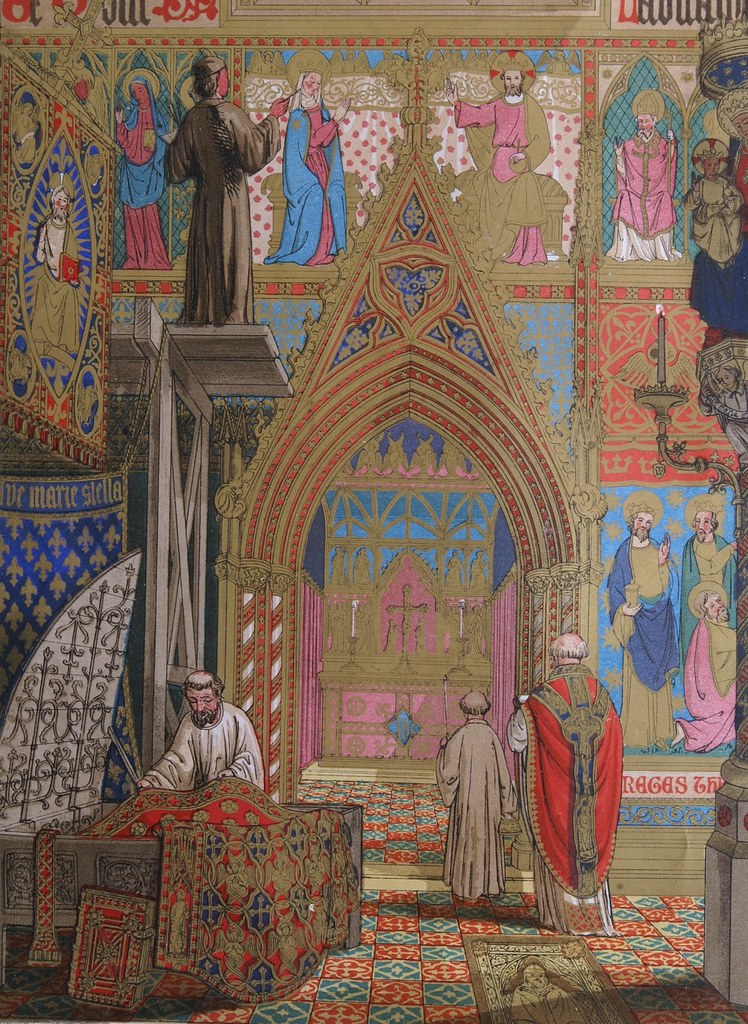
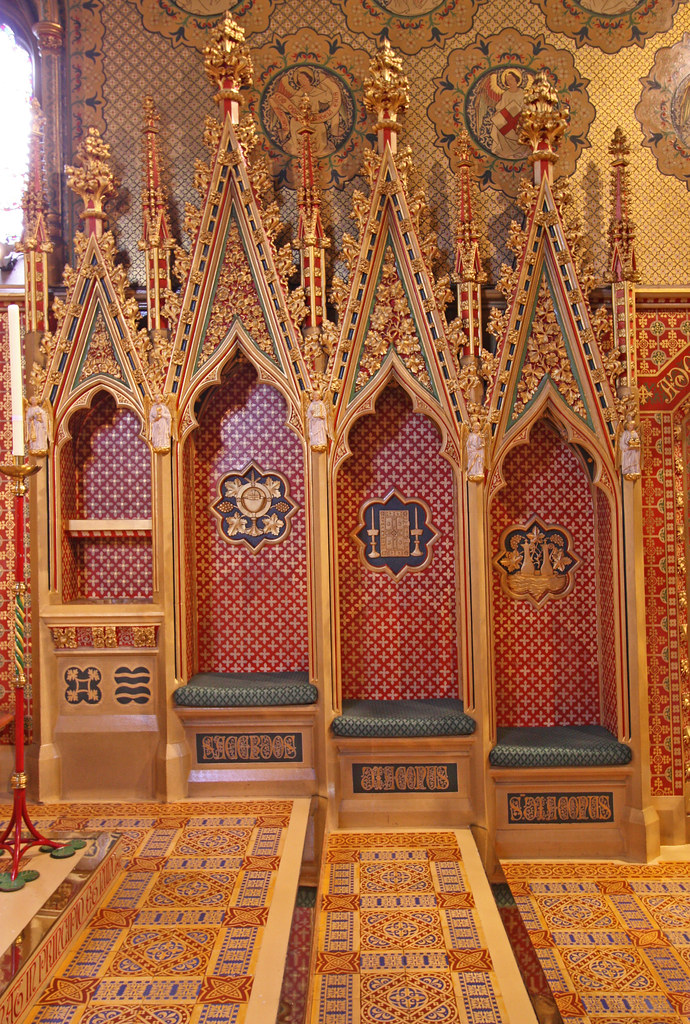
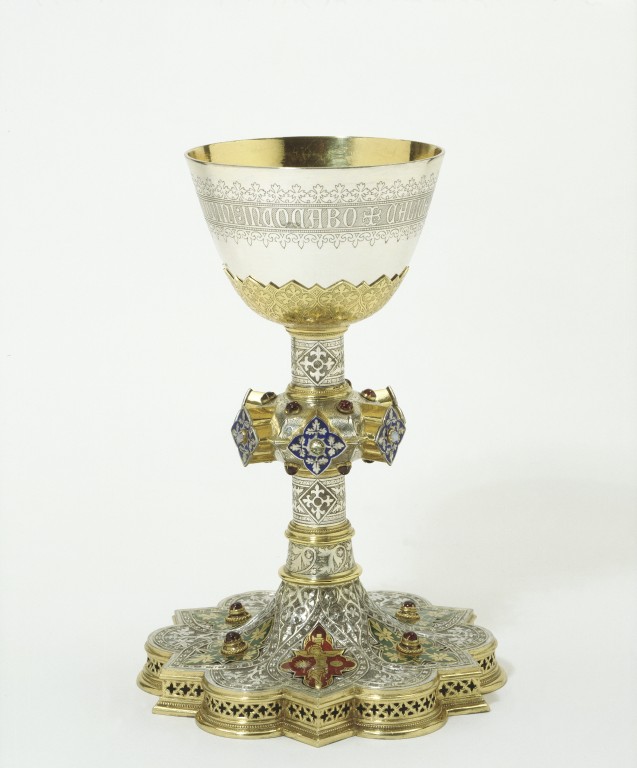
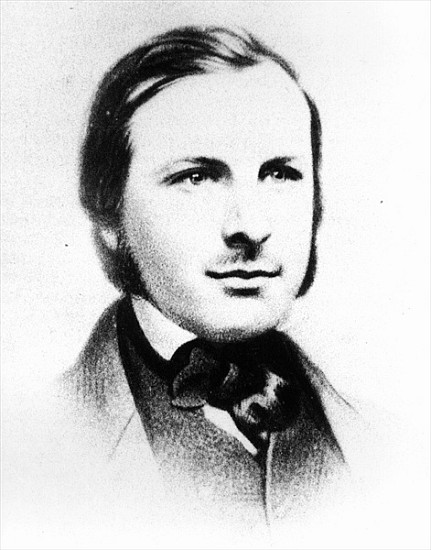
A quick introduction: Augustus Welby Pugin was the most prominent Gothic revival architect and designer of Victorian Britain. Though his name is obscure, he is responsible for the design of Britain's most iconic building, the Clock Tower of Big Ben, as well as the interior of the Houses of Parliament. Pugin spent most of his brief forty years on earth, however, designing churches, cathedrals, and convents for the fledgling Catholic communities of 19th century England. He revolutionized the field of architecture by insisting on a moral dimension. To Pugin, one style of architecture (namely the Gothic, which he always called "Christian architecture") could be more moral than another. A building had to be true to its appearance: to use cheap bricks in the back while gilding the front would incur God's displeasure. Generations of architects after Pugin would look to his books, such as The True Principles of Christian Architecture, as something more like gospel than a mere manual of design.
Pugin never limited himself to the art of raising buildings. He insisted that the ethos behind the True Principles could be applied to everything, sacred or secular. In 1850, the year before he died, Pugin composed a pamphlet in defense of Gregorian chant and congregational singing. The patrimony of Christendom's medieval sacred music held a most revered place in his heart, as in his eyes, the hall of a church built according to the spirit of the medieval Christians could not possibly echo with anything but the plainchant for which the Gothic cathedrals of old were designed.
The edition I transcribed is a 1905 reprint by Benziger Press. It should become quickly apparent that Pugin was a man of passion. He had to contend with abuses in the Church that still persist today, which he confronted with "radical" remedies. Some of his positions may be considered extreme even for Catholics of a traditional persuasion: for example, his total assault on the practice of choir or organ lofts in place of the traditional chancel with choir stalls in the sanctuary. He even seems to challenge metered polyphony itself, though I believe if Mr. Pugin were alive today for me to question him further on the subject, he would direct his rage more to the compositions of the Baroque and later periods, rather than the earlier polyphony of, say, Palestrina, Tallis, or Josquin.
And now, I present to you all the first edition of Mr. Pugin's Earnest Appeal ever on the Internet. My only additions are of a few pictures to break the monotony of text. Otherwise, the formatting is all as it appears on the original pages, save for (obviously) page breaks. Enjoy!

An
Earnest Appeal for the Revival of the Ancient Plain Song
by
A. Welby Pugin
Prefatory
Note
Through
the kindness of Mrs. Pugin, the devoted widow of the great and gifted
architect, it is permitted to reprint this paper, which first saw the light in
1850, and which is not without interest at the present moment. The medieval
revival was not confined, in Pugin’s scheme, to architecture; it was to affect
all the arts that had an ecclesiastical function, and notably Church Music.
The pamphlet may be left to speak
for itself. Those who know Pugin’s style of writing will not need to be told
that he never watered down his statements. Had he lived in these days, he would
undoubtedly have been among the most fervent advocates of the restored
Plainsong. By reprinting this “Appeal” I hope to make his influence once more
active in favour of the Ritual Music of Holy Church.
The tender aspiration with which
Pugin closes this paper seems to blend in striking harmony with the “Motu
proprio” on Church Music of His Holiness Pope Pius X across the space of half a
century.
Becket.
July 7, 1905
An
Earnest Appeal
For the Revival of Ancient Plain Song
When
chancel screens were first attacked, about three years since, I at once
denounced the writer of the article as one who was opposed to the very
principles of Christian Architecture, and, I then stated my firm belief, that
the objection to screens was merely raised as a test of public opinion, and in
order to ascertain how far the party, (of which the writer was an organ) might
proceed in their opposition to the whole system on which the revival of true
Ecclesiastical Architecture was based.
 |
| A chancel screen at Pugin's church of Saint Giles, Cheadle |
But, although I foresaw the evil
tendency of their opinions, yet, I must confess, I was not prepared for the
extent to which they have been carried in so short a period. At first the
screens alone were objectionable, the architecture itself was praised as
beautiful and appropriate, but now we are told that it is utterly unsuited to
Catholic worship; that our finest Cathedrals, those most noble evidences of the
piety of our forefathers, are only fit for demolition, and that, in fine, the
buildings we should erect for divine worship should be as similar as possible
to dissenting conventicles in their arrangement, only rather more offensive
than their meager prototypes, by the meretricious decoration of their
interiors. Now, monstrous as these suggestions must appear to Catholic-minded
men, they become light when compared to the changes that are proposed in the
divine service itself, and which have been lately put forth in a publication
which is the recognised organ of the party from whom this miserable system of
modern degeneracy emanates. It is, indeed, seriously proposed to change the
whole nature of the divine services of the Catholic Church, under the specious
pretext of rendering them more popular and adapting them to the spirit of the
age: and what is scarcely credible this change is advocated not merely for the
services of a peculiar order or body, but for the Parochial Churches of the whole
country. (See the Rambler of 1850)
Now, however we may deplore the
wretched taste and principle which regulates the services of some religious
bodies, yet as long as they are confined within the walls of their own
institutions, and are not censured by the ecclesiastical authorities, we may
view them in silent sorrow. No Catholic is compelled to assist at their maimed
rites or to enter their conventicle-looking chapels, if any among the faithful
are so debased as to prefer the trumpery display of a toy-shop and the vocal
entertainment of a concert-room to a more solemn service, why we only pity and
pray for them. But when we find that an attempt is made to thrust this parody
of a Catholic service into the Parochial Churches of this country, where we are all bound to worship, it is
time that every man who has a heart in the Catholic cause should testify his
unbounded horror of so unhallowed an attempt to change the ancient offices. What! shall the song of Simeon, the hymn of Saint Ambrose, the canticle of our
Blessed Lady herself, give place to the doggerel rhymes and poetical effusions
of a few individuals whose tendencies and principles should have led them down
to Geneva, but who appear to have mistaken their road and found their way into
the Catholic Church, only to create divisions among the faithful, and to use
the ancient liturgy as a mere vehicle for the display of their Methodism. I do
not hesitate to say, that the Book of Common Prayer, bare as it is in
comparison with the ancient office from which it is taken, is yet a far more
Catholic service, and more in accordance with the ancient traditions than what
is now proposed as the beau ideal of a popular service. On the same principle
of lowering the divine service to the debased spirit of the age, some moral
essays and family tales, embodying amusing anecdotes, should be substituted in
lieu of the old lessons taken from Holy Writ, which are certainly quite out of
date, and far more suited to the ambons of the Basilicas, and the rood lofts of
the pointed churches, than for the assembly rooms for 19th century
Christians. England can never be Catholicised by the destruction of her
cathedrals, the conversion of the liturgy into a song-book, and the erection of
churches, whose appearance is something between a dancing-room and a mechanic’s
institute, and I do greatly mistake the souls of Englishmen, if this miserable
system is ever permitted to take root in this land; for, although some weak
persons may be led away by novelties, yet there is a general feeling of solid
devotion, and a growing appreciation of the glories of Catholic antiquity that
will effectually preserve us from the encroachment of modern innovations. And,
although there is every reasonable hope, that in due time this country will
again receive Catholic truth in all its fulness, yet such a result can only be
accomplished by our rising to the high standard of ancient excellence and
solemnity, and not by lowering the externals of religion to the worldly spirit
of this degenerate age.

But as good frequently grows out of
evil, it is most earnestly to be hoped, that this monstrous proposal of
substituting vernacular compositions for the Church Offices, will be the means
of awakening the ecclesiastical authorities to the absolute necessity of
restoring the ancient Chaunt in all its purity, and I most gladly embrace this
occasion for urging this all important subject.
The very fact of such a proposal
being made is an evidence that there is something very rotten in our present
system; for, although the remedy suggested is far worse than the disease, yet
that a disease does exist, and to a very great extent, no man who reflects on
the subject can deny. There does exist a want
of reality in the present services of the Churches, as they are performed
in this and many other countries, and from what does it proceed, but the corrupt and artificial state of
ecclesiastical music. Owing to the complicated nature of modern figured
compositions, both the clergy and the people have been precluded from taking
any real part in the service of Almighty God. They are reduced to the position
of listeners instead of worshippers; so that, in lieu of the grand and edifying
spectacle of priests and people uniting in one great act of adoration and praise,
the service is transformed to a set of hired musicians, frequently heretics and
infidels who perform in a gallery, while the congregation are either amused or
wearied, and the clergy who are present generally take advantage of those
interminable fugues to say their own office, which has no reference whatever to
the great act of sacrifice at which they are ostensibly assisting. Thus the
unity of this, the most majestic, the most solemn act of Christian worship, is
destroyed, and in many places, it has degenerated into a mere musical
entertainment for the audience, and at which they assist with no more devotion,
than in a common theatre. Let no one think this picture is overdrawn. In one of
the most Catholic cities of Flanders, Sunday after Sunday, an orchestra is set
up in the nave, round which a full band arranges itself, and during the whole
Mass—Kyrie, epistle, gospel, creed, offertory, and horrible to relate, even the
consecration and elevation—do these men blow forth profane airs, taken from
popular operas, while the Church is filled with irreverent listeners of their
symphonies, and no man reverencing the Lord’s Body. Now, this is not a solitary
example by any means. Scarcely is there a great Church in Europe which is not
profaned by these miserable parodies of Divine Service; and what is most
distressing, the greater the feast, the greater the abomination. I have been
assured by a dignitary of the French Church, who abode at some time with the
Franciscans of Assisi, that their daily offices were most solemnly sung; but
the feast of St. Francis arriving, the Church was inundated with fiddlers from
all parts of the neighbouring country, and this most glorious church converted
into a perfect salle d’opéra. But I build not only on the testimony of others,
I have been frequently grieved to the heart at what I have been compelled to
hear and witness. No later than the Sunday in the octave of the last Corpus
Domini, I was present at the High Mass in Antwerp Cathedral, whose choir and
stalls were filled with lay spectators, two cantors standing among the crowd,
who appeared to be only there for the purpose of displaying their copes, while the
service was shouted and fiddled from a gallery at the end of the nave, an
unintelligible mass of confused and irreverent sounds.
 |
| Antwerp Cathedral from the nave |
Were it not tedious, I could
multiply examples without number of this miserable system which has completely
cut off the people from taking part in the most solemn act of Christian
worship, and degraded it in appearance to the level of pageant. It is
impossible for men to sing this modern music, and worship at the same time,
they are there as performers, and to
these hirelings are the praises of Almighty God transferred, while the clergy
and people look on in dumb show.
Formerly such persons as now
constitute the choir were unknown. The service was sung in Parochial Churches,
between the clerks and devout laymen (ministri), who assisted them in the
chancel, and the people in the body of the church, who responded in unison.
This grand and overpowering effect of the people answering the priest is yet to
be heard in parts of Germany. At Minden the Habemus
ad Dominum rose from more than two thousand voices of faithful worshippers.
What a difference from the vicarious reply of three or four professionals,
thrusting their heads from out of their curtained gallery in the intervals of
their private conversation, and whose hearts, instead of being raised up, were
probably groveling in the contemplation of a pull at a wine bottle between the
acts of the performance, for it must be distinctly understood that all persons
who sing in galleries are performers by position. Nutshells, orange peel, and
biscuit bags, abound in organ lofts and singing galleries, and those who are
acquainted with the practical working of these places must be aware, that they
are a constant source of scandal and irreverence.
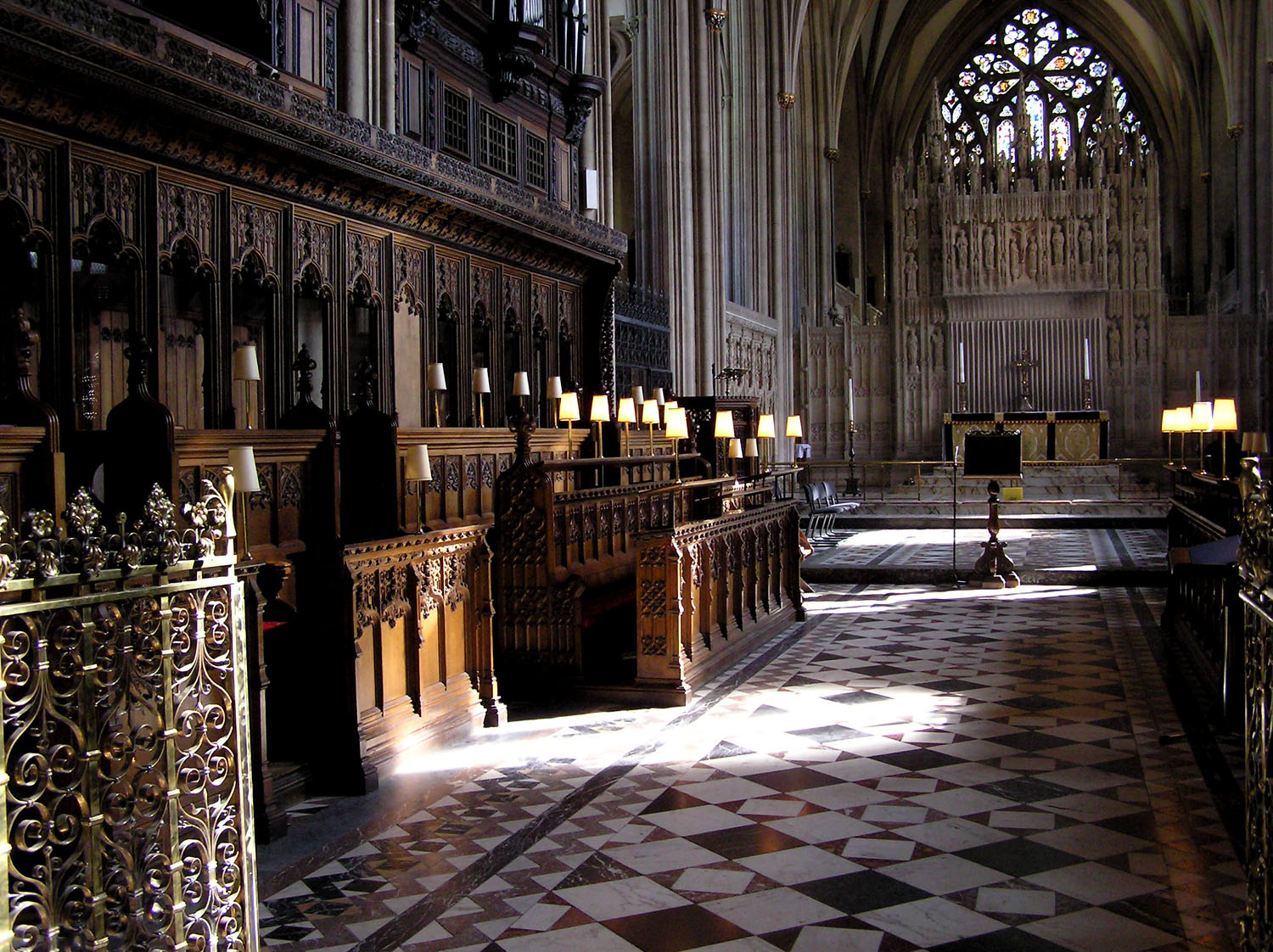 |
| The choir stalls in the chancel of Bristol Cathedral |
Now, when we contrast the Catholic
arrangement in a chancel to their miserable expedient of a gallery, we shall at
once perceive the infinite wisdom and beauty of the former. All are habited in
vestments, whose colour reminds them of the purity of heart and intention, with
which they should celebrate the praises of Almighty God. They stand within the
sacred enclosure set apart for sacrifice; the very place tends to preserve a
recollection of the Divine presence, and to keep the singers in a devout
posture. The distinct and graduated Chaunt offers no impediment to the perfect
union of the heart and mind with the words as they are sung; and in lieu of a
more empty and vain display of vocal eccentricities, we have a solemn,
heartfelt, and, we may trust, an acceptable service to the honour of Almighty
God.
Now, it cannot be too earnestly impressed
on the minds of all, that these arrangements for the Church service were
universal throughout Christendom. It is no new scheme or system, proposed for
trial; it is simply carrying out the practices of the Church for certainly more
than fourteen centuries. Not only were the cathedral and collegiate churches
provided with stalls and seats, and ample space for the ceremonies of the
choir, but every parish church, and even chapel, had its due proportion of
chancel, where the divine praises were always sung; and from the Basilica of
St. Clement’s, down to the humblest church of the 17th century, we
shall find the same traditional arrangement. Singing galleries are modern
abominations, and no good will ever be effected in Church music, until they are
utterly destroyed, and the service sung in its legitimate and ancient position—the
choir or chancel. While these galleries are suffered to remain, the erection of
pointed churches is a mere sham. In vain the long succession of clustered
pillars; in vain the carved screen and gilded rood; the soul of the whole thing
is wanting; it is the system of a modern chapel worked in the shell of an old
church. Who, then, will be asked, are those who sit robed in surplices in the
stalled seats? Only privileged persons, perhaps subscribers, who go in for a
show, like supernumeraries on the stage; lay figures as the “Ecclesiologist,” most
wittily termed them, and but dumb dogs into the bargain.
A greater sham than this cannot be
seen. And was it for this that the long chancel was stalled and screened? That the
cunning work was carved and the gold laid on—merely for the accommodation of
some good easy men, who take no part in the solemnity, nor contribute one note
to the divine praise! Surely not; it is the greatest possible perversion of a
chancel; a scandal, and a shame. What could be more painful than to read the
account of the new church recently consecrated at Sheffield, where the
architect had really produced an edifice quite in the old spirit; and instead
of the solemn Chaunt of the dedication rising from its chancel we are sickened
by a long eulogy on the quaverings of female singers. St. John’s, Salford, is even
a more melancholy example; a great cruciform church, with an ample choir, and
yet fitted up as if for the followers of John Knox; a most disheartening
spectacle.
 |
| The carved stalls of Albi Cathedral |
While this wretched system of
gallery singing, with Mozart’s and Haydn’s music, was carried on in the
room-like chapels of the last century, it was in character with the edifices;
but when the English Catholic body was awakened, or appeared to be awakened, to
a sense of better things, and churches arose whose form and arrangement told
somewhat of more ancient and better times, then, indeed, we might have hoped
and expected, that with the shell they would have revived the soul; that they would have cast off for
ever the worldly efforts of modern men, who merely make use of the sacred
liturgy as a vehicle, for a display of their professional skill; and have
returned to that simple and divine song, which was created, like the
architecture, by the influence of the Christian faith, and which assimilates
and harmonises with its lofty vaults and lengthened aisles; without this the
service and the fabric will be at utter variance, a most humiliating spectacle
of ancient grandeur and modern degeneracy.
Whenever an attempt has been made by
the members of the separated English communion to restore some of the external
ornaments of religion which were lost by the apostasy of their Catholic
forefathers in the 16th century, they have been usually met by
insult and ridicule from a great portion of what is called the Catholic press;
but I must say that the dedication of a modern Catholic church, as we have seen
it occasionally announced, accompanied by a full band of music, and where
bishops and dignitaries are exposed to the degradation of sitting in dumb show
to listen to the interminable squalling of a few female professionals and
whiskered vocalists from the front of a gallery, is a far more ridiculous and
inconsistent exhibition. Indeed, with some few exceptions, the churches that
have been raised after the old models are become so many evidences of our
degradation and our shame. The altar and the arch may belong to the ages of
faith, but the singing drags us down to the concert-room of the 19th
century, and is a sad and striking proof of the little sympathy which exists
between the architecture and the men.
 |
| A choir loft typical of many Catholic churches today |
I have long mourned most bitterly in
secret on this state of things, but when a scheme is actually put forth to
abolish the very words of the ancient offices and to reduce the services of
Almighty God to the level of the conventicle, I can remain no longer silent. It
is evident that the extreme hollowness of the present system is attracting
attention; but alas! instead of advocating the only remedy, a return to the
real music of the Church in all its purity, we are assailed by a scheme for its
utter abolition. Monstrous suggestion! but by its very enormity, as I have
before said, I trust in God that it will awaken our ecclesiastical rulers to a
sense of the absolute necessity of casting aside all novelties and private
conceits and returning to that music which has the sanction of ages and the full authority of the existing Church.
What can be more perfect, what more edifying and consoling than that Divine
Office, the compilation of so many saints and glorious men, and which is so
wonderful in the perfection of its system and composition, that the more it is
studied, the more it gains on our reverence and love! What appropriate fitness
in all the antiphons—what noble simplicity in the hymns! while the Chaunt of
the Psalter has an almost sacramental power in calming a troubled spirit and
leading the soul to God; these were the divine Chaunts that penetrated the
heart of St. Augustine, and though many centuries have elapsed, they have not
lost one fraction of their influence. It is a monstrous error to suppose that
the people cannot be brought to enter fully into the spirit of the Divine
Office. In France, there is hardly a country parish where the people do not
join in the Vesper Chaunt and the offices with heartfelt devotion. The mass of
persons are opposed to the plain song from pure ignorance; they do not
understand it; all their ideas are, perhaps, formed from some miserably corrupt
version they have heard drawled out by a cantor, who scarcely knew a note of
music, and they never trouble themselves to examine and study the wonderful
beauty of these heavenly compositions, which, independent of their own
intrinsic merit, have all the weight and authority of the Church to recommend
them.
To what extreme inconsistency and
absurdity does not the substituting of any other music lead in the celebration
of the Divine Office! It is well known that the Kyrie is ordered to be sung nine
times in honour of the Holy Trinity; modern composers utterly disregard the
mystical symbolism of the number, and multiply the supplications to an
indefinite repetition merely to suit their notes. Again, the priest intones the
Gloria after the old traditions, while the choir takes it up in a totally
different manner. The Credo, so far from being a distinct profession of faith
as ordered, is a mass of unintelligible sound; and at the Sanctus, where the
priest invites the people to join with the angels and archangels, in one voice (cum una voce), in singing the
Trisagion, a perfect babel of voices usually break forth, and the Ter Sanctus
is utterly lost in a confusion of Hosannas, Benedictuses, and broken sentences
all going together in glorious confusion, which scarcely ceases in time to enable
the distracted worshipper a moment’s repose to adore at the Elevation. After a
short pause the din recommences, and this generally lasts till a thundering
Agnus Dei begins. Whether it is a spirit of pure contradiction that modern
composers have usually imparted to this supplication for peace the character of
a great row it is impossible to say, but such is decidedly the case. Some of
these compositions would be admirably adapted for a chorus of drunken revelers shouting
for wine outside a tavern, and if the words—“Wine, give us more wine,” were
substituted for “Dona nobis, nobis pacem,” we should have a demand in perfect
accordance with the sound with which it is accompanied. In lieu of this, were
the simple Chaunt, as ordered by the authoritative books, the Antiphonals and
Graduals of the Roman Church, restored, the people would soon be able to take
part in responding to the clerks in the chancel. The Kyrie would be alternate,
the Gloria a real hymn of praise, and the Credo would be again a real
profession of the Christian faith, not a piece of complicated music, while the “O
Salutaris” would rise from the lips of hundreds, and ascend with the incense to
the throne of grace.

How easy in the age of printing to
multiply Choral books ad infinitum.
How simple to print music for the five Gregorian Masses, so as to bring them
within the reach of the humblest individual. If these were taught in every
school, and inculcated in every Catholic family, our churches would soon
present the cheering, the inspiring
spectacle of a mass of people united, not only in heart, but in voice, in the worship of their Creator;
and this not in modern and unhallowed sounds, but in the very words sung by the
angels in heaven, when the Redeemer was born; and in words to which the old
vaults raised to God centuries ago, have often re-echoed with the returning
festivals; and in words which, protected by Catholic authority, will descend,
by tradition, to ages yet unborn. May the Almighty God in His mercy open the
hearts of our rulers to these important truths; may He inspire our
ecclesiastics with the spirit of reviving these solemn offices, which alone
embody the spirit of the liturgy and set forth the majesty of the divine
mysteries. May He grant us to see a restoration not only of the external glory
of His temple but of the reverent service which is alone suited to its ancient
symbolism; and may our churches—which, for the most part, are so many stumbling
blocks to our separated countrymen, from the discrepancy between the fabric and
the service—be purged from the disgrace of these modern performances, and
become as shining beacons, not alone by the altitude of their spires, but by
the purity and reality of the Divine Office as celebrated in them.
A. Welby Pugin
A. Welby Pugin
If you enjoyed this post, you'll want to click on the following links to see what else I've posted on the subject of Augustus Pugin:
-The Marvelous Creations of Pugin, and Other Photos
-Selections from Ferrey's "Recollections of A.N.W. Pugin"
-Gems from Pugin's "Glossary of Ecclesiastical Ornament"