Tuesday, April 7, 2015

The Exultet and "Lucifer"

Chanting the Exultet at Blackfriars, Oxford

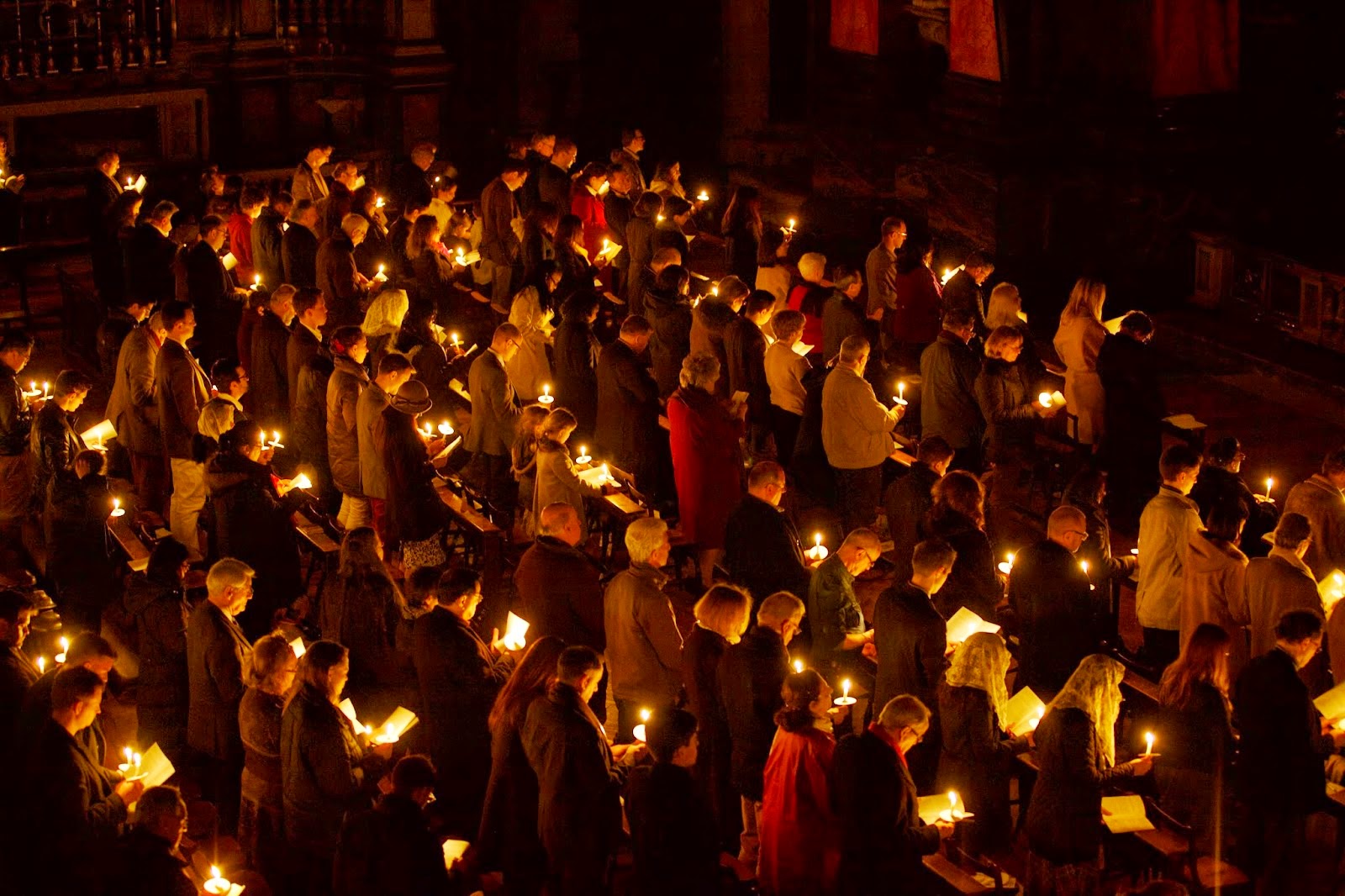
One of the most spectacular rites of the Easter Vigil is the singing, traditionally by the deacon, of one very long prose called the Exultet before the Paschal Candle. While you read this entry, I invite you to listen to it below as it was sung at the "Anglican Use" parish church of Our Lady of the Atonement, where I attended the Vigil of Easter last Saturday night. The church uses a beautiful translation into hieratic English, which you may follow along with in a new tab here.
The Exultet is sung between the 3:45 and 15:50 marks

There are so many beautiful expressions of hope and rejoicing: consider the felix culpa, the "happy fault" of Adam's sin, that brought mankind to a greater good through Christ, the "blessed iniquity, for whose redemption such a price was paid by such a Saviour". And let's not forget the bees! The Exultet "waxes" poetic on the Paschal candle as the fruit of bees' labor; a creature that the medievals believed reproduced asexually and, therefore, were virgins. "For wax that melteth doth but feed the flame, for thereunto have God's creatures the bees brought it forth, that it should give light in darkness." The version we have in the Roman Rite today is much abbreviated from older versions, such as the one found on the Exultet scroll of Salerno, whose praise of the bees ends with:
"O truly blessed and wondrous bee, whose sex the males do not dishonor, the bearing of offspring does not violate them, nor do (the bearing of) children destroy their chastity. Just as the holy virgin Mary conceived and bore a child and yet remained a virgin."
I've long decided that if I were to be ordained a deacon some day in the future, I'd earnestly hope I would find some church that would allow me to sing it in the full, traditional tone every year.

Unfortunately, as a friend pointed out to me a few months ago the truth of Ecclesiastes 1:15; that is, "The perverse are hard to be corrected, and the number of fools is infinite". About half of all discussions on the Internet about the traditional Latin Exultet are conspiracy theories about the Catholic Church worshipping Satan. If you have the stomach for it, proceed to videos such as this expose of a recent Easter Vigil Mass at Saint Peter's Basilica. Or webpages such as this. (I hope you have your antacid pills at the ready.)

In the Latin version of the text, as it appears in the reformed Missal and which is sung by the deacon at Saint Peter's in those videos circulated by the conspiracy theorist hacks, it goes:
"Flammas eius lúcifer matutínus invéniat: ille, inquam, lúcifer, qui nescit occásum. Christus Fílius tuus, qui, regréssus ab ínferis, humáno géneri serénus illúxit, et vivit et regnat in sæcula sæculórum."

As you may know, the word Lucifer literally means "lightbearer" (lux for light, ferre for "to bear" or "to carry"). The ancients typically associated this word with Venus, the Morning-star.... and it also happens to be a name traditionally assigned to the adversary, Satan. Here's the official translation of the Latin phrase I posted above:
"May this flame be found still burning by the Morning Star: the one Morning Star who never sets, Christ your Son, who, coming back from death's domain, has shed his peaceful light on humanity, and lives and reigns for ever and ever. Amen."

To anyone with a modicum of common sense, not to menton those who have actually attended the ceremony and followed along with the text, the deacon is clearly singing about Jesus Christ. The conspiracy theorists are quick to accuse the hymn of enthroning Satan as messiah in place of Jesus, as Catholics have always apparently been wont to do since Saint Peter's day. Strangely, these accusers, who are probably all Protestants claiming to be speaking the Biblical truth, are unaware that Scripture itself calls Jesus the morning star:
"I, Jesus, have sent Mine angel to testify unto you these things in the churches. I am the root and the offspring of David, and the bright and morning star." (Revelation 22:16, King James Version)

The traditional text of the Exultet is a little subtler, but the message is the same. Christ is the light in the darkness, who brings us out of the gloom of the Crucifixion into the everlasting day of the Resurrection.

For those who want to see the full Latin text, this page has both the 1962 version and the revised ending for the current rite (the "1975") with a slightly different translation than the one I first linked you to side-by-side.

The Exultet sung at Our Lady of the Atonement, San Antonio, 2015


I end today's entry with another treasure: a translation of the Exultet used in Sarum. The rubric has the deacon sing it facing north at a point in between the quire and the altar. As far as I can tell, the text is the same as in the classical Roman Rite, with one little exception: along with the pope and the local bishop, it also prays for the king by name. (The king was also prayed for by name in the Canon of the Sarum Mass.) The tradition of praying for the ruler in the Exultet was maintained all the way up until 1870 in France, at the end of Emperor Napoleon III's rule. The Missal of Trent also had the curious effect of imposing a prayer at the end for the Holy Roman Emperor across the entire Roman Catholic world, regardless of nationality. That prayer was finally removed with the 1955 Holy Week revisions. 

Now let the angelic host of heaven exult, let the divine mysteries be celebrated with exultation, and let the trumpet of salvation sound for the victory of so great a King. 
Let the earth rejoice, irradiated with so great brilliancy, and illuminated by the splendour of the eternal King, let it perceive the darkness of the universe to have been done away. 
Let mother church also be joyful, adorned with the brilliancy of so great a light, and let this court resound with the mighty voices of peoples. 
Wherefore, most dearly beloved brethren, as ye stand before the so wonderful brilliance of this holy light, I beseech you invoke along with me the tender mercy of almighty God; 
That he who hath deigned to enrol me, not for mine own merits, within the number of the Levites, pouring forth upon me the grace of his light, may cause me to declare fully the praise of this taper. 
Through our Lord Jesus Christ his Son, who with him liveth and reigneth God in the unity of the Holy Ghost. World without end. 
R. Amen.
V. The Lord be with you.
R. And with thy spirit.
V. Lift up your hearts.
R. We lift them up unto the Lord.
V. Let us give thanks unto our Lord God.
R. It is meet and right so to do. 
Because it is very meet and right to proclaim with full desire of heart and mind, and through the instrumentality of the voice, the invisible God almighty, the Father, and his only-begotten Son, our Lord Jesus Christ, together with the Holy Ghost.  
Who paid for us the debt of Adam to the eternal Father, and blotted out the bond of the old sin by his holy blood. 
For this is the Paschal feast, in which that true Lamb is slain, and the door-posts are consecrated by his blood. 
This is the night in which thou first madest our fathers, the children of Israel, whom thou leddest up out of Egypt, to pass through the Red Sea dry-shod. 
This, therefore, is the night in which he cleared away the shades of sin by the pillar of light. 
This is the night which, as at this day, sets apart from the vices of this world and from the darkness of sin, and restores to grace, and unites in sanctity the believers in Christ throughout the whole world. 
This is the night in which Christ burst the bonds of death, and rose a conqueror from the grave. 
For it had advantaged us nothing to be born except we had the advantage of redemption. 
O marvellous condescension of thy loving-kindness concerning us! 
O inestimable tenderness of love! thou gavest up thy Son to redeem thy servant. 
O truly necessary sin of Adam and of ourselves, which was blotted out by the death of Christ!  
O happy guilt, the desert of which was to gain such and so great a Redeemer! 
O truly blessed night, to the desert of which alone was granted to know the time and the hour in which Christ rose from the grave!  
This is the night of which it was written, And the night is as clear as the day, and, Then shall my night be turned to day. 
Therefore, the hallowing of this night putteth wickedness to flight, washeth away sins, and restoreth innocency to the fallen, and joy to the sorrowful ; it banisheth hatred, and prepareth peace, and maketh sovereignties to yield. 
Therefore, in favour of this night, receive, O holy Father, 
Here the deacon shall put incense into the candle or into the candlestick in the form of a cross; and in the same way into the small candle, the bearer thereof approaching with it. 
the evening sacrifice of this incense. 
Which the holy church offereth to thee by the hands of her ministers in this solemn oblation of wax, the work of the bee. 
But now we know the praise of this pillar, which the glowing fire kindleth to the honour of God. 
At this point the candle shall he lit from the new fire, and not be extinguished till after Compline on the day following. And the Paschal candle shall burn continuously throughout Easter week at Matins, and at Mass, and at Vespers; and likewise on the Octave of Easter. But on all Sundays from the Octave of Easter until Ascension Day it shall be lit at Mass only, as well as on the feasts of St. Mark the Evangelist, and of SS. Philip and James the Apostles. On the Annunciation of the Blessed Mary, and on the Invention of the Holy Cross it shall he lighted as on the Octave of Easter. Then shall the candle-bearers light their candles throughout the church.

Bees!
Which although it be divided into parts of borrowed light, knoweth not loss. It is fed by the liquid wax which the queen bee produced for the composition of this precious taper. 
O blessed night, which spoiled the Egyptians, and enriched the Hebrews! Night in which heavenly things are united to earthly. 
We beseech thee, O Lord, that this candle, consecrated to the honour of thy name, may last unfailing for dispelling the darkness of this night. 
Being accepted for its sweet odour, let it be mingled with the lights above. 
May the Morning Star find it burning. That Morning Star, I say, who knoweth no setting; He who returned from the grave and shone serene upon mankind. 
We, therefore, pray thee, O Lord, that thou wouldest grant unto us thy servants, all the clergy, and the most devout people, together with our father pope N., and our king N., and also our bishop N., that in quietness of time we may keep our paschal joy. 
Who ever livest, reignest, rulest, and also art glorified, God alone, alone the most highest, O Jesus Christ, with the Holy Spirit in the glory of God the Father.

An Exultet scroll from medieval southern Italy

A medievalist defense of the nocturnal Vigil of Easter

The Easter fire at (I think) the Abbey of Fontgombault

The Vigil of Easter has always been my favorite liturgical service of the entire year. There's so much I could say about any one of the many individual ceremonies, but a friend suggested that I write about the timing of this feast, so, here we go. 

Most liturgical traditionalists who are familiar with the Holy Week liturgies as they were both before and after the 1950-1955 revisions of Pope Pius XII seem to agree that the changes to the rites were near universally a bad thing. About half of everyone in that camp will stop short by saying that at least the revised horarium was a good: that is, the Mass of the Lord's Supper on Maundy Thursday in the evening, the Good Friday Mass of the Presanctified at 3pm, and the Vigil of Easter on Black Saturday night. Before 1955, the Tridentine Missal required that all Masses had to take place in the morning before noon. (As long as the first Mass of Christmas, the missa in nocte, began at midnight, it avoided the ban.) The other half will say that even this change was a disaster, and that all the liturgies should occur in the morning.

At the risk of naysaying some very well-learned liturgists out there, I've always thrown in with the restored horarium crowd, especially in the case of the Easter Vigil. For me, Holy Saturday, or Black Saturday, has always been the day in which Christ rested in the tomb. It is the one day no Mass of any kind, including of the Presanctified, is celebrated; a glimpse of an alternate history in which He (if such a thing were even imaginable) proved a false messiah and never harrowed hell or escaped from Joseph of Arimathea's sepulchre. The gloom of Good Friday continues until the eve of the Resurrection. Though there's currently no rule for it, I usually try to keep the fast from Good Friday til after the Easter Vigil. The very thought of having the Vigil on Holy Saturday morning barely gives Christ any time to rest, and punctuating the air with alleluias anticipates the glory of the Resurrection too far in advance. As the 1955 Restoration of the Holy Week Order states:
"The solemn liturgy of the Easter Vigil in particular lost its original clarity and the meaning of its words and symbols when it was torn from its proper nocturnal setting. Moreover, Holy Saturday, with too early a recollection of the Easter gladness intruding into it, lost its original character as a day of mourning for the burial of the Lord."

I'm afraid that my little essay won't be able to convince the die-hard pre-1955'ers, but I hope it will at least demonstrate that one can comfortably claim to be a medievalist and a Vigil nocturnalist without any contradiction.

The Lumen Christi procession at the London Oratory


Introduction


All camps agree that in the ancient Church, the early Christians observed quite a few vigils: all-night observances ending with Mass before or at dawn. The otherworldly zeal which the first Christians had paid no mind to staying awake and fasting all night long, listening to one reading from Scripture after another, and singing hymns. The Easter Vigil was the most sacred of all, with a whole host of its own rites: the great fire, the Paschal candle, the singing of the Exsultet, endless readings from Scripture, and particularly, the baptisms of dozens of even hundreds of converts. As the centuries of Christianization went on and the medieval parish's boundaries approached just about a 100% rate of baptized adults in the area, there was no longer any need for the Vigil to extend from midnight to dawn. The Church's ancient rules on fasting for holy Communion, however, remained. As long as the Vigil began on Saturday night, any priest who was tasked with celebrating the Easter Vigil Mass had to fast from all food and water through the entire day until after the Vigil had ended. By then, it would be Sunday morning; therefore, the priest would have gone without eating anything for over a 24-hour period.

The medieval Church, like the Church in every other era, was faced with a "pastoral" dilemma: change the fasting rules, or change the starting time of the Vigil? The Church held the traditional Communion fast from midnight so sacrosanct that it wasn't revised until 1953 (when Pope Pius XII issued the apostolic constitution Christus Dominus, reducing the fast to only three hours). Instead, from the 7th or 8th century onward, we see evidence of the Easter Vigil being pushed, gradually, earlier and earlier until the whole rite was performed in daylight. 

Where the liturgical purists part ways is on exactly when this development took place, and whether it was a gain or a loss. I've assembled some of the most common pro-morning arguments and my answers to them below.


Antiquity vs. innovation


Pro-morning argument: Regardless of the Easter Vigil's origins as a night service, the pre-1955 starting time on Holy Saturday morning has been hallowed by time to the point that it should now be considered traditional. Bugnini's reversal is an example of the kind of "exaggerated and senseless antiquarianism" which Pius XII condemned in Mediator Dei.

Response: First, it was Pius XII himself who approved the restoration of the Easter Vigil to the night, so the move couldn't have fallen under the Pope's own definition of an antiquarianism.

Second, the question of "tradition" is tricky for many arguments extending well beyond that of the Easter Vigil. The pro-morning camp correctly point out that the Latin word traditio signifies something that's passed down from one generation to the next, without interruption. Once it's dead, it's dead; and so, a revival of a dead custom can't be said to be "traditional", strictly speaking.

In the mid-19th century, though, the monks of the abbey of Solesmes weren't satisfied with the decrepit state of liturgical music in their day. In the cathedrals and chapels of the elite, "traditional music" meant the orchestral Mass settings of Mozart and Haydn. For everyone else, they were the saccharine vernacular hymns sung over the priest at low Mass, or at best, harmonized psalm tones of the proper chants. It was only through monumental efforts by Solesmes, the first Liturgical Movement, and the backing of Rome itself that Gregorian chant enjoyed its short-lived revival until the post-Vatican II era banished it back to the album collections of classical and choral music enthusiasts. Nonetheless, all Roman Catholics who self-identify as "traditionalists" recognize that Gregorian chant is the traditional music of the Latin Rite in a greater sense than the literal. It doesn't matter whether the vast majority of chant directors at Latin Mass communities today learned chant from books and CD's, rather than a retreat at a monastery in France. In this case, the power of tradition has transcended the ignorance of succeeding generations. And, I dare say, this understanding of tradition must prevail once the last generation of people who were born before 1965 pass away. Elsewise, traditionalists must condemn themselves to calling the "traditional" Latin Mass itself as an antiquarianism, and the reformed rite the true standard of tradition.

Third, to the question of the morning Easter Vigil's own antiquity, there is surviving evidence that this wasn't a settled question until the Counter-Reformation of the later 16th century. The historian James Monti, author of my favorite biography of Saint Thomas More, has also published a number of excellent works on the historical development of the liturgy, and on the Holy Week rites in particular. Monti dedicated a few pages to the timing of the Easter Vigil in his book A Sense of the Sacred: Roman Catholic Worship in the Middle Ages. According to him, the first stage of medieval development was to bring the timing forward by beginning the Vigil's rites in the afternoon, but ensuring that they wouldn't end before nightfall. This is because Christ rested in the tomb until the some time, known only to Him, during the night of Holy Saturday.
"In fact, several texts from this period, including the late ninth-century pontifical of northern France formerly known as the Pontifical of Poitiers, speak of ensuring that the vigil Mass, beginning with the Kyrie and the Gloria, would not commence until eventide: 'Care should be taken, however, with all solicitude, that the Gloria in excelsis Deo on this night not be begun earlier than a star should appear in the sky.'"

Nonetheless, there's still a fascinating medieval precedent to the desire to restore the Easter Vigil to the ancient nighttime observance:
"An effort to restore the entire Easter Vigil to its ancient nocturnal setting was undertaken by Saint John Gualbert (+1073), founder of the Vallombrosan Order, a Benedictine congregation of Italy, as related by his biographer Blessed Andrew of Strumi (+1097): 'Who in Tuscany other than he moved from the day to the night the annual and renowned office to be done on the night of the holy Resurrection? For with stealthy negligence and gathering gluttony this office was performed at None on Saturday, that is now rightly and worthily done in the holy night, this our father John beginning and establishing in our times.' Thus the Easter Vigil rubrics of the twelfth-century customary of Vallombrosa direct that the blessing of the Easter fire with which the vigil begins is to commence only when 'the dusk of night shall have begun to appear.'"

And, Monti provides one final sign that the nighttime Vigil persisted in some places until the eve of the Reformation:
"The Holy Saturday rubrics of the 1498 missal for the Portuguese see of Braga state: 'On this day, however, None should be sung more slowly [than] usual. And this is to be observed such that the office should be drawn out, that the Mass may be said in the night.'"

The final nail in the coffin of the night Vigil was Pope Pius V's bull of 1566, Sanctissimus, which finally banned priests from celebrating Mass after noon. (As I said earlier, the first Mass of Christmas, so long as it began at or after midnight, eluded the ban.) These regulations later carried over into the Missal of 1570, which became adopted as the standard for nearly the entire western Catholic world. This was based on the reckoning of the age that the liturgical day began at midnight. However, the breviary reforms of Pope Pius X at the turn of the 20th century, whatever their other flaws, at least restored the ancient concept that a greater feast, such as a Sunday (and certainly the Vigil of Easter) began with First Vespers on the evening prior. I'm not sure why the celebration of Mass during the eves of these feasts required further permission, which didn't arrive until the 1950's.

The London Oratory again

The integrity of the Hours


Pro-morning argument: Moving the Masses of the sacred Triduum to later hours completely disrupted the traditional cycle of Tenebrae and the other hours of the Divine Office that had been long established.

Response: Conceded..... partially. Since the question of Tenebrae doesn't touch the Easter Vigil, I'll save that discussion for another day. The Holy Week revisions decree that Compline (Night Prayer) for Holy Saturday is now omitted since the Vigil takes its place. While someone could certainly pray Compline privately for devotional reasons in any case, there's no way to beat around the fact that as long as the Easter Vigil takes place at night, it's simply too taxing for us moderns to demand a public observance of Compline afterward; notwithstanding the other small fact that Compline is unlikely to be prayed publicly in any case.

The decrees state that Vespers (Evening Prayer) is "said after noon at the accustomed hour". But then, there's the problem of Matins and Lauds (Morning Prayer). As it stands now, the 1962 Missal attaches Lauds to the end of the Easter Vigil as a means of conclusion. This actually has the effect of exposing the ordinary lay faithful to Lauds in the first place; for most traddies, the mandatory inclusion of Lauds to the end of the Easter Vigil will be the only Lauds they ever attend in their lifetimes.

The purists rightfully point out that by jamming the Vigil in between Vespers and Lauds, this means Matins of Easter Sunday has been abolished. To be specific, the 1962 Breviary and its modern successor, the Liturgy of the Hours, still provide Matins of Easter Sunday, but only for those who didn't attend the Easter Vigil. Since most churches will celebrate the Easter Vigil, this means public observances of Easter Sunday Matins would be quite rare. Dom Prosper Gueranger describes how Easter Sunday Matins and Lauds were kept with the greatest of solemnity in medieval times, at least where the Vigil had slinked into Holy Saturday morning:
"Matins of Easter Sunday morning used to be celebrated in a most dramatic manner. In most of the churches of the West during the Middle Ages, as soon as the third Lesson was read, and before the Te Deum, the clergy went in procession, singing a Responsory, to the chapel where the Blessed Sacrament had been kept since Holy Thursday, which was called the Chapel of the Sepulcher. Three clerics were vested in albs, and represented St. Mary Magdalene and her two companions. When the procession reached the chapel, two deacons, in white dalmatics, representing the two Angels who were standing at either end of the tomb, thus addressed the three clerics: Whom seek you in the sepulcher, friends of Christ? The clerics answered: Jesus of Nazareth, O ye citizens of Heaven! Then the deacons: He is not here; He hath risen as He foretold: go, say that He is risen.
The three clerics here went to the altar, and raising up the cloths which covered it, they reverently kissed the stone. Then turning towards the Bishop and the clergy, they sang these words: Alleluia! This day the Lord hath risen: the strong Lion, Christ the Son of God, hath risen.
Two cantors stepped forward towards the altar steps, on which the clerics were standing, and addressed them in these words of the Sequence: Tell us, O Mary, what thou sawest on thy way?
The first cleric, who represented St. Mary Magdalene, answered: I saw the sepulcher of the living Christ: I saw the glory of the Risen One. The second cleric, who represented Mary the mother of James, added: I saw the Angelic witnesses: I saw the shroud and cloths. The third cleric, who represented Mary Salome, completed the reply thus: Christ, my Hope, hath risen! He shall go before you into Galilee. The two cantors answered with this profession of faith: It behooves us to believe the single testimony of the truthful Mary, rather than the whole host of wicked Jews. Then the whole clergy joined in this acclamation: We know that Christ hath truly risen from the dead. Do Thou, O Conqueror and King, have mercy on us!
The two deacons then opened the tabernacle. Taking the pyx, in which was the Blessed Sacrament, they laid It upon a portable throne and carried It in procession to the high altar. Clouds of incense perfumed the way while a beautiful Responsory was sung. The procession having reached the sanctuary, the deacons placed the Blessed Sacrament upon the altar. The Bishop, after offering the homage of incense, intoned the Te Deum, in thanksgiving for the Resurrection of Our Redeemer.
This touching ceremony, from which probably originated what were called The Mysteries, was not officially part of the Roman Liturgy; still, it was an expression of the lively and simple faith of the Middle Ages. It gradually fell into disuse during the 16th and 17th centuries, when men became absorbed in material things, and lost that appreciation of the supernatural which their forefathers loved to encourage by every possible means. The ceremony we have just described varied in the manner of its being carried out; but we have given its chief traits, such as we find them mentioned in the ancient Ordinaries of great cathedrals." (The Liturgical Year)

My solution for those who regret the removal of Easter Sunday's Matins is simple: keep the pre-1955 order of the Vigil, and merely delay it until just past sunset. You'll have energy enough to restore the Vigil's nocturnal character, and then (hopefully) arise early enough to celebrate Sunday Matins and Lauds with all the solemnity of former times. This might be especially worthwhile for those who chose not to attend the Vigil at all. As to the legality of using the pre-1955 ceremonies, I'm not well-read enough on that question to make an argument in favor of it, but it seems many churches of the Institute of Christ the King get away with it without stormtroopers from the Curia bearing down on their doorsteps.


The First Saturday devotion


Pro-morning argument: Moving the Vigil of Easter to the evening prevents those who have a devotion to receiving Communion on the first Saturday of every month from doing so on the month where Easter falls.

Response: This would be unworthy of even mentioning in this post if I hadn't personally run into this objection more than once. My answer is simply that this is an overly legalistic reading of the First Saturday devotion. Common sense suggests that Communion can simply be commuted to the Vigil, if not any of the Masses of Easter. For those who need complete reassurance, though, this article on the World Apostolate of Fatima, USA explains how the devotion can still be fulfilled by attending the nocturnal Easter Vigil.


The Easter fire at Clear Creek Abbey

Monday, April 6, 2015

Terra tremuit!


The schola at our diocesan traditional Latin Mass sang this antiphon, which is appointed for the Offertory rite on the Mass of Easter Sunday. 

Terra tremuit et quievit * dum resurgeret in judicio Deus, alleluia.
The earth trembled and was still * when God arose in judgment, alleluia.

Listen here while reading the rest of this post!

Offertory antiphon and verses of Easter Sunday: Terra tremuit


The chant is from Psalm 75 (76 in the KJV-style numbering). On Easter, the phrase "the earth trembled" evokes the medieval image of Christ harrowing hell and, of course, the earthquake in Matthew's account of the Resurrection:

"And in the end of the sabbath, when it began to dawn towards the first day of the week, came Mary Magdalen and the other Mary, to see the sepulchre. And behold there was a great earthquake. For an angel of the Lord descended from heaven, and coming, rolled back the stone, and sat upon it." (Matthew 28:1-2)

The Douai-Reims translation is one of very few that uses the phrase "the earth trembled" for the psalm. Other translations, such as the King James, use "the earth feared". If this version were sung in an English adaptation of the traditional Offertory antiphon, the rationale behind its use would be lost to modern listeners. No, I think "the earth trembles" is the way to go.

At Mass, we also added one of the fantastical verses from the 1935 Offertoriale compiled by Karl Ott. Here are all the verses as used by Ensemble Organum is the wonderful recording above. You'll notice that the structure is responsorial, rather than antiphonal. After the antiphon, one or two cantors sing an elaborate verse which continues the psalm; in this case, Psalm 75; and then the rest of the choir repeats the last section of the antiphon. These Offertory verses seem to have fallen out of fashion by the 13th century, perhaps thanks in part to the low Mass's influence on high Mass; namely, the omission of all but the most essential texts of the propers in the Missal. Still, a final vestige can be seen in the Requiem Mass's famous Offertory antiphon, with its verse and the repetition of quam olim Abrahae.

(And, of course, since this is an Easter chant, the word alleluia is liberally attached to the end of every verse. This is a happy chant!)

1. Notus in Judea Deus in Israel magnum nomen eius, alleluia *
dum resurgeret in iudicio Deus, alleluia.

2. Et factus est in pace locus eius et habitatio eius in Sion, alleluia *
dum resurgeret in iudicio Deus, alleluia.

3. Ibi confregit cornua arcum, scutum, gladium et bellum, iluminans tu mirabiliter a montibus aeternis, alleluia.
1. In Judah is God known: His name is great in Israel, alleluia, *
when God arose in judgment, alleluia.

2. His dwelling is in peace and in repose, and in Sion is His habitation, alleluia, *
when God arose in judgment, alleluia.

3. There He broke bow arrows, shield, sword, and war weapons, you are glorious, more wonderful than eternal mountains, alleluia.

The harrowing of hell


Saturday, April 4, 2015

Holy Week at Westminster Cathedral, 1939

A friend forwarded me this old post from the Saint Lawrence Press blog. It's a snippet from a 1939 issue of The Tablet with Westminster Cathedral's Holy Week schedule for that year. See below:


Three observations:

1.) They're using the pre-1955 times, like having the Easter Vigil on Saturday morning. I'm actually not in favor of those (except for retaining Tenebrae at night), but one has to respect just how robust the services are. According to Rubricarius, this schedule is only listing the "highlights", too. All the Divine Hours were regularly observed at Westminster in these days.

2.) Westminster's schedule today seems rather paltry by comparison. See here.

3.) Easter Sunday sermon to be given by "the Rt. Rev. Mgr. Canon M. Howlett, D.D., Ph.D." I'm not sure if this species of priest even exists anymore.


All articles in my Holy Week 2015 series, short and long


Palm Sunday in Sarum

Palm Sunday 1461: the bloodiest battle of the Middle Ages in England

The kiss of peace (for Spy Wednesday)

The mandatum: Maundy Thursday and stinky feet

The Easter sepulchre

Holy Week at Westminster Cathedral, 1939

A medieval defense of the nocturnal Vigil of Easter

The Exultet and "Lucifer"

The Exultet scroll: the Powerpoint of medieval Italy

Terra tremuit! (the Offertory antiphon of Easter Sunday)

Friday, April 3, 2015

The Easter sepulchre

Augustus Welby Pugin's Easter sepulchre at Saint Giles, Cheadle. The shields below it show the instruments of the Passion in heraldic form.
Last night in Catholic churches around the world, the tabernacles were emptied and the Eucharist was carried in procession to another altar, called the altar of repose, there to remain until the "Mass of the Presanctified" on Good Friday. Before the Reformation, however, and most especially in England, a second shrine was set up during Holy Week to reserve the sacrament: the Easter sepulchre.
After the Good Friday ceremonies and the "creeping to the cross", which commemorate the ultimate sacrifice of Christ's crucifixion, the crucifix which the whole congregation in these "superstitious" days was then wrapped in linen, as though it were a burial shroud, and then carried in procession to a niche, a wall recess in the north side of the church, which was designed just to appear like a tomb. There, after the priest and deacon removed their vestments and shoes, the crucifix was "entombed" in a chest, along with a pyx carrying a Host that had been consecrated on Maundy Thursday.
The priest intoned:
"I am counted as one of them that go down into the pit: I have been even as a man that hath no strength, free among the dead."
 And the people responded:
"Thou hast laid me in the lowest pit, in a place of Darkness and in the Deep. There have I been."
With Christ's real presence entombed, decorated with velvet hangings, and candles lit all around this Easter sepulchre, a watch was appointed to keep guard over the sepulchre at all hours until just before daybreak on Easter Sunday. (So, it seems, even if the Vigil of Easter was celebrated on Saturday morning, the devotions surrounding the Easter sepulchre ignored it.)
The best surviving examples of Easter sepulchers range from the 14th to 16th centuries. See below:
Marvelous decorated Gothic: the sepulchre at Saint Andrew's, Heckington
The sepulchre at Lincoln Cathedral, complete with sleeping guards
This sepulchre at Holcombe Burnell, Devon, was made in the 16th century, at the eve of the Reformation, and hints at the arrival of the Renaissance style on England's shores.
After Henry VIII declared himself Head of the Church of England, he still attempted to preserve the sepulchers, his convocation declaring:
"On Good Friday is prepared, and well adorned, the Sepulchre in remembrance of Christ's sepulchre, wherein is laid the image of the Cross with the Most Blessed Sacrament to signify that there was buried no corpse or body that could be corrupted but the pure and undefiled Body of Christ without spot or stain, which was never separated from the Godhead."
Nonetheless, Cranmer, archbishop of Canterbury, secretly despised the sepulchres and all similar displays of religion, so shortly after the boy king Edward VI acceded the throne, Cranmer and his lackeys passed laws ordering their destruction. We have surviving records of how vicars sold their wooden chests used for the sepulchre to profane use. One, for example, used the coffer to store his clothes; another, to serve as a dish rack. Queen Mary's brief restoration heralded the return of the sepulchres, but with her sister Elizabeth, they once again went into abeyance.
Augustus Welby Pugin was the first designer of the modern age to build Easter sepulchers in his churches. As you saw at the top of the post, his sepulchre at Saint Giles, Cheadle, as with the rest of the church, stunned all who glanced upon it. It seems to have never caught on even in Pugin's own lifetime, for he routinely complained that the priests who took over his churches didn't know what to do with them: "The truth is the churches I build do little or no good for want of men who know how to use them. Dudley is a complete facsimile after an Old English parish church and nobody seems to know how to use it.". (A.W.N. Pugin: Master of Gothic Revival, page 57)
The one thing we can be thankful for, perhaps, is that the successors of Pugin's churches were so completely ignorant of the customs surrounding their furnishings that when the iconoclasms of the 1960's came around, few of Pugin's sepulchres were destroyed because no one knew what they were for in the first place.
Pugin's sepulchre at Our Lady and Saint Wilfrid's.

Thursday, April 2, 2015

The mandatum: Maundy Thursday and stinky feet

The kings of medieval Europe washing the feet of beggars
It's another Maundy Thursday, the first day of the Easter Triduum: it's a busy day, with the consecration of holy oils for the upcoming year by the bishop at his cathedral, the washing of feet in remembrance of Christ's new commandment ("to love one another as I have loved you"), and most importantly, to commemorate the last supper, the first Mass, on the night He was betrayed.

Maundy Thursday also means another slew of pictures of Pope Francis washing random marginalized people's feet to the fawning of his fans and eye-rolling of a tiny minority of skeptics also called traditionalists. This year, as usual, the Vatican announced well in advance that the Pope will be celebrating the Mass of the Last Supper at a prison and washing the feet of inmates. We can expect, based on previous publicity stunts in the reign of Francis, that the selection of people to be washed may include a Muslim or two.

The New Liturgical Movement just posted an article to let Catholics know that the rubrics of the modern Roman Mass make the mandatum, the rite of foot-washing, merely an option; but if it is to be used, the people to be washed must be male. It's all quite sound from a legal point of view. The article is completely correct: at the Mass of the Last Supper, only men's feet can be washed. But there's an elephant in the room: the fact that Pope Francis himself has washed women's feet on this day in the past, and has even made quite a media spectacle of it. Some apologists point out that, since Francis is the Pope, he's above the law and can do whatever he wants in the liturgy, including washing women's or Muslims' feet. Again, strictly speaking, that's true... though since he was also known to wash women's feet during his time as archbishop of Buenos Aires, while he was still fully subject to liturgical law, this entire line of argument reeks of the papal positivism; the "because he's the pope" mentality that's permeated the faith for well over a century.

The mandatum, Francis-style.
Back when I was a Seventh-day Adventist, our church, a few times a year (not Maundy Thursday), though it wasn't big on ceremonies of any kind, practiced foot-washing. Basically, a bunch of buckets were distributed, and everyone washed everyone else's feet. It wasn't just a ceremonial pouring of water, though. No, we had to get between the toes and everything. When I became a Catholic, the foot-washing rite during Maundy Thursday was something I could readily identify with. It signified to me that Catholic priests, too, were willing to bend the knee to others and show that they were ready to serve their flock, not just rule their souls. This is why the rite on Maundy Thursday is called the mandatum. Traditionally, as the priest goes to wash the first foot, the choir sings an antiphon from John's gospel: Mandatum novum do vobis ut diligatis invicem sicut dilexi vos. "A new commandment I give unto you, that ye love one another; as I have loved you." The mandatum, the commandment, is even how this day came to be called "Maundy".

Up until yesterday, I actually never thought much about the liturgical law which restricts it to men. When I first became Catholic, I learned that twelve men are chosen to represent the twelve Apostles whom Christ ordained that day as the first priests of the Church. Since only Catholic men can become priests, Pope Francis's spectacle of washing the feet of women or non-believers seemed to be a deliberate subversion of the traditional understanding.

The mandatum in the Benedict XVI era, at Saint John Lateran.
But then, in the course of my usual readings of liturgical history, I discovered that the mandatum wasn't even performed during the Mass of the Last Supper until 1950.

At that point, I came to the conclusion that all talk of what is or isn't "traditional" bears much closer investigation before issuing a verdict on the curious case of Pope Francis. I haven't been able to learn a whole lot more since then, but here's what I've been able to piece together so far:

1.) The practice of foot-washing is ancient, predating Christ to time immemorial. The first reference to it in Scripture is a mention of Abraham offering to wash the feet of the three wayfarers in Genesis 18. In a middle Eastern and Mediterranean culture, people typically wore sandals and gathered dust over their bare feet every day. The foot-washing was part of an ancient rite of hospitality, an aspect which is perhaps lost on northerners and moderns whose feet are enclosed in shoes or boots. Furthermore, the Rule of Saint Benedict, first written in the 6th century, ordered monks to receive all guests by washing their feet, as well as pouring water over their hands.

2.) Nonetheless, the rite of the mandatum wasn't always a part of Maundy Thursday ceremonies. Saint Augustine's letters suggest it wasn't universally accepted in his day. In Spain, though, the third set of canons of the Seventeenth Council of Toledo (A.D. 694) mandate its use everywhere on pain of excommunication: "Since Our Lord has not disdained to wash the feet of His disciples, why should we refuse to emulate the example He gives us? It now happens that, partly from slackness, partly from custom, in sundry churches the priests no longer wash the feet of the brethren on Maundy Thursday."

3.) The mandatum had come into use in Rome itself by the 7th century, where the Roman Ordo in Coena Domini instructs the pope to wash the feet of his attendants; though not, it seems, during Mass itself. The next mention of the mandatum among Roman sources doesn't come up again until Roman Ordo 11, dating to the 12th century. There, the pope has two ceremonies: one in public, where he washes the feet of his subdeacons... and one in private, in his apartments, where he washes the feet of thirteen poor men. It seems the medieval popes wanted to cover both bases: the sacerdotal and the servile.

4.) In imitation of the popes and archbishops, the medieval kings of Europe also washed the feet of the poor on Maundy Thursday. Saint Elizabeth of Hungary was known to wash the feet of twelve lepers. Until the 20th century, the kings and queens of Spain washed the feet of twelve poor men and twelve poor women, respectively, every year after Maundy Thursday Mass in the royal chapel. All were also provided with new clothes. James Monti's The Week of Salvation relates one story: when Queen Isabella II's diamond bracelet fell from her arm into the water, the woman being washed reached down to give it back to her, but the queen said, "keep it, mia hija; it is your luck."

Maundy money in Elizabeth II's reign
5.) The kings of Great Britain still practice the "royal Maundy" service to this day, where alms in the form of specially coined "Maundy money" are still given out; though the footwashing itself fell out of practice after the last Catholic king of England, James II, was overthrown. His successor, the Protestant William III, apparently wasn't much for smelly feet. William eventually stopped showing up to the services altogether, passing it on to the royal almoner. It was only in the 20th century, with George VI (Queen Elizabeth II's father), that the kings began to personally participate in the Royal maundies again.

6.) What about at the local parish? It seems that having a mandatum (in its own rite, apart from Mass) was widespread in the Middle Ages, but gradually waned through the Counter-Reformation (the 16th century) until, by the 20th century, it was dead (though still on the books as an official Holy Week rite).

7.) With the 1950-1955 Holy Week reforms, the mandatum was inserted into the Mass of the Last Supper itself, giving it more prominence than ever before.

And now, here we are, back in the 21st century. What did that romp through history tell us? First, while the washing of feet is a powerful sign of Christ's ordaining the first priests, that's not the original reason. We can call that a legitimate development, but the association of the mandatum with the poor has been there since its introduction. Second, including the mandatum into the Mass itself opens the rite up to a sort of criticism that wouldn't otherwise exist. The Mass of the Last Supper is bound up with the institution of the first Mass, and that significance is arguably lessened by merging it with the mandatum of the poor.

Still, omitting the mandatum entirely just to avoid the politics around excluding women at Mass is, in my mind, a case of throwing the baby out with the bathwater, just as with the omission of the kiss of peace (which I described in another article earlier this week). Traditionalists may think they're tainted with touchy-feely sentimentalism; and they are; but they're also venerable signs of what it means to be a Christian.

Father Sean Finnegan left an interesting comment on the New Liturgical Movement article I linked you to at the beginning of the post. He wrote,
"I have recently taken over a parish where washing women's feet is routinely done. So I have decided to try delving into liturgical history. In the Sarum Use, the Mandatum took place at lunch (after the Solemn Mass in those days, of course), with the High Priestly Prayer of our Lord being read. Not only would the 'presider' wash others' feet, but all would participate, washing and being washed. Finally, a loving cup was shared. I am going to try that here this year: we will have an 'agape' simple meal in the evening, long enough before the Mass to observe the liturgical fast. We will all, men and women, wash each others' feet, and share a loving cup as the account of the Last Supper is read from St John's Gospel. Then, at the Mass of the Lord's Supper, we will omit the Mandatum entirely, as the rubrics permit. Hopefully, this way everyone will be happy."
(For more info, Father Finnegan has a blog article from 2009 detailing the Sarum mandatum rite here. Like many other rites in the Sarum Missal, it was written with cathedral usage in mind and assumes that one has a chapter house.)

That seems like the perfect resolution to the problem, and I wish something like it was offered here in my city. If I can find the text of the Sarum Use's ceremony, or even the pre-1955 Roman ceremony of the mandatum outside of Mass, I'll share it with you.


All articles in my Holy Week 2015 series, short and long


The kiss of peace (for Spy Wednesday)


Terra tremuit! (the Offertory antiphon of Easter Sunday)

Wednesday, April 1, 2015

How to kill a king: archaeology and history meet to tell us of Richard III's last moments


This day in Holy Week is called Spy Wednesday, for on this night, Judas Iscariot made his fateful deal with the Temple priests to betray his master. Today, I'll tell you another story of betrayal: the fate of Richard III, the last king of England to die in battle. For centuries, historians have had to rely chiefly on the official histories of the battle written years after the fact, during the height of the Tudor regime, such as Polydore Vergil's Anglica Historia; but after Richard's remains were recovered under the car park in Leicester, archaeologists, in the course of identifying them, were able to piece forensic evidence together to determine just how the last Plantagenet king died. The conclusions are remarkable: a visceral end to an age marked by brutality, yes.... but also one that demanded their rulers to show superhuman courage and lead their soldiers to victory from the front.


Lead-in to the battle

By 1485, the Wars of the Roses had killed off most of the House of Lancaster. Their claim to the throne came down to a young man who had never even lived in England: Henry Tudor, the son of Margaret Beaufort, who was a great-granddaughter to John of Gaunt (father of King Henry IV, the first Lancastrian king) and his mistress, Katherine Swyneford. This unlikely adventurer, who grew up alternately in Wales and Brittany, France, is a classic case of being a contender for power by sheer virtue of being anyone other than the guy in charge. Henry raised a challenge to Richard III held up by three pillars: the Woodvilles (Richard's enemies at home), the French, and the Welsh. To the first, on Christmas of 1483, Henry pledged to marry Elizabeth of York, the eldest daughter of King Edward IV and Elizabeth Woodville, sister to the two assumed-dead princes in the Tower, and (for Yorkists considering Richard to be a usurper) the heir to Edward V's crown. To the second, Henry gained troops and supplies from the queen regent of France, where he had lived the last 14 years of his life. And to the third, when he landed in Wales with his army of French mercenaries, he capitalized on his Welsh birth and descent from local legend Rhys ap Gruffydd. Henry found an invaluable ally in Rhys ap Thomas, who brought 500 men with him.

How could this 28-year old man who never lived in England, never seen combat, and whose last ancestor king was a thrice-great grandfather, lead an army of five or six thousand mostly non-English soldiers right to London unopposed?

Lord Thomas Stanley: the face of pragmatism
Richard III knew the answer to that question: treachery in the ranks. His warden in the west marches was Sir William Stanley, who as Chamberlain of Chester and north Wales, was bound by his office to stop Tudor's forces from crossing. Richard demanded that William and his more powerful brother, Thomas, the Lord High Constable of the realm, raise forces to intercept Tudor. This would have put Lord Stanley in an awkward position since he also happened to be Margaret Beaufort's husband... and, therefore, Henry Tudor's stepfather. Stanley excused himself on account of "sweating sickness", but not before Richard could arrest Stanley's eldest son and heir, George, as a surety for the father's loyalty. George confessed that he and his family had been in correspondence with Tudor the entire time, and that they had allowed Tudor to march on London without a fight. All Richard could do now was raise up as many loyal lords as possible on short notice and hope it was enough. The king placed his most loyal supporter, John Howard, Duke of Norfolk, at the head of the Yorkist army, and ordered all allies to assemble at the village of Leicester.


Betrayal at Bosworth

Three armies met outside Leicester, at Bosworth, on the 22nd of August:
 
-Henry Tudor's 5,000 or 6,000 troops made up of French mercenaries, Welshmen led by Rhys ap Thomas and a few (no more than a thousand) English exiles from Buckingham's rebellion and other Lancastrians. These men fought in Henry's name, but since Henry had no battlefield experience, they were truly at the command of the Earl of Oxford, a grizzled veteran of the Wars of the Roses, and Henry's own uncle/foster father, Jasper Tudor.
 
-Richard III's army of between 8,000 and 10,000. His personal army numbered about 3,000 infantry, with the rest split between the Duke of Norfolk and the Earl of Northumberland. The king had the advantage of numbers and cannons at his disposal, but whereas Tudor had a lot of professional soldiers to rely upon, Richard had to make do with a host of hastily summoned militia fighters and other conscripts.
 
-And then, there were the Stanley brothers. Their forces together numbered perhaps 6,000, but they parked themselves casually upon a hill to the south, committed to neither side. Though they were both officers of Richard's court, the brothers actually had a long history of fence-sitting. They always calculated having at least one brother on the winning side to have the other pardoned; unsurprisingly, this strategy ensured their accumulation of unsurpassed wealth and influence across three tumultuous changes in dynasty, all the while other leading families of England slaughtered each other to extinction.
 
After the initial cannon volley from Richard and storms of arrows from both sides, Tudor's men charged up the hill held by Richard's and Norfolk's men, taking heavy losses but holding their ground. No one knows exactly why, but when Richard signaled Northumberland to send in his forces to sweep the field and take the day, Northumberland didn't engage. We don't know if it was treason, since there's no evidence of correspondence between him and Henry Tudor prior to Bosworth or any reward for services after the battle, or if he was merely tactically hindered by his position on the field; or, perhaps, if he truly considered the king a usurper and unworthy of defending. Whatever the case, Northumberland's uninvolvement meant the king's superior numbers were for naught.


The last gallant charge of an era

From the corner of his eye, Richard saw his rival, Henry, make for Lord Stanley's army, still in reserve to wait until there was a clear victor to side with. We can only guess that Richard assumed Henry was going to appeal to his stepfather, join forces, and ensure defeat for the Yorkists.... for at this point, Richard makes one last charge. Suicidal by our standard, but a gallant display of chivalry and courage in his day, Richard and his royal household knights split off from his main force to make a death-defying charge straight at Henry. Did the king think cutting the serpent off at the head was the only way to rout the enemy? Or was he resigned to defeat, determined to go down in history as a warrior who fought for his birthright?
 
From the 2013 re-enactment of Richard's charge at Bosworth
The entire course of history came down to the crossing of lances and swords, as Richard's cavalry charge actually broke through Henry's defense. The king personally unhorsed Henry's champion, Sir John Cheyne, and slew the Welshman's standard-bearer, William Brandon. Richard came up to a sword's length of Henry Tudor's person. Victory was almost at hand... until Sir William Stanley's forces swooped down behind Richard's men and attacked. The king was unhorsed and killed, and his army fled in short order. The Stanleys, still fresh, now engaged in favor of the Lancastrians and began the slaughter in earnest while the Yorkists were in retreat. The Duke of Norfolk perished with the king on the field. Richard's bannerman, Sir Percival Thirwell, also goes down in history as having held the Yorkist banner aloft even without his legs, until he was hacked to death. This bloody episode of England's story closed in a moment straight from the tropes of Shakespearean fiction: Lord Stanley picked up Richard's crown, which tumbled off his helmet, and placed it upon his stepson's head. Henry Tudor was now Henry VII, King of England and Lord of Ireland.
 
As to the mortal remains of his predecessor, Henry had Richard entombed at a poor friary in the nearby village of Leicester. The Franciscans, or Greyfriars as they were known in England, buried him in the quire of their small church, there to remain until Henry's son, Henry VIII, broke from the Roman Church and ordered the dissolution of the monasteries. The friary was sold to local landowners in 1538 and demolished shortly thereafter. And, as we all know now, urban development eventually covered the site of this old friary with a parking lot until 2012, when the Richard III Society and the University of Leicester uncovered it and found the king's grave only two hours into the dig.


500 years later

Courtesy of LiveScience!
The discoveries made by the University of Leicester from some half-millennium old bones are nothing short of magical to my mind. There was, of course, the obvious: major spine curvature that confirmed that Richard III did indeed have scoliosis, that the myth of "Richard Crookback" was based on at least a grain of truth. Samples of carbon and nitrogen isotopes in his bones determine that he had a major change in diet within the last three years of his life. It was one of the many facts that established those bones as that of Richard: only a king could have afforded to feast on fish and flesh virtually every day of the last two or three years of his life, coinciding with the historical record (Richard was crowned king in 1483, two years before his death). They could even tell from the amount of oxygen in his lungs that Richard must have consumed an average of one bottle of wine a day in his last years.
 
But what of the cause of death? Upon examination, the University's researchers found barely any combat wounds on Richard's body. Rather, nine were found on his skull. Dr. Sarah Hainsworth of the University said,
"Richard's injuries represent a sustained attack or an attack by several assailants with weapons from the later medieval period.
"The wounds to the skull suggest that he was not wearing a helmet, and the absence of defensive wounds on his arms and hands indicate that he was otherwise still armoured at the time of his death." (The Guardian, 16 Sept. 2014)
 
The nine wounds were delivered from a combination of bladed and blunt weapons, probably including a poleaxe. Since Richard's arms and legs went unscathed, the likely conclusion is that after being unhorsed, the king was pinned by either Tudor's or Stanley's soldiers, his helmet removed, and then bludgeoned to death. There was one major wound to the body, at the pelvis. But judging by the upward angle of the blow, and the likelihood that Richard's rear would have been well-armored, archaeologists have posited that this was a posthumous wound. Most likely, as the chroniclers wrote, Richard's dead body was stripped naked and thrown over a horse. One of his enemies probably stabbed his corpse on the buttocks, piercing the pelvis, as a show of further humiliation.


How could a hunchback fight like that?

Meet Dominic Smee, Richard's body double
As I said, the bones show that Richard had scoliosis, but no historical record that I know of mentions it until Sir Thomas More's History of King Richard III, begun under Henry VII's reign. While it's also possible that Richard or his elder brother, Edward IV, suppressed any mention of the former's condition in their lifetimes, I believe the Tudors didn't even know about it until they stripped the fallen king's armor and saw his unusual spinal curvature protrude from his uncovered flesh.
 
During the studies performed on Richard III's remains, Channel 4 produced a fantastic documentary, raising this very question. To find the answer, a 27-year old teacher by the name of Dominic Smee, who has the same degree of scoliosis as Richard, volunteered to take a series of tests to see if his condition would affect a medieval warrior's battle prowess. Though Mr. Smee fatigued on foot, he performed quite admirably on horseback at the joust. The suit of armor crafted just to his measurements betrayed no suggestion of any unusual stature whatsoever, and in fact, the armor, combined with the sturdy medieval-style wooden saddle, ensured that Smee was positioned comfortably upright through all mounted tests.
 
If we take into account that Mr. Smee trained in the arts of medieval combat for only a brief time, while Richard Plantagenet was raised from birth to fight for his title, it's no surprise that this "hunchbacked" king was able to kill his enemies on the lance, and even unhorse Henry Tudor's champion: a mountain of a man, estimated to have stood at 6' 8". Mounted combat evened the playing field. Whatever else Shakespeare got wrong, we can agree with him that Richard's kingdom truly was lost for want of a horse.
 
Channel 4's documentary is below: I highly recommend watching it when you get a chance!


Reburying a medieval king

I dedicated a slew of posts last week to Richard III's reburial in Leicester last week. Though I missed the live broadcast of his official reinterment service at Leicester on account of work and living in another country and time zone, I was finally able to watch a recording of the entire event later on Youtube. The rest of Holy Week will delay my ability to proffer my full thoughts on that ceremony until next week at the earliest, but I am glad for one thing, at least: that the people of England assembled by the thousands in Leicester to see their last medieval king now buried in solemnity. The troglodytes of the Internet hawed and huffed about the ceremonies being a waste of money, or a pageantry of irrelevance. But we see by the crowds, and all the ensuing discussions throughout the world; my blog being one small part; that the Middle Ages live on in our memories. Whether he was a tyrant and usurper, or a courageous warrior-king who went down fighting with his people, Richard III still touches us today, even as far away as the United States.
 
Let's close this entry with the words of Polydore Vergil, who, I remind you, was Henry VII's official court historian. Even in that position, Vergil conceded what must have been agreed upon by all:
 
"King Richard, alone, was killed fighting manfully in the thickest press of his enemies." (Anglica Historia)
 
My thoughts on this service are still in the works....


Other articles from "Richard III Week":

-Today in history: Henry IV: the man whose claim to the crown started the troubles that led to the Wars of the Roses

-The first day: Richard on tour: select photos from the procession on Sunday, and the cardinal-archbishop of Westminster's Compline homily

-The Bible in Richard's day, and, was Richard a proto-Protestant?: on the king's reading habits and what to make of his Wycliffe New Testament

-A requiem for Richard: on the Requiem Mass, the king's faith, his book of hours, the cult of purgatory, and the chantry chapels of Richard's age

-Of hearses and hearse cloths: looking at Richard III's funeral pall and dressing the dead in medieval times

-Richard III's claim to the throne: sanguinity, statue, or sacrament?: Examining Richard's dynastic claims and what makes a king the king

-O God of Earth and Altar: a hymn by G.K. Chesterton, used at the reinterment on Thursday

-The poet laureate on Richard III: the poem at the reinterment. Also, Benedict Cumberbatch.

 -Anatomy of a prayer: a look at one of the prayers used at Thursday's reinterment, versus its original medieval text.