Wednesday, July 31, 2013

The Gothic Revival in India (and other thoughts)

Other thoughts first. Apologies for the tangent:


There's nothing like a flurry of pope-related news to remind me that I have a blog to maintain! The crowd gathered for Pope Francis's World Youth Day in Brazil already surpassed the crowds for Benedict XVI's in every year of his whole pontificate. While it's true that the mass media is heavily invested in creating a bite-sized narrative of Benedict as a big bad Nazi reactionary with Francis as a champion of humility, the poor and non-whites, most of the Catholic blogosphere appears equally ridiculous in trying to paint the two as being practically the same guy. Let's face it: Benedict was a lot harder to love than the ever-avuncular, "call me Jorge" Francis. His vision of the Christian church (disregarding a few over-educated young fogeys like you and me, perhaps) was a lot less appealing to the tastes of the modern world.

Now, don't get me wrong. I'm glad to see that in the year 2013, there are three million people in my age group who are willing to fly across the world to see the vicar of Christ, even if only a glimpse of him in the distance. By contrast, I can barely muster the strength to get up on a Sunday morning. I don't doubt most of the folks who showed up to World Youth Day are more faithful than I am. But it's mighty awkward to run a blog called Modern Medievalism when one of the last vestiges of that age, the pope, believes that the idea of being a father of kings, a patron of the arts and sciences, and champion of western civilization is not just something to put on the backburner (that, I could understand), but absolutely inimical to his office. For all his supposed inclusiveness and internationalism, Francis has a bizarre habit of putting beautiful liturgy and social justice or love of the poor at odds with each other. No doubt he would fail to see the point behind most of the articles I've posted here and dismiss the topics as quaint anachronisms, rather than things to be loved and restored. And while I fully realize that the pope has a near-zero impact on the course of my everyday life, I must admit that his election, among other things, has still managed to put me in a spiritual malaise. What else could one feel when faced with the thought that if he were somehow granted an audience with the pope himself and related the reasons for his conversion, the pope would probably just shrug his shoulders and say "that's nice"?

All this to say that this is why I haven't posted lately. I've spent the better part of the summer retreating to the strictly "modern" side of my interests, namely gaming. In fact, I'm making plans to start a new blog for PC game reviews and such, but I'll do my best to not let that interfere with my activities here. I haven't given up on you dear readers yet, assuming you're still out there.


Now, to the meat of today's post. Despite my love of the west's medieval art and architecture, I have an intercontinental heritage. The achievements of imperial China, Japan, and Indonesia (my mum's home country) have not escaped my study by any means. Indeed, there's almost nothing I enjoy more than seeing the West and East come together in harmony. I therefore share with you some photos of Indo-Saracenic architecture, also sometimes called Indo-Gothic or Hindu Gothic. We have the British Raj to thank for bringing the Gothic revival to the valleys of India. That's not to say that the synthesis of Gothic with traditional Mughal architecture was wholly peaceful. After the rebellion of 1857, the Brits smashed quite a bit of the old Red Fort for no good reason. But in the aftermath, British architects sought to blend the Gothic revival (along with other European styles) with Mughal to harmonize the transition and legitimize their reign. Here are some examples:

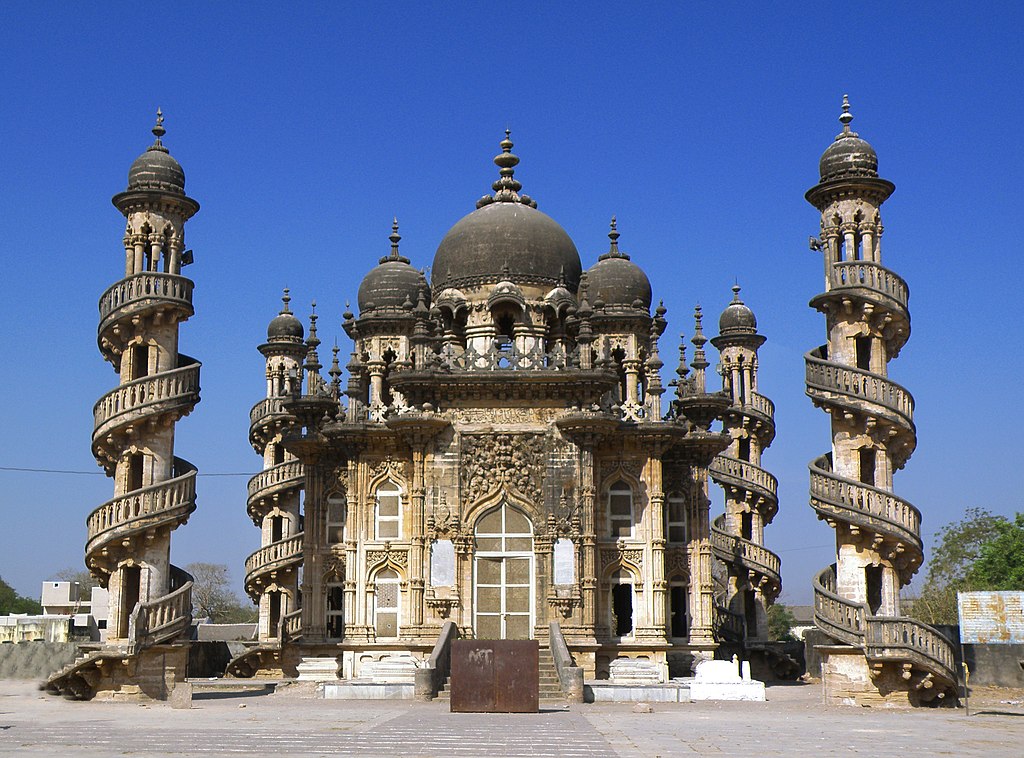
Mohabbat Maqbara Palace, Junagadh (a mausolem)

Municipal Corporation Building, Mumbai (Bombay).

Mysore Palace. I believe it may still be an official residence of the maharajas of Mysore.


Velankanni Matha church. Designated a basilica by Pope John XXIII.


Lahore Museum (Pakistan)

Sunday, June 2, 2013

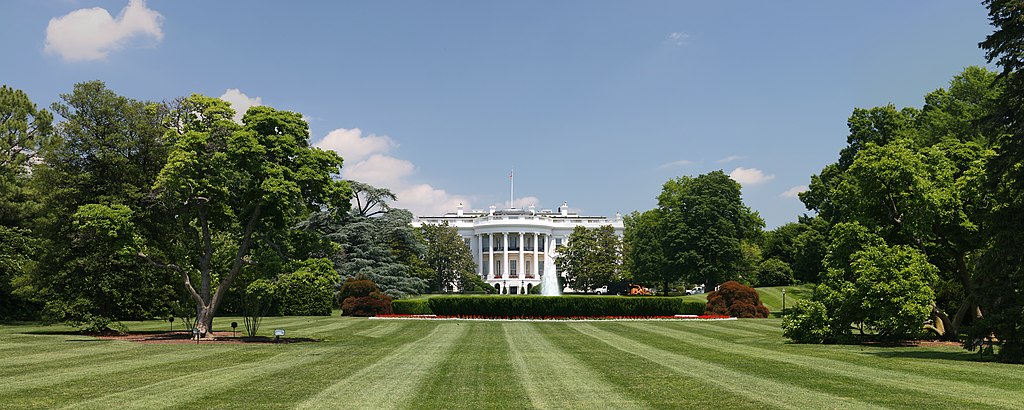
No visitors allowed: a medieval solution to the cessation of White House tours


Versailles. Fontainebleau. Windsor Castle. The Tower of London. The Vatican Palace. In the old world, lives were made and broken in these halls of power. Some people go to tea gardens or the great outdoors to commune with nature; I choose to tour historic sites and get in touch with the forefathers of our civilization by walking through the same corridors, seeing the same walls they passed through day in and day out. The places I mentioned above are just a few of the great buildings I've visited in the past, but one very important site is conspicuously absent from that list: the presidential palace of my own country, the White House.

Every time I've visited Washington, DC in the past and checked with my local member of Congress to get tickets for the White House, they were either unavailable or I was asking less than a month in advance. Since it's an active seat of government and not just a museum, and the President is probably the most desirable assassination target on the planet, I understand the need to jump through hoops. Truly, I do. But this year, before another upcoming trip to the capital, I checked with my Congressman again, only to find this message on his website:
"President Obama has chosen to suspend White House tours effective March 9, 2013. The President claims that this is due to sequester spending cuts. But there are plenty of unnecessary and duplicative government programs that could be cut instead of White House tours. The President should find ways to reduce spending in other areas so White House tours can resume. Meanwhile, public tours of the United States Capitol will remain open. Congress chose to implement alternative spending reductions to ensure that public tours of our nation’s Capitol building would continue. Please enjoy your time in the nation’s Capital. And if we can be of help in other ways, let us know."

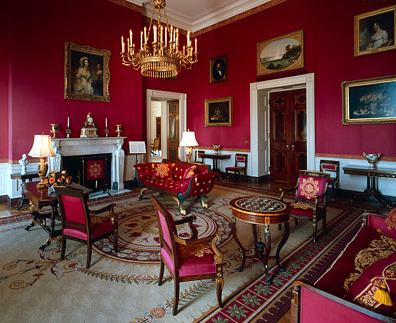
Indeed. I confirmed on the White House's own website and other sources that tours are still suspended. Now, some people make a profession out of reading the news and hating President Obama (or Bush, five years ago) for everything he does or doesn't do. They remind me of those who blame God for starving children in Africa, and in doing so, they've made Obama a god in their own minds. In this instance, however, I believe I'm fair in saying that the President, being clearly in charge of White House affairs, has committed a major faux pas here, and it's not just because touring the White House has been one of my aspirations since I read a book about it in the 3rd grade. How many generations of children have passed through the East Room, the Blue Room, the Lincoln Bedroom, inspired to ask themselves, "some day I will work here"? Not anymore, apparently. A transparent administration? Negro, please. We can't even see the public areas of your house now; and I use "your" in a very limited sense, because the White House is actually the property of the state, funded by the public. It stands to reason that with the proper precautions, good citizens should be able to tour the seat of the executive branch, just as I can still visit the Capitol or the Supreme Court building. Right?

The given reason for the suspension of tours is to cut federal spending. A noble goal in itself, but the cessation of tours only saves the Secret Service about $74,000 a week. That's just a drop in the great ocean of deficit, but it still raises the question of why it would cost that much just to give tours. Having never been on one, I couldn't imagine.... I do have one solution nonetheless. 

In the medieval world, a noble family would send their children away to be trained in the arts of war and leadership at another nobleman's castle. The first step on the path to knighthood was becoming a page, a servant in another lord's household. Perhaps one reason the medievals sent their children away was to break them out of their comfort zones and more quickly adapt to responsibility and obedience. In any case, our federal government today has a similar institution. The U.S. Senate has pages recruited from the nation's brightest high school juniors to deliver messages and otherwise serve senators' daily needs. The House of Representatives had pages as well until 2011, again due to budget cuts and a belief that they were obsolete in our age of smart phones and other toys (which clearly misses the point entirely). 

Capitol pages with Vice President Thomas Marshall (Wilson administration)


But still, flying in, housing and feeding all those pages from around the country for all those Congressmen must have cost some money. Let's assume, for now, that the cut was reasonable. I have a similar, but more cost-friendly solution for the White House. Let the President instead take as his "servants" the children of statesmen who already live and work in the capital: the children of Congressmen, other federal officials and their employees. They would naturally want their children to get a "foot in the door" of political office by working as closely to the President as possible, so positions will be competitive. But since their parents work in DC, they can go directly home afterward without the need for room and board provided by federal funds. And of course, as children of civil servants, they would be working at the White House for free. The only cost to the government would be minimal Secret Service supervision in case things go awry. The children get a taste of responsibility and get to meet hundreds or even thousands of their future "subjects" every week through tours. It's a win-win for everybody.

Tuesday, May 28, 2013

Memorial Day goes Gothic: the Washington Chapel

(This is technically a day late, but I started on it yesterday.)

Happy Memorial Day, medievalists. I have to confess that, despite being a former soldier, if I couldn't go to work today or go back to my university to do an errand, I would've forgotten Memorial Day even happened. This is probably the real reason why we have state-sanctioned holidays. 

Before I show you these photos I assembled (some from my own camera, but most from elsewhere on the Internet), I'll share with you something I learned from my southern history class last semester. Did you know that southerners didn't commonly celebrate the Fourth of July until after World War II? I didn't, and I'm from a centuries-long line of southerners. You see, it took two world wars, suffering and bonding with men from the North and the West in godforsaken trenches and foxholes, in order for us southerners to feel truly a part of this nation again. Before that, southerners observed Memorial Day. In those days, it was called Decoration Day because families would decorate the graves of loved ones who died for the ill-fated Confederacy. The tradition of honoring the fallen of the "lost cause" continued even after anyone who had personally known those soldiers had died. In every single county of the South, you'll see a monument of a young man in Confederate dress, perhaps looking away into the distance. What about these fallen soldiers was so potent, so powerful that it would cause 3rd and 4th generation southerners after the war to venerate men they had never known?

Because there is power in sacrifice. Whether the cause was actually righteous or not is irrelevant; the simple truth is that in the Civil War, as in most modern wars, those who died were chiefly the nation's youngest, ablest-bodied men. The monuments show young men looking away into a life they never had. Now imagine nearly a million men with entire lifespans, dreams, and ambitions ahead of them, all put into the meat grinder of politics at the behest of the wrinkled politicians who have already lived theirs, whose greatest discomfort is the sweat soaking their over-starched Victorian suits as they look over war briefs behind a desk. That, I believe, is the tragedy which made Decoration Day the surrogate national holiday of southerners for a century. Sadly, the situation is not much different today. You may have noticed the memorial pages on your favorite news websites: so-and-so killed in the line of duty in Iraq or Afghanistan sometime between 2001 and the present, age 20. 24. 19. Perhaps, as you read this, you realize you've lived twice or even three times longer. If it were up to me, I'd pass a constitutional amendment requiring the President and at least 10% of all the members of Congress at any given time to take to the field of battle in person, whenever a war must be waged. Since no president wants to spend his entire term in a bunker in some remote wasteland, fearful of a suicide bomber charging in at any given moment, wars would end a lot more quickly. Though that, of course, is a debate for another time. For now, let's look at a unique monument to soldiers from an even earlier war.


Upon the hills of Valley Forge, Pennsylvania, where General George Washington's troops spent the winter of 1777, there stands a chapel in his memory, as well as those of the soldiers who died in the Independence War. Now, you may be well aware that our "national architecture" usually consists of classical knockoffs designed to make America look like the Roman Republic reborn. Abraham Lincoln looks over the National Mall, enthroned like Jupiter in a Greek temple. Thomas Jefferson stands proudly in a new Pantheon. But you may have never seen our national history (or "civic religion" as it called it in my previous post) given the Gothic treatment until now.

I had the pleasure of visiting the Washington Memorial Chapel, built between 1903 and 1917, last year. For a building that was raised, brick by brick, in the 20th century (and completed in the middle of World War I, no less) it is a magnificent edifice. It defies the modern man who says "we have forgotten how to build great temples" or "there is no money to build these wasteful things". 


The chapel itself has a modest seating capacity (about 200) but is quite well-furnished. The photo below is from the back of the nave in HDR so you can see all the little details. For example, the coats of arms of all the states studded amidst the wooden ceiling.


This one is in natural lighting.


I believe all the flags are of the original 13 colonies, and the one on the right, furthest from the camera, is George Washington's coat of arms. (For those curious, that design has been used by Washington's family ever since his ancestor, William de Wessyngton, took possession of Washington Old Hall in Durham in the 12th century! It appears on a 15th century window in Selby Abbey here.) I also seem to recall a tour guide saying that a flag of each of the 50 states is placed upon the altar every week so that prayers are made for the people of that state. The remaining two weeks are given to the territories and the District of Columbia. If that's not right, it's because I mixed it up with what a tour guide said when I visited the National Cathedral in DC, or because I just made it up. Moving on...

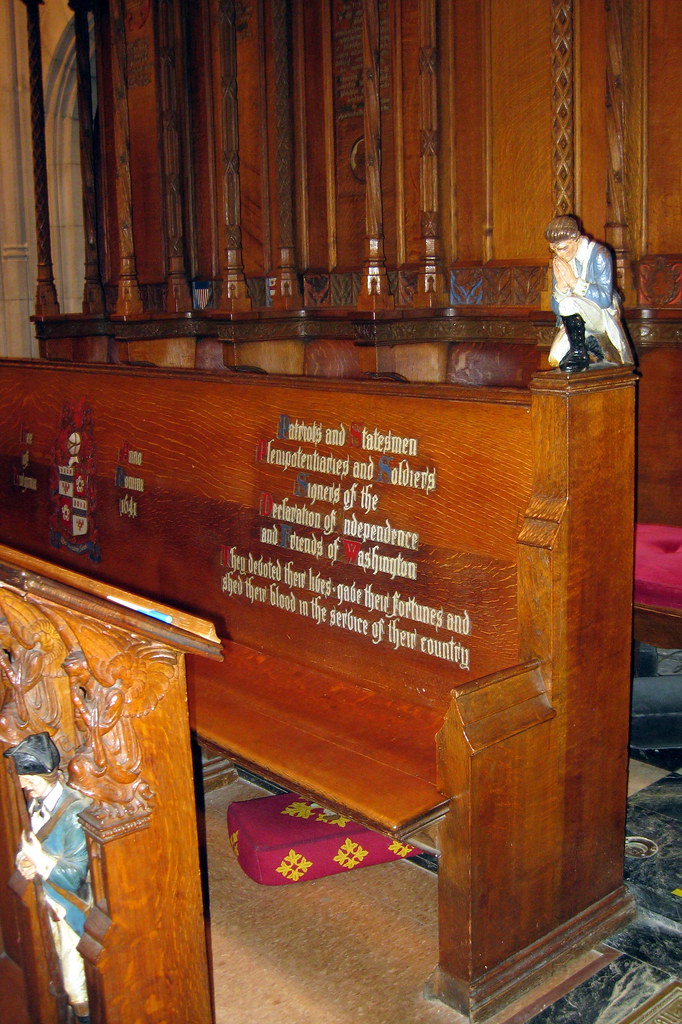
The details on the woodwork behind the choir stalls are especially remarkable. The choir is guarded by statuettes of soldiers in the uniforms that would have been seen in Valley Forge. I can't tell what's written below them, under the coats of arms.


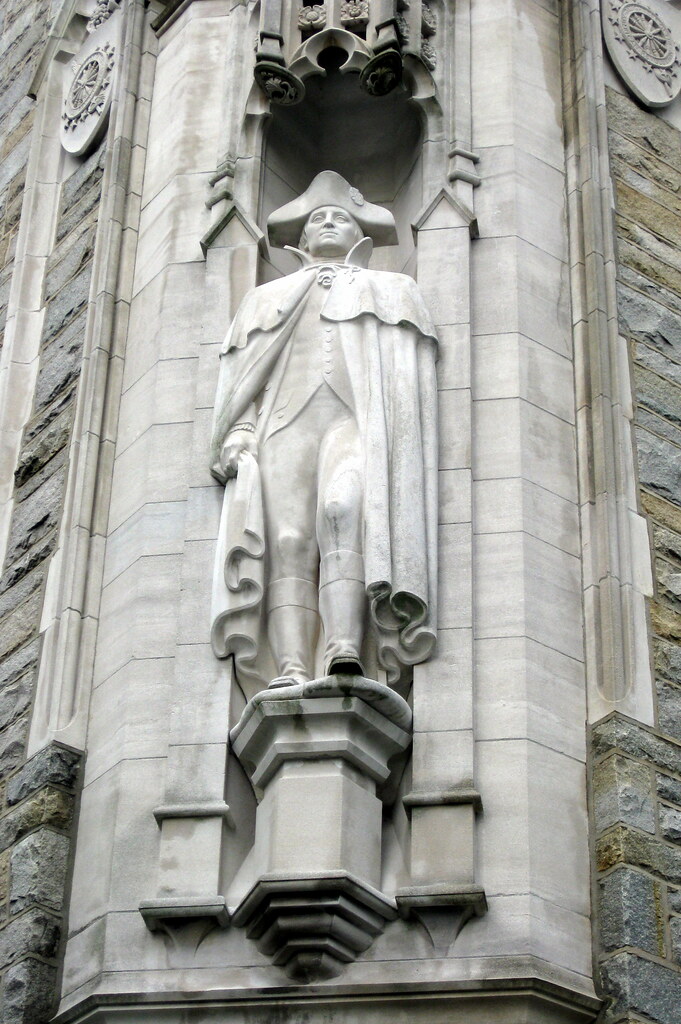
"Idols" of Washington:


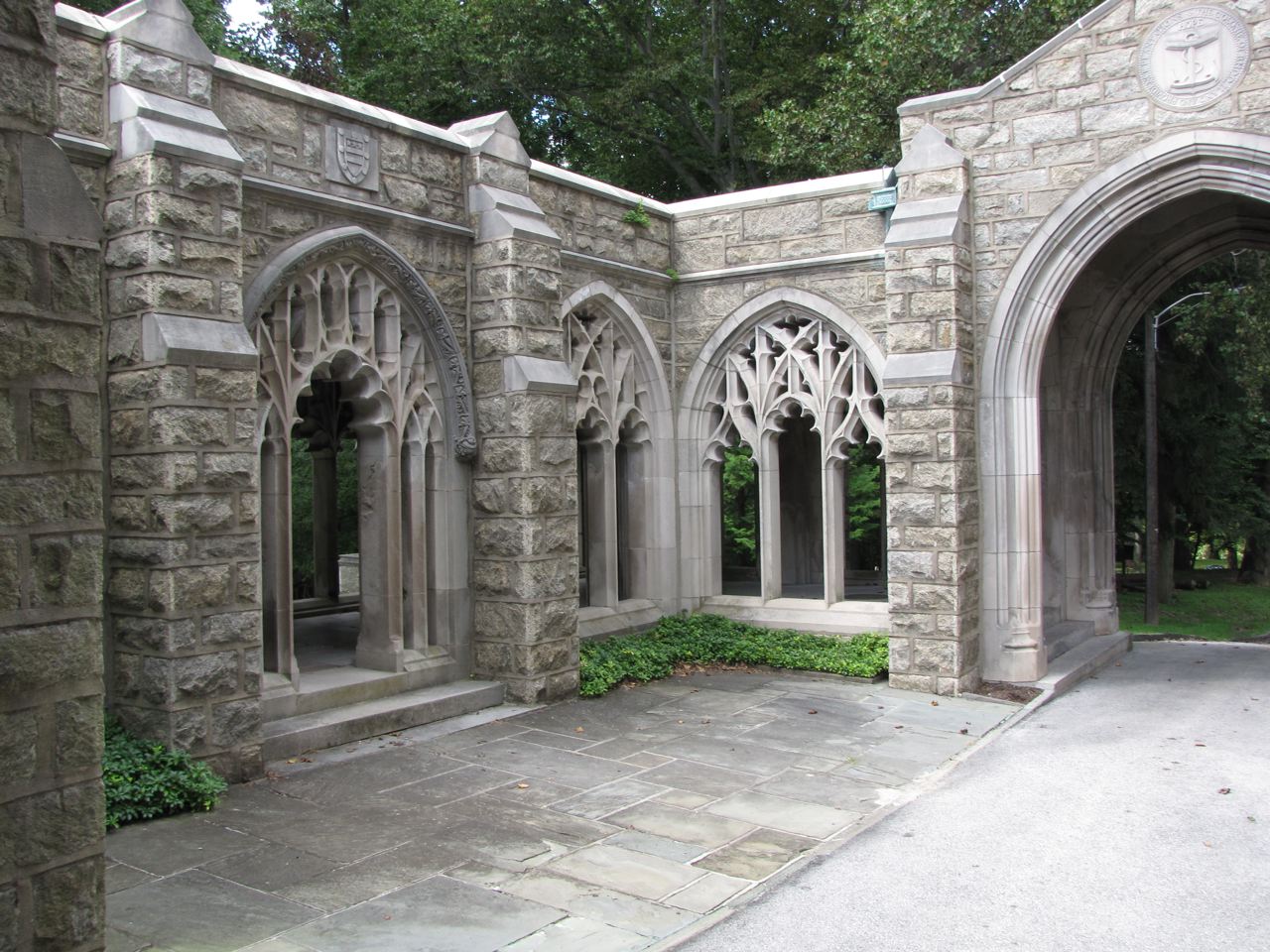
The chapel also sports a monk-less cloister:


Though a national shrine, there are many memorials for the foreign generals who trained the colonials at Valley Forge or otherwise fought in the war. This floor seal names Casimir Pulaski, a Polish noble who saved Washington's life and commanded one of only a few cavalry regiments in the entire Continental Army. He was mortally wounded in the Battle of Savannah and is one of only seven people to have ever been awarded "honorary American citizenship". Similar seals exist beside this one for the Marquis de Lafayette, the Comte de Rochambeau, and Baron von Steuben, among others (in case anyone forgot that the American Revolution was an international endeavor).


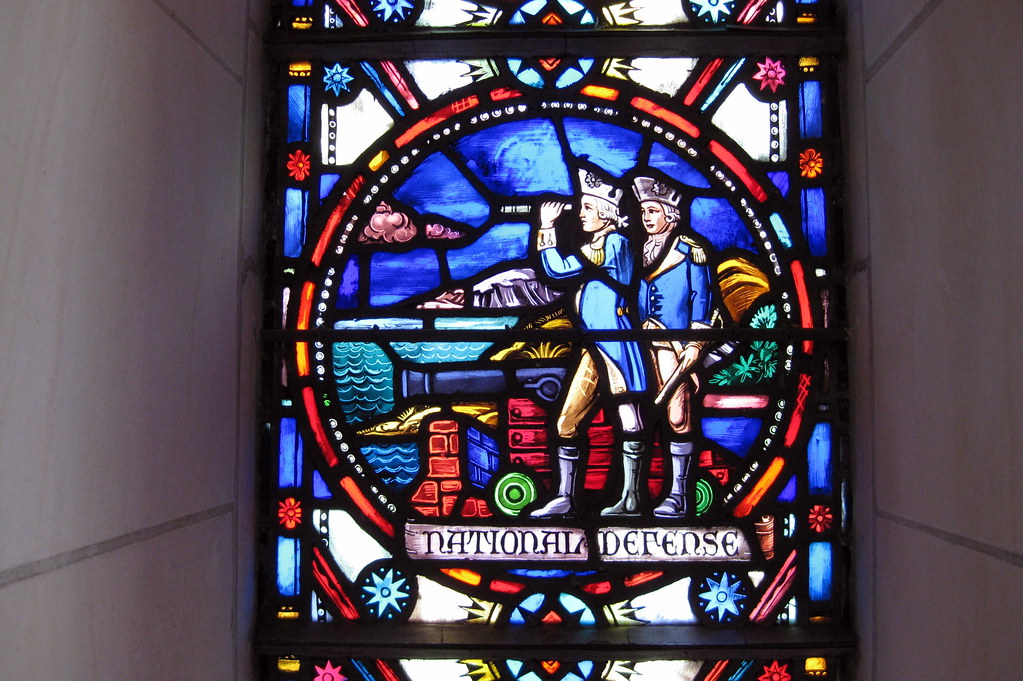
Detail of a stained-glass window in the "Patriot Tower".


The Washington Chapel is such a charming, Gothic edifice that it's no wonder it's a popular wedding destination. I'd get married there myself if it weren't Episcopal and wouldn't require an Episcopal's bank account to rent out. But as an experiment on conforming Americana to a romantic medieval aesthetic, I give it high marks. And for the skeptics out there, please be aware that the Gothic royal chapels of Europe (such as Saint George's Chapel at Windsor Castle) are no less works of propaganda to boost the egos of their kingly patrons. By contrast, the Washington Chapel was built entirely by donations from private citizens. It was built upon the romanticism of the American citizenry; the same which allows fallen servicemen and women to be revered in this country more than any other in the world, and which raised up a thousand monuments in a post-war South. The phenomenon is not really so different from that which created so many saints by popular acclaim in the early medieval world, and that which built the great shrines of Santiago de Compostela and Thomas Becket from the offerings of pilgrims. With due respect to American canonized saints like John Neumann and Kateri Ketakwitha, they just don't occupy the same space in even a pious American Catholic's heart, much less an average American who has certainly never heard of them. For good or ill, our soldiers and generals are the closest thing we in the United States have to saints. And if the cult of the American warrior is not an example of modern medievalism, I don't know what is.


Sunday, May 26, 2013

A good week for medievalism, and thoughts on education

I've been remiss in posting, dear friends, but the world still turns whether or not I issue forth a new article every week. This week is especially good for the medievally minded, and here's why:

1.) J.R.R. Tolkien published a new book. The mastermind behind middle-Earth is starting to rival Tupac in posthumous contributions; this time, it's The Fall of Arthur, an unfinished epic poem giving us Tolkien's spin on the matter of Britain. I've not yet read it myself, but from what I know, Tolkien has dispensed with the Grail and the courtly love traditions, opting instead to give his audience a raw, more "English" approach to the legend of King Arthur and his war against the Saxon invaders of the early Middle Ages. I have full faith that his style won't bear any resemblance to that abortion starring Clive Owen. However, buyer beware: the poem only occupies a small portion of the book. The bulk is filled by notes and essays written by his son Christopher on "The Poem in Arthurian Tradition" and other such subjects. You'll be disappointed if you were hoping to pick up a fully-fleshed, or even half-fleshed work.


2.) Sir Christopher Lee will release his next metal album tomorrow on his 91st birthday. Talk about a prolific career: Lee, who is old enough to have fought in World War II (and did), already holds the record for the biggest filmography of any major actor ever. Aside from reprising his role as Saruman in the Hobbit films, he can also boast of being the oldest metal performer of all time. Tomorrow will usher the arrival of Charlemagne: The Omens of Death, a sequel to Lee's previous album (Charlemagne: By the Sword and the Cross).


A music video from Lee's previous album:


3.) For those of you who are fans of George R.R. Martin's A Song of Ice and Fire saga, HBO's Game of Thrones next episode (the following Sunday, as there is no episode scheduled tonight) is titled "The Rains of Castamere". If you've read the books, then you already know what's about to happen. If you've only been following the TV series...... well, gird your loins. Winter is coming.

"And so he spoke, and so he spoke, that Lord of Castamere but now the rains weep o'er his hall with no one there to hear."


In other news, I've been dwelling a lot on what really matters to the average American, and how to gain their attention. I never expected this blog to go viral, but my goal from the beginning has been to reach a relatively broad audience. If I can't go beyond the tweed jacket and pipe smoking crowd, then I've failed. The trouble is that I often feel completely out of touch myself. In my column a couple months ago, I already outlined how Pope Francis and I seemingly exist on two different planets, despite being of the same religion. Not long ago, I had the unpleasant experience of feeling like a dinosaur in my mid-20's when I was substituting for a high school class and the given assignment was to watch The Empire Strikes Back. No one in any of the classes that day had ever seen a Star Wars movie before, not even a nerdy kid in the back of the room to play the exception to the rule. It makes sense now, but at the time, it took me a while to wrap my head around the idea that an entire generation could miss out on what I took for granted to be a staple of pop culture. 

Now, obviously there's nothing to gain from being able to distinguish the various kinds of TIE fighters or AT walkers, but I learned a valuable lesson that day: the things which I assumed were part of a commonly shared American culture don't actually exist. I routinely ask students what sorts of movies they watch or games they play, and find that despite the fact that I'm not much older than them, my interests and theirs rarely ever coincide. The same can probably be said for the entire faculty at innumerable inner-city schools across the nation. Google for accounts from inner-city public school teachers and you'll find the same story everywhere: white, middle-class do-gooder seeks to change the lives of disadvantaged kids in poor areas, then experiences severe culture shock on his first day when he realizes it was nothing like his own school. All of a sudden, yesterday's bickering over the effects of Harry Potter on our kids seems ludicrous when you come across a whole classroom of high schoolers who are incapable of reading any of those books, even if they wanted to (they probably don't). Worried about helicopter parents intruding into every aspect of their adult children's lives? Instead, be thankful they have the time and energy to bother in the first place. There are countless schools where parental involvement is almost nonexistent because the parents have to work multiple jobs just to make ends meet. The children who have been saddled by generational poverty go on to have more children, and the cycle perpetuates itself. And since lower-class families reproduce at a higher rate than the affluent middle classes, it doesn't take a genius to figure out who will be inheriting America in 20 or 30 years.

The above statement, to be clear, is not a preamble to a racist or eugenicist rant about the direction our nation is going. Nor does it precede a patented 7-step solution based on what the medievals would have done, because (as members of a subsistence economy) they wouldn't have done anything. Public education is an entirely modern construct which requires a modern solution, if it can be fixed at all. I'm merely raising a question: in 30 years, what will be the ties that bind our western, American culture? Certainly not the civic religion of the Founding Fathers, those ancient dead white men who owned slaves and whose descendants stole half of Mexico. (It's already a usual sight for entire classrooms to remain seated and gab through the Pledge of Allegiance. I don't know why schools still bother with it.) Nor will it be Christianity, which continues its endless fracturing and commercialization at the hands of hack preachers. Shakespeare? He's already been the bane of high school students for generations, but I've spoken to students who were seniors and never exposed to the Bard at all because it wasn't relevant to achieving acceptable standardized test scores. (I was amused when one student thought I was British because of the way I speak, though I assure you my dialect is your average newscaster American.) To those certain "conservatives" who think education is useless if it doesn't gear people toward being a cog in the industrial workforce, I hope you're happy. At any rate, despite the current over-saturation of liberal arts graduates, the future doesn't bode well for the humanities, much less medieval studies in particular. Ironic that as we lose sight of our past, we're bound to resemble the world as Saint Gregory of Tours saw it, when in describing 6th century Gaul in The History of the Franks he said,

"With liberal culture on the wane, or rather perishing in the Gallic cities there were many deeds being done both good and evil: the heathen were raging fiercely; kings were growing more cruel; the church. attacked by heretics, was defended by Catholics; while the Christian faith was in general devoutly cherished, among some it was growing cold; the churches also were enriched by the faithful or plundered by traitors-and no grammarian skilled in the dialectic art could be found to describe these matters either in prose or verse; and many were lamenting and saying: 'Woe to our day, since the pursuit of letters has perished from among us and no one can be found among the people who can set forth the deeds of the present on the written page.'"

Tuesday, January 22, 2013

The Problem of Criminalizing Vice, Part I: America's War on Beer


Dear readers, I announced over a month ago that, on the occasion of the 79th anniversary on the end of Prohibition, I would write an article about its causes legacy. My original intent was to present some research involving alcohol consumption in the Middle Ages, but let's face it: if you're reading these words, you likely already know that the average medieval peasant drank a lot more alcohol than we do because it was safer than water. There's not much more to say about that, so allow me to tell you something you might not have known.

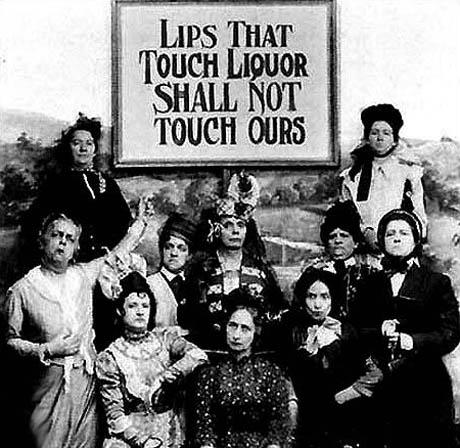
You might not have known that Prohibition was by no means the product of "backwards" religious extremists. On the contrary, the Volstead Act was entirely a product of the modern world. Certainly, evangelical Protestants championing the temperance movement were at the forefront of the war against booze. But their efforts would have amounted to nothing were it not for their alliance with social activist groups of every stripe in early 20th century American politics: no other cause could bring Protestant social reformers marching shoulder to shoulder with Catholics and Jews, whites with blacks, Democrats with Republicans, capitalists with communists, and Klansmen with suffragettes. Prohibition was a great experiment which pitted "the concerned" of every religious and political persuasion against the ignorant working class man who couldn't be trusted not to blow his paycheck at the bar rather than see to his wife and children. 

So what does this have to do with the Middle Ages? My "thesis" for this series, if you could call it that, is that the United States' grand experiment of alcohol Prohibition is a classic example of why criminalizing vice, merely because it is vice, is both anti-medieval and dangerous. Why does that matter? In short, because medievalism quite understandably attracts those who are sick of this world's rampant corruption, immorality, and lack of soul. They turn to the medieval ideals of kingship and order; a world where a man could be roasted alive for preaching a bad idea, and a rapist could be force-fed his own genitals. Surely, if Charlemagne were alive today, he would ban pot, Internet porn, condoms, and Muslim women from veiling in public.... right? Because as we all know, in a proper medieval Christian government, the king is God's lieutenant on earth, whose first responsibility is ensuring the salvation of his subjects' souls. Therefore, allowing any of his subjects to sin with impunity is to participate in sin itself.

A modified Charlemagne anti-sin bot: now with condom-zapping eye laser technology.
The truth of the matter is that only a modern American could dream up such a system. The average medieval king ruled over a decentralized government and had little power to control his subjects' personal lives, even if he wanted to. It certainly was a Christian king's responsibility to defend the Church, but they rarely had the luxury to play the idealist. Later on, we'll explore how the medieval world not only tolerated brothels, but rationalized their existence as necessary to prevent greater evils. For now, though, let's begin with more familiar ground and work backwards. Our story begins here in America with the causes that led to the noble cause of breaking our nation's addiction to Satan's brew: alcohol.


An Overview of America's War on Beer

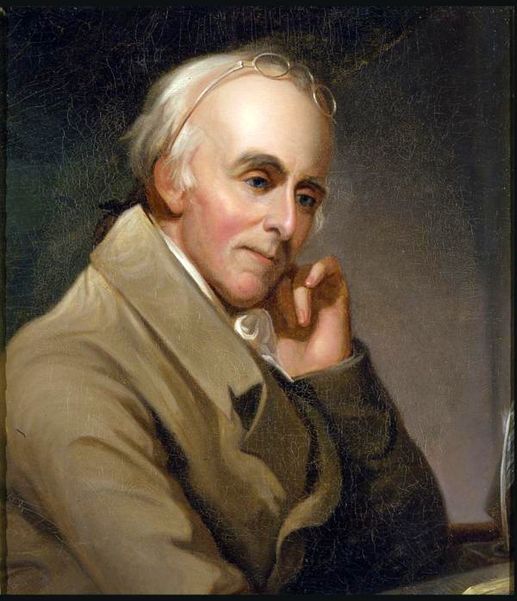
Prohibition wasn't the brainchild of a few early 20th century politicians out to score some votes from the "moral majority" crowd. Rather, it was the climax of a movement over a century in the making. Dr. Benjamin Rush, the famed Philadelphian physician and founding father, was an early and oft-cited influence upon the temperance activists. He published an Inquiry into the Effects of Ardent Spirits Upon the Human Body and Mind in 1785, which diagnosed alcohol as a substance prone to inducing both madness and acts of moral evil upon those who consume it. He lists some effects in his introduction:

"I shall begin by briefly describing their prompt or immediate effects, in a fit of drunkenness.

This odious disease (for by that name it should be called) appears with more or less of the following symptoms, and most commonly in the order in which I shall enumerate them.

1. Unusual garrulity.
2. Unusual silence.
3. Captiousness, and a disposition to quarrel.
4. Uncommon good humor, and an insipid simpering, or laugh.
5. Profane swearing and cursing.
6. A disclosure of their own or other people's secrets.
7. A rude disposition to tell those persons in company, whom they know, their faults.
8. Certain immodest actions. I am sorry to say this sign of the first stage of drunkenness sometimes appears in women, who, when sober are uniformly remarkable for chaste and decent manners.
9. A clipping of words. 
10. Fighting; a black eye, or a swelled nose, often mark this grade of drunkenness.
11 . Certain extravagant acts which indicate a temporary fit of madness. These are singing, hallooing, roaring, imitating the noises of brute animals, jumping, tearing off clothes, dancing naked, breaking glasses and china, and dashing other articles of household furniture upon the ground or floor."


We can forgive Dr. Rush for the errors of 18th century medicine, but the damage was done: the so-called Age of Reason, which (like our own generation) so highly valued any study christened in the name of science or medical progress, rubber-stamped its seal of approval on Dr. Rush's Inquiry. Four years later, a temperance organization of 200 Connecticut farmers came into existence. Virginia saw theirs in 1800, and New York's in 1808. 
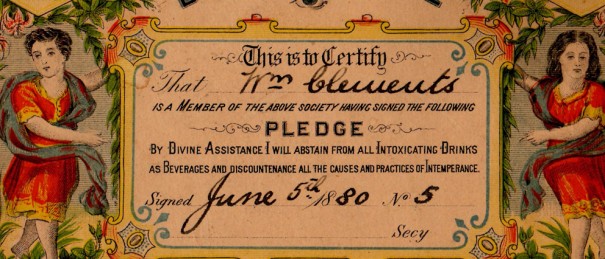
A teetotaler's certificate: because nothing in the Victorian era was official until you made a pledge on paper.
These early associations were motivated by the scientific community's diagnosis of alcohol as a poison, but it took a great awakening to supercharge the temperance movement into a formidable political force. The Second Great Awakening swept the country with a spirit of religious revival and moral reform, for which the temperance societies became a perfect vehicle to achieve their ends. Previously, temperance societies typically presented members with a pledge card holding two options: moderation in drink, or total abstinence. A member who signed on for T.A. (total abstinence) became known as a tee-totaler. But after the Great Awakening, moderation was increasingly viewed as a weak half-measure; and since Americans loathe half-measures, total abstinence became the only acceptable goal.
 
Thomas Welch made a fortune by changing the meaning of the Bible
See, in order for society as a whole to purge alcohol, the issue had to be freed from being the pet project of some health nuts (the equivalent of today's vegans or organic food advocates). It needed to be a matter of salvation or damnation. For the followers of these revival preachers, alcohol was not just poison: it was the devil's brew. Of course, reasons had to be manufactured to explain why Christ would turn water into wine for a party, or use wine to institute the Lord's Supper. It was convenient that around this time, Thomas Welch, a Methodist minister and dentist, found a way to mass-produce an unfermented, and therefore non-alcoholic "fruit of the vine": what we call grape juice. This feat of scientific engineering bizarrely enabled a very large part of Protestant America to substitute grape juice for wine in their services. Within a generation, their Biblical scholars claimed it was how Jesus did the Last Supper and the wedding at Cana all along.

The Civil War, as wars so often do, threw a wrench into the cogs of the temperance machine, but after the dust had settled, the prohibitionists returned with a vengeance. Kansas has the dubious distinction of being the first state in the Union to completely outlaw alcohol in its constitution (1881). Its chief enforcer: Carrie Nation, the mother-in-law from hell who barged into saloons and smashed their stock with her signature hatchet. Year by year, other states followed suit. North Dakota even entered the Union as a dry state. By the time Congress had passed the 18th Amendment, over half of all the states had already enacted statewide prohibition.

At the turn of the 20th century, both "science" and "religion" were firmly geared toward the prohibition of alcohol in America. It needed one final catalyst: social reform. The Enlightenment and the Great Awakening had already played their parts, but it was ultimately the Progressive Era that made prohibition a national mandate. The years between 1890 and 1930, emboldened by America's victory against Spain and the beginnings of empire, yearned for progress in every sector. It meant trustbusting Standard Oil and the robber barons of the old years. It meant destroying the old bosses and political machines of the past like Tammany Hall. It meant giving women the vote, and teaching eugenics to keep poor people from having too many children. And yes, it meant reforming the working man by destroying the alcohol industry. The working man had many enemies. The capitalist could afford to ban alcohol to keep his workers productive, while stockpiling alcohol before the beginning of enforcement for his own use. The communist could oppose alcohol because it was seen as a means for the capitalists to keep the proletariat down. The suffragette sought to destroy the saloon so that her husband would come home sooner with more money in his pocket. Her ally, the Klansman, targeted the saloon because it was a gathering place for Italians and Catholics. And yet, even many priests and bishops of the Catholic hierarchy were active members of the temperance movement.

America's entry into World War I provided the perfect excuse. In 1917, Congress passed the Food and Fuel Control Act, which banned the production of distilled spirits to conserve wheat for the war effort. The Conscription Act also forbade the sale of alcohol on or near military bases. Wartime necessity had conditioned the few last wet states and counties in the nation to total abstinence. Congress used the war to pass an amendment to ban the sale or manufacture of alcohol nationwide, pending its ratification by the states. By the time the needed majority from the state legislatures had come, the war was already over. On October 28, 1919, the Volstead Act was passed, providing the means to enforce Prohibition.


Stay tuned for the next issue, where we examine Prohibition's effects: organized crime, contempt for the law, and public enemies abound!


Saturday, December 8, 2012

Coming soon

The past month has set a lot of distractions upon my way, but not to fear: I'm currently working on a piece about alcohol consumption in the Middle Ages and the causes of the temperance movement in the late 19th and early 20th centuries. This will commemorate the recently past 79th anniversary of the Eighteenth Amendment's repeal, signaling the official end of Prohibition. It won't be entirely the sort of article you're expecting, though.

In the mean time, I can share with you a trinket I made for my girlfriend: a choker made from a Gothic fabric trim, with a griffin locket to hold sentimental portraiture. It was my attempt at applying the medieval arts to a popular Victorian fashion accessory, though I suppose a mind to practicality might be of use in future experiments. Some say the choker was born from the French Revolution, when women would wear red ribbons around their necks to show solidarity with those who lost their heads to the guillotine. The fashion continued well into the 1920's, among commoners and high-born alike, as a way to emphasize a graceful neck.


Monday, November 12, 2012

The priest hole: the pre-modern speakeasy


I went to see 007: Skyfall last night and was thoroughly impressed at its unabashedly traditionalist approach to the espionage genre. Skyfall commemorates the 50th anniversary of the Bond film franchise. This quick entry requires a couple of spoilers, so watch out:


The movie's name comes from Skyfall, the name of the Bond family estate in Scotland which is used for the final shootout. The bad guy is hunting down M, whom Bond sends down a "priest hole" when the going gets too tough for bullets; the implication is that if Bond himself isn't a Catholic, he is at least descended from a family of noble Catholic recusants: people who stubbornly held onto Catholicism after the Reformation. The priest hole isn't strictly a medieval phenomenon, but may be said to have preserved a vestige of medievalism in Reformation England, Scotland, and Ireland. In the reign of Elizabeth I, the Church of England became thoroughly Protestant and measures were placed against the practice of the old religion. Anyone in England caught celebrating or participating in Catholic rites was to lose all his property on the first offense, one year's imprisonment on the second, and life imprisonment on the third. The penalty for either converting to, or helping another convert to Catholicism, was death. Nonetheless, the Catholic faith persisted in certain circles. 

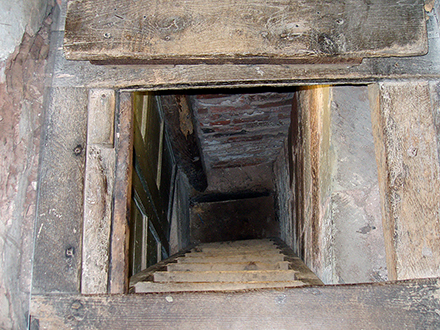
Priest hole in the cupboard of Harvington Hall, Worcestershire
Among the noble families which maintained the old religion, they converted their castles and country houses to easily hide priests, vestments, chalices, and other religious items in the event that a "pursuivant", or priest-hunter, would come to search the house. These "priest holes" had to be especially secure, as searches were known to have lasted as long as two weeks. Priest-hunters would sometimes conscript carpenters or masons to inspect the house for any weaknesses in the walls or woodwork. There are, indeed, cases of priests having died of starvation inside these holes while the pursuivants tore the house apart. 

The most famous designer of priest holes was Saint Nicholas Owen, a Jesuit lay brother. He was most likely a carpenter and spent thirty years building priest holes around England. It's said that Owen engineered the escape of another Jesuit, the priest John Gerard, from the Tower of London in 1597. Owen was eventually tortured to death in 1606 in the aftermath of the Gunpowder Plot, but he never revealed a single priest hole he constructed. Some of his priest holes may remain undiscovered even to this day.