
 |
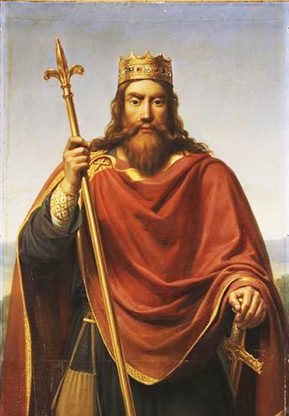
| Clovis, first Christian King of the Franks |
Today I saw a great piece, courtesy of Medievalists.net, on the beliefs regarding hair in the Middle Ages. The article, Scissors or Sword? The Symbolism of a Medieval Haircut by Simon Coates, opens with this story:
"Whilst residing in Paris in the sixth century, Queen Clotild (d. 554), the widow of the Merovingian ruler Clovis, became the unwilling subject of the inveterate plotting of her sons, Lothar and Childebert, who were jealous of her guardianship of her grandsons, the children of their brother, Chlodomer. Childebert spread the rumour that he and his brother were to plan the coronation of the young princes and sent a message to Clotild to that effect. When the boys were dispatched to their uncles they were seized and separated from their household. Lothar and Childebert then sent their henchman Arcadius to the Queen with a pair of scissors in one hand and a sword in the other.
"He offered the Queen an ultimatum. Would she wish to see her grandsons live with their hair cut short, or would she prefer to see them killed? Beside herself with grief, Clotild stated that if they were not to succeed to the throne she would rather see them dead than with their hair cut short. Rejecting the scissors, she opted for the sword.The sequel to this story, told by Gregory of Tours (d. 594), reveals an alternative to death or short-haired dishonour. A third grandson, Chlodovald, was well guarded and escaped his uncles. Seeking to escape the fate of his brothers, he cut his hair short with his own hands and became a priest. Voluntary tonsuring did not carry the ignominy of shearing under duress."
The precise sentiments attached to hair have fluctuated over the medieval period; after all, we are talking about a thousand years and hundreds of cultures; but for the most part, a full head of hair was typically associated with privilege and power. We see that the Merovingian kings preferred to lose their heads rather than their hair, because a haircut was a sign of humiliation, even the loss of the claims to kingship.
Very occasionally, I'm asked why I don't get a haircut. Depending on the mood and context, I give a different answer. "I save money on haircuts" or "my girlfriend would be cross if I did" both work in a pinch, and both are true. But there's a more reasoned motive as well. Four years of service in the U.S. Army forced me to rack up quite a bill on haircuts over time for the sake of a "neat, uniform appearance". The idea of military service in the modern age involves a complete breakdown of a recruit's personality in order to make him a dependable member of a cohesive unit in life-and-death situations. The original rationale for these ridiculously short haircuts came from preventative measures against lice in the trenches of the First World War. So many men of the western world served in the Great War that military fashion dictated style even among civilians. Trench warfare has long since slipped into irrelevance, but the haircuts remain to impose a uniformity among the ranks. I dare say it's something like a mark of slavery, akin to the the letters SPQR tattooed on the arm of a soldier in the ancient Roman legions. Whether it's a tattoo or a high-and-tight, it visibly marks you as property of the government.
Short hair in the Middle Ages likewise most often denoted that a man was of low social standing. A peasant who toiled daily in the fields couldn't afford to keep his hair clean, so it was just as well to chop it off. Closely cropped hair could also mark a man as a serf, bound to the land and his lord. It also explains why the tonsure was such an important rite for monks and clerics. Just as the haircut is the first thing a modern man receives when entering military life, a monk or cleric traditionally received a haircut before entering those states of life to symbolize the cutting away of worldly glory and ambition. Nevertheless, medieval Christians wouldn't dare depict Our Lord with the haircut of a monk or serf because, poor as He was, to portray Him with short hair would just have been disgraceful. Even today, I suspect most Christians would find it awkward and unbecoming to see an image of Christ with a buzzcut.

Portraits of men with hair to the chin or below are commonly found until the Renaissance revived the customs of pagan Greece and Rome. During this time, we see more portraits of men like Henry VIII with close-cropped hair, but let's remember that this is the same generation of men who called the Virgin Mary "Minerva" and painted Christ in the form of Apollo with short hair and no beard on the wall of the Sistine Chapel. (Of all the portraits of the later Renaissance, the one by Holbein of Saint Thomas More seems to feature a hairstyle most in keeping with the medieval spirit.)
In the next century, the paganism of the Renaissance temporarily receded and gentlemen of England grew their hair out again. The English Civil War divided the country into Cavaliers, whose long hair marked them as high Anglicans, papists, or otherwise the King's men on one side; and "Roundheads" on the other, whose Puritan and populist leanings had them adopt the hairstyle of serfs. The Roundheads enjoyed only a brief victory before the royal courts of Europe made long hair fashionable once again. Decadence, and the balding of a certain French king, the fourteenth of his name, introduced the wig.
When Robespierre led his reign of terror in France, he accomplished the work of a thousand Childeberts: lose your hair (or wig), or lose your head. Of course, thousands of Frenchmen lost both anyway, but even after the Terror ended, the fashions of the proletariat triumphed. Long hair enjoyed some revived popularity among romantics and medievalists of the Victorian age, but for the most part, the French Revolution won. As with so many other things, yesterday's liberalism became today's conservatism. The rampant militarism of the World Wars renewed the fashion of short hair for another few generations, and now, today we have to deal with short hair as yet another false conservatism, alongside choir lofts, operatic music at Mass, warmongering, crony capitalism, and the cult of American football, which really ought to be called handegg considering the nature of the game.
When I left military service, I rejoiced in my freedom and never got a (significant) haircut again. I suppose it would be extreme and counter-productive to just start wearing medieval costume every day, but I wear my hair long enough to tie back as a sign of solidarity with the past, as well as (for now) freedom from servitude to the government, the clerical state, or any other institution that would dictate my appearance outside of work hours.
So now you know.
