Showing posts with label medieval Church. Show all posts

Thursday, June 1, 2017

Corpus Christi: a medieval feast for modern man


Today we enter into the month of June: the month of the Holy Eucharist. The medieval Church might not have gotten everything right, but one thing they excelled at beyond all human measure was devotion to the Blessed Sacrament. To read any secular historian's account of how the feast of Corpus Christi came into existence, you'd be forgiven for thinking it was all centered around a quaint belief system not seen for hundreds of years. And yet, despite the passage of time, nothing has changed. The Catholic Church, whether in the 13th or the 21st century, has consistently taught that, at the words of a validly ordained priest, mere bread and wine are transformed into the incarnate God: Jesus, not symbolically, but truly present in our midst to be worshiped and consumed. 

At the height of the Middle Ages in the west, adoration of the Eucharistic Lord--not the reception of Communion--was the climax of the liturgy for the average layperson. The faithful, called to attention by the ringing of the Sanctus bells, would jostle each other for a glimpse of the Host raised up by the priest over his head at the elevations. As told by Eamon Duffy in The Stripping of the Altars: Traditional Religion in England, 1400-1580, zealous parishioners might not leave until they had satisfactorily gazed upon the Lord, shouting across the nave, "raise it higher, sir priest! Raise it higher!" 


No one did more to foster a devotion to Christ's real presence in these crucial centuries than Saint Norbert of Xanten: founder of the Praemonstratensian Order. Four hundred years before the Protestant Reformation, a wandering preacher known as Tanchelm had caused many people in the city of Antwerp to deny the saving power of the Eucharist and the authority of the bishop. St Norbert was invited by Bishop Burchard of Cambrai to take a few trusted disciples with him into the city and bring it back to the orthodox faith: a feat he accomplished with both gentleness of heart and zeal in preaching. He said to the people, 
“Brothers, do not be surprised and do not be afraid. Unwittingly you have pursued falsehood thinking it to be the truth. If you had been taught the truth first you would have been found effortlessly tending toward salvation, just as you now effortlessly lean toward perdition.”
Focusing on Christ's discourse on the "bread of life" in John 6, Norbert reconciled the city to the Church and was thereafter known as the Apostle of Antwerp. For teaching clergy and laity alike to reverently care for the altar cloths and handling of the Sacred Species wherever he went, even bringing the Blessed Sacrament away from the church to the battlefield, making Christ the instrument of peace between warring clans, Norbert became known as the Apostle of the Eucharist. 

A young woman soon picked up where Norbert left off to take the medieval Church's Eucharistic devotion to its apex. Saint Juliana of Liège, a Norbertine canoness, reported having a vision of a full moon, shining brightly but marred by a dark line across its surface. She understood the moon to represent the Church on earth, reflecting the light of Christ's glory. The dark line was a void in the Church's myriad cycle of celebrations: a lack of a day dedicated to the Lord's real presence in the Eucharist. Until then, Maundy Thursday was the only day to commemorate the institution of the Eucharist (at the Last Supper), but it was inevitably shadowed by the gloom of Good Friday. St Juliana petitioned her bishop to declare a feast for the Body and Blood of Christ within the diocese--which he did, though he died before he could act on it.

A splendid illustration of St Juliana by Daniel Mitsui
St Juliana died in 1258, before the feast of Corpus Christi could take root outside her city. Shortly thereafter, though, the former archdeacon of Liège was elected Pope Urban IV. Juliana's surviving friend petitioned the Pope to institute a feast according to Juliana's plan. This he did, well beyond what St Juliana could have ever dreamed: on the 11th of August, 1264, Urban IV issued the bull Transiturus, proclaiming a feast in honor of the Body and Blood of Christ throughout the entire Latin Church, which we now call Corpus Christi:
"although this memorial Sacrament is frequented in the daily solemnities of the Mass, we nevertheless think suitable and worthy that, at least once a year – especially to confound the lack of faith and the infamy of heretics – a more solemn and honourable memory of this Sacrament be held. This is so because on Holy Thursday, the day on which the Lord himself instituted this Sacrament, the universal Church, occupied with the reconciliation of penitents, blessing the chrism, fulfilling the Commandments about the washing of the feet and many other such things, is not sufficiently free to celebrate so great a Sacrament."
The feast would be marked with Eucharistic processions (still novel at that time) through every city in Christendom on the Thursday after Trinity: Thursday to link the celebration with the institution of the Eucharist at the Last Supper. The Angelic Doctor himself, Saint Thomas Aquinas, was commissioned to write an office and several now-famous hymns for the feast. The sight of the Lord enthroned in a monstrance, paraded through the central square with all the magistrates of the city in attendance, naturally captivated the medieval imagination with a fervor we may never see again, giving birth to thousands of local traditions and guilds.

The Protestant Reformation challenged belief in the Real Presence (Luther once preached of Corpus Christi, "at no festival are God and his Christ more blasphemed"), yet for many Catholics in Europe, the sight of Jesus in the Eucharist, borne in procession through the city, was enough to bolster their faith against every threat of war or schism in those turbulent times. At last, in 1582, centuries after his death, Norbert of Xanten was canonized a saint--thanks, I'm sure, in no small part to his defense of the Eucharist.

Today we stand at another fork in the road: will the Church, after losing her prominent place in civic life, retreat behind closed doors to celebrate the sacraments away from unbelieving eyes? Or will she dare to take to the streets once again, holding the Lord for all to adore, even at the risk of jeers, blaring horns, or the eyerolls of apathy?

Wherever you may find yourself this feast of Corpus Christi, dear reader, may we find the same fervor of the Body and Blood of Christ that moved simple peasants to fall to their knees in the mud when the Blessed Sacrament passed them by. May we find the true meaning of the words of Aquinas' hymn, Pange lingua gloriosi, when we sing:
"Sing, my tongue, the Saviour's glory,
Of His Flesh, the mystery sing;
Of the Blood, all price exceeding,
Shed by our Immortal King,
Destined, for the world's redemption,
From a noble Womb to spring."

The Blessed Sacrament carried through the streets of Manhattan by Bishop Joseph Perry at the 2015 Sacra Liturgia conference. More wonderful photos at this link.
In 2014, my schola of chanters sang the royal praises, Christus vincit, as the Blessed Sacrament was carried under the rotunda of the Texas State Capitol building in Austin. Benediction was unapologetically given under the dome, in the very midst of the state's seat of government.
The Blessed Sacrament in procession following solemn Mass in the traditional Latin rite at the Cathedral-Basilica of Philadelphia last year (2016).

If you're in the Philadelphia area, the Modern Medievalist invites you to join us for our celebration of this marvelous feast this year (2017).


Thursday, September 29, 2016

Magna opera Domini: a reflection on the institution of acolytes

(Unless excepted, photos are courtesy of the Personal Ordinariate of the Chair of St. Peter)
Magna opera Domini: "great are the works of the Lord". This is the motto on the coat of arms of Bishop Steven Lopes of the Personal Ordinariate of the Chair of St. Peter, who explained its meaning in his first remarks after being raised to the order of bishop here. This past Sunday, on the feast of Our Lady of Walsingham (transferred), I was very privileged to be a part of that motto brought to life when I was instituted as an acolyte by Bishop Lopes alongside a fellow parishioner and 50 other men nominated by their pastors across the Ordinariate in the US and Canada. Some were new additions to the ranks of our Cathedral's clerks, but most of those who traveled to our cathedral in Houston, Texas with me, even as far as Nova Scotia, are lay leaders of their respective parishes in and out of the liturgy.

As some of you may know, I've written here and elsewhere extensively about the minor orders and the role that they once played at the parish level in the medieval Church to carry out the work of divine worship; indeed, how these orders was once required for admittance to the choir or altar service. Even after the Church of England abolished the minor orders, the lay "parish clerk" continued to feature in Anglican life as an invaluable assistant to the priest, and has thankfully been re-introduced into the post-conciliar Catholic Church through the Ordinariate.

To be sure, some of the 52 men instituted last Sunday were chosen for their encyclopedic knowledge of ceremony. The cathedral rector said to us that the parish clerk is often the man to whom the priest can turn when he stares blankly into an unfamiliar page in the Missal and whispers, "explain to me what I'm supposed to do here!" Others were called not so much for that, but to expand upon their many years of dedicated service to their parishes in general, now in an established manner. When I learned that one of my fellow candidates to be installed was a papal Knight of the Order of St. Gregory the Great, I felt in some sense that I was standing among giants.

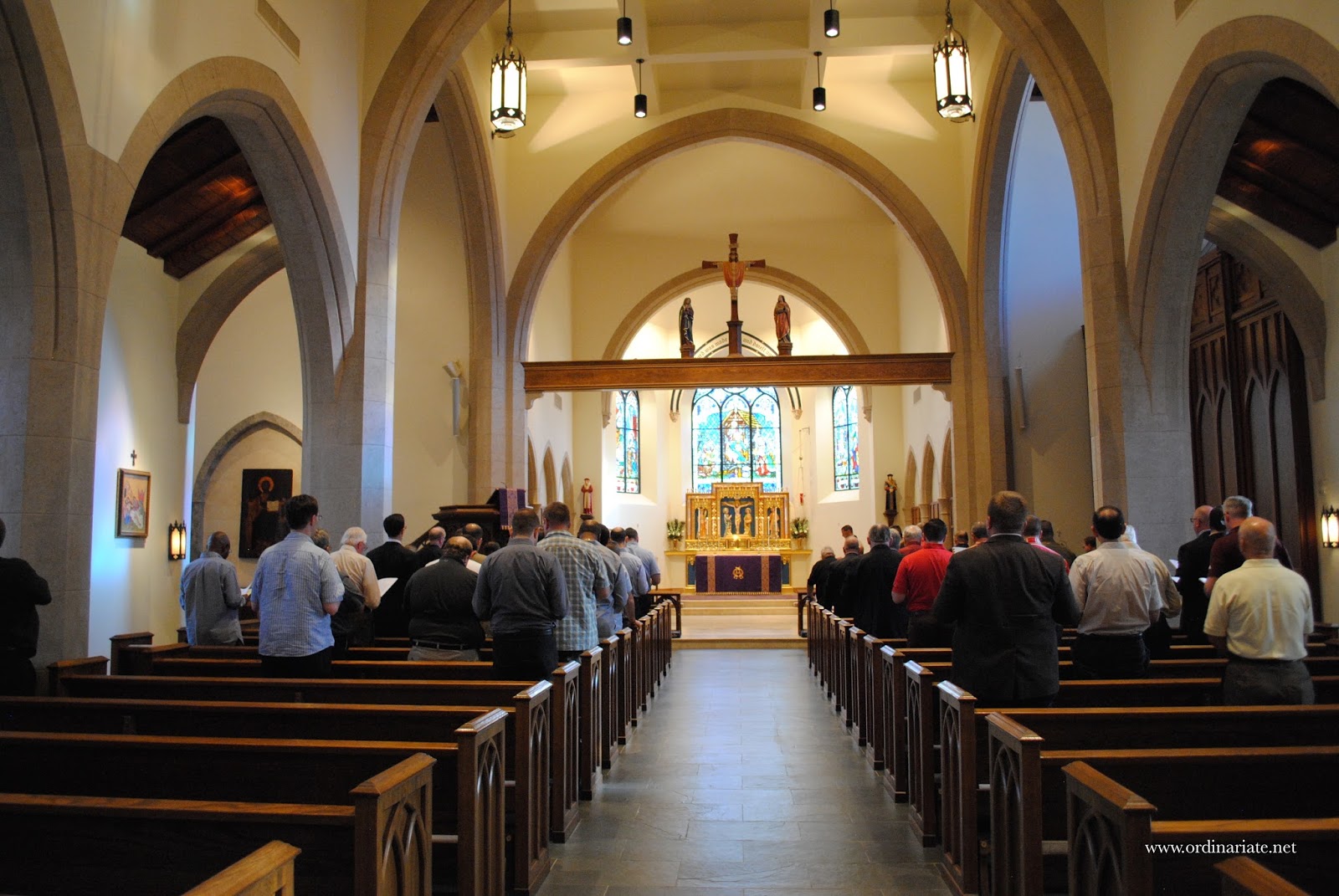
Shortly before the principal Mass and rite of institution. After this, we all recited the Prayers of Preparation with Bishop Lopes before processing into the cathedral.
The training during the weekend of institution, which arose particularly in response to the desire among various parishes to offer solemn high Mass with the classical three-fold ministry of the altar (priest, deacon, and subdeacon), numbers among the most grace-filled experiences I've ever had. We prayed morning and evening hours of the Divine Office in common, shared stories of growth and struggle amongst our communities, and partook of the richness of beauty in worship offered by the Cathedral of Our Lady of Walsingham. I especially enjoyed how, during the principal Mass, there was a vested schola for plainchant in the north transept, in addition to the cathedral choir. The schola chanted the Introit, Offertory, and Communion antiphons out of the Plainchant Gradual (in sacral English but with the ancient Gregorian melodies). A schola chorister sang the first reading in the Prophecy tone, and the acolyte acting as subdeacon sang the second reading in the Epistle tone. I came away with the sense that it was the supreme model for sung vernacular liturgy in the Latin Rite today.

Our weekend began with Evening Prayer of Ember Friday
Instituted acolytes are authorized to serve Mass in both the Ordinariate's unique Missal; Divine Worship; as well as the Extraordinary Form (traditional or "Tridentine" Latin Mass), in the ancient role of subdeacon, clad in colored vestments, chanting the Scriptures, and standing at the priest's left hand or behind the deacon at the foot of the altar. In the Ordinary Form, they may be asked to purify the sacred vessels. In the absence of a priest or deacon, they may also lead hours of the Divine Office, deliver holy Communion to the sick, or prepare a monstrance for Eucharistic Adoration (but not give Benediction). Bishop Lopes, who personally delivered instruction to us despite having just returned from a visit with other American bishops to the Pope himself in Rome, made it clear that we were to be instituted not just for the Ordinariate, but for the entire Church. He encouraged us to engage and give service (in and out of liturgy) at our neighboring diocesan parishes, including for solemn celebrations of the Extraordinary Form.

In return, we pledged to intensify our prayer lives, frequency of confession, and particularly grow in devotion to the holy Eucharist through regular Adoration. We were asked even to take into account our public witness of Christ, remembering that we extend the ministry of the priest and deacon in places they can't reach. The subdiaconal ministry was compared to a Wifi signal in a large house. If the router is in a closet at one end of the house and you're trying to get a connection from the living room on the other side, your reception will be poor and slow; so to remedy, you might think to install a repeater to boost the signal. Likewise, in the places in and out of the church where neither the priest nor deacon can reach, the acolyte is there extend their ministry. It doesn't advance the kingdom of God for an acolyte to insult a parishioner in a Facebook comment one day and present themselves in a tunicle the next, so we're called to be the face of Christ as far as we can.

The cathedral rector, Fr. Hough (in cassock), teaching a practicum on the subdiaconal role in the Divine Worship Missal (photo by my friend Armando, one of our Ordinariate seminarians)

Another of my photos. This one models the acolyte holding the Gospel-book for the deacon, using the common "in the midst" method of singing the Gospel. In this style, the procession enters partly into the aisle of the nave. Though seldom used in the Extraordinary Form, it's also permitted there. I've also seen it done in Eastern Divine Liturgies with the congregation flocking in to surround the ministers.
It was an arduous journey which began with a train ride well before the crack of dawn, but I'm glad my wife and children were able to make the journey from Philadelphia to Houston with me and partake of the worship at the Cathedral; especially solemn choral Evensong at the end of the weekend, directed by Mr. Edmund Murray, whom I sang Gregorian chant with for many years. That Evensong, a form of Vespers which preserves some of the finest choral works of the Anglican tradition, such as four-part psalmody and even splendid compositions from 20th century masters like Sir John Tavener, was recorded and may be watched or listened to here or below. It was well attended by lay faithful, local diocesan clergy and seminarians, and Knights and Dames of the Order of Malta.


In the rite of institution, we approached the bishop two at a time as he presented a ciborium filled with unconsecrated bread. We held the base with our right hands as he said, "Take this vessel with bread for the celebration of the Holy Eucharist. Make your life worthy of your service at the Table of the Lord and of his Church."

As I finish this entry, the following verse from the Psalms comes to mind:
“What shall I render unto the LORD for all his benefits toward me? I will take the cup of salvation, and call upon the name of the LORD.”

More photos from the weekend can be found here.