Showing posts with label chivalry. Show all posts

Saturday, October 17, 2015

Lessons on manliness, from a medieval knight's own words

The founding of the Order of the Star in 1351, an early and short-lived order of chivalry. These knights were the primary audience of Geoffroi de Charny's Book of Chivalry.
From time to time, I like to read what people on the very opposite end of the political spectrum are thinking about any given subject and seriously try to understand their point of view. A couple of weeks ago, in the aftermath of the shooting at Umpqua Community College in Oregon, I peered over at an acquaintance's Facebook post on the subject and scrolled through the deluge of diagnoses on why America has become the land of the school massacre. Since everyone commenting on that thread, other than myself, was a radical leftist, the consensus was that Umpqua was a symptom of our nation's oppressive patriarchy and culture of white supremacy. If you're here on my site, chances are good that you share my skepticism of those conclusions; the hard facts force us all to agree, though, that whoever the shooter is or whatever his motive was, it will almost certainly be "his". 98% of the time, an American who goes berserk on an unarmed populace with a firearm will be male.

We seem to be so busy pointing the finger at something we don't like or understand, whether it be mental illness, race, or "gun culture", that we're missing the obvious: that we have a crisis of masculinity. Virtually every mass shooter is a young male who sees himself as a failure of some kind and has, therefore, decided to take his anger out on the society that booked him a one-way trip to involuntary celibacy, lousy employment, and unending pangs of inadequacy. Of course, I'm not the only person who's noticed (feminist columnists such as Soraya Chemaly certainly have). But where where they might prescribe that the only solution to ending our fears of being massacred in a public place is to destroy the idea of masculinity itself, I see just the opposite: that it's precisely the decline of "patriarchy" and the resulting void of duty, responsibility, and rites of passage that turn listless young men into monsters. The surest defense against cowards with guns is not legislation, but raising up a generation of men of virtue and courage to stand against them, as Chris Mintz did in Oregon. 


You can order the book here on Amazon.
Thankfully, as "there's nothing new under the sun", we can turn the pages of history and see what the wisdom of our ancestors has provided in similar times of crisis. In the middle of the 14th century, following France's humiliating loss to England at the Battle of Crécy in the Hundred Years' War, a French knight by the name of Geoffroi de Charny responded to his people's wavering faith in the worth of chivalry and knighthood by writing The Book of Chivalry. This comprehensive guide to a knight's code of conduct was hardly the only such manual of chivalry to have been penned in the Middle Ages, but Geoffroi's book is unique in being, so it seems, the only surviving guide to chivalry by an active knight. Other works passed down the ages were typically written by priests or monks, and while still valuable, tend to be heavy on theory, light on practicality; the warrior caste as idealized (or demonized) by the clergy.

King Philippe Auguste raises the Oriflamme
Geoffroi was not just a real knight and veteran of battles, but was the medieval equivalent of a recruiting poster Marine. Once, when he was captured by the English, Geoffroi's captor actually released him, trusting him to go back home to raise money for his own ransom (which, as far as we can tell, Geoffroi actually did). Another time, he resolved a personal feud he had against one Aimery of Pavia, the English-appointed captain of Calais, by raiding Aimery's castle, kidnapping him, then beheading him for his betrayal. The way I describe it surely makes Geoffroi sound like a brute, but Geoffroi made a sharp distinction between personal and state violence; by targeting only Aimery and not attempting to seize the castle or the city of Calais, Geoffroi respected the truce between French and English forces at that time. And at last, no knight could ask for a more ballad-worthy death in combat than Geoffroi de Charny's. In 1356, at the Battle of Poitiers, King Jean II of France had assigned Geoffroi with bearing the royal standard: the Oriflamme. Not only was this one of the most prestigious battlefield duties (the Oriflamme was originally the banner of the Abbey of Saint-Denis and recurs frequently in literature as having mystical power, like a relic), it was also the most dangerous because it made the bearer a target. So Jean Froissart wrote:
"There Sir Geoffroi de Charny fought gallantly near the king. The whole press and cry of battle were upon him because he was carrying the king’s sovereign banner. He also had before him his own banner, gules, three escutcheons argent. So many English and Gascons came around him from all sides that they cracked open the king’s battle formation and smashed it; there were so many English and Gascons that at least five of these men at arms attacked one gentleman. Sir Geoffroi de Charny was killed with the banner of France in his hand, as other French banners fell to earth."

We know, then, that every word of the Book of Chivalry can be read with the weight of a man who turned words to deeds and went to his death to uphold his code, even while others around him dropped their banners and ran for their lives. I've studied Geoffroi's work over the past few weeks to see what can be useful to worthy men of all stations in 21st century life. It bears mentioning that "chivalry" meant something rather different in the 1300's than today. In common usage, we say "chivalry is (or isn't) dead" solely in reference to some courtesies toward women, but this has as much relation to medieval chivalry as a calendar of inspirational quotes has to the Bible. Geoffroi of Charny was writing about an unspoken ethos for men-at-arms, a "way of the warrior" every bit as encompassing as bushido was for the samurai of feudal Japan. Only a very small portion of the Book of Chivalry actually touches upon the proper treatment of ladies. Naturally, the many portions dealing with tourneys and medieval combat, while interesting, won't have much relevance for the average modern man, so I've decided to extract a few of the equally abundant general principles for conduct below:


On the enjoyment of food and drink

First, Geoffroi has a lot to say about his fellow knights' love of eating and drinking (he was, after all, a Frenchman), which he found gluttonous and dulls a man's readiness to action:
"In addition, the above-mentioned good men-at-arms teach that those who want to achieve honor should not set their minds on the pleasures of the palate, neither on very good wine nor on delicious food, for these delights are very out of place at a time when they are not to be had nor to be found at will, as is usually the case for those who want to seek such honor; and desire for such things makes it more difficult for them to endure, and their hearts and bodies find it less easy to bear the lean fare in food and drink which the quest for such honor requires. A man will be reluctant to risk death who has not learned this, and also a man is reluctant to abstain from such pleasures of eating and drinking who has become accustomed to them. One should take no pleasure in such delights; do not concern yourself with being knowledgeable about good dishes and fine sauces nor spend too much time deciding which wines are the best, and you will live more at ease."

At the same time, Geoffroi is neither an ascetic nor a priest describing the ideals of knighthood from an ivory tower. As with many other things, he says "everything in its place", including food, which a knight may enjoy so long as he avoids excess.
"But if it so happens that you find good food and drink, partake of them gladly and sufficiently but not to excess, for men of worth say that one should not live in order to eat, but one should eat in order to live, for no one should eat so much that he is too full, nor drink so much that he is drunk..... Thus one should not grow sluggish in this way, for the man who for his greedy gullet fails to make a name for himself, should have all those teeth pulled out, one by one, which do him so much damage as to lose him the high honor he might have acquired in his youth."


On games, gambling, and the proper pastimes of men

Geoffroi isn't much for games, but knows that young men will inevitably play them. He focuses instead on cautioning them not to bet high stakes, because when a man does, it no longer becomes play. Geoffroi also goes on to describe ball games as a women's sport that men have wrongly taken from them! Worthy men, rather, should be spending their leisure time on either war games or the arts of singing, dancing, and conversation. How radically the opposite of stereotypical masculinity today, and how odd to think that these words were said by a man who was no stranger to cutting heads from their shoulders!
"One should leave playing dice for money to rakes, bawds, and tavern rogues. And if you are determined to play, do not mind too much about winning, and do not stake too much of your money lest your game turn to anger. The situation is the same for real tennis; women have greatly suffered over this, for ball games used to be women's pastime and pleasure. Yet it should be apparent that the finest games and pastimes that people who seek such honor should tire of engaging in would be in the pastimes of jousting, conversation, dancing, and singing in the company of ladies and damsels as honorably as is possible and fitting, while maintaining in word and deed and in all places their honor and status. All good men-at-arms ought rightly to behave thus, for in such society and such occupations and pastimes worthy men-at-arms make a good start, for glances and desire, love, reflection and memory, gaiety of heart and liveliness of body set them off on the right road and provide a beginning for those who would never have known how to perform and achieve the great and honorable deeds through which good men-at-arms make their name.... Yet fine games are good when there is no anger, but when tempers rise, it is no longer play."


The only thing holding a man back from attaining honor is himself

We now speak of honor as a trait one innately has, but Geoffroi usually speaks of it as a thing that can be achieved by deeds. He also makes it clear that honor is not earned only by knights, but men of all classes or estates.
"Indeed anyone who wants to attain this high honor, if he retains his physical health and lives for long enough, cannot and should not be excused from achieving it, provided he be willing to do what is required and could do well if he does not hang back; and no one should be held to be excused, unless physically prevented, whether for lack of funds or of the will for it. Therefore, you should know for certain that there is no one who can or should excuse himself from performing well according to his station, some in relation to arms, others in relation to the clerical vocation, others in relation to the affairs of the world."


Wealth is no measure of personal worth
"Be sure that you do not despise poor men or those lesser in rank than you, for there are many poor men who are of greater worth than the rich."


A knight must still be cunning

Against the stereotype of the knight without any common sense or discretion, always charging headlong into danger, Geoffroi says:
"And be careful not to be too guileless, for the man who knows nothing, neither of good nor of evil, is blind and unseeing in his heart, nor can he give himself or others good counsel, for when one blind man tries to lead another, he himself will fall first into the ditch and drag the other in after him."


On debating with idiots

This bit is something I should probably take more heed of myself....
"Refrain from remonstrating with fools, for you will be wasting your time, and they will hate you for it."


On the value of true friends
"Do not put too much faith in people who have risen rapidly above others by good fortune, not merit, for this will not last: they can fall as quickly as they rise. And the aforementioned men of worth tell you that fortune tests your friends, for when it abandons you, it leaves you those who are your friends and takes away those who are not."


A warning to plutocrats: don't exploit the poor
"And above all refrain from enriching yourself at others' expense, especially from the limited resources of the poor, for unsullied poverty is worth more than corrupt wealth."


On the true purpose and function of rulers

What is the point of having a king? The modern cynic would say that medieval kings were merely the descendants of those soldiers of fortune who were best at hoarding land and commanding armed thugs to enforce their will. Our presidents, by contrast, are elected to follow the whims of the masses. Contrary to either of these perversions, Geoffroi had quite a different notion of rulership: 
"Now, after all these questions and answers, we must come to the true explanation for the creation of such emperors, kings, and princes of great lands and peoples. You should know that at that time were chosen those who were seen to have good physique, strong, and well equipped to endure hardship of all kinds and to strive for the good government of their people, whether in time of war or of peace. These personages and these lords were not raised up to have great periods of rest nor great pleasures nor great delights, but to endure more and to strive harder than any of the others.... They were, therefore, chosen so that they should not despise any poor people, whether men or women, nor disdain to listen to them, and should treat them more benevolently than they would treat richer men, and as a result, many poor men, on account of their lack of financial means, have failed to achieve by their lengthy endeavors what by right they should have done. They were, therefore, chosen so that they should in no way use bad language nor curse in the name of Our Lord or that of the Virgin Mary or those of the saints, for the higher their rank the more they should make sure that God be feared, loved, served and honored in word and deed wherever they are. They were, therefore, chosen that there might be no idleness in them, lest they might not always devote all their thoughts and efforts to striving on behalf of themselves and their people."


Beware the "holier-than-thou"

This archetype as Geoffroi describes it is less and less prevalent the further we sink into a post-Christian world, but in place of God or gods, we have new idols and standards with which to scrutinize others: dieting, body shaming, fashion, parenting choices, to name but a few. Beware those who adopt airs of sanctimony (whether it has to do with religion or not) as a smokescreen to cover their own faults.
"Some may be held to be in a different way men of worth, that is those who give alms freely and like to be in church and attend mass frequently and say many paternosters and other prayers and fast in Lent and other recommended fasts. But perhaps there are in some of those men less obvious characteristics opposed to the good qualities mentioned above: for example, there may be concealed in their hearts greed or envy of others or hatred or ill will or many other things that detract from a great part of the good characteristics mentioned above. They are held to be men of worth for the characteristics which are apparent in them, but nevertheless one can do better as far as being a man of worth is concerned."


Good and Bad Reasons for Getting Married

Even in an age where marriage for wealth, titles, and position was the norm among men and women in Geoffroi's social circles, the good knight makes it clear that one who marries solely for material concern is attended by devils. 
"Having considered the order of knighthood, it is appropriate to turn our attention to the order of marriage. There are three possible ways of entering into marriage. Some men and women marry when the man has no carnal knowledge of a woman, nor a woman of a man, and they do it more for love than for greed for riches, such a marriage is good in that provides heirs and saves the man and woman from sin. There are some who pay no regard to the person when entering into marriage, but do so out of greed for riches; in the case of those who marry more for gain than for any other pleasure, it is unlikely that any good will come of it, for indeed the devils must be at their wedding. There are some who are widowers, have children, are old, and marry more to keep themselves from sin than to have descendants, nor could they because of their age; these can live fittingly within the order of marriage. It is those who conduct themselves most properly in the order of marriage who live joyfully and pleasantly."


The Order of Priesthood

At last, since some of my friends are discerning a call to priestly service, I thought to post this section, although they might not find it very relatable in the modern Church. Geoffroi's idea of a priest's responsibilities is so far removed from what nearly all seminaries teach today that one can wonder if they're even talking about the same thing. A priest, in Geoffroi's mind, isn't supposed to have to do anything except sing their services, and this still (unlike marriage, knighthood, or religious life) can only be properly taught from a young age! He says nothing about spiritual counseling, community service, or politics whatsoever.
"We could also speak briefly of the worthiest order of all, that of priesthood. In this order, unlike those considered above in relation to entry when young, no one should enter it unless he learns as a youth his service, which he must study and know very well; for there are many who begin so young that they know nothing of it and have no understanding of it, and this can give rise to great dangers. There are also many who do have an understanding of it, but they do not conduct themselves as befits their office; it ill behooves them not to behave properly, in accordance with the worthy office which they have entered upon and which they have undertaken. But there are those who have set their minds to it and know and perform their service well and sing and chant devoutly and know how to behave in a manner befitting the noble estate of an ordained priest.... It is not for them to undertake other duties, and if they behave in this way, they act in keeping with their position as befits their office. They should not have anything to do except say their masses with diligence and devotion, and this office should suffice without learning any other."

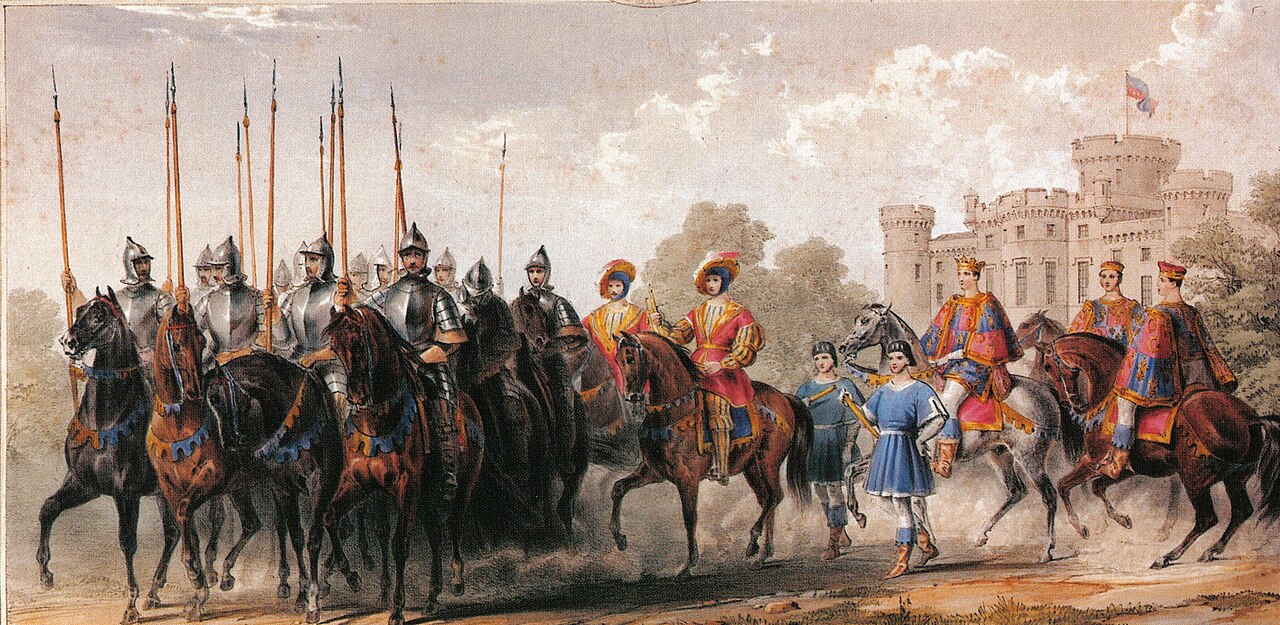
Saturday, August 25, 2012

Merry Ole England Reborn, Part III: The Eglinton Tournament - The First Renaissance Fair


(Previous entries in the series:

The Eglinton Tournament: The First Renaissance Fair


Don't let the picture fool you. That illustration above took place in 1839!

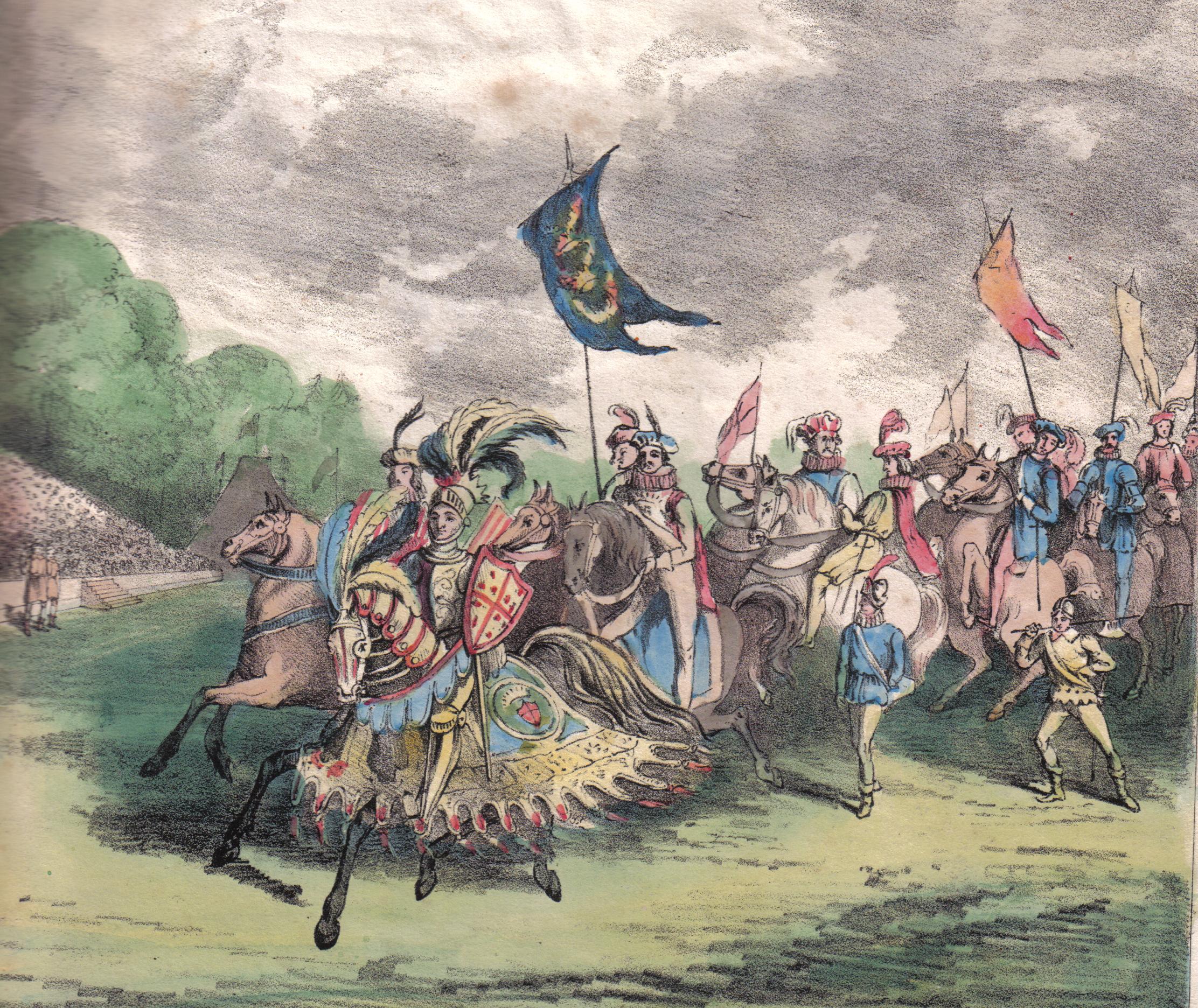
            In our last issue, we explored the triumphant return of the Middle Ages in literature, and particularly in how Britons were reminded of their mythic heritage in the tales of King Arthur. But Arthur was only the first falling snowball in a veritable avalanche of medieval literature that was just becoming available after centuries of neglect. John Mitchell Kemble, a scholar of old Anglo-Saxon and a student of Jacob Grimm (of “the brothers Grimm”), published a modern English translation of Beowulf in 1836, to the great excitement of both the English and the German world. (The Germans were actually decades ahead of the English in the medieval revival, but that’s a subject for another post.) Enthusiasm for Britain’s medieval past reached an all-time high. It inevitably became time for the Victorians to apply all the pomp and chivalry of the Middle Ages as they understood it into action. Thus was born the ill-fated Eglinton Tournament of 1839.

            The year prior, Alexandrina Victoria was crowned Queen of the United Kingdom of Great Britain and Ireland. She inherited a country in the midst of a recession, and memories of George IV’s absurdly decadent coronation banquet were still fresh in Britons’ minds. Could the government justify such lavish spending while so many people were unemployed, or even starving? Victoria did the “appropriate” thing and cut the banquet entirely, as well as many other “obsolete” rituals of state associated with the coronation. One such ritual involved the King’s Champion. Ever since the Norman Conquest in 1066, the King had a duly appointed champion to fight duels in his name (as, by protocol, the King could not fight a duel against anyone but another king). At every coronation banquet, the Champion would ride into the hall in full plate armor, throw down his gauntlet, and issue a challenge to all those present: 

"If any person, of whatever degree soever, high or low, shall deny or gainsay our Sovereign Lord [Name], King of the United Kingdom of Great Britain and Ireland, Defender of the Faith, son and next heir unto our Sovereign Lord the last King deceased, to be the right heir to the imperial Crown of this realm of Great Britain and Ireland, or that he ought not to enjoy the same; here is his Champion, who saith that he lieth, and is a false traitor, being ready in person to combat with him, and in this quarrel will adventure his life against him on what day soever he shall be appointed."—from the words used at the last coronation banquet in 1821

George IV's coronation banquet. It's said that his festivities were so sumptuous that people started eating right in the middle of the sermon at Westminster Abbey.


            But those rites were from more tumultuous times. Britain was a parliamentary government now, was it not? And so, the rituals of old were cast out, and the nobles who were expected to fill these roles were snubbed. One such nobleman was Sir Charles Lamb, who as Knight Marshal of the Royal Household would have led the Champion’s steed into the banquet hall. His stepson, Archibald Montgomorie, Earl of Eglinton (a staunch medievalist), was infuriated that the Crown was skimping on the widely loved ceremonies of state for a “penny crowning”, as Victoria’s coronation came to be known. The disgruntled nobles got together and decided they would fill the void in Britain’s sense of pageantry and chivalry by hosting a spectacle of their own.

            It was decided that these disenfranchised gentlemen would stage a spectacular show of medieval chivalry and honor at Lord Eglinton’s country manor. That fall, 150 prospective knights answered the call of duty and assembled at a medieval arms-dealer’s showroom to discuss the particulars of the tournament. Most soon dropped out when told of the frighteningly high cost of the armor, horses, squires, livery, and so on. But a few dozen remained steadfast in their commitment to making this fantasy of the Middle Ages a reality. Make no mistake: this was no mere staged performance. The knights who were to fight in the tournament spent the whole following year in training for the joust. Although the rehearsals held in London were by invitation only, nobles and commoners alike buzzed with interest, whether it was eager anticipation or scorn.

            Nothing could have prepared Lord Eglinton for the crowds that arrived on the first day of the tournament. The tournament itself was free and open to the public, and they arrived in hordes. A hundred thousand spectators poured in to the tournament grounds, amounting to the longest traffic jam (over thirty miles from Ayr to Glasgow) in all Scottish history up to that point. The nearby town had only one hotel. Local residents charged exorbitant prices for tourists to spend the night in. Others were left sleeping under the grandstands or even inside tree trunks. Most tragically of all, the forces of nature decreed Eglinton’s spectacle would end in disaster. In true Scot style, the first day of the tournament opened with a torrential downpour from the heavens. Women’s fancy dresses were soaked, the roof on the grandstands proved useless, and the field itself turned to mud. The first two knights of the joust, the Hon. Edward Jerningham (the Knight of the Swan) and Captain James Fairlie (the Knight of the Golden Lion), proved all that training was for naught. They charged at one another again and again, but neither could actually land a hit. Fairlie even accidentally dropped his lance, wrapped with his wife’s handkerchief, into the mud. Worse still, they took their time in between tilts to adjust their ill-fitting armor, driving the crowds to boredom and ridicule. The day was only redeemed by the joust of Lord Waterford (the Knight of the Dragon) and Lord Eglinton (the Lord of the Tournament) himself. Both were sportsmen who took their training seriously, and at the third tilt, Eglinton broke his lance squarely against Waterford’s shield.

            Nonetheless, the rain had taken its toll, and despite the presence of many notable nobles such as Prince Louis Napoleon (the future Emperor Napoleon III), the crowds failed to return for the subsequent days of the tourney. Meanwhile, the Whig press heaped column after column of scorn, scandal, and mockery over the excesses of the knights and their farcical attempt to recreate the past. The media’s handling of the Eglinton Tournament was, in many ways, a blow to the medieval revival because it caricatured the movement as nothing more than the play-acting of some out-of-touch Tory aristocrats. If Eglinton failed revive the culture of sport jousting in his own country, though, he inadvertently inspired the birth of a new jousting tradition in America. A Marylander by the name of William Gilmor was in attendance at the Tournament. The next year, he hosted a spectacle of his own in Virginia, kickstarting an entire jousting movement in the antebellum South. These sporting events undoubtedly served as the forerunner of the modern jousts at the Renaissance fairs that so many Americans enjoy today.


The knights process by the Queen's Gallery.
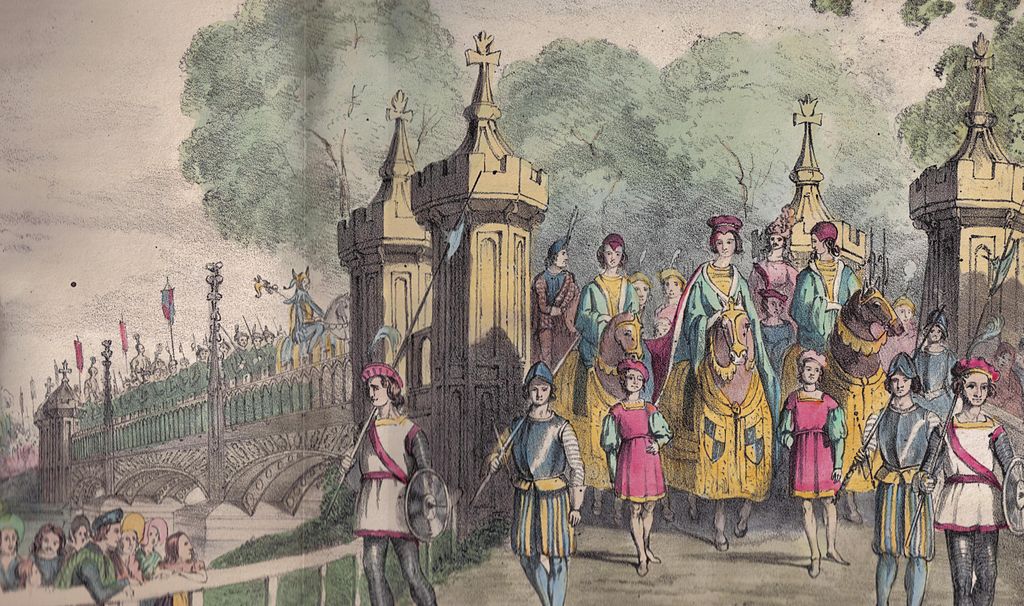
Procession across the Tournament Bridge.

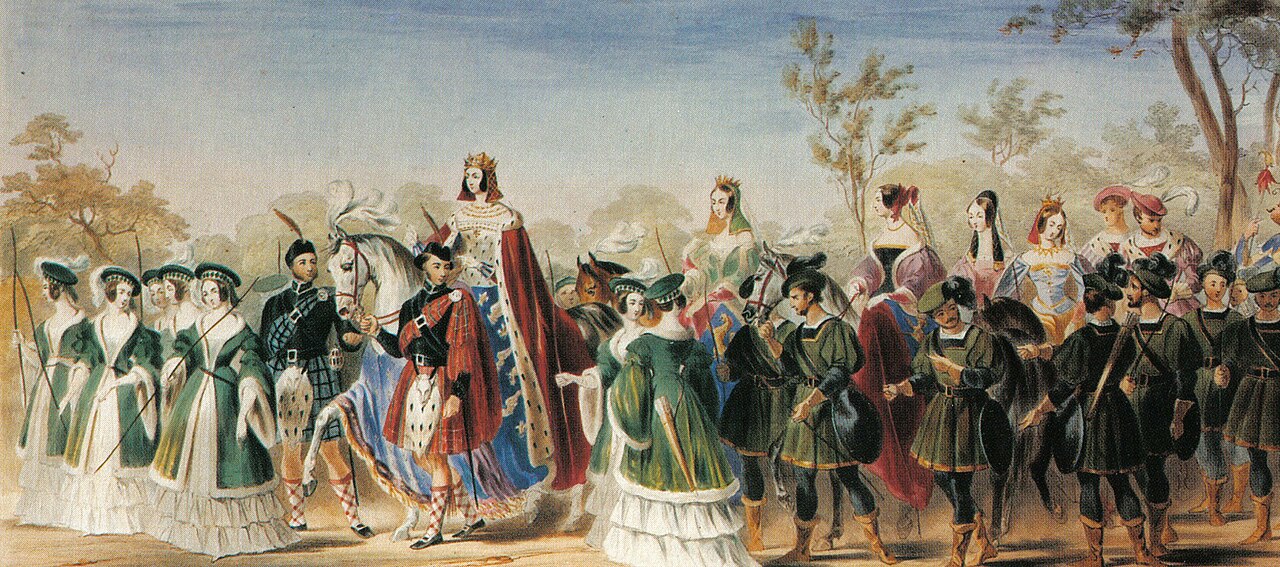
Lady Seymour, a distant descendant of Henry VIII's third wife, was crowned Queen of Love and Beauty.
The melee.
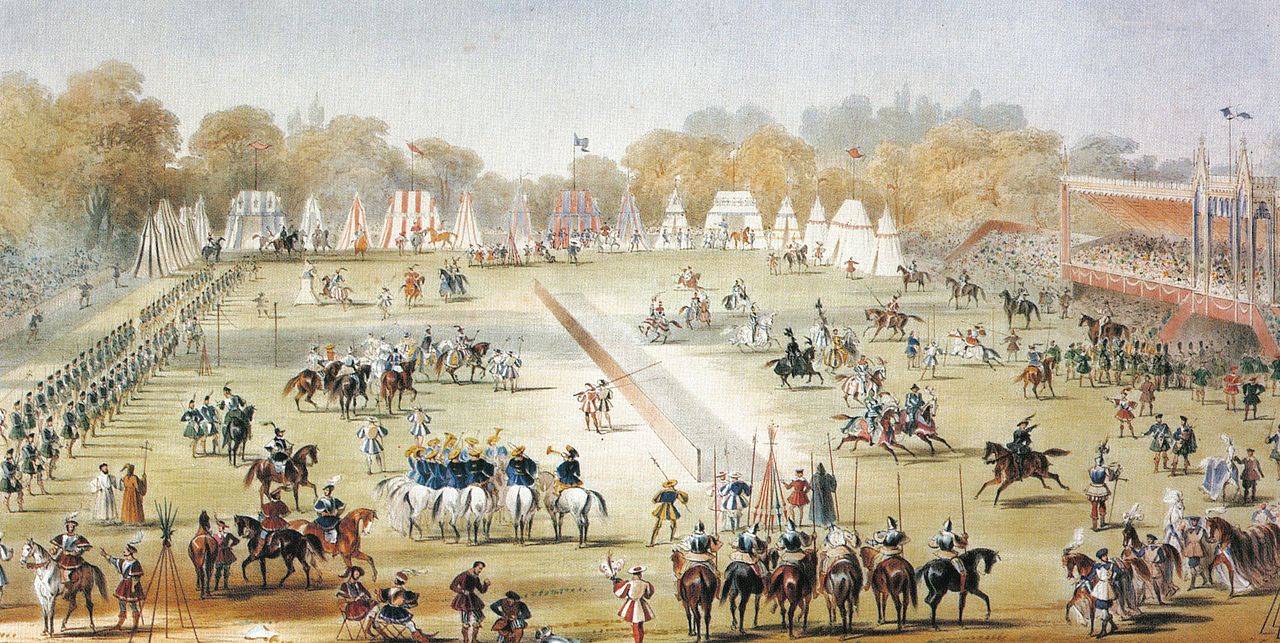
The lists.
The banquet, served with period-accurate food which reportedly disgusted a lot of the guests.
The ball. The men look a bit silly with their non-period, Elvis-like sideburns.
The grand prize trophy, made of real silver. Makes the Lombardi Super Bowl trophy look like a cheap souvenir by comparison!
An earthenware jug at the Victoria & Albert Museum that commemorates the Tournament.

Wednesday, August 1, 2012

The Once and Future Batman


I started this blog to take my love of medievalism and the Middle Ages out of history books and make them relevant to the issues and concerns of our present age. I'll be working on the design over the next few weeks to make it less (or more?) garish.

For my inaugural post, I've taken advantage of the recent release of The Dark Knight Rises to write an entry examining the values and themes of the superhero of my childhood from a medievalist's eye.


The Once and Future Batman
By J.T.M. Griffin

Despite the efforts of a domestic terrorist in Aurora, The Dark Knight Rises lived up to its title and climbed to a spectacular success at the box office. The Batman is on everyone's lips, ensuring his place in American pop culture for generations to come. A few respectable commentators and a legion of hack writers have been swept up in Batmania, publishing their thoughts on the last film's political implications. Is The Dark Knight Rises a tool of the right-wing propaganda machine to quash the Occupy movement? Is Bane a stand-in for Bain Capital and Mitt Romney? Why even bother asking these questions about another dumb superhero flick? 

Those issues have assuredly been talked to death on countless Yahoo! comment boxes and juvenile flame wars by now. I'm more interested in examining what the character of Batman means as a cultural icon. Who is this man whose likeness or logo appears on every other kid's t-shirt or bedsheets, or on billboards and bus stop posters across America? The thought that prevailed in my mind above all others as I left the theater that opening night was this: that Batman is not quite an American icon at all.

Sure, Bruce Wayne is a natural-born American citizen. Gotham City is geographically somewhere in the United States. But the connections end there. The following thoughts will examine Batman as a character and reveal why he is truly the Dark Knight... and why he is not a classically American hero, but a medieval, aristocratic one.


Noblesse oblige

"Indeed you can usually tell when the concepts of democracy and citizenship are weakening. There is an increase in the role of charity and in the worship of volunteerism. These represent the élite citizen's imitation of noblesse oblige; that is, of pretending to be aristocrats or oligarchs, as opposed to being citizens." —John Ralston Saul


Why does Batman don the cape and cowl night after night, risking his life for the people of a city so hopelessly corrupt and ungrateful? "You don't owe these people anymore. You've given them everything," Catwoman tells Batman in the third film. He replies, "Not everything. Not yet." 

As long as Batman draws breath, he owes the people of Gotham his wealth, service, even his life because he is the prince of Gotham and lives by the code of conduct of the ideal aristocrat: noblesse oblige (nobility obliges it). That is to say, that because Bruce Wayne has been blessed with wealth, resources, and privilege beyond ordinary men, he is bound by duty to use them in service of the people of his "domain", just as his father did, and his father's father, and so on. 

The principle of noblesse oblige is the counter-balance to that of divine right, presenting power as a gift, rather than something to be won. The American mindset could not be more different. "My wealth is my own, to be disposed as I please", a classic American entrepreneur would say. He spends a lifetime working, perhaps even in multiple jobs at once, to join the elite one percent of society. Some American self-made millionaires value "work" so much that they even refuse to pay their grandchildren's way through college. What do such folk have in common with a man like Bruce Wayne, born in a mansion, and who as an adult still never answers his own door or makes his own bed? Even other people born to wealth may resent the Waynes' philanthropy and charity. The comics provide such an example in the character of Roman Sionis, a fellow trust-fund baby who, unlike Bruce, led his family's company to ruin. Bruce rescued Sionis by buying out his company, only for Sionis to grow embittered and turn into the mob boss known as Black Mask.

And yet, Batman is no socialist. He does not say, "My wealth is not my own, but the state's." How could the Waynes have developed the public railway system in Gotham, research into cancer treatment or alternative fuel sources, or the many gadgets that make Batman the world's greatest detective without the resources of Wayne Enterprises? If Bruce decided to simply liquidate all his assets and make paper rain in Gotham from helicopters in the sky, most of it would simply find its way into the pockets of the criminal underworld. If he simply wrote a massive check to the IRS, the money would be squandered on weapons contracts, pointless wars, or bloated bureaucracies. No, Batman is none of the above: he is an aristocrat. "My wealth is to be given to the people, but according to how I see fit." It's a method that works effectively (at least in the hands of an ideal aristocrat like Bruce Wayne), and earns the resentment of criminals and honest working Americans alike.


The Prince of Gotham

If Gotham is in such need of dramatic examples to stir the good citizens of Gotham out of apathy, it's reasonable enough to think that Batman would like them all to don pointy-eared masks and patrol the streets, right? Perhaps allow Batman a night off?

As The Dark Knight revealed in the second scene, that route will sooner get you bound and gagged with the rest of Batman's victims than a solemn nod of thanks. Batman's crusade is his burden alone; other masked vigilantes in his city only operate with his consent and according to the same set of standards he's imposed upon himself. It's like a medieval serf picking up a sword and shield to patrol a knight's territory. It's insulting, and the serf is likely to get himself hurt. And when it comes to the business of crimefighting, ordinary Gothamites are indeed serfs in Batman's mind. The police, with a few honorable exceptions like Gordon, are little better. 

Only a natural elite are allowed to rise from the ranks to join in Batman's inner circle as vigilantes. His "squire", Robin, must endure intense training to live up to Batman's strict no-killing code, and even then, Batman often keeps Robin away from the front lines. It's no surprise that the first Robin, Dick Grayson, was stifled by Batman's control and had to strike out on his own as Nightwing, even moving to a different city. Batman essentially rules Gotham as his own fiefdom, where there can only be one man at the head. Certain comic writers have taken Batman’s control of Gotham to extreme lengths. In the miniseries Kingdom Come, set twenty years after the present, the Caped Crusader is no longer fit to patrol the streets. His future self watches over the city with an army of robots in his likeness and a surveillance camera on each corner, all which he controls from his computer console in the Batcave. Excessive? Perhaps, but in Batman's mind, still preferable to allowing outsiders like Superman take his place as the protector of Gotham.

Batman critics are quick to accuse the Caped Crusader of elitism or of being a rich bully. The truth lies in the simple fact that as most of Batman's villains are agents of chaos, Batman is a symbol of order. His entire crusade is to dispel the chaos left in the wake of his parents' murder and ensure no Gothamite will have their loved ones taken away by a madman on the streets. In the traditional medieval mind where characters like Batman fit best, order is best given from monarchy: the rule of one. It sees a city or a country not as a disparate group of voices needing to reach a consensus, but rather as a human body. The people are the heart, which pump life throughout the nation. The police and Batman's vigilante allies are two arms, enforcing justice and order. But there can only be one head, and make no mistake, it's not the mayor. The mayor of Gotham changes every election cycle by the whim of the masses. He's prone to corruption (such as whenever Gotham elects the Penguin or a member of his family, the Cobblepots), mind control (Quincy Sharp in the game Arkham City), or assassination (in countless comic arcs). It's truly the Wayne family that provides a dynastic continuity of leadership in the city by day, and the sigil of the Bat illuminated across the night sky that strikes fear in the heart of criminals. 


Blasters are so uncivilized

 "I thought the movie was terrible, just an awful trainwreck of plot holes and stupidity. Also, Batman's idiotic unwillingness to use a handgun despite him being perfectly happy strapping heavy machine guns onto every vehicle he drives has killed more Gothamites than 9/11 did New Yorkers." --A neoconservative NRA member's review of The Dark Knight Rises

Batman's aversion to guns is one of the distinguishing marks of his character... but what could be a greater blasphemy to the American spirit? We have the minuteman, musket in hand, ready to fight for independence at a moment's notice; the cowboy winning the West with a revolver on each hip; the protagonist on every other movie poster brandishing a semi-automatic at the viewer. Even a director who personally advocates strict gun control is likely to lay down heavy gun violence in his film because it's the American way.

To be sure, the Bat's attitude toward guns has evolved with time. The original Batman strips did have Batman use a firearm on occasion. Soon after, comic censorship forbade heroes from carrying guns so they wouldn't usurp the place of police and stand above the law in the imaginations of 1950's children. The old Comics Code has long since bitten the dust, but Batman's disdain for the firearm has prevailed... and frankly, it makes sense. It's not solely because Bruce's parents were gunned down in Crime Alley. Other comic characters such as the Punisher have lost loved ones to gun violence, only to pick up even bigger guns and exact vengeance. But for a man as rich, powerful, and intelligent as Bruce Wayne, guns are truly beneath him.

In the Middle Ages, a knight's prowess was tested in close combat with lance, mace, and sword. Bows were most often used by commoners, but even those required extensive training to use effectively. It was the invention of the crossbow that drew ire from the knightly caste as an unsportsmanlike, unchivalrous weapon. The crossbow allowed any peasant to point, shoot, and pierce a knight's costly armor, negating decades of training and battlefield experience. The crossbow was so reviled that Pope Innocent II allegedly forbade its use on anyone but infidels. And of course, the introduction of the firearm to Europe signaled the end of the armored knight as the prince of the battlefield. A culture of training and martial discipline gave way to a new strategy: putting guns into as many peasants or mercenaries as you could find and have them point in the same direction.

It was the gun, "the great equalizer", that allowed a vagrant like Joe Chill to murder the most powerful couple in Gotham City, Bruce Wayne's parents, at the twitch of a finger. With such a traumatic moment shaping his life, Batman would rather learn 77 ways to incapacitate an enemy rather than take the commoner's route and draw a gun on them. Perhaps the best example is in the first episode of the series Batman Beyond, where an aged Batman suffers a heart attack while rescuing a kidnapped hostage. With his body failing, he scares off the last thug with a handgun. When the cops arrive, Batman drops the gun in horror and realizes that he's become too old and unworthy of wearing the cape and cowl, then seals the Batcave for decades until a worthy successor rises up to take his place.


The Mark of Zorro

“I have so often been asked the question: ‘But how did you come to think of The Scarlet Pimpernel?’ And my answer has always been: ‘It was God's will that I should.’ And to you moderns, who perhaps do not believe as I do, I will say, ‘In the chain of my life, there were so many links, all of which tended towards bringing me to the fulfillment of my destiny.’” --Baroness Emma Orczy, author of The Scarlet Pimpernel

It would be remiss to not mention Batman's literary inspirations, neither of whom are particularly "American" heroes. The first is, of course, the colonial Californian swashbuckler known as Zorro. By day, he is Don Diego de la Vega, a Spanish nobleman who poses as a poor swordsman and a fop who cares little for the poor. This is a ruse to diffuse suspicion of him being Zorro, a hero who dons a black mask and cape to defend the oppressed from bandits and corrupt politicians. It's no surprise that in many tellings of Batman's origins, Bruce was at the theater watching The Mark of Zorro the night his parents were murdered.

Less direct but no less relevant is the character of the Scarlet Pimpernel, a British aristocrat with limitless wealth who dons disguises to rescue fellow nobles in France from the terror of the French Revolution. His playboy persona and mastery of intrigue have served as the template for Zorro, Batman, and other rich men moonlighting as heroes. The Pimpernel's creator, Baroness Emma Orczy, was an expatriate in Victorian Britain. Her family fled Hungary over fears of a peasant uprising. Those sentiments were clearly reflected in her characterizations of the French Revolution in the Pimpernel novels, as well as her many public statements in support of British imperialism and aristocracy. Whether by intention or not, Batman also frequently grapples with villains who wreak chaos throughout Gotham in the name of empowering the common people… including Bane in The Dark Knight Rises.


The Once and Future Batman

            Although Batman strives for a Gotham in which he’s no longer needed, where the police and rule of democratic law will be sufficient to keep citizens safe, it’s a utopian fantasy that will never come to pass. Like the Arthurian legends, Gotham’s fate is tied directly to the presence and health of Bruce Wayne. When he disappears to train in the Himalayas, is broken by Bane, retires, or even does so much as attempt to take a vacation, the city rots. It’s the ultimate proof of original sin: men are inclined to evil and need to be governed. But in Batman’s world, the American way; cops, lawyers, and due process; is not good enough. They can be corrupted or destroyed. The people of Gotham need a dramatic example and all the pomp that goes with it. They need the ultimate symbol of benevolent order in our modern age. They need an aristocrat, a Dark Knight. They need the Batman.