Showing posts with label sacred music. Show all posts

Saturday, April 14, 2018

The glorious return of the boy choir

(Photo credit: Mitchell Mark)
 In 2014, I visited Mater Dei Parish in the Diocese of Dallas (the FSSP's largest apostolate in the US) for a Sunday Mass on my way to attend a concert by the world-famous Choir of Westminster Abbey, over at Incarnation Episcopal Church. I even took the occasion to write about the importance of men & boys' choirs on my blog afterward. Well, as Providence would have it, my focus returns to Dallas once again. I'm pleased to share with you--nay, shout "alleluia" across the rooftops--that the very same Mater Dei Church recently debuted its own choir of men and boys! This is, as far as I know, the only boys' choir dedicated to the traditional Latin Mass in the entire United States. The FSSP's efforts in Dallas here are an unqualified triumph for traditional liturgy and a beacon of inspiration for the rest of us around the world. 

To celebrate this advancement and share the news with my readers, I casually spoke on the phone with Mater Dei's associate music director and founder of the Men & Boys Choir program, Mr. Chase Fowler. Mr. Fowler (incidentally a longtime reader of this blog) began at Mater Dei in 2016. He has a highly liturgical spirit and knew very well that the perennial tradition of the Church, when it comes to sacred music, as constantly expounded upon by Saint Pius X and other popes and leaders of the liturgical movement, valued the schola cantorum of men and boys singing together as the ideal. While Mater Dei is blessed to have many parishioners--five fully packed Masses back to back on Sunday, as many old-timers remember before Vatican II--they still have all the other obstacles against establishing a boys' choir that most of us do. The parish has no school at all, much less one that could focus specially on a music curriculum. Most parishioners live outside the usual territorial parish boundaries (some as far away as the state of Oklahoma, I hear), so commuting on another day of the week for even just one rehearsal after school hours is a pain. 

And yet, undaunted by any of these challenges, Mr. Fowler pressed on. The fruits of their labor blossomed this Passion Sunday, March 18, when the Men & Boys' Choir, clad in the traditional cassock and surplice of an ecclesiastical choir, sang in liturgy for the first time at the 9am missa cantata. The men naturally handled the minor Propers in their full melodies from the Liber Usualis, while the boys assisted with the Ordinary of the Mass. Not to be treated with kid gloves, the boys still capably handle serious choral works of the Catholic tradition by composers like Palestrina and Victoria: a feat most professional directors might scoff at as impossible for boys not enrolled in a full-time choir school and, therefore, not even worth trying. So far, the boys' choir is still going strong. They'll continue to sing at Mater Dei, in rotation with the other choirs of the parish, until the end of this term (the Fifth Sunday after Easter).

Why all the fuss, though? Why not just rely on capable female singers, like virtually every other church does? Mr. Fowler and I chatted about this, and he outlined a few reasons: 


The spirit of the liturgy: the choir of Levites

Illustration of the old cursus honorum. The first four degrees after tonsure are the minor orders.
First, the all-male choir is most in keeping with the spirit of the liturgy. Basically all Catholic communities dedicated to traditional liturgy in some form or another (whether the traditional Latin Mass, the "Anglican" Ordinariate, or the Eastern rites) accept that altar servers should all be male. Lay altar servers fill roles which were, in times long past, exercised only by men or boys who were tonsured and "ordained" to the minor orders. These minor orders eventually came to be restricted to men in formation for the priesthood, despite the canons of the Council of Trent ordering them to be restored to normal parish use. The canons were ignored, but it was universally understood that lay substitutes should at least potentially be able to be ordained acolytes... therefore, male.

What even most traditional Catholics today have lost is the understanding that singing in an ecclesiastical choir is, in itself, a form of altar service; perhaps better described as the foundation of all other altar service. This is obvious if you observe the daily worship at a traditional seminary or monastery chapel. A few seminarians assist the ministers at the altar as acolytes, but the rest sit in the choir stalls in cassock and surplice (fittingly called "choir dress") and assist primarily by singing the Mass or Divine Hours. The sheer amount of singing done at a traditional seminary is probably mind-numbing to diocesan students, but this is simply how the clergy lived for the first seventeen or so centuries of Christian history. In medieval times, an inability to sing on-key was considered an impediment to priestly ordination. This is why medieval literature usually describes priests not as "saying", but as "singing Mass".


The ideal of the seminary choir is shown beautifully in the FSSP's promotional video above for their Requiem album.

One of the biggest favors any parent can do for a son who might have a vocation to Holy Orders, therefore, is to develop his singing talent at a young age. This is where a boys' choir comes in. By learning liturgical music, especially how to read and sing Gregorian chant, and by becoming intimately familiar with many settings of the Ordinary of the Mass (Kyrie, Gloria, Credo, Sanctus, Agnus Dei), a boy is formed in liturgy just as he would by serving the altar. Indeed, a boy's time is better spent in learning music because the ceremonies of altar service are easier learned as a teenager or adult, while the skills for singing are better formed from youth. But whether the boys sing well or poorly, they nonetheless fulfill a clerical role in liturgy which can't be said for mixed or women's choirs. Pius X felt strongly enough about this that, in his 1903 motu proprio on sacred music, Tra le sollecitudini, he banned women from church choirs entirely (with varying levels of success):
"With the exception of the melodies proper to the celebrant at the altar and to the ministers, which must be always sung in Gregorian Chant, and without accompaniment of the organ, all the rest of the liturgical chant belongs to the choir of levites, and, therefore, singers in the church, even when they are laymen, are really taking the place of the ecclesiastical choir. Hence the music rendered by them must, at least for the greater part, retain the character of choral music."
And:
"On the same principle it follows that singers in church have a real liturgical office, and that therefore women, being incapable of exercising such office, cannot be admitted to form part of the choir. Whenever, then, it is desired to employ the acute voices of sopranos and contraltos, these parts must be taken by boys, according to the most ancient usage of the Church."

Feminization of sacred music and decline into performance art

The Choir of King's College, Cambridge, established by King Henry VI in 1441, is considered by many to be the greatest men/boys choir in the world.
Second, an all-male choir helps counteract the feminization of sacred music. Here, I don't mean to denigrate the countless women who devote so much time and talent towards the betterment of worship (nor do I have any foolhardy plan to abolish women from church choirs overnight). Indeed, it's because of women's tendency to more freely devote their time that church choirs everywhere have more women than men unless they enforce an all-male schola. Traddy parents often, subconsciously, send their boys to serve, and their girls to sing in choir. The end result is that singing becomes perceived to be a feminine activity, or perhaps a consolation for not being able to serve the altar. The greater consequence is that the choir becomes divorced from its traditional understanding as a liturgical office, and then becomes focused more as performance art--pretty background music while the real work is done around the altar.

Some of the strongest evidence for this mentality is from a screed I found in the April 1917 issue of The Musical Quarterly, titled "The Boy Choir Fad", which you can read in full here. N. Lindsay Norden wrote this diatribe as a response to the revival in the later 1800's of boys' choirs, starting in the Anglican churches with the Oxford Movement, then expanding to Rome by the efforts of the Cecilians and others we might call "plainchant fundamentalists". Here are some of the more pungent excerpts:
"The boy choir fad has grown so alarmingly that the choral ideals of the American church will degenerate unless a decisive check is firmly put upon this disastrous evil in church music."

"Who would dare compare any boy choir with some of the splendid mixed choirs in New York City? Only an individual with no musical conceptions upon which to base judgment, or perhaps one imbued with the idea that a 'real' church choir should look in real life as some painters have elected to picture it."

"The principal elements which have made for the development of the boy choir are: sentimentality, a certain amount of ignorance about the 'angelic' qualities of a boy's voice, hollow imitation of the English church, and the unusual belief that it is not proper to have women in the chancel."

"If church music standards in this country are to equal those in the secular field, the boy choir must go. Rational, refined, musical considerations must overcome sentimentality, and uncultured, unworthy motives, which make for lower standards and insufficient results."
And perhaps worst of all:
"Church music in this country is mainly a mechanical echo of the ideals of the English church, which some of us consider the stupidest and dullest the world has ever known."

For the Modern Medievalist, at least, all these protests simply betray a mind more geared to sacred music as performance art rather than an act of liturgical worship. In any case, I would say Mater Dei's success over one hundred years after the publication of Norden's screed, long after the "fad" of boys' choirs collapsed everywhere outside of the most famous English cathedral and collegiate institutions, shows that with faith, the impossible can be made possible.


The chancel: uniting altar and choir

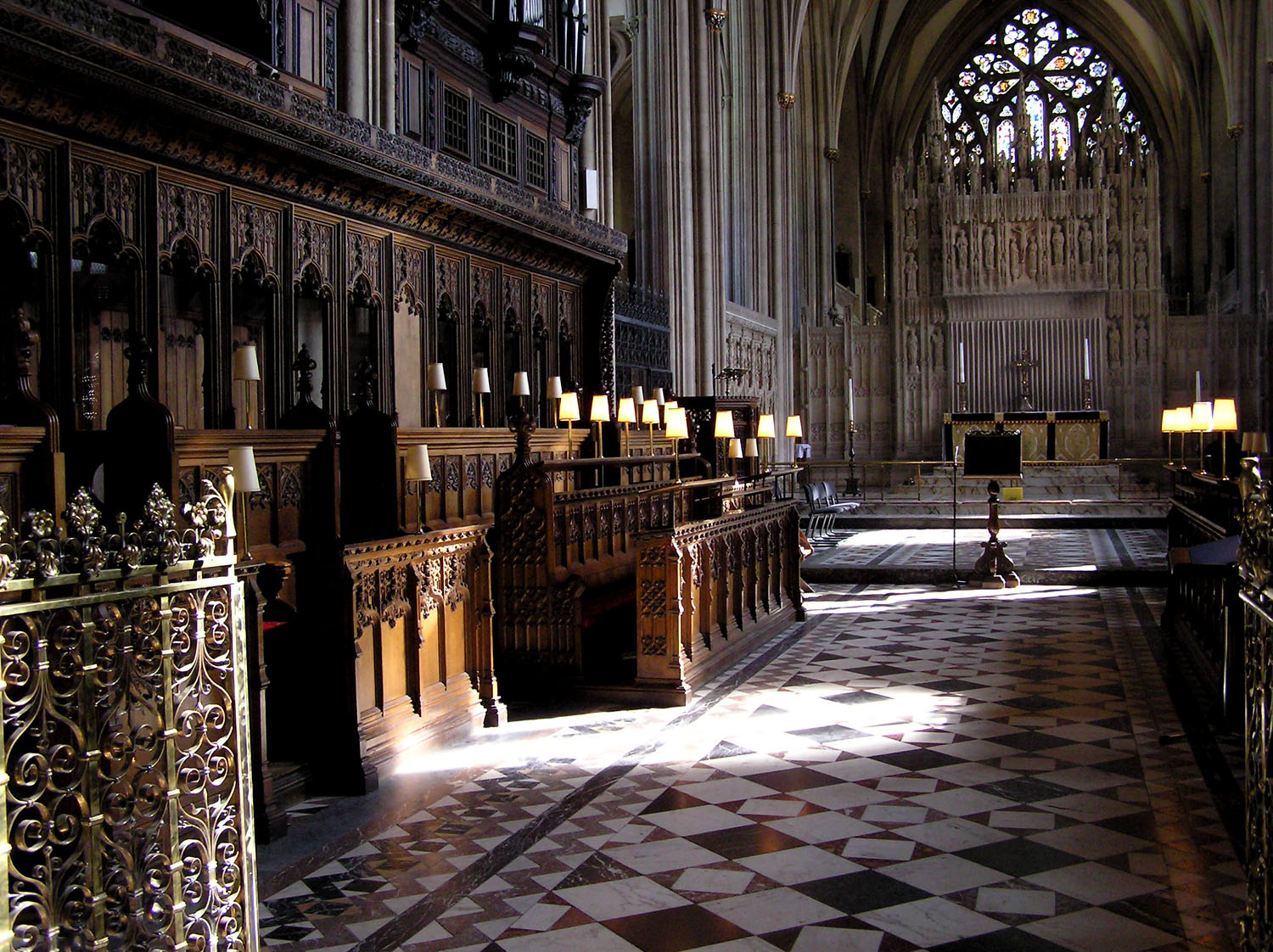
The chancel of Bristol Cathedral, with choir stalls
Mater Dei doesn't have a chancel and so this isn't an option for them, but this aspect of the choral tradition deserves some commenting on as well. A much more edifying article was posted in response to the above piece, in The Musical Quarterly's July issue of the same year, titled "Why We Have Male Choirs in Churches". This piece, which explains how all-male choirs were inherited even from the ancient Temple of Solomon under the Old Covenant, can be read here. It goes on through medieval history up to the Anglican movement to restore proper chancels with choir stalls, now seen in so many Anglican churches built from the mid-1800's and after. Ironic that so many Catholics perceive the choir loft in the back of the church as the more traditional style when it was really a later innovation to accommodate the introduction of women singers. The article has a fascinating quotation from the Bishop of Covington (presumably Ferdinand Brossart):
"We have succeeded in the past in removing the choir as far as possible from the altar, and have been spending money in the wrong way. Therefore we need not be surprised that we have succeeded in banishing also the music of the altar, the music of the Holy Service, from the church, and have substituted in its stead something more in keeping with exterior worldliness and profanity, and, with all, we have driven in a measure from the hearts of our men and boys that love for things most sacred, which the closer communication between altar and choir fostered so extensively in the Ages of Faith. Let us learn to spend more and more wisely, and restore the chancel choirs to the churches, and bring our men, old and young, back into the Sanctuary of God, that they may take a more active part in our magnificent Liturgical Service. Let us return to the old Catholic way of building our churches with a long chancel, and, if possible, an organ chamber, and vestries not only for the priests but also for the choristers. Let us bring altar and choir nearer each other."

A powerful call to action, to be sure! When I bring my chant schola out to some church for Mass, there are many times when we have to sing in the choir loft as a practical necessity because of the architecture of the place. However, whenever possible, I try to situate us within or near the sanctuary to emphasize our role as a true liturgical choir. 

It's also worth revisiting one of my favorite quotations from Augustus Welby Pugin, in his Earnest Appeal for the Revival of the Ancient Plainsong, which I transcribed for my blog long ago (see here). In addition to his many skills as architect and designer, the father of the Gothic Revival also sensed the importance of recovering the Church's traditional Gregorian chant. He had this to say about the state of choir lofts in his day:

"Formerly such persons as now constitute the choir were unknown. The service was sung in Parochial Churches, between the clerks and devout laymen (ministri), who assisted them in the chancel, and the people in the body of the church, who responded in unison. This grand and overpowering effect of the people answering the priest is yet to be heard in parts of Germany. At Minden the Habemus ad Dominum rose from more than two thousand voices of faithful worshippers. What a difference from the vicarious reply of three or four professionals, thrusting their heads from out of their curtained gallery in the intervals of their private conversation, and whose hearts, instead of being raised up, were probably groveling in the contemplation of a pull at a wine bottle between the acts of the performance, for it must be distinctly understood that all persons who sing in galleries are performers by position. Nutshells, orange peel, and biscuit bags, abound in organ lofts and singing galleries, and those who are acquainted with the practical working of these places must be aware, that they are a constant source of scandal and irreverence.  

Now, when we contrast the Catholic arrangement in a chancel to their miserable expedient of a gallery, we shall at once perceive the infinite wisdom and beauty of the former. All are habited in vestments, whose colour reminds them of the purity of heart and intention, with which they should celebrate the praises of Almighty God. They stand within the sacred enclosure set apart for sacrifice; the very place tends to preserve a recollection of the Divine presence, and to keep the singers in a devout posture. The distinct and graduated Chaunt offers no impediment to the perfect union of the heart and mind with the words as they are sung; and in lieu of a more empty and vain display of vocal eccentricities, we have a solemn, heartfelt, and, we may trust, an acceptable service to the honour of Almighty God."

The next step: the parochial school

The Atonement Academy, San Antonio
Mater Dei has shown us that it's possible to establish a boys' choir even without the benefit of a school. Still, for the perfection of the art, a school is the logical next step. In my chat with Mr. Fowler, he said one of his inspirations was the parochial school attached to my hometown parish, Our Lady of the Atonement in San Antonio, where I was received into the Church. The Atonement Academy is a full K-12 school (for both boys and girls) in the Ordinariate of the Chair of Saint Peter which, in addition to its overall mission in providing an orthodox Catholic education in the classical liberal arts tradition, requires every student, in every grade, to be in a choir. For this, Atonement has the outstanding honor to have one of the only Catholic parish churches in the whole world to have a daily choral Mass during the school year. 

The Atonement Academy represents a rare example of the fulfillment of an ideal espoused long before, during the original Liturgical Movement of the early 20th century. I recently picked up a book from 1963: really, a collection of essays titled Liturgy for the People. Most of the authors are Jesuit priests of a heavily progressive stripe, typical for the era. But one essay stands far above the rest: it's titled "The Schola Cantorum and the Parish School", by Theodore N. Marier. Marier was one of the leading advocates of Gregorian chant in the American Church, and was the second president of the Church Music Association of America. Shortly after writing this essay, he went on to found the St. Paul's Choir School in Cambridge, Massachusetts: the only Catholic boys' choir school in the United States. It still exists today (see website here) and is working hard to reclaim its identity as a liturgical choir, even singing Vespers every Thursday.

But what about the essay? In it, Marier says that the difficulties in fully participating in the liturgy are not Latin or Gregorian chant, but a lack of education. It's important to observe that Marier wrote this essay at the height of the Catholic parochial school's glory days in the US. Indeed, Marier himself seems to know it at the time of his writing: "our vast and complex network of parochial schools serving the cause of Catholic education from the kindergarten through graduate schools is vigorously operative in these times."

And yet, he laments that almost nowhere is any of this energy being directed toward the cause of sacred music. Where they are thought of at all, the choirs are "lunchtime choirs", with rehearsals made only during recess while other kids are at play. Drawing on the many statements from the popes of that era on the need for a schola cantorum to be established in every parish, Marier outlines a plan in his essay for every parish school:

First, of course, is the hiring of a full-time music director. The director would be responsible for developing a special curriculum for choir boys within the larger school, with the assistance of two other teachers, from fifth to eighth grade.

Second, one of the parish priests would be assigned to the schola's spiritual direction. He would teach the boys Latin, the liturgy, and how to serve Mass (all choirboys would also be expected to serve the altar).

Third, as the schola develops, it would take on more and more liturgical duties, enhancing the overall life of the parish. The schola would become the principal choir for Sunday high Mass and major feasts, and hopefully take up one or more of the Divine Hours (such as Vespers or Compline). Teams of boys in rotation would handle the cycle of Requiems, weddings, and other votive Masses as they come.

Marier ends this essay with an imperative, which is as relevant for 2018 as it was for 1963. I'll use it to end this column as well. Marier writes:
"The training of leaders must begin early in their formative years and continue over a long period of time. The Palestrina, Josquin Des Pres, Guido D'Arezzo or even St. Gregory of tomorrow is perhaps today in a parochial school third grade, waiting to be led, encouraged, and motivated by the Church to a life of fruitful creativity in her service. If the opportunity of training him is not seized now, the Church will sit by and watch him spill out his musical talents in the service of the theater or a television network, instead of in the fully dedicated service of her liturgical music."

My personal favorite men/boys choir is that of Westminster Cathedral (the chief church of the Catholic Church in England, often confused with the also-excellent Westminster Abbey Choir)

Saturday, February 20, 2016

The importance of singing the Mass


I just watched the whole funeral broadcast for Justice Scalia and have to say, that was the most reverent Mass of burial anyone could reasonably expect out of the National Shrine, given the circumstances. I could nag about certain details like the use of white instead of black vestments, or the (entirely-expected) lack of the Dies Irae, but let's face it: we will probably never again witness such a high-profile Mass with the Vice President and so many other notable persons in attendance where the Introit Requiem Aeternam is sung and the priest uses the Roman Canon, much less preaches a homily so explicitly Catholic and mindful of the four last things as what just happened this morning in Washington. Has Biden ever sat through a funeral oration where the priest began:
"We are gathered here because of one man. A man known personally to many of us. Known only by reputation to even more. A man loved by many. Scorned by others. A man known for great controversy. And for great compassion.

That man, of course, is Jesus of Nazareth." 
Talk about a bait-and-switch to remember!

Here, though, I'd like to focus on a smaller detail that no other blog is likely to mention: the fact that Father Paul Scalia went so far as to sing the collects, the Preface, and a great deal of the other parts of Mass. One of the potential geniuses of the pre-conciliar rite was how it required a priest to sing the entire liturgy if there was to be any sung or solemn Mass at all. Of course, in the last couple of centuries or more, security turned to folly, and clerical laziness meant that low Mass would be the most well-trod path. With the 1970 Missal abolishing the hard distinctions between low, sung, and solemn Mass, the vast majority of priests naturally opt not to sing any of the Mass at all (except, oddly, the "by him, and with him, and in him" at the end of the Eucharistic Prayer; a phenomenon which I hope someone will explain to me some day).

Why does it matter, you might ask? Quite simply, because it takes the man's personality out of the liturgy and gives him the voice of the saints throughout the ages. Wolfgang Amadeus Mozart, of all men, has said he would have traded all of the music he ever composed in exchange for having the credit for composing the Gregorian Preface. But when a priest or other reader in the liturgy merely recites a text, he inevitably gives it his own voice; he impresses the liturgy with his own personality. As glad as I was to see Justice Clarence Thomas read the Epistle, and as dignified as his voice is, it's still distinctly Clarence Thomas reading the word of the Lord. When a lector or subdeacon chants the text in the traditional tone, it's much harder to think of its words emanating from another mere mortal's mouth. Above all, when a deacon sings the Gospel in the midst of the assembly, I think not of the man reading it, but of the words as though they were coming from Christ Himself.


The deacon singing the Gospel at our nuptial Mass


Tuesday, October 2, 2012

Pugin: An Earnest Appeal for the Revival of the Ancient Plain Song, now online

[Update Oct. 6: I just wrote a commentary on the Earnest Appeal which may can read here. That being said, I still want this tract to stand on its own merits, apart from my pontifications.]

[Update Oct. 10: You can now download an easy-to-read .pdf version of the Earnest Appeal here. The format is very nearly similar to the original pamphlet.]

Friends, I'm quite pleased to announce that after an edifying visit to Fisher-More College in Fort Worth, I made a quick stop at the Bowld Music Library of the Southwestern Baptist Theological Seminary. The reason: their library, with its vast collection of books and other resources on religious music, happens to have one of the few surviving copies of Augustus Welby Pugin's Earnest Appeal for the Revival of the Ancient Plain Song in the entire country. With only half an hour until closing time, I got permission to go into their treasures room and photograph every page of Pugin's pamphlet. The pamphlet fell apart in my hands due to its age, but I've carefully transcribed every word as it appears in Pugin's tract onto my computer, and posted it below. I've scoured the Internet in vain for digitized versions of this work anywhere, and could find nothing more than short excerpts from this or that Victorian digest. Therefore, I can safely declare that I've published Pugin's Earnest Appeal on the world wide web for the first time ever.

A quick introduction: Augustus Welby Pugin was the most prominent Gothic revival architect and designer of Victorian Britain. Though his name is obscure, he is responsible for the design of Britain's most iconic building, the Clock Tower of Big Ben, as well as the interior of the Houses of Parliament. Pugin spent most of his brief forty years on earth, however, designing churches, cathedrals, and convents for the fledgling Catholic communities of 19th century England. He revolutionized the field of architecture by insisting on a moral dimension. To Pugin, one style of architecture (namely the Gothic, which he always called "Christian architecture") could be more moral than another. A building had to be true to its appearance: to use cheap bricks in the back while gilding the front would incur God's displeasure. Generations of architects after Pugin would look to his books, such as The True Principles of Christian Architecture, as something more like gospel than a mere manual of design.

Pugin never limited himself to the art of raising buildings. He insisted that the ethos behind the True Principles could be applied to everything, sacred or secular. In 1850, the year before he died, Pugin composed a pamphlet in defense of Gregorian chant and congregational singing. The patrimony of Christendom's medieval sacred music held a most revered place in his heart, as in his eyes, the hall of a church built according to the spirit of the medieval Christians could not possibly echo with anything but the plainchant for which the Gothic cathedrals of old were designed.

The edition I transcribed is a 1905 reprint by Benziger Press. It should become quickly apparent that Pugin was a man of passion. He had to contend with abuses in the Church that still persist today, which he confronted with "radical" remedies. Some of his positions may be considered extreme even for Catholics of a traditional persuasion: for example, his total assault on the practice of choir or organ lofts in place of the traditional chancel with choir stalls in the sanctuary. He even seems to challenge metered polyphony itself, though I believe if Mr. Pugin were alive today for me to question him further on the subject, he would direct his rage more to the compositions of the Baroque and later periods, rather than the earlier polyphony of, say, Palestrina, Tallis, or Josquin.

And now, I present to you all the first edition of Mr. Pugin's Earnest Appeal ever on the Internet. My only additions are of a few pictures to break the monotony of text. Otherwise, the formatting is all as it appears on the original pages, save for (obviously) page breaks. Enjoy!


An Earnest Appeal for the Revival of the Ancient Plain Song
by A. Welby Pugin


Prefatory Note

Through the kindness of Mrs. Pugin, the devoted widow of the great and gifted architect, it is permitted to reprint this paper, which first saw the light in 1850, and which is not without interest at the present moment. The medieval revival was not confined, in Pugin’s scheme, to architecture; it was to affect all the arts that had an ecclesiastical function, and notably Church Music.

            The pamphlet may be left to speak for itself. Those who know Pugin’s style of writing will not need to be told that he never watered down his statements. Had he lived in these days, he would undoubtedly have been among the most fervent advocates of the restored Plainsong. By reprinting this “Appeal” I hope to make his influence once more active in favour of the Ritual Music of Holy Church.

            The tender aspiration with which Pugin closes this paper seems to blend in striking harmony with the “Motu proprio” on Church Music of His Holiness Pope Pius X across the space of half a century.
                                                                                    Becket.
            July 7, 1905


An Earnest Appeal
For the Revival of Ancient Plain Song

            When chancel screens were first attacked, about three years since, I at once denounced the writer of the article as one who was opposed to the very principles of Christian Architecture, and, I then stated my firm belief, that the objection to screens was merely raised as a test of public opinion, and in order to ascertain how far the party, (of which the writer was an organ) might proceed in their opposition to the whole system on which the revival of true Ecclesiastical Architecture was based.

A chancel screen at Pugin's church of Saint Giles, Cheadle

            But, although I foresaw the evil tendency of their opinions, yet, I must confess, I was not prepared for the extent to which they have been carried in so short a period. At first the screens alone were objectionable, the architecture itself was praised as beautiful and appropriate, but now we are told that it is utterly unsuited to Catholic worship; that our finest Cathedrals, those most noble evidences of the piety of our forefathers, are only fit for demolition, and that, in fine, the buildings we should erect for divine worship should be as similar as possible to dissenting conventicles in their arrangement, only rather more offensive than their meager prototypes, by the meretricious decoration of their interiors. Now, monstrous as these suggestions must appear to Catholic-minded men, they become light when compared to the changes that are proposed in the divine service itself, and which have been lately put forth in a publication which is the recognised organ of the party from whom this miserable system of modern degeneracy emanates. It is, indeed, seriously proposed to change the whole nature of the divine services of the Catholic Church, under the specious pretext of rendering them more popular and adapting them to the spirit of the age: and what is scarcely credible this change is advocated not merely for the services of a peculiar order or body, but for the Parochial Churches of the whole country. (See the Rambler of 1850)

            Now, however we may deplore the wretched taste and principle which regulates the services of some religious bodies, yet as long as they are confined within the walls of their own institutions, and are not censured by the ecclesiastical authorities, we may view them in silent sorrow. No Catholic is compelled to assist at their maimed rites or to enter their conventicle-looking chapels, if any among the faithful are so debased as to prefer the trumpery display of a toy-shop and the vocal entertainment of a concert-room to a more solemn service, why we only pity and pray for them. But when we find that an attempt is made to thrust this parody of a Catholic service into the Parochial Churches of this country, where we are all bound to worship, it is time that every man who has a heart in the Catholic cause should testify his unbounded horror of so unhallowed an attempt to change the ancient offices. What! shall the song of Simeon, the hymn of Saint Ambrose, the canticle of our Blessed Lady herself, give place to the doggerel rhymes and poetical effusions of a few individuals whose tendencies and principles should have led them down to Geneva, but who appear to have mistaken their road and found their way into the Catholic Church, only to create divisions among the faithful, and to use the ancient liturgy as a mere vehicle for the display of their Methodism. I do not hesitate to say, that the Book of Common Prayer, bare as it is in comparison with the ancient office from which it is taken, is yet a far more Catholic service, and more in accordance with the ancient traditions than what is now proposed as the beau ideal of a popular service. On the same principle of lowering the divine service to the debased spirit of the age, some moral essays and family tales, embodying amusing anecdotes, should be substituted in lieu of the old lessons taken from Holy Writ, which are certainly quite out of date, and far more suited to the ambons of the Basilicas, and the rood lofts of the pointed churches, than for the assembly rooms for 19th century Christians. England can never be Catholicised by the destruction of her cathedrals, the conversion of the liturgy into a song-book, and the erection of churches, whose appearance is something between a dancing-room and a mechanic’s institute, and I do greatly mistake the souls of Englishmen, if this miserable system is ever permitted to take root in this land; for, although some weak persons may be led away by novelties, yet there is a general feeling of solid devotion, and a growing appreciation of the glories of Catholic antiquity that will effectually preserve us from the encroachment of modern innovations. And, although there is every reasonable hope, that in due time this country will again receive Catholic truth in all its fulness, yet such a result can only be accomplished by our rising to the high standard of ancient excellence and solemnity, and not by lowering the externals of religion to the worldly spirit of this degenerate age.


            But as good frequently grows out of evil, it is most earnestly to be hoped, that this monstrous proposal of substituting vernacular compositions for the Church Offices, will be the means of awakening the ecclesiastical authorities to the absolute necessity of restoring the ancient Chaunt in all its purity, and I most gladly embrace this occasion for urging this all important subject.

            The very fact of such a proposal being made is an evidence that there is something very rotten in our present system; for, although the remedy suggested is far worse than the disease, yet that a disease does exist, and to a very great extent, no man who reflects on the subject can deny. There does exist a want of reality in the present services of the Churches, as they are performed in this and many other countries, and from what does it proceed, but the corrupt and artificial state of ecclesiastical music. Owing to the complicated nature of modern figured compositions, both the clergy and the people have been precluded from taking any real part in the service of Almighty God. They are reduced to the position of listeners instead of worshippers; so that, in lieu of the grand and edifying spectacle of priests and people uniting in one great act of adoration and praise, the service is transformed to a set of hired musicians, frequently heretics and infidels who perform in a gallery, while the congregation are either amused or wearied, and the clergy who are present generally take advantage of those interminable fugues to say their own office, which has no reference whatever to the great act of sacrifice at which they are ostensibly assisting. Thus the unity of this, the most majestic, the most solemn act of Christian worship, is destroyed, and in many places, it has degenerated into a mere musical entertainment for the audience, and at which they assist with no more devotion, than in a common theatre. Let no one think this picture is overdrawn. In one of the most Catholic cities of Flanders, Sunday after Sunday, an orchestra is set up in the nave, round which a full band arranges itself, and during the whole Mass—Kyrie, epistle, gospel, creed, offertory, and horrible to relate, even the consecration and elevation—do these men blow forth profane airs, taken from popular operas, while the Church is filled with irreverent listeners of their symphonies, and no man reverencing the Lord’s Body. Now, this is not a solitary example by any means. Scarcely is there a great Church in Europe which is not profaned by these miserable parodies of Divine Service; and what is most distressing, the greater the feast, the greater the abomination. I have been assured by a dignitary of the French Church, who abode at some time with the Franciscans of Assisi, that their daily offices were most solemnly sung; but the feast of St. Francis arriving, the Church was inundated with fiddlers from all parts of the neighbouring country, and this most glorious church converted into a perfect salle d’opĂ©ra. But I build not only on the testimony of others, I have been frequently grieved to the heart at what I have been compelled to hear and witness. No later than the Sunday in the octave of the last Corpus Domini, I was present at the High Mass in Antwerp Cathedral, whose choir and stalls were filled with lay spectators, two cantors standing among the crowd, who appeared to be only there for the purpose of displaying their copes, while the service was shouted and fiddled from a gallery at the end of the nave, an unintelligible mass of confused and irreverent sounds.

Antwerp Cathedral from the nave
            Were it not tedious, I could multiply examples without number of this miserable system which has completely cut off the people from taking part in the most solemn act of Christian worship, and degraded it in appearance to the level of pageant. It is impossible for men to sing this modern music, and worship at the same time, they are there as performers, and to these hirelings are the praises of Almighty God transferred, while the clergy and people look on in dumb show.

            Formerly such persons as now constitute the choir were unknown. The service was sung in Parochial Churches, between the clerks and devout laymen (ministri), who assisted them in the chancel, and the people in the body of the church, who responded in unison. This grand and overpowering effect of the people answering the priest is yet to be heard in parts of Germany. At Minden the Habemus ad Dominum rose from more than two thousand voices of faithful worshippers. What a difference from the vicarious reply of three or four professionals, thrusting their heads from out of their curtained gallery in the intervals of their private conversation, and whose hearts, instead of being raised up, were probably groveling in the contemplation of a pull at a wine bottle between the acts of the performance, for it must be distinctly understood that all persons who sing in galleries are performers by position. Nutshells, orange peel, and biscuit bags, abound in organ lofts and singing galleries, and those who are acquainted with the practical working of these places must be aware, that they are a constant source of scandal and irreverence.

The choir stalls in the chancel of Bristol Cathedral
            Now, when we contrast the Catholic arrangement in a chancel to their miserable expedient of a gallery, we shall at once perceive the infinite wisdom and beauty of the former. All are habited in vestments, whose colour reminds them of the purity of heart and intention, with which they should celebrate the praises of Almighty God. They stand within the sacred enclosure set apart for sacrifice; the very place tends to preserve a recollection of the Divine presence, and to keep the singers in a devout posture. The distinct and graduated Chaunt offers no impediment to the perfect union of the heart and mind with the words as they are sung; and in lieu of a more empty and vain display of vocal eccentricities, we have a solemn, heartfelt, and, we may trust, an acceptable service to the honour of Almighty God.

            Now, it cannot be too earnestly impressed on the minds of all, that these arrangements for the Church service were universal throughout Christendom. It is no new scheme or system, proposed for trial; it is simply carrying out the practices of the Church for certainly more than fourteen centuries. Not only were the cathedral and collegiate churches provided with stalls and seats, and ample space for the ceremonies of the choir, but every parish church, and even chapel, had its due proportion of chancel, where the divine praises were always sung; and from the Basilica of St. Clement’s, down to the humblest church of the 17th century, we shall find the same traditional arrangement. Singing galleries are modern abominations, and no good will ever be effected in Church music, until they are utterly destroyed, and the service sung in its legitimate and ancient position—the choir or chancel. While these galleries are suffered to remain, the erection of pointed churches is a mere sham. In vain the long succession of clustered pillars; in vain the carved screen and gilded rood; the soul of the whole thing is wanting; it is the system of a modern chapel worked in the shell of an old church. Who, then, will be asked, are those who sit robed in surplices in the stalled seats? Only privileged persons, perhaps subscribers, who go in for a show, like supernumeraries on the stage; lay figures as the “Ecclesiologist,” most wittily termed them, and but dumb dogs into the bargain.

            A greater sham than this cannot be seen. And was it for this that the long chancel was stalled and screened? That the cunning work was carved and the gold laid on—merely for the accommodation of some good easy men, who take no part in the solemnity, nor contribute one note to the divine praise! Surely not; it is the greatest possible perversion of a chancel; a scandal, and a shame. What could be more painful than to read the account of the new church recently consecrated at Sheffield, where the architect had really produced an edifice quite in the old spirit; and instead of the solemn Chaunt of the dedication rising from its chancel we are sickened by a long eulogy on the quaverings of female singers. St. John’s, Salford, is even a more melancholy example; a great cruciform church, with an ample choir, and yet fitted up as if for the followers of John Knox; a most disheartening spectacle.

The carved stalls of Albi Cathedral
            While this wretched system of gallery singing, with Mozart’s and Haydn’s music, was carried on in the room-like chapels of the last century, it was in character with the edifices; but when the English Catholic body was awakened, or appeared to be awakened, to a sense of better things, and churches arose whose form and arrangement told somewhat of more ancient and better times, then, indeed, we might have hoped and expected, that with the shell they would have revived the soul; that they would have cast off for ever the worldly efforts of modern men, who merely make use of the sacred liturgy as a vehicle, for a display of their professional skill; and have returned to that simple and divine song, which was created, like the architecture, by the influence of the Christian faith, and which assimilates and harmonises with its lofty vaults and lengthened aisles; without this the service and the fabric will be at utter variance, a most humiliating spectacle of ancient grandeur and modern degeneracy.

            Whenever an attempt has been made by the members of the separated English communion to restore some of the external ornaments of religion which were lost by the apostasy of their Catholic forefathers in the 16th century, they have been usually met by insult and ridicule from a great portion of what is called the Catholic press; but I must say that the dedication of a modern Catholic church, as we have seen it occasionally announced, accompanied by a full band of music, and where bishops and dignitaries are exposed to the degradation of sitting in dumb show to listen to the interminable squalling of a few female professionals and whiskered vocalists from the front of a gallery, is a far more ridiculous and inconsistent exhibition. Indeed, with some few exceptions, the churches that have been raised after the old models are become so many evidences of our degradation and our shame. The altar and the arch may belong to the ages of faith, but the singing drags us down to the concert-room of the 19th century, and is a sad and striking proof of the little sympathy which exists between the architecture and the men.

A choir loft typical of many Catholic churches today
            I have long mourned most bitterly in secret on this state of things, but when a scheme is actually put forth to abolish the very words of the ancient offices and to reduce the services of Almighty God to the level of the conventicle, I can remain no longer silent. It is evident that the extreme hollowness of the present system is attracting attention; but alas! instead of advocating the only remedy, a return to the real music of the Church in all its purity, we are assailed by a scheme for its utter abolition. Monstrous suggestion! but by its very enormity, as I have before said, I trust in God that it will awaken our ecclesiastical rulers to a sense of the absolute necessity of casting aside all novelties and private conceits and returning to that music which has the sanction of ages and the full authority of the existing Church. What can be more perfect, what more edifying and consoling than that Divine Office, the compilation of so many saints and glorious men, and which is so wonderful in the perfection of its system and composition, that the more it is studied, the more it gains on our reverence and love! What appropriate fitness in all the antiphons—what noble simplicity in the hymns! while the Chaunt of the Psalter has an almost sacramental power in calming a troubled spirit and leading the soul to God; these were the divine Chaunts that penetrated the heart of St. Augustine, and though many centuries have elapsed, they have not lost one fraction of their influence. It is a monstrous error to suppose that the people cannot be brought to enter fully into the spirit of the Divine Office. In France, there is hardly a country parish where the people do not join in the Vesper Chaunt and the offices with heartfelt devotion. The mass of persons are opposed to the plain song from pure ignorance; they do not understand it; all their ideas are, perhaps, formed from some miserably corrupt version they have heard drawled out by a cantor, who scarcely knew a note of music, and they never trouble themselves to examine and study the wonderful beauty of these heavenly compositions, which, independent of their own intrinsic merit, have all the weight and authority of the Church to recommend them.

            To what extreme inconsistency and absurdity does not the substituting of any other music lead in the celebration of the Divine Office! It is well known that the Kyrie is ordered to be sung nine times in honour of the Holy Trinity; modern composers utterly disregard the mystical symbolism of the number, and multiply the supplications to an indefinite repetition merely to suit their notes. Again, the priest intones the Gloria after the old traditions, while the choir takes it up in a totally different manner. The Credo, so far from being a distinct profession of faith as ordered, is a mass of unintelligible sound; and at the Sanctus, where the priest invites the people to join with the angels and archangels, in one voice (cum una voce), in singing the Trisagion, a perfect babel of voices usually break forth, and the Ter Sanctus is utterly lost in a confusion of Hosannas, Benedictuses, and broken sentences all going together in glorious confusion, which scarcely ceases in time to enable the distracted worshipper a moment’s repose to adore at the Elevation. After a short pause the din recommences, and this generally lasts till a thundering Agnus Dei begins. Whether it is a spirit of pure contradiction that modern composers have usually imparted to this supplication for peace the character of a great row it is impossible to say, but such is decidedly the case. Some of these compositions would be admirably adapted for a chorus of drunken revelers shouting for wine outside a tavern, and if the words—“Wine, give us more wine,” were substituted for “Dona nobis, nobis pacem,” we should have a demand in perfect accordance with the sound with which it is accompanied. In lieu of this, were the simple Chaunt, as ordered by the authoritative books, the Antiphonals and Graduals of the Roman Church, restored, the people would soon be able to take part in responding to the clerks in the chancel. The Kyrie would be alternate, the Gloria a real hymn of praise, and the Credo would be again a real profession of the Christian faith, not a piece of complicated music, while the “O Salutaris” would rise from the lips of hundreds, and ascend with the incense to the throne of grace.


            How easy in the age of printing to multiply Choral books ad infinitum. How simple to print music for the five Gregorian Masses, so as to bring them within the reach of the humblest individual. If these were taught in every school, and inculcated in every Catholic family, our churches would soon present the cheering, the inspiring spectacle of a mass of people united, not only in heart, but in voice, in the worship of their Creator; and this not in modern and unhallowed sounds, but in the very words sung by the angels in heaven, when the Redeemer was born; and in words to which the old vaults raised to God centuries ago, have often re-echoed with the returning festivals; and in words which, protected by Catholic authority, will descend, by tradition, to ages yet unborn. May the Almighty God in His mercy open the hearts of our rulers to these important truths; may He inspire our ecclesiastics with the spirit of reviving these solemn offices, which alone embody the spirit of the liturgy and set forth the majesty of the divine mysteries. May He grant us to see a restoration not only of the external glory of His temple but of the reverent service which is alone suited to its ancient symbolism; and may our churcheswhich, for the most part, are so many stumbling blocks to our separated countrymen, from the discrepancy between the fabric and the service—be purged from the disgrace of these modern performances, and become as shining beacons, not alone by the altitude of their spires, but by the purity and reality of the Divine Office as celebrated in them.

                                                                                    A. Welby Pugin


If you enjoyed this post, you'll want to click on the following links to see what else I've posted on the subject of Augustus Pugin:

-The Marvelous Creations of Pugin, and Other Photos

-Selections from Ferrey's "Recollections of A.N.W. Pugin"

-Gems from Pugin's "Glossary of Ecclesiastical Ornament"