Showing posts with label Augustus Pugin. Show all posts

Friday, August 14, 2015

The Pugin brothers: Saint Mary's, Warrington


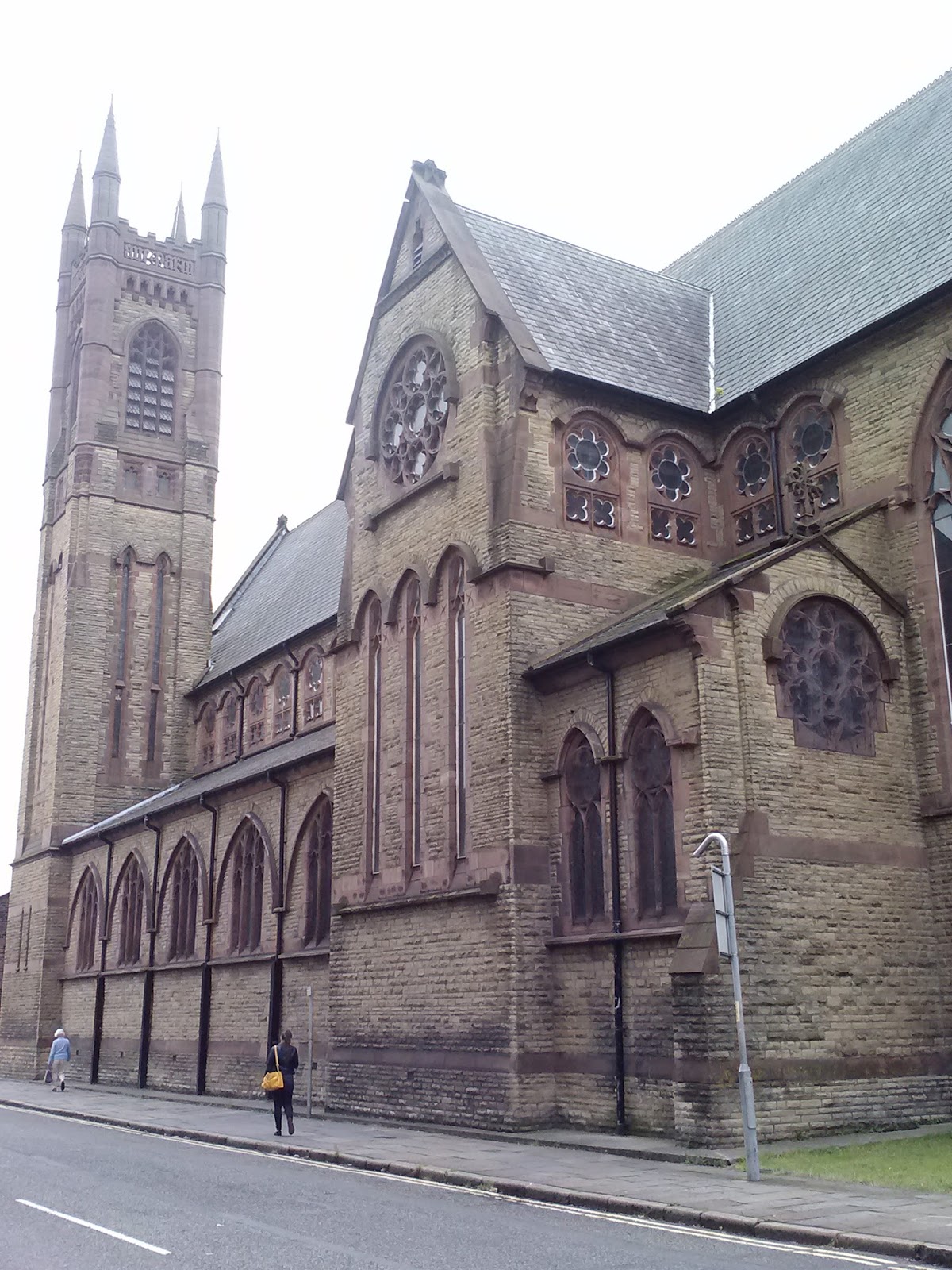
I'm jealous of a friend of mine, a seminarian of the Priestly Fraternity of Saint Peter, who lately had the opportunity to visit that Fraternity's latest acquisition: a splendid Gothic revival church in Cheshire (the archdiocese of Liverpool): the church of Saint Mary's, Warrington. The church was built by the Benedictine monks of Ampleforth Abbey beginning in 1875, which they managed to operate continuously all the way up to 2012! The church was designed by Edward Welby Pugin, Augustus's oldest son and successor to the business. Unfortunately, Edward died shortly after breaking ground (at 41, just one year longer than his father), but his younger brother, Peter Paul Pugin, assumed the project and took it to completion in 1877.

Here are some pictures my friend took. You'll see that Edward's style gradually diverged from Augustus's, particularly after 1859. Augustus's churches were usually of "country parish" proportions with very deep and narrow chancels, while Edward eventually addressed some of Cardinal Newman's criticisms against his father's work and brought the Gothic revival in line with "Tridentine" norms: smaller chancels, wider altars, and no rood screens to obscure the people's view of the high altar, to name a few. At the same time, Edward greatly enhanced the "vertical" aspect so that, in true Gothic style, even a common city parish was sure to make you feel like an ant inside it.


Friday, April 3, 2015

The Easter sepulchre

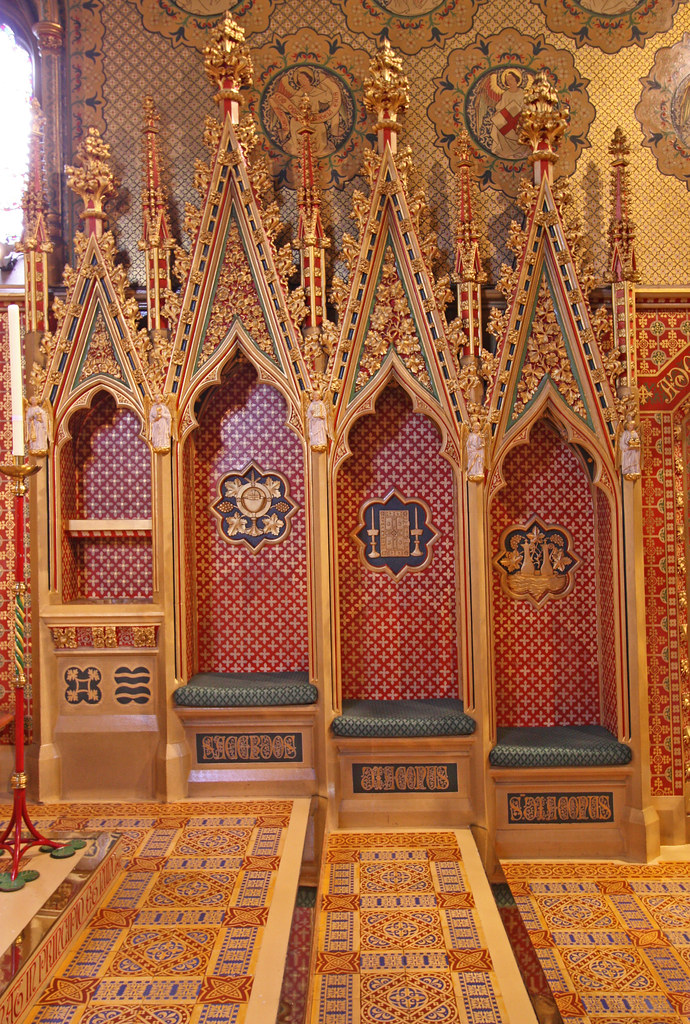
Augustus Welby Pugin's Easter sepulchre at Saint Giles, Cheadle. The shields below it show the instruments of the Passion in heraldic form.
Last night in Catholic churches around the world, the tabernacles were emptied and the Eucharist was carried in procession to another altar, called the altar of repose, there to remain until the "Mass of the Presanctified" on Good Friday. Before the Reformation, however, and most especially in England, a second shrine was set up during Holy Week to reserve the sacrament: the Easter sepulchre.
After the Good Friday ceremonies and the "creeping to the cross", which commemorate the ultimate sacrifice of Christ's crucifixion, the crucifix which the whole congregation in these "superstitious" days was then wrapped in linen, as though it were a burial shroud, and then carried in procession to a niche, a wall recess in the north side of the church, which was designed just to appear like a tomb. There, after the priest and deacon removed their vestments and shoes, the crucifix was "entombed" in a chest, along with a pyx carrying a Host that had been consecrated on Maundy Thursday.
The priest intoned:
"I am counted as one of them that go down into the pit: I have been even as a man that hath no strength, free among the dead."
 And the people responded:
"Thou hast laid me in the lowest pit, in a place of Darkness and in the Deep. There have I been."
With Christ's real presence entombed, decorated with velvet hangings, and candles lit all around this Easter sepulchre, a watch was appointed to keep guard over the sepulchre at all hours until just before daybreak on Easter Sunday. (So, it seems, even if the Vigil of Easter was celebrated on Saturday morning, the devotions surrounding the Easter sepulchre ignored it.)
The best surviving examples of Easter sepulchers range from the 14th to 16th centuries. See below:
Marvelous decorated Gothic: the sepulchre at Saint Andrew's, Heckington
The sepulchre at Lincoln Cathedral, complete with sleeping guards
This sepulchre at Holcombe Burnell, Devon, was made in the 16th century, at the eve of the Reformation, and hints at the arrival of the Renaissance style on England's shores.
After Henry VIII declared himself Head of the Church of England, he still attempted to preserve the sepulchers, his convocation declaring:
"On Good Friday is prepared, and well adorned, the Sepulchre in remembrance of Christ's sepulchre, wherein is laid the image of the Cross with the Most Blessed Sacrament to signify that there was buried no corpse or body that could be corrupted but the pure and undefiled Body of Christ without spot or stain, which was never separated from the Godhead."
Nonetheless, Cranmer, archbishop of Canterbury, secretly despised the sepulchres and all similar displays of religion, so shortly after the boy king Edward VI acceded the throne, Cranmer and his lackeys passed laws ordering their destruction. We have surviving records of how vicars sold their wooden chests used for the sepulchre to profane use. One, for example, used the coffer to store his clothes; another, to serve as a dish rack. Queen Mary's brief restoration heralded the return of the sepulchres, but with her sister Elizabeth, they once again went into abeyance.
Augustus Welby Pugin was the first designer of the modern age to build Easter sepulchers in his churches. As you saw at the top of the post, his sepulchre at Saint Giles, Cheadle, as with the rest of the church, stunned all who glanced upon it. It seems to have never caught on even in Pugin's own lifetime, for he routinely complained that the priests who took over his churches didn't know what to do with them: "The truth is the churches I build do little or no good for want of men who know how to use them. Dudley is a complete facsimile after an Old English parish church and nobody seems to know how to use it.". (A.W.N. Pugin: Master of Gothic Revival, page 57)
The one thing we can be thankful for, perhaps, is that the successors of Pugin's churches were so completely ignorant of the customs surrounding their furnishings that when the iconoclasms of the 1960's came around, few of Pugin's sepulchres were destroyed because no one knew what they were for in the first place.
Pugin's sepulchre at Our Lady and Saint Wilfrid's.

Wednesday, March 18, 2015

Pontifical Mass at Pugin's church of Saint Augustine, Ramsgate

As longtime followers of this blog know, I try to repost anything of relevance to the great Gothic revival architect, Augustus Welby Pugin. I only just discovered that His Eminence Cardinal Burke, a celebrated (or controversial) American prelate who has distinguished himself over the years by championing the cause of the traditional Latin Mass and pre-Vatican II forms of the sacraments in the Catholic faith, very recently made a pilgrimage through England and celebrated pontifical solemn Mass (packed to standing room only) at the shrine of Saint Augustine, Ramsgate. This is not in reference to the famous theologian and author of the Confessions; but rather, the first archbishop of Canterbury, who was sent by Pope Gregory the Great to minister to the Britons. Pugin had a great devotion to his namesake saint, and bought property on the cliffs of Kent, near the site where Saint Augustine is believed to have first landed in England. There, in addition to his home, he built a church fully "according to the true principles of Christian architecture". What little money he was receiving from his concurrent projects at the Palace of Westminster and its great Clock Tower in London, he poured right back into the raising of this church. Indeed, the church was Pugin's not only by design, but by the fact that he used his own personal fortune to build it.... and, of course, the fact that his remains are at rest there.
Much can be said about the history and design of Saint Augustine's, but I only intended to make this post to share a few pictures of the Mass celebrated there. As well as an architect, Pugin was a liturgical enthusiast, known even to sing Latin hymns to himself on the train or while walking down the street. He designed not only churches, but all the furnishings that went with them: chalices, vestments, altar hangings, candlesticks, and every other thing that had a place in the realm of worship. I think he would appreciate that the traditional Latin Mass is once again being offered in the church he dedicated so much of his life and energy to build.
Also, the cardinal's homily, with its sketch of the history of Catholic devotion in the realm of England, is most definitely worth reading in full (you may do so here if you wish), but I quote only one paragraph:
"Coming on pilgrimage to this shrine, I cannot fail to note the example of the Catholic architect Augustus Welby Northmore Pugin, architect of this beautiful church which is also the place of his burial. Augustus Pugin was attracted to the truth of the Catholic faith through its reflection in the beauty of the great Church architecture of the Middle Ages. He, in turn, sought to express and inspire by his architecture the nobility and beauty of a Christian culture during a time in which the Christian foundations of society were already under serious threat from the radical secularism of the thinking of the so-called Enlightenment. Offering Holy Mass is this church which can rightly be called his, let us thank God for him and for the great treasure of the beauty of the faith which he has given to us."
 Pictures are courtesy of Juventutem London, which may be found here and here.


Friday, January 2, 2015

Gothic splendor and Christian charity at odds?

One of Pugin's Tasmanian churches
I'm going to open this year of 2015 with a short reflection on a paper I read from the Pugin Foundation, given to the Newman Society in Hobart (in Tasmania, Australia). It's called Mr Pugin the Bigot, and you may find it here.

Some background: Augustus Pugin and John Cardinal Newman were, arguably, the two most influential converts to Catholicism in England during the age of Victoria. When it came to how the newly emancipated and restored Catholic faith would express itself, though, these two luminaries were at odds with the other. Newman, father of the Birmingham Oratory, imported Italianate, Baroque architecture into England; stepping into his church brought a taste of papal Rome right to the English Catholic's front door. Pugin, champion architect of the Gothic revival, wouldn't stand for anything except the total restoration of that style which sprung forth from the minds and hands of native Englishmen during the most Catholic centuries, the 14th and 15th. Baroque churches, in Pugin's world, were gaudy imitations of heathen temples. The position led Newman to confide, in a letter to a friend, the title of the article linked above:

"Mr Pugin is a man of genius; I have the greatest admiration of his talents, and willingly acknowledge that Catholics owe him a great debt for what he has done in the revival of Gothic architecture among us. His zeal, his minute diligence, his resources, his invention, his imagination, his sagacity in research, are all of the highest order. It is impossible that any one, not scientifically qualified to judge of his merits, can feel a profounder reverence than I do, for a gift which it has pleased the Author of all Truth and Beauty to endow him. But he has the great fault of a man of genius, as well as the merit. He is intolerant, and if I might use a stronger word, a bigot. He sees nothing good in any school of Christian art except that of which he is himself so great an ornament. The Canons of Gothic architecture are to him points of faith, and everyone is a heretic who would venture to question them."

The author, Brian Andrews, supplies an extreme anecdote for an extreme character:

"One chalice tells us much about Pugin and Willson’s taste. In May 1847 Willson was given a chalice by Pope Pius IX. A typical Classical vessel for its time, it was abhorrent to Willson who took it back to England where Pugin made a new Gothic design. The Papal chalice was melted down, some extra silver added and an inscription engraved on the base of the new Gothic chalice ‘+ Gift of His Holiness Pius the IXth to Robert William + Bishop of Hobart Town + Rome + May + Mdcccxlvii’. Well it sort of was—at least most of the silver!"


(Willson here is Robert William Willson, first Catholic bishop of Hobart, Tasmania. He was a close friend of Pugin's and strong supporter of the Gothic revival in Australia.)
 
Robert William Willson, Bishop of Hobart
 
It's no secret where my sympathies in that whole debate lie, but I also wanted to draw some attention to some anecdotes from the same essay which dispel the whole notion of Pugin as the Grinch of Victorian England. Andrews submits a snippet from the writings of Pugin's son-in-law, John Hardman Powell, shewing the total harmony of someone who lived a fully liturgical, fully charitable life:

'At eight the Chapel bell rang for Compline, which was solemnly recited by Pugin in Cassock and Surplice, followed by the De Profundis, but too rapidly for a stranger to respond to readily. At nine supper in the brightest of Kitchens; the eldest daughter Anne, an elegant maiden was present and Miss Greaves, a family friend, who had kindly taken care of the children after their mother’s death. Rice pudding, Bread and Cheese, Celery and Water, was the simple fare, Pugin with Times in hand commenting on the news of the day.
'In the morning, bell at eight for prayers; Pater, Ave, Credo, Litany, short and quick, “no time for distractions”. The Chapel though small was complete for Mass, with organ in Sacristy … the windows were filled with Stained Glass, St. George, St. Augustine, St. Edmund, St. Cuthbert, with the Family beneath, holding petitions. Though simple, everything was of the best, Oak, Cedar, Encaustic tiles, and a small stove always burning in cold weather: “most people pray better when warm”.
'Pugin gave in Charity “with both hands” on the principle that life was too short for “chasing up only deserving cases” and “everybody must take their chance of being done at times”, in fact he literally gave away his boots more than once and walked home without. At offertories he never counted but took a handful of silver from his pocket. During the famine in Ireland, he sent all he could get together and influenced others to do the same. Shipwrecked foreign sailors were taken into special care, lodgings found, doctor, and sustenance. At that time there was no seamen’s hospital at Ramsgate so Pugin went and by his influence got one organised. Once a barque, full of poor Bremen Emigrants struck on the Goodwin Sands and were towed into the Harbour after great suffering. Finding eighty of them were Catholics he wrote to London for a German Priest and turned the Cartoon room into a Temporary Chapel where they went to confession heard Mass and received Communion. The Blessings they invoked on leaving were a real happiness.
'Pugin set himself to illustrate “True Principles” in the Household life. Reverence, order, simplicity, Holy Mass in the Chapel whenever he could get a priest friend to stay, then plenty of work, good food and exercise, the Church Festivals being holidays in both senses. … After the Church was built he enjoyed going into the choir as Cantor and singing the Mass from his big Gregorian books at the lectern, giving his most sonorous notes at the Credo and his daughter Annie accompanying on the organ over the cloister.'
 
 
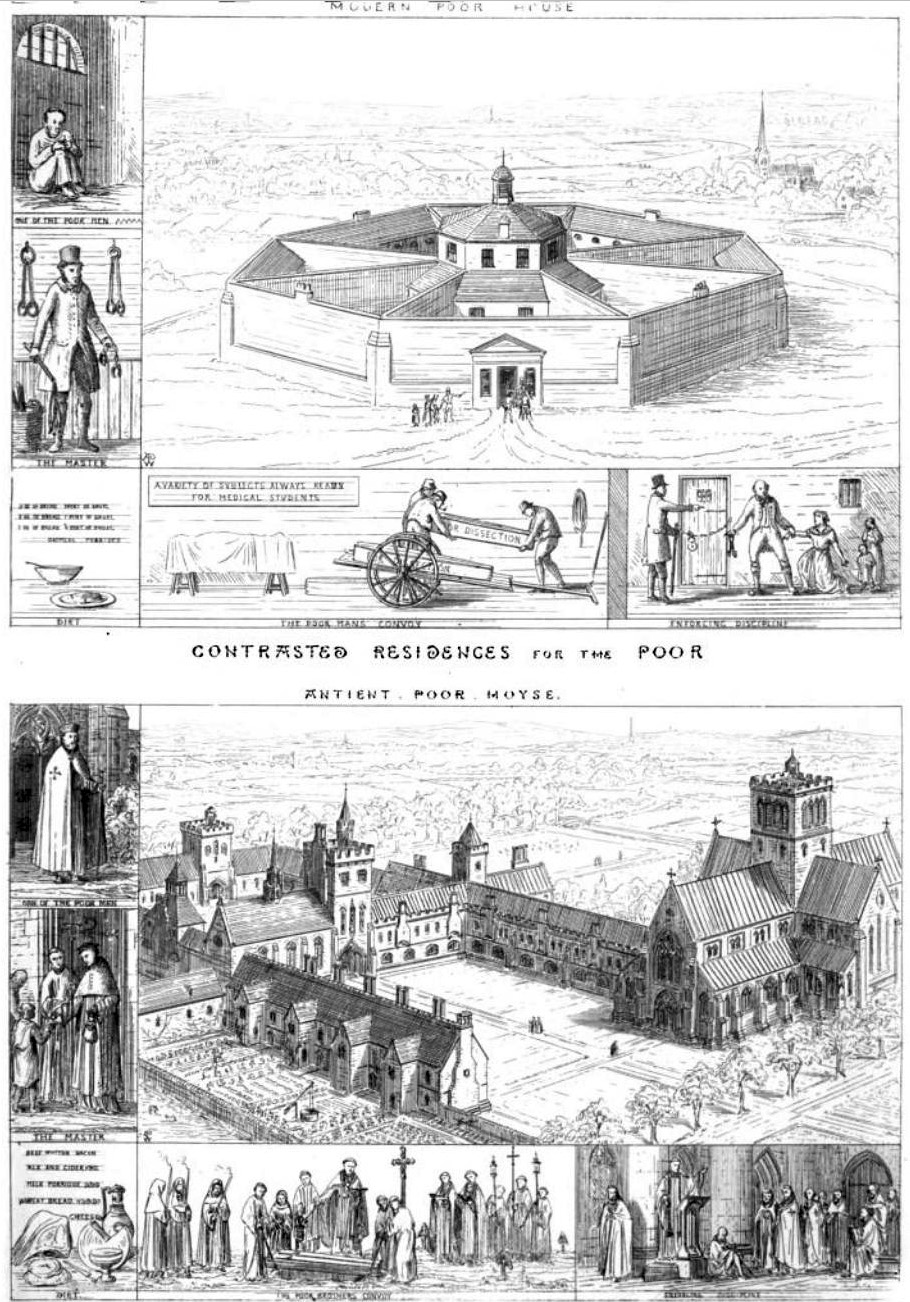
The architect applied his concern for social justice to his profession in more than one way. When his friend, Bishop Willson, was sent to minister to the poorest of the poor in Tasmania, Pugin designed all of the furnishings the good bishop would need to set up a new diocese at no charge. And we can see in a sketch like that of two contrasted poor-houses below, from Pugin's Contrasts, that he believed his architectural vision extended not only to the great houses of church and state, but to house the less fortunate more humanely than the "cutting-edge" utilitarianist monstrosities then being built.


I'll end this brief foray into the mind of Pugin with some words from the man himself, shedding some light onto the spirituality behind his design:
 
'And the reason that Catholicism does not produce such glorious piles as in days of old, that it does not number a crowd of devout architects, painters, sculptors, and cunning workmen within its pale, as formerly, is purely owing to the decay of faith and the lightness with which even the majority of Christians regard their religion.
'If the mass of the Catholics of the nineteenth century possessed the same zeal, devotion, reverence and fear of God as those of the thirteenth, the Madeleine would never have arisen for the performances of the same worship as generated the stupendous vaults and towers of Notre Dame; but the latter was the spontaneous creation of the faith, raised by zeal and devotion—the former a cold adaptation of a heathen temple, erected by infidel architects to the purposes of a Christian church. Revive the true Catholic faith and devotion and the flaunting chapel, with all its glare and finery, will soon be deserted for the solemn recesses of the ancient piles, where men can pour forth their supplications in retirement and devotion, content to penetrate the veil of the sanctuary with the eyes of faith, and feel that they are scarcely worthy to kneel on the pavement of that temple where their God deigns to dwell. Restore the old reverence, and gladly will men welcome the old things—arch and aisle, and pillar and chancel, and screen, and worship as their fathers worshipped, who now sleep in Christ; and the green bough will twine in the tracery, and the tapers sparkle round the rood, and surpliced clerks sing in chancel stalls, whilst the saints shrine bright in the mullioned lights—venit hora et nunc est—when the old glory of the sanctuary will be restored and solemnity revived with returning faith.'
'… architecture is the barometer of faith; it is not the arch, the pinnacle, the pillar, that profiteth, but the spirit which produces them; and the revival or decline of true Ecclesiastical architecture is commensurate with that of the true faith. It is for these reasons that we labour for its restoration and not as a mere abstract question of art.'
 
Pugin's high altar, with canopy and Sarum-style curtains, at Birmingham Cathedral
 

Wednesday, October 17, 2012

Two lost arts: singing from oversized books, and using lecterns


Add this to the list of medieval practices that ought to be restored: the art of chanting from oversized books. Today I revisit a pet subject of mine: medieval plainchant.

My schola's current practice is for everyone to have a copy of the Liber Usualis, a compendium of chants about the size of a brick, which conveniently has all the chants for the 1962 Mass and Office for the entire year. It's a wonderful little invention, but it's relatively new in the grand scope of sacred music history. The first edition of the Liber was published by the Abbey of Solesmes in 1896. Before then, chanters had the wearisome task of sorting through several books at once. Granted, it was still a better lot than that of the monks in the Church's much younger days, who had to simply memorize everything they had to sing. The further back in time you look, the harder it would have been for choirs to provide music books for every singer due to cost and technology. I believe the Middle Ages found a happy solution in between: to end the trouble of brute memorization, the monasteries first developed a system of notation (which would eventually grow into our modern sheet music)... and to save the trouble and expense of copying so many books for each individual monk, they would create a single, large book that could be read by the entire choir. 

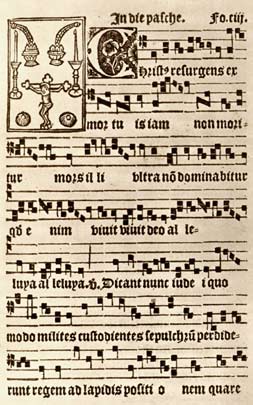
A 16th-century Spanish antiphonal.

I was browsing through the website of Ensemble Organum, one of my favorite early music performance groups, and found this page for a project called Lectern International. They purport to have a network of locations where singers can chant from original medieval manuscripts grouped around a lectern. The page reads:
"An international network of locations where it is possible to sing from original documents (manuscripts or printed material of the era) grouped together around a lectern.

The venture consists of reliving medieval music by initiating singers to the practise of the lectern chant. Thus one of the essential aspects of the recreation of music prior to the XIX century is their context of execution. The size of the books, their position on the lectern, the spatial and acoustic conditions of the execution are fundamental elements which are lost when one sings using small-format modern transcriptions.

For close to eight centuries, the lectern was fundamental in the transmission of musical know-how for both voice and instrument. Yet the musical and pedagogical value of this object, its role in the conceptualisation and creation process of the music is widely ignored nowadays.

Singing polyphony or monody around a lectern radically transforms the musical interpretation, but singing from an medieval manuscript has an even greater significance. The tempi become slower, the listening of the other singers is totally modified, the memorisation processes are different as well.

Places where it is possible to do this are rare. More often than not the manuscripts are preserved in libraries where their use for their original purpose is met with disapproval. Lectern International federates places where this sort of practise is encouraged."

I emailed them over a week ago to ask about it but never got a response. I imagine there aren't any churches in the United States which have giant chant books in the first place, but I did have the pleasure of seeing one right here in Texas a few weeks ago. When I visited the Bowld Music Library in Fort Worth to look at their copy of Pugin's Earnest Appeal for the Revival of the Ancient Plain Song, they actually had a giant antiphonal from the 15th century or so behind a glass case. It's just a pity that these books will likely remain solely behind glass cases around the world for the rest of time, rather than be used for their original purpose.

In any case, Ensemble Organum's premise is that the style of plainchant will sound different when everyone is singing from one book. I can't say I've done it before, but I can imagine it: all the chanters, including the director, are facing the same direction. The director is presumably at the front, waving his hands right before the book so that all the chanters see the notes and his direction at the same time. More than any other method, it forces the choir to chant as a unit. This leaves one question, though: how does it work if the choir is divided in half facing each other in the traditional stalls? Are there two books and two lecterns?

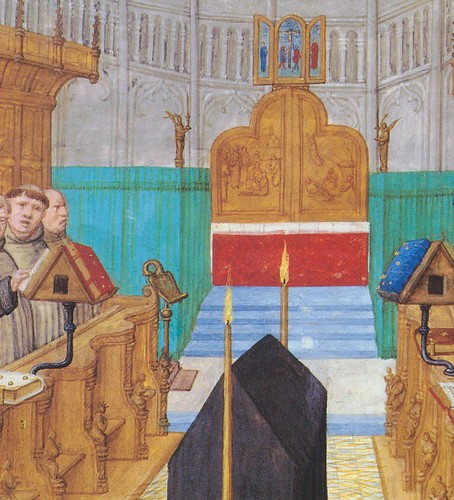
This image from a 16th century Book of Hours has one choir lectern for each stall, plus an eagle lectern on the Gospel side.

This brings me to the second topic I wanted to write on: the proper use of reading desks, lecterns, ambos, and pulpits. The vast majority of churches in which I've attended the traditional Latin Mass are arranged in what we might call a "Tridentine style" that has, for some reason, completely eschewed the use of reading desks and platforms. They have a single speaking platform on the Gospel side of the sanctuary: a wooden box which more closely resembles a politician's podium in a press conference, rather than one of the glorious pulpits of the medieval age. This platform is used for everything, from sermons to mundane announcements: though rarely, if ever, for actually proclaiming Scripture or any other sort of liturgical usage. The contemporary trad practice at solemn Mass (on the few times it's to be had in the first place) is for the subdeacon to hold up the book with his own hands when singing the Epistle, and to hold the book as the deacon sings the Gospel.

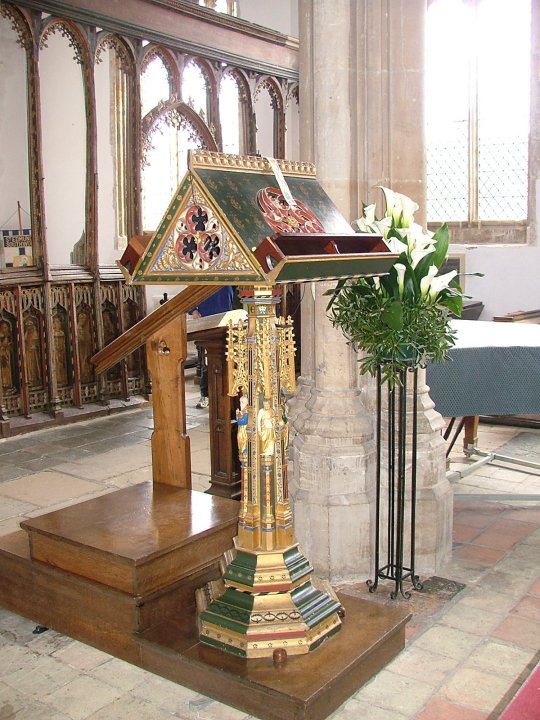
The craftsmanship of the medieval masters in fashioning reading desks, lecterns, and pulpits should be a testament to our lack of imagination. This first example is of a lectern from the 15th century, repainted in the 1930's. It's housed in the church of Saint Edmund, a pre-Reformation church in Suffolk. Notice the popular double-desk style, which I suppose could have allowed for a cantor on either side (the Sarum Use's rubrics propose two cantors for the Graduals and Alleluias of Mass).

15th-century lectern at Saint Edmund, Southwold

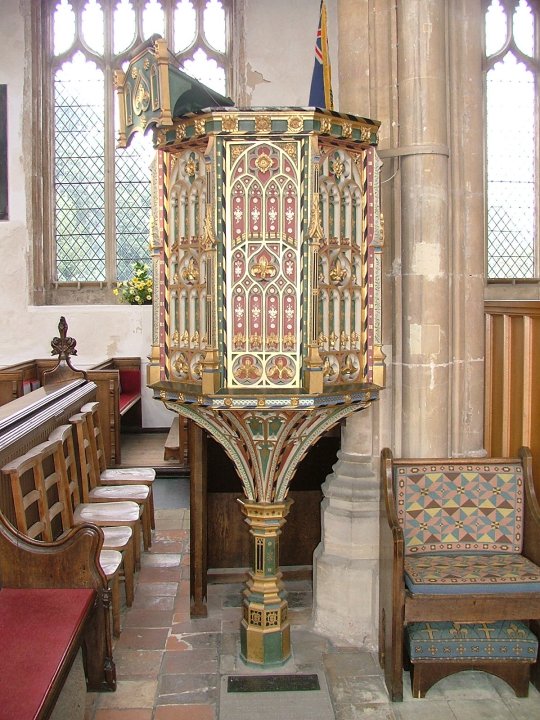
The same repainting is featured on a pulpit in the same church:

In my book, a pulpit can't be properly called by that name unless you have to climb a set of stairs to speak from it.

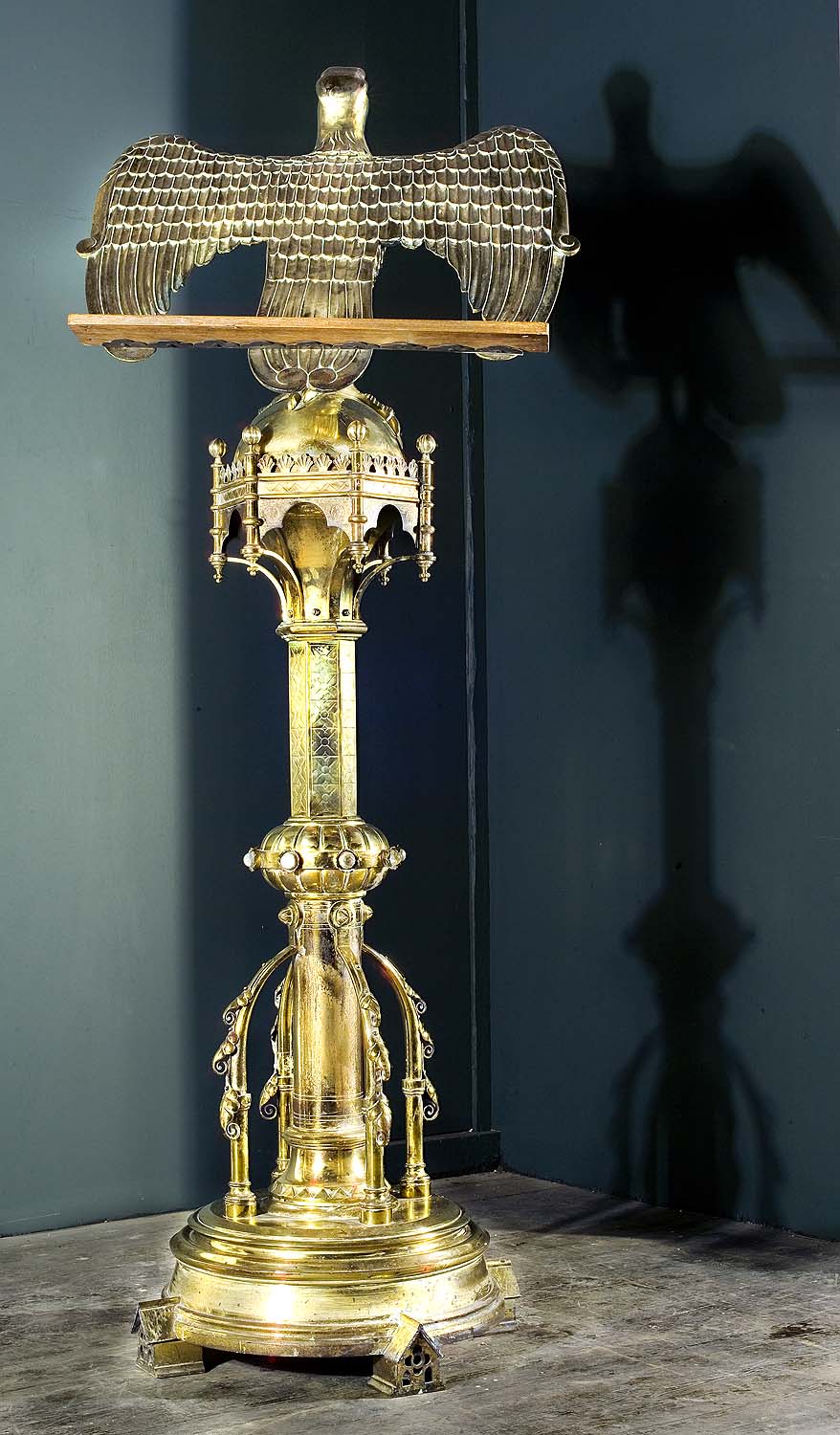
A great many lecterns of the later Middle Ages, especially the ones used for reading the Gospels, were fashioned in the shape of eagles. The eagle was said to be the bird that flew the highest, and therefore the closest to heaven. The eagle was also supposed to have been able to gaze directly into the bright light of the sun without harm. The faithful Christian, likewise, could stare at the sight of the deacon proclaiming the Gospel from this eagle-shaped lectern without flinching.

16th century brass lectern at the church of Saint Mary, Redenhall.

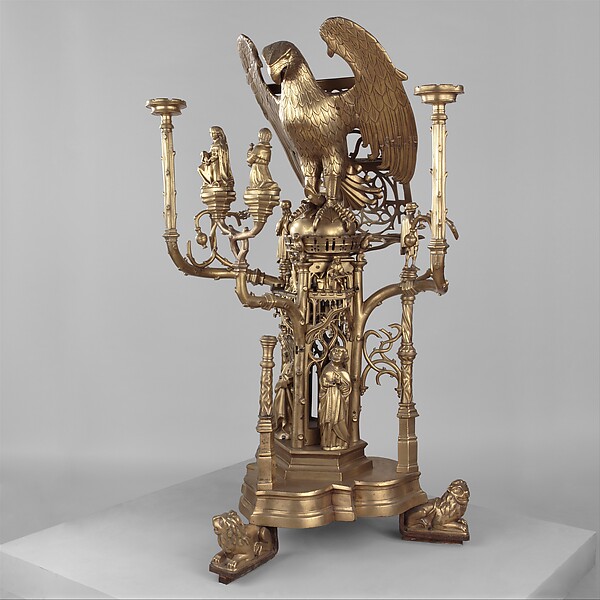
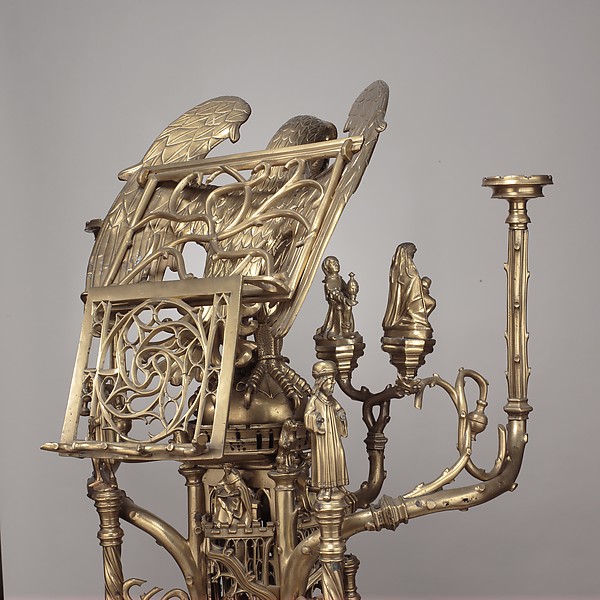
The most splendid eagle lectern of all is this one fashioned by Aert van Tricht, also in the 16th century. It was bought by Pugin's wealthiest patron, John Talbot, Earl of Shrewsbury, for Augustus Pugin's Cathedral of Saint Chad, Birmingham: the first Catholic cathedral built in England since the Reformation. The eagle holds a dragon under its talon.

It's decorated with figures of Christ, the three Magi, Saint Barbara, and the Old Testament prophets, among others.

 I believe it was Pugin and his brassmaker, John Hardman, who replaced the missing Saint Barbara figure.

Sadly, the lectern currently resides in a museum. I don't know how it got there, but I wouldn't be surprised if it was sold by the Vatican II vandals. At least it has the honor of being housed at the Met in New York City. 

Pugin, of course, proved that these lecterns could be made for in the modern age and be used in the modern liturgy (which, in his day, was the Tridentine Mass). Here's a drawing he made in his book, Designs for Iron and Brass in the Style of the 16th and 17th Centuries

I believe this page shows the same lectern in physical form, though the images are very small.


Another lectern by Pugin, in the eagle style.


An eagle lectern at Pugin's church of Saint Giles, Cheadle, on the Gospel side. I don't know if Pugin actually made it or not.


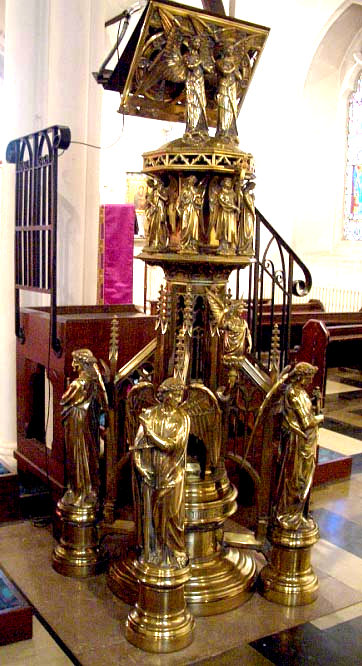
This is a very elaborate lectern by Pugin's son-in-law and pupil, John Hardman Powell, currently at the church of Saint Paul, Brighton.

The base depicts the angels of the Apocalypse.

Now we come to the pulpits, from which sermons are preached. The medievals favored high pulpits because they signified the scaling of a mountain to proclaim the Gospel truths from the highest heights. According to the Catholic Encyclopedia, Pope Innocent III's treatise on the Mass quoted Isaias in reference to the deacon's scaling of the ambo to read the Gospel: "Get thee up upon a high mountain, thou that bringest good tidings to Sion: lift up thy voice with strength".

England is fortunate to have many surviving examples of pulpits. They endured the Reformation, probably because the Protestant commissioners, for once, didn't find them objectionable. Ironically, the Counter-Reformation on the continent gradually saw these pulpits dismantled or de-emphasized in what I see as a misguided effort to direct all visual focus toward the altar.

A 15th-century pulpit (heavily restored by Victorians) at the church of the Holy Trinity, Long Sutton.

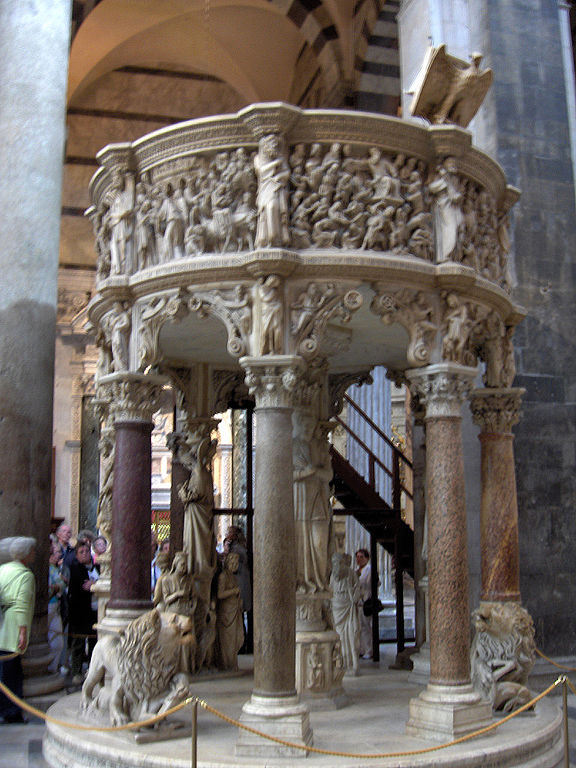
A massive stone pulpit, with eagle lectern within, at the Duomo in Pisa.


Perhaps the finest pulpit of all. This one is at Canterbury Cathedral. Though it currently rests in the chief church of Anglicanism, one of the carvings depict Pope Gregory the Great sending Saint Augustine of Canterbury in a mission to establish the church in England.

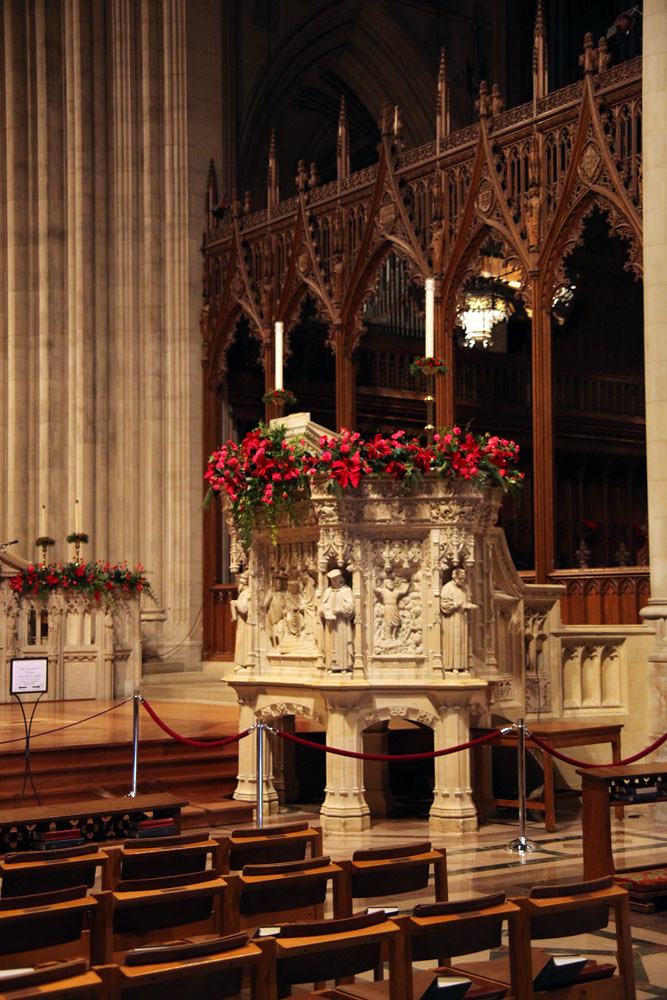
A fine modern example is the pulpit in the Washington National Cathedral, which was carved less than a century ago. It was given by the Archbishop of Canterbury to the new cathedral in D.C. as a gift, and was remarkably fashioned out of stone from Canterbury Cathedral itself.


The central relief depicts a medieval Archbishop of Canterbury, Stephen Langton, urging King John to sign Magna Carta. Not a subject I would've chosen for a pulpit, but there it is.

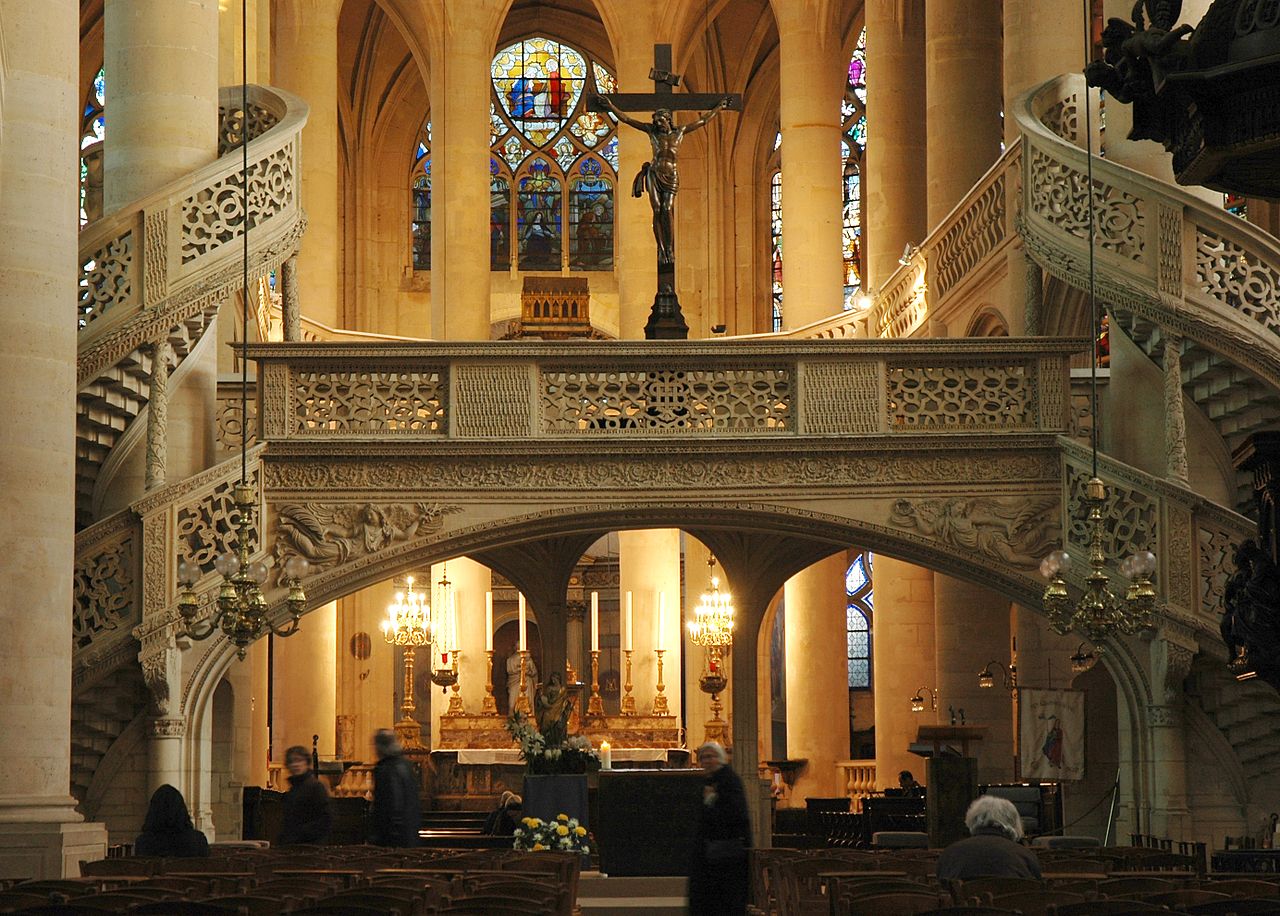
Finally, here are some photos of yet another kind of platform that was in use in the Middle Ages: the jube. The jube was the name given to rood lofts in France. While it's unclear whether the Scriptures were read from the top of the English rood lofts (the staircases may have been only to allow acolytes to light the candles at the top), the French jubes were certainly used for readings: probably at the right for Lessons and Epistles, and the left for Gospels.

The jube of the church of Saint-Étienne-du-Mont.
The name "jube" comes from the Mass. Before the deacon sings the Gospel, he approaches the celebrant and asks for his blessing with the words jube, domne, benedicere ("pray, sir, a blessing").

The one pictured above is the last surviving jube in France. It was built in the mid-1500's, in what was perhaps the very last Gothic work of art in that country before the total onslaught of the Classical and Baroque. The church of Saint-Étienne-du-Mont, by the way, has a colorful history. In the French Revolution, it was temporarily closed and re-dedicated as "the Temple of Filial Piety". We have Napoleon Bonaparte to thank for its restoration as a church, due to the Concordat of 1801. Saint-Étienne was also the site of an assassination. In 1857, the Archbishop of Paris, Marie-Dominique-Auguste Sibour (who also witnessed the marriage of Napoleon's nephew, Napoleon III), was murdered by an excommunicated priest who, in the act, cried out "Down with the goddesses!". The priest, Jean-Louis Verger, killed the Archbishop for promulgating the dogma of the Immaculate Conception in Paris, which had been declared by the Pope just a few years before. I believe that would make Archbishop Sibour the only person ever to have been martyred specifically over a dogma declared ex cathedra by the Pope.

Thursday, October 11, 2012

The Use of Sarum: A Brief History and Why It Matters

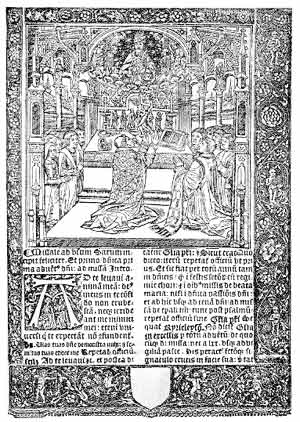
From a Sarum Missal
[The liturgy of pre-Reformation England has been a subject of interest to me ever since I became Catholic in the first place. I'd go so far as to say that attending a high Mass according to the Use of Sarum is part of my "bucket list". I plan to write a series outlining the differences between the liturgies of Sarum and of 1962, but before I get to that, I ought to introduce this series with a history of the Sarum Use. None of this will be new to Sarum enthusiasts (all 6 of you out there in the entire world), but it'll be a good primer for the uninitiated.]


The traditionalist's bedtime storybook account of history might have us believe that the Roman Mass began when Christ in the upper room, adorned in fiddleback chasuble and an abundance of lace, uttered Te igitur, clementissime Pater in the Emperor's Latin. The Apostles then spread the "Mass of All Time" to the four corners of the earth, where it was transmitted faithfully without any addition or subtraction across the ages until 1965, when Bugnini and his cronies imposed vernacular worship, liturgical dance, polka Masses, and Masonic banality from on high. The late Archbishop deserves credit for somehow being able to radically reinvent the worship lives of a billion people by committee, but change itself has been a constant companion in the history of the liturgy.

In fact, in the early Middle Ages, worship was as feudalized as government. Just as every lord was virtually sovereign in his own territory, so too did every bishop govern how the liturgy was to be offered in his own diocese. This great variety of forms seemed like anarchy to Charlemagne, who ordered that the Roman Rite be adopted throughout all his realms for the sake of uniformity. (Ironically, the influence that Charlemagne wielded was so great that the liturgy of the Franks, in turn, changed the way the Mass was celebrated in Rome itself.) The battle for uniformity in worship played out differently in the other regions of Europe. It was never truly and completely won in England until Cranmer imposed his Prayer Book in 1549, but when discussing the liturgy of England prior to the Protestant Reformation, one form deserves examination above all the others: the liturgy of Sarum.


The Course of Sarum: From the Norman Conquest to Now

Saint Osmund, second Bishop of Salisbury
When the Normans conquered England in 1066, they brought French language, French literature, French law, and French liturgy. In an act of benevolent nepotism, William the Conqueror appointed his nephew, Saint Osmund, who had formerly served as Lord Chancellor for eight years, Bishop of Salisbury in 1078. There, in the settlement which was then also called by the Latin name of Sarisburium or Sarum for short, Osmund undertook the great task of revising and codifying the liturgy in his diocese into something which would satisfy Normans and Saxons alike. He did not invent; A.H. Pearson observes in his introduction to The Sarum Missal in English that the rites Osmund produced bear great similarity to those of the see of Rouen, which at that time was also the capital of the Duchy of Normandy. "The Epistles and Gospels, the custom of Rulers of the choir, the procession from the sacristy with the elements, and that of the Gospel, were the same as in the Sarum rite". 

The Ordinal of Osmund naturally found favor with the new generation of Norman bishops. Within a century, the Use of Sarum became the predominant form of liturgy in England. While a number of other uses developed, such as those of York and Hereford, even those uses drew heavily from the Sarum books. Certainly, no other use in England could claim as much cultural impact; Sarum was adopted in Winchester Cathedral, the universities of Oxford and Cambridge, London, all the chapels royal, and even Canterbury. Canon J. Robert Wright's essay on the Sarum Use notes that between the introduction of the printing press and the imposition of the Book of Common Prayer in 1549:
"As regards the Missal, there were 51 printings of the Sarum as compared with York 5; of the Sarum Breviary 42, the York Breviary 5; of the Sarum Manuale, 13 editions but of York 2; the Sarum Processional saw 11 printings and that of York 1; of the Ordinal 4 at Sarum and 1 at York; and of the Sarum Primer 184 (!!) compared with only 5 editions of the Primer from York. All told, more sources survive for the Use of Sarum than for all other medieval English rites put together."
King Henry VIII, after being declared Supreme Head of the Church in England, ordered the suppression of all other uses in favor of Sarum, though this decree was not to last long before his death and the arrival of the Prayer Book under the boy king. Queen Mary temporarily restored the Use of Sarum throughout the realm. She ordered a reprint of the Sarum books in 1555, and was wedded to Prince Philip in Winchester Cathedral according to the Sarum Manual. That was the last time the Sarum Use was to enjoy any official status in the English Church. The last reprint of any Sarum book was of the Manual in 1604, by exiled Jesuit priests of the English College at Douai, France. The English Jesuits, however, soon adopted the Roman books exclusively, and the Use of Sarum was forgotten for two centuries.

Pugin's Sarum-style sedilia at Saint Giles, Cheadle
The medieval revival in the Victorian age seemed to give the Use of Sarum a new lease on life, at least among academics and eccentrics. Augustus Welby Pugin naturally designed all of his churches in the expectation, however unreasonable, that they would house celebrations according to the Sarum books. (Most of his churches, for example, have seats for the clergy in which the priest sits higher and closer to the altar than the deacon, who in turn sits higher and closer than the subdeacon. The Roman practice has the clergy sit on a bench in equal height, with the priest in the middle.) With the restoration of the Catholic hierarchy in 1850, Pope Pius IX supposedly gave the English bishops the option of restoring the Use of Sarum, but they chose to stick with the Roman books instead. The Anglicans of the Oxford Movement took far more interest in Sarum than the Catholics, but even they mostly limited it to a reference for which to dress up Prayer Book services in a more Catholic and ritualist appearance.

A few modern celebrations of the Sarum Mass, all under the auspices of the Roman Church, deserve mention. The Rev. Seán Finnegan gives an account of one from the '80s:
"The first I heard of was in Englefield Green, Surrey, where in the mid-1980s the inappropriately baroque Catholic parish church was the setting for a Mass as part of the celebrations commemorating Runnymede, the nearby setting for the signing of Magna Carta in 1215. Deacon and Subdeacon wore fancy baroque dalmatics stiff with gold braid, while the celebrant wore a 70s striped Slabbinck creation with a high collar and overlay stole. And yet it was still beautiful."
Another celebration took place at Merton College, Oxford in 1996 for the feast of the translation of Saint Frideswide. Merton College hosted another Sarum Mass the following year for Candlemas, for which there is a series of recordings on YouTube, the first of which I post below:


The most recent occurrence I know of was celebrated in 2000 by the Most Rev. Mario Conti, then Bishop of Aberdeen, at the King's College Chapel at the University of Aberdeen for the 500th anniversary of its founding. 


Why Sarum Matters

Up to now, I admit I haven't demonstrated how the Sarum Use has any relevance whatsoever to the average Christian in the pew. The preceding examples of its revival were all organized either for the attendance of academics, or to mark historic events. That would seem to damn the Sarum Use to the anachronistic world of pipe-smoking, cape-wearing young fogeys in tweed jackets and bow ties. I can see it already: a discussion at the dinner table is centered around whether acolytes should wear tunicles, and every other sentence is punctuated by a Chesterton quote which isn't at all relevant to the topic but still accidentally makes the speaker sound like a genius. If these are the only people the Sarum liturgy can speak to, then it's dead on arrival.

The more important question is: how could the Sarum liturgy, which was used throughout England for 400 years, not have a lasting impression on the culture of the English and English-speakers around the world? I hope to uncover some of the Sarum Use's treasures in language and ceremonial in following posts. For now, it's worth observing that the most recent celebration of the Sarum Mass by Bishop Conti took place in Aberdeen in the northeastern region of Scotland, which actually had its own use. The Sarum Use was never celebrated there before. That a prince of the Church would celebrate the Sarum Use there demonstrates three things: first, that there should be no shame for any priests who wish to adopt the Sarum liturgy, at least for occasional use. Second, that celebration of the Sarum liturgy is by no means bound only to parts of the world where it had been celebrated locally. If it can be celebrated in northern Scotland, it can just as well be celebrated in the United States, Canada, or Australia. And finally, that the Sarum liturgy can be used apart from exercises in historical re-enactment. 

I hadn't been completely convinced of this last point myself until I saw, a few days ago, an order for Compline from the Sarum Breviary in Indonesian! You can view it here if you don't believe me. Now, speaking as someone of half-Indonesian descent, I can tell you that the presence of Catholicism in that country, which is the most populous Muslim country in the world, is quite negligible. Nevertheless, if someone can appreciate the beauty of the Sarum liturgy enough to translate it into Indonesian and set it to square notation, there's absolutely no reason why those of us in the English-speaking world who are far more touched by the influence of Sarum can't investigate the treasures of pre-Reformation England as well.


The series continues with a comparison, step by step, of the Sarum and Tridentine low Mass.

A Sarum processional chant

Saturday, October 6, 2012

My Thoughts on the "Earnest Appeal"

I had a great deal of fun posting the Earnest Appeal online for the liturgical movement's benefit. Faithful readers, considering there are only a handful of you, please do me a favor and share it to all your friends so that this monumental work doesn't slip wholly under the radar! I've prepared a printable .pdf edition which I can email to any who request it. I'm also looking into making an edition for the Kindle and Nook.

When I posted the Earnest Appeal, I wanted to get it online "as is", with no commentary other than my introductory note. Now that it's been up for a couple of days, I can now give you my thoughts on what Pugin said, beyond the obvious "I agree" or "this!" 

When Pugin was received into the Catholic Church, he entered a culture which largely refused to adopt the Gothic revival which he brought to life. For most English Catholics, being "Roman" meant embracing the fashions of Baroque and Rococo Italy: marble pillars, lifelike statues, fiddleback chasubles, copious amounts of lace, and operatic music. Pugin's ideals often clashed with those of John Cardinal Newman, who respected the architect's genius, but vociferously disagreed on how the Catholic faith should be expressed by the newly emancipated Catholics of the British Isles. When Pugin called Classical architecture "pagan", Newman replied by calling Pugin an "architectural bigot". In a private letter, Newman wrote:
"In details Pugin is perfect but his altars are so small that you can’t have a Pontifical High Mass at them, his tabernacles so low that you can scarce have exposition, his east windows so large that everything is hidden in the glare, and his skreens (sic) so heavy that you might as well have the function in the sacristy, for the seeing of it by the congregation."
Pugin did have his supporters in the hierarchy, namely Nicholas Cardinal Wiseman, first Archbishop of Westminster, and Bishop Robert Willson of Hobart, Australia, but his aesthetic ideals were, for the most part, far more readily adapted by the Anglicans whose communion he broke with, rather than the Catholics for whom he had sacrificed so much to join. He died at only 40 years of age, frustrated that so few Catholics would see the world as he did: Gothic, veiled in rood screens and mystery, resounding with the ancient Gregorian chants of the Middle Ages.

Mass as Performance Art

Pugin, in line with his profession, approached the topic of sacred music in his Earnest Appeal from an architectural point of view. Everything that wrong with sacred music in his time (1850) can be traced to a wrong ordering of where the choir is physically placed in the church building. Before we get to that, though, a word on Gregorian chant itself: it's easy to assume that Gregorian chant lived in a healthy, unbroken tradition from the Middle Ages onward until Vatican II destroyed everything. Nothing could be further from the truth. In 1850, Gregorian chant was only just getting back on its feet after centuries of neglect. Much of it can be traced to the downfall of the solemn Mass itself. The liturgy endured a steady decline in the hearts of the people until by the 18th century, low Mass became the usual experience for laypeople on Sundays, even in those places where there was no shortage of clergy. When low Mass is the usual form for Sundays, it's forbidden to sing the Ordinary of the Mass, the Propers, or any other liturgical music. Any music at low Mass must be extra-liturgical: hymns, motets, etc. The matter of deciding what's to be sung at Mass, then, no longer is one of looking at the books and seeing what's appointed for the day, but instead mixing and matching what sounds appropriate, like mixing a CD to play in your car on long road trips.

Even at solemn Mass, the fashion was to play the Mass like a concert performance, complete with professional singers hired from outside the parish or even the faith, with Glorias and Credos that required the clergy to sit and contemplate the singers' vocal mastery for 15 or 20 minutes at a time. Pugin entered the Church when there was no appreciation for the spirit of the liturgy; most Catholics approached the Mass as either a performance or a ritual to be rushed through as quickly as possible. Some things never change.

This is only one reason why Pugin uses such harsh words in the Earnest Appeal. He says such things as...
"I must say that the dedication of a modern Catholic church, as we have seen it occasionally announced, accompanied by a full band of music, and where bishops and dignitaries are exposed to the degradation of sitting in dumb show to listen to the interminable squalling of a few female professionals and whiskered vocalists from the front of a gallery, is a far more ridiculous and inconsistent exhibition."
... because, in 1850, it was true. Solemn Mass had devolved into a spectacle where the priests and people were put at the mercy of a gang of sopranos, counter-tenors, or contraltos alternately wailing or sneering at them from on high:
"There does exist a want of reality in the present services of the Churches, as they are performed in this and many other countries, and from what does it proceed, but the corrupt and artificial state of ecclesiastical music. Owing to the complicated nature of modern figured compositions, both the clergy and the people have been precluded from taking any real part in the service of Almighty God. They are reduced to the position of listeners instead of worshippers; so that, in lieu of the grand and edifying spectacle of priests and people uniting in one great act of adoration and praise, the service is transformed to a set of hired musicians, frequently heretics and infidels who perform in a gallery, while the congregation are either amused or wearied, and the clergy who are present generally take advantage of those interminable fugues to say their own office, which has no reference whatever to the great act of sacrifice at which they are ostensibly assisting."

The Place of the Choir: Within the Sanctuary vs. a Choir Loft

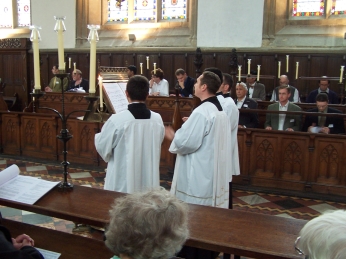
Pugin's diagnosis was that the problem of sacred music laid in where the choir sat. In the Ages of Faith, the choir sat in the sanctuary, typically within stalls facing one another. To be a chanter in the choir was no different than serving the altar; and the servers were expected to sing the Mass as well. In this system, a chanter must be vested in cassock and surplice and carry himself with a server's discipline: an upright posture with eyes forward and palms laid flat on his lap when seated, bowing to the altar at Adoramus te and Jesu Christe in the Gloria, remembering to stand or kneel at the times appointed by the rubrics, and even making the sign of the cross in unison with the other chanters, as far as possible. It promotes a server's discipline if for no other reason than because the whole congregation's eyes are upon the choir, or at the very least, the chanter who idly chatters or checks his Facebook wall when in choir will get a stern look from Father. 
"Now, when we contrast the Catholic arrangement in a chancel to their miserable expedient of a gallery, we shall at once perceive the infinite wisdom and beauty of the former. All are habited in vestments, whose colour reminds them of the purity of heart and intention, with which they should celebrate the praises of Almighty God. They stand within the sacred enclosure set apart for sacrifice; the very place tends to preserve a recollection of the Divine presence, and to keep the singers in a devout posture. The distinct and graduated Chaunt offers no impediment to the perfect union of the heart and mind with the words as they are sung; and in lieu of a more empty and vain display of vocal eccentricities, we have a solemn, heartfelt, and, we may trust, an acceptable service to the honour of Almighty God."
That brings us to the topic of the singing gallery, or choir loft. These lofts are nearly universal in the United States, even in those churches that exclusively offer the Latin Mass. They have become "traditional", largely because we Americans haven't known anything else. We don't have medieval churches, and laymen have very little exposure to the tradition of choir stalls in the monastic, collegiate, or seminary communities. I've actually heard several times from Catholics that having the choir sit in the sanctuary is a "liturgical abuse" or "modernism". As outrageous as it is, I can't exactly blame them for not knowing anything else. Today, in the US, you tend to see the choir in the sanctuary only in Episcopal churches or in churches that aren't liturgical at all (Baptists, for example). 

So where did these lofts come from, anyway? My reading has led to three causes which collectively account for the demise of the traditional chancel and choir stalls.

First, Saint Charles Borromeo, Archbishop of Milan and major figure in the Council of Trent, led a massive reform of church architecture in his diocese. In 1577, he published Instructiones Fabricae et Supellectilis Ecclesiasticae, a comprehensive manual on how a church ought to be planned, built, and furnished. Most of his ideas were solid; others were peculiar, such as his insistence on raising a wooden partition right down the entire length of the nave in order to divide men and women. Borromero's most remarkable and longstanding reform was that, to answer the objections of the Protestants by making the sanctuary more visible to the people, his churches removed the chancel screens, and in their place installed much lower altar rails, to provide a much more open view of the altar. His Instructiones were distributed to reform-minded bishops and priests all over Europe, but they still assumed the choir would be in the chancel. We can thank the Jesuits for the next step.

In 1584, the Jesuits consecrated the Church of the Holy Name of Jesus, better known as the Gesù. It was to serve as their headquarters church in the Eternal City, and an example to all the new churches of the Counter-Reformation. The sanctuary was wide open, the altar was only a few steps away from the reach of the laity, the narthex was done away with, and there were no choir stalls whatsoever. Since the Jesuits were dispensed from any obligation to pray the Divine Office at all, the choir stalls were considered superfluous to them. When I visited Rome back in 2005, I was still a fan of the Baroque style and thought the Gesù was a cool expression of Catholic triumphalism. Now I consider the church a gaudy assault on the True Principles of Christian Architecture laid out by Pugin. Nonetheless, the Catholic world followed the Jesuits' example.
The final blow to the traditional choir lies in the devolution of sacred music from altar service to solely a performance art. Plainchant had already endured a steady decline in favor of polyphony by the 16th century. The clergy and congregation ceased to be vocally active in the liturgy. The Baroque period made operatic music fashionable even for church use. Many relics of this period, such as the Schubert Ave Maria (which wasn't even actually set for that prayer by Schubert himself, but for Sir Walter Scott's The Lady of the Lake) or the Mozart Ave Verum, are considered staples of the traditional repertoire today. When sacred music became a professional enterprise, churches then needed to hire professional singers who weren't suited well at all to being seated in the choir. They also frequently needed to employ women for the soprano voices, in place of boys. It became necessary to put these singers in the back of the church, well away from the view of the congregation.

I can tell you from personal experience that sitting in the loft, at the furthest point in the church from the altar, has a strange effect of making one feel like he's not completely in a holy place. I'm more likely to crack a joke or fall asleep during the sermon when in the loft, simply because I'm so far removed from the sacred space around the altar. In some places, it gets much worse. The lofts are used to store extra chairs or sound equipment. They're cluttered and dusty, but it's considered okay because it's well out of the congregation's view. You might even see empty drink cups laying about. Apparently, in Pugin's day, it was much worse:
"Formerly such persons as now constitute the choir were unknown. The service was sung in Parochial Churches, between the clerks and devout laymen (ministri), who assisted them in the chancel, and the people in the body of the church, who responded in unison. This grand and overpowering effect of the people answering the priest is yet to be heard in parts of Germany. At Minden the Habemus ad Dominum rose from more than two thousand voices of faithful worshippers. What a difference from the vicarious reply of three or four professionals, thrusting their heads from out of their curtained gallery in the intervals of their private conversation, and whose hearts, instead of being raised up, were probably groveling in the contemplation of a pull at a wine bottle between the acts of the performance, for it must be distinctly understood that all persons who sing in galleries are performers by position. Nutshells, orange peel, and biscuit bags, abound in organ lofts and singing galleries, and those who are acquainted with the practical working of these places must be aware, that they are a constant source of scandal and irreverence."
Of course, recognizing the problems inherent in choir lofts doesn't change the fact that what's done is done. They're already built; meanwhile, the sanctuaries are too cramped to fit a choir without extensive and costly renovations. For Pugin, the solution is simple:
"Singing galleries are modern abominations, and no good will ever be effected in Church music, until they are utterly destroyed, and the service sung in its legitimate and ancient position—the choir or chancel."
For the rest of us who aren't architects, we have to make do with what I  have. I have some potential solutions at the end of the column, but let's move on to that dreaded topic which always causes the most controversy....


Women in Choirs and the Feminization of Church Music

I've had the M word thrown at me quite a few times for asserting the superiority of the all-male choir in cassock and surplice. The way I see it, if you accept that altar servers should all be male (and if you're reading this column, you probably already think that female servers are at least distasteful), then it's no great leap to conclude that choirs ought to also be all-male. After all, Pope Saint Pius X, in his 1903 motu proprio on sacred music, said: 
"On the same principle it follows that singers in church have a real liturgical office, and that therefore women, being incapable of exercising such office, cannot be admitted to form part of the choir. Whenever, then, it is desired to employ the acute voices of sopranos and contraltos, these parts must be taken by boys, according to the most ancient usage of the Church."
Considering how effectively Pius X carried out the other reforms of his pontificate, it would be easy to believe that the Church gave up the use of women in choirs shortly afterward, too. In truth, the Vatican was issuing dispensations for the use of singing women within days of the motu proprio's release. But for the most part, this clause was ignored completely. If churches, especially in the United States, were to rely solely on boys and men for their choral music, they wouldn't have any at all.

I can't pinpoint exactly when singing in the choir became the domain of women, but the fact is that today, in most church communities, women carry the choir. They're far more likely to volunteer their time to sing. Meanwhile, I've heard more than one man express the opinion that singing is a woman's hobby. I've even heard fathers proudly express their children's activity in church, saying "I send my sons to serve and my daughters to sing", as though one is completely different than the other, or that girls are more suited than boys to sing in choir.

The worst realization I ever had on this subject came when I was attending a midnight Christmas Mass in London last year. In England, all the great Anglican churches still maintain the tradition of choirs made up solely of men and boys. The Catholic church I attended offered the traditional Latin Mass, but still employed the typical mixed choir of adult men and women. This was in the heart of a metropolis where men and boys' choirs are still the norm, and where there are many choir schools established to teach boys to sing. At least Westminster Cathedral, the chief Catholic church for England and Wales, still has a traditional all-male choir; one which is, in fact, widely reckoned to be superior to all the Anglican choirs of London. But then, I very recently heard that none of the adult scholars of their choir are actually Catholic! Pugin's concern about "a set of hired musicians, frequently heretics and infidels who perform in a gallery" still lives on.

To be clear, there is still a place for women singers. After all, if Pugin encouraged the whole congregation to sing, that would include women. A lay choir with men and women can be understood as simply a trained subset of the congregation. But the distinction between the liturgical choir and lay choir can only be made if a liturgical choir exists in the first place.


Some Ideas for the Restoration

It's one thing to complain about what's wrong with the state of sacred music, and another thing entirely to create a solution. Pugin can be credited with the fact that every single church he ever built had a chancel with stalls. He was also known to participate in the Divine Office at his own church, in cassock and surplice. His love of Gregorian chant was so great that he would sing chant out loud on the street while going about his daily business.

I'm not quite on Pugin's level of genius yet, but the solution I and some like-minded friends have created is the founding of Schola Peregrina, an independent men's choir dedicated entirely to Gregorian chant. We sing in any church that invites us on our own terms, according to liturgical principles as best as we can implement them: wearing the cassock and surplice, observing the choir rubrics, and as frequently as humanly possible, singing the full chant Propers from the Liber Usualis. Most of the time, the architecture of the churches we've sung at have forced us to make use of the loft, but the very existence of a liturgical choir is a good (really, the most important) first step toward a renewal of the ancient traditions of plainchant.

If Gregorian chant is really to have the pride of place that Pius X, Vatican II, and so many other sources have dictated, then it's absolutely necessary for chant to be sung at least in part every Sunday. Even at low Mass, chant hymns may be sung by the whole congregation as a devotion during the processional, offertory, communion, and recessional. To that end, concrete steps must be taken to promote chant among the people in the pews. Here are some ideas:

1.) Use as much congregational chant as possible. Congregational singing is at the heart of Pugin's Earnest Appeal. The Mass already provides us with its own congregational hymns in the form of the Ordinary: the Kyrie, Gloria, Credo, Sanctus, and Agnus Dei. They appear so regularly that the words ought to be inscribed in the heart of every Latin Christian in the world. Polyphonic settings of the Mass, which only the choir can sing, should be reserved for greater feasts. This passage of Pugin's deserves to be quoted in full:
'To what extreme inconsistency and absurdity does not the substituting of any other music lead in the celebration of the Divine Office! It is well known that the Kyrie is ordered to be sung nine times in honour of the Holy Trinity; modern composers utterly disregard the mystical symbolism of the number, and multiply the supplications to an indefinite repetition merely to suit their notes. Again, the priest intones the Gloria after the old traditions, while the choir takes it up in a totally different manner. The Credo, so far from being a distinct profession of faith as ordered, is a mass of unintelligible sound; and at the Sanctus, where the priest invites the people to join with the angels and archangels, in one voice (cum una voce), in singing the Trisagion, a perfect babel of voices usually break forth, and the Ter Sanctus is utterly lost in a confusion of Hosannas, Benedictuses, and broken sentences all going together in glorious confusion, which scarcely ceases in time to enable the distracted worshipper a moment’s repose to adore at the Elevation. After a short pause the din recommences, and this generally lasts till a thundering Agnus Dei begins. Whether it is a spirit of pure contradiction that modern composers have usually imparted to this supplication for peace the character of a great row it is impossible to say, but such is decidedly the case. Some of these compositions would be admirably adapted for a chorus of drunken revelers shouting for wine outside a tavern, and if the words—“Wine, give us more wine,” were substituted for “Dona nobis, nobis pacem,” we should have a demand in perfect accordance with the sound with which it is accompanied. In lieu of this, were the simple Chaunt, as ordered by the authoritative books, the Antiphonals and Graduals of the Roman Church, restored, the people would soon be able to take part in responding to the clerks in the chancel. The Kyrie would be alternate, the Gloria a real hymn of praise, and the Credo would be again a real profession of the Christian faith, not a piece of complicated music, while the “O Salutaris” would rise from the lips of hundreds, and ascend with the incense to the throne of grace.'
2.) Supply the congregation with the tools needed to sing chant. The diocesan traditional Latin Mass community in San Antonio, so I've heard, is ordering a set of Corpus Christi Watershed's Saint Edmund Campion Hymnal, which has all 18 Gregorian Masses from the Kyriale, in addition to the complete order of Mass to follow along with, and many other chant hymns. Another surprisingly comprehensive work is currently in progress by the Catholics of the University of Cambridge, called the Saint John Fisher Missale. If it's out of the budget to provide so many hymnals, at least print out the settings of the Mass in cheap programs which will be sung that day.

3.) Encourage, or even require altar servers to sing the Ordinary of the Mass. Servers typically have worship booklets with the order of Mass, or at least cue cards with things like the prayers at the foot of the altar, laid out in case they forget something. Append these with settings of the Mass which the servers can follow with. After all, as Pugin observes, the priest traditionally intones the Gloria and Credo to inspire the people to sing after him. If even the servers at the altar can't be bothered to sing the Mass, it's hopeless to get the people in the pews to do so.

4.) Use a liturgical choir as means to train a new generation of chanters. One reason why we don't have boys' choirs anymore is because they have no incentive to join one. They would be far more motivated if they could join the liturgical choir, wearing cassock and surplice, under the direction of men experienced in chant. Imagine, further, if the liturgical choir processed to the altar with the servers and sat in the sanctuary! Boys would find that a much greater incentive to join.