Showing posts with label Latin Mass. Show all posts

Thursday, July 23, 2015

The Anglican Ordinariate and the gift of sacral English worship


Two weeks ago, I wrote my impressions of an Ordinariate community I visited for Sunday Mass. For some reason, that article ended up being one of the most widely shared pieces I've ever done; so much that when I came to see Blessed John Henry Newman's sister community in Mount Airy (a northwest section of Philadelphia) this past Sunday, at least three people there recognized me as the Modern Medievalist.

To the people of Saint Michael's consternation, I won't do a full-fledged review because there's not too much I could add which hasn't already been said for Newman. This community, which is slightly larger than Newman, was formed a couple years earlier. The two groups share the same priest and organist. Most of the liturgical practices are the same, though I observed that Saint Michael's omits the sign of peace and adds the Last Gospel at the end of Mass. As at Newman, everyone uses their "The Hymnals" to full effect. I was a tad surprised when we used a recessional hymn set to the Old Hundredth (I believe it was "All People That on Earth Do Dwell"); I don't remember singing anything to that tune since I was in my mother's Seventh-day Adventist church. 


The community borrows the parish church of Holy Cross, a sturdy stone building in the Gothic revival style. I wasn't able to find anything online about its history, but it fits in surprisingly well with the Gothic churches of the old Protestant establishment. That is to say, there isn't any of that Continental/Baroque fru-fru when you step inside. Everything from the reredos, to the confessional booths, to the wonderful, wooden crossbeam ceiling falls in sync with the Gothic revival and Pugin's "true principles of Christian architecture". They even remembered to paint the doors red. The edifice is marred only by (as you could expect) an unsightly marble freestanding altar that must have been placed there following Vatican II.


Saint Michael's isn't the only community to borrow this church. As I later discovered, Holy Cross is now also home to two other nearby parishes whose churches have closed down. The Archdiocese of Philadelphia has been hemorrhaging since the Council, and paired with sexual abuse lawsuits, has been obliged to shut down scores (hundreds?) of churches over the past few years. This is a foretaste of what's in store for Catholic dioceses around the country, even the so-called healthy ones in the Midwest. I suspect even with all the consolidating, these churches are merely forestalling the inevitable. The institutional Church's lack of willpower to pass the faith on to the next generation will cause even Holy Cross, now home to three parishes and an Ordinariate community, to be shuttered or turned into apartment space before I bite the dust.

I chatted with virtually every member of the community in the basement after Mass, hearing their stories and struggles. As at Newman, nearly all were former Episcopals. I learned that the founding members originally came from an Episcopal church called Saint James the Less. That parish actually separated from the Episcopal Church over a decade ago and finally lost a bid against the Episcopal Diocese to keep their property in 2006. They had floated adrift for a time until 2012, when they were received into the Catholic Church and their leader was ordained as a Catholic priest. I hope the current pontiff hasn't been giving them too much buyer's remorse.


Looking back, the most valuable thing I learned about this entire visit was that people who drive long distances to church for a specific liturgy or community (and here, I mainly have some, though thankfully by no means all traditional Latin Mass groups in mind) have no excuse for being standoffish and disinterested in newcomers. The usual excuse is that Latin Massers are cranky because they drive a long way and spend most of their lives besieged by modernists or whatever other negative influences there might be out there. Which is true, but at Saint Michael's, I talked to an elderly woman who drives over a hundred miles each way to make it to this church, and she still made a point to say hello to us and personally pour us coffee. Quite a few members drive in from other states. These people had to endure the realization that something was horribly wrong with their previous church, leave that sect and all their property behind, and float in limbo for years until arriving home in the Catholic Church, still to be treated like second-class citizens among many parties in the hierarchy and elsewhere.... and despite all that, it's not too much of an obstacle to make a visitor feel welcome.

Confessional booths

At last, let's ask ourselves: why does the Ordinariate even matter to those of us non-Anglicans or Episcopals? And what does this have to do with your theme of Modern Medievalism?

The Personal Ordinariate and other Anglican Use communities are among the only people in the Catholic Church willing to give English-speaking people beautiful worship in a common, though sacralized, tongue. While I certainly prefer the traditional Latin Mass and maintaining the use of Latin in the western liturgy as far as possible, I need to make an uncomfortable reality check for fellow "traddies": no one else cares. We can't revive Latin the way that Jews were able to bring Hebrew back from the dead and make it the functional language of an entire country because, frankly, they just care about it more than we do. Hebrew in Israel comes from a culture which, since its beginning, insisted that all young men learn the rudiments of the ancient tongue as a rite of passage into adulthood. Could a man dare call himself a rabbi without having learned Hebrew? Could a Muslim call himself an imam or Islamic scholar without even bothering to read the Koran in Arabic?

But a Christian priest isn't really the equivalent of a rabbi or imam, is he? The latter two are scholars and interpreters of their holy books, but they're not priests. The Christian priest could be a scholar as well, but for most of Church history, the average parish priest presumed no such role. They trained to offer the sacrifice of the Mass and celebrate the sacraments. The priest's job is chiefly a sacramental one. And so, it sufficed for so many centuries for priests to be trained to fulfill their vocations by rote memorization or reading prayers from a book. This shouldn't imply that most medieval country priests could actually compose letters in Latin or freely translate verses from Scripture on demand. No, the priest needed to know his Latin only enough to "say the black, do the red". Most priests in these Middle Ages weren't even authorized to preach sermons or hear confessions. Those pastoral duties, which we now take for granted, were formerly assigned to specialists.


The Protestant Reformation, of course, challenged the old expectations of a priest's duty to his flock and found them wanting. Guildsmen in Germany, for instance, took to suing their chaplains for not providing them with "evangelical" sermons; the priests cited their contractual obligations, which only ever expected them to offer Masses and prayers at the appointed times (the Office). Yet the people of northern Europe decided it was no longer good enough. Entire nations revolted against the Latin Mass and all it stood for. In those kingdoms which remained faithful, seminaries were established to reform the clergy into a body of scholarly professionals that could go toe-to-toe against the likes of "Dr. Luther" and his followers. Latin was taught in these institutions to bolster their defenses. And yet, it never really left seminary grounds. There was never a concerted effort to make the study of Latin a universal precept for all young men; even for altar servers and choristers, their parts were learned by rote or reading, but without much emphasis on understanding or translating. Meanwhile, the common people grew further and further apart from the liturgy and the culture that built it until, finally, in the 1960's, Pope Paul VI and nearly all the bishops in the world said goodbye to the Latin Mass with nary a peep of protest from either clergy or congregation; not even in Italy itself! It was almost as though a few non-Catholic intellectuals, writers, and classical musicians were more perturbed by the jettisoning of nearly two thousand years of tradition than the faithful themselves.

We can walk away from Vatican II with one of three conclusions: either,

a.) the gates of hell prevailed against the Church after all;
b.) Paul VI wasn't a true pope, and the real Church is actually in hiding, or;
c.) Latin was never really that important to begin with.

A sounds flippant, but I know of, and have personally spoken to more than a handful of old-timers who gave up being Catholic altogether because they believed all of the liturgical and social changes that followed the Council proved that the Church was no longer the infallible institution it had spent so long cultivating itself as. B is, of course, the "sedevacantist" option. But for the rest of us, we have to concede with C to some degree or another. Therefore, if Latin was never absolutely integral to Catholic worship, then traditional Catholics are doing outsiders a disservice by insisting such things as "only the Latin Mass matters", "Mass in the vernacular is displeasing to God", or "if you want to pray in the vernacular, go to the Novus Ordo". These dichotomies make the great the enemy of the good, and when the dust has settled, no one wins except the devil.

Latin isn't analogous to Hebrew for Jews and Arabic for Muslims because traditional Christians aren't "people of the book". Scripture is just one, not the sole source of revelation. The Latin liturgy is worth preserving because it represents a nearly two-thousand year tradition in the West... but it's not worth making an idol of, and certainly not posing as an obstacle to conversion or a barrier to entry. This is where the Anglican tradition comes in. Whereas the Catholic Church went directly from Latin to the most plebeian, uninspiring form of English it could concoct (and I understand the Church's translations of the Mass to nearly all other languages are just as bad, if not worse), as though it held back from total mediocrity solely by the pains of canon law rather than any real sense of reverence, the Church of England, at least, had a real interest in using its native language to uplift its flock as far as possible. Cranmer was, if a heretic, still also one of the greatest wordsmiths in the history of English; his version of the Lord's Prayer persisted even in English-speaking Catholics' private prayers and survived in the Novus Ordo Mass as a sole anachronism of sacral prose in a sea of contemporized banality. The King James Bible sounded antiquated even in 1611, for it was composed not for absolute fidelity to the text, but to sound beautiful when read from the pulpit or during the liturgy.

Holy Cross is one of the only western churches I've seen with Greek, rather than Latin lettering over the entrance.
Today, the Catholic Church has a crisis of ugliness and irreverence in her worship. The traditional Latin Mass, despite its resurgence in recent years, will unfortunately never be restored as the normative rite because Pope Paul VI already drove the last nail in the coffin by forever breaching us from the continuity of earlier Christian civilization. It's like that butler in the PBS documentary on Highclere Castle who prides himself on setting the Earl of Carnarvon's table exactly as his predecessors had done for so many generations: because he knows that as soon as he lets standards slip, the tradition will be gone forever. Now, in 2015, we have a generation of younger people who can see past the foolishness of the hippie Masses, clown Masses, and other "experimentations" of the later 20th century and yearn for a serious approach to God, but most will never get past the hurdle of a Mass entirely in Latin. We would have better luck rebuilding the Roman Empire first.

Fortunately, the Ordinariate can show us another way. It shows that we can have God-centered worship facing the altar together. We can take the Gospel seriously, adore the Blessed Sacrament, and sing to the Lord all in a sacral English that commands awe and respect, yet is accessible enough for the seeker or long-lapsed Catholic unexpectedly walking through the door one Sunday. By the time our prelates figure out how sensible (how English!) a model this is, it'll be too late for all but a sliver of what the Church once was; but at least the Ordinariate communities, who by then will boast some of the largest and most faithful congregations around, will be able to say, "we knew we were on to something good all along. Now, would you like to join us for some coffee after Mass?"

A view of the neighborhood around the church

Friday, July 17, 2015

The Latin Mass in Pennsylvania's capital


Last weekend, we sojourned out to central Pennsylvania to visit my grandmother-in-law, so while we were out there, we thought it would be a good idea to visit the Priestly Fraternity of Saint Peter's (FSSP's) chapel in Harrisburg for Sunday Mass.

The chapel of Saint Lawrence is situated beside the muddy--err, mighty Susquehanna River, as well as the foot of a grand avenue leading up to the steps of the Pennsylvania State Capitol building. The Capitol looks quite magnificent from the outside (when President Teddy Roosevelt dedicated it in 1906, he called it "the handsomest building I ever saw"), and I intend to visit it the next time we're in the city. It bewilders me that Madame, a lifelong Pennsylvanian, hasn't yet done her duty as a loyal citizen of the Commonwealth and toured the place. (A native Texan wouldn't dare dream of reaching their 20's without visiting the State Capitol building in Austin.)

Pennsylvania's Capitol complex is so big, in fact, that the Commonwealth bought up the old Saint Lawrence, a parish church built by a German Catholic community, and demolished it for expansions. The current Saint Lawrence was finished in 1918 in the same Gothic style as its predecessor, but as far as I can tell, was never returned to parish status. It became a chapel for the nearby cathedral of the Harrisburg diocese. Over the years, that old German community fizzled out and the chapel collected dust until 2005, when the bishop that year gave the building to the FSSP. Unofficially, I've read that the primary motive was mostly to allow the diocese to compete with an independent priest in York rather than for altruism, but I can't confirm it. Whatever the reasons were, the Fraternity has made good use of the property and placed the old Latin Mass right in the middle of a busy metropolis; a refreshing change from the usual state of affairs, where bishops or the laws of economics sentence Latin Mass communities to death by suburbia.

Wonderful iconography around the Mary altar.
We arrived early enough for me to take a look around the building. The church appeared to be a sturdy Gothic edifice of plaster and stone, and filled with stained-glass, altarpieces, and all the other usual furnishings that we've apparently forgotten how to make over the last century. My only gripes were with the floor tiling which looked like those you'd find in an old Pizza Hut, and the small sanctuary; though, to be fair, even ugly tiling is better than the carpeting I got used to at so many Latin Masses in Texas, and virtually no Catholic parish in America has a properly sized sanctuary with a chancel. As I studied the architecture, the congregation was praying the Rosary, and a few were in line for confessions. It wasn't packed to standing room only, but all the pews were respectably filled out with few gaps in between. Throw in a bunch of lace veils, and it was like stepping back into a Catholicism that virtually no longer exists, even though these sights and sounds were still the norm within my mother-in-law's memory.

Yes, these signs are here for a reason!
At 10, sung Mass begun with the priest and servers processing from the front door of the church to a processional hymn from the Collegeville Hymnal. As with most other Catholic churches in our country, hymnody wasn't one of the more cherished traditions here, so only a few people actually sang. With that done, the celebrating priest began the Asperges and Mass flawlessly. The choir, an all-male schola of five or six guys, made all the responses alone. Though I knew they existed, this was the first time I actually attended Mass with an entirely silent congregation (save for the ones at Clear Creek Abbey, an unusual circumstance). Even at the diocesan TLM where I lived previously, where the vast majority of people weren't much interested in singing the Ordinary of the Mass as a congregation, you could still squeeze some et cum spiritu tuo's out of them. Even the basic responses at Saint Lawrence, though, were sung by the schola alone, albeit done well. They also sang the complete Missa Orbis Factor, even the Gloria, and all the minor propers according to the full melodies in the Liber Usualis.

To be honest, I spent the greater part of Mass in the narthex holding our daughter, who was by far the noisiest person there. From what I could tell going in and out, though, Mass proceeded just as you would expect from a society of priests dedicated to preserving the traditional liturgy; no funny business whatsoever. Another priest, not the celebrant, preached the homily. The substance was a solid, hold-no-punches tour of the errors of religious liberty and the French Revolution, probably timed to precede France's annual celebration of that jailbreak in 1789; perhaps so punchy and replete with quotes going back to Pope Pius VII that one who wasn't already well-formed in the Church's traditional teachings would lose a tooth. I didn't have the heart to ask my mother-in-law, who Madame dragged out with us (and hadn't even attended a TLM since Vatican II), what she thought of the homily afterward. In fact, if such homilies are a normal occurrence at this chapel, I'm surprised the bishop still allows them to operate at all.

The beautiful, but small, sanctuary.
After the last Gospel, the priest and servers exited the church to another English hymn. This time, I made sure to grab a hymnal and turn to the right page, even with baby in tow, but again, not too many other singers. There was, however, still a fundamental difference between how the recessional hymn was treated here versus my old diocesan TLM community back home. In San Antonio, everyone starts filing out as soon as the priest passes the last pew while the choir alone sings two verses of the hymn. There's not even a pretense of trying. But in Harrisburg, although only a few people bothered singing, everyone still stayed standing in their places until all four verses were done. There was, at least, a respect for the hymn's place.

Servers putting the sanctuary in order after Mass.
Following the thanksgiving prayers and so on, I took a few pictures of the church and followed the congregation to the basement, where a farewell reception was being held for their outgoing chaplain, the same one who celebrated Mass. Other than the priests themselves, the people weren't very chatty with newcomers, so I only got to ask two laypeople about the church's history. The schola director actually looked about the same age as me, and I learned he started singing chant around the same time I did. We talked a bit about music, I had a dessert or two, then headed out.

Look at this excellent wooden ceiling!
In leaving, I realized the most unusual thing of all about this community, compared to other TLM venues: there were no female choir members. Usually, the music for sung Masses is provided by a mixed choir of adult men and women (more women than not), or a choir mostly of women augmented by a small men's schola for the proper chants. Although I'm a big proponent of congregational singing, I thought on my way out that perhaps the reason this church was content to leave all the singing to the schola was because the all-male responses, combined with the reverberation from the stone walls and non-carpeted floor, gave the sacred music a strong air of the monastic. I can't say I blame them for not wanting to "ruin" it, at least.


It's not every day that you see even the organ's pipes adorned in Gothic at an American Catholic church.

Tuesday, April 7, 2015

A medievalist defense of the nocturnal Vigil of Easter

The Easter fire at (I think) the Abbey of Fontgombault

The Vigil of Easter has always been my favorite liturgical service of the entire year. There's so much I could say about any one of the many individual ceremonies, but a friend suggested that I write about the timing of this feast, so, here we go. 

Most liturgical traditionalists who are familiar with the Holy Week liturgies as they were both before and after the 1950-1955 revisions of Pope Pius XII seem to agree that the changes to the rites were near universally a bad thing. About half of everyone in that camp will stop short by saying that at least the revised horarium was a good: that is, the Mass of the Lord's Supper on Maundy Thursday in the evening, the Good Friday Mass of the Presanctified at 3pm, and the Vigil of Easter on Black Saturday night. Before 1955, the Tridentine Missal required that all Masses had to take place in the morning before noon. (As long as the first Mass of Christmas, the missa in nocte, began at midnight, it avoided the ban.) The other half will say that even this change was a disaster, and that all the liturgies should occur in the morning.

At the risk of naysaying some very well-learned liturgists out there, I've always thrown in with the restored horarium crowd, especially in the case of the Easter Vigil. For me, Holy Saturday, or Black Saturday, has always been the day in which Christ rested in the tomb. It is the one day no Mass of any kind, including of the Presanctified, is celebrated; a glimpse of an alternate history in which He (if such a thing were even imaginable) proved a false messiah and never harrowed hell or escaped from Joseph of Arimathea's sepulchre. The gloom of Good Friday continues until the eve of the Resurrection. Though there's currently no rule for it, I usually try to keep the fast from Good Friday til after the Easter Vigil. The very thought of having the Vigil on Holy Saturday morning barely gives Christ any time to rest, and punctuating the air with alleluias anticipates the glory of the Resurrection too far in advance. As the 1955 Restoration of the Holy Week Order states:
"The solemn liturgy of the Easter Vigil in particular lost its original clarity and the meaning of its words and symbols when it was torn from its proper nocturnal setting. Moreover, Holy Saturday, with too early a recollection of the Easter gladness intruding into it, lost its original character as a day of mourning for the burial of the Lord."

I'm afraid that my little essay won't be able to convince the die-hard pre-1955'ers, but I hope it will at least demonstrate that one can comfortably claim to be a medievalist and a Vigil nocturnalist without any contradiction.

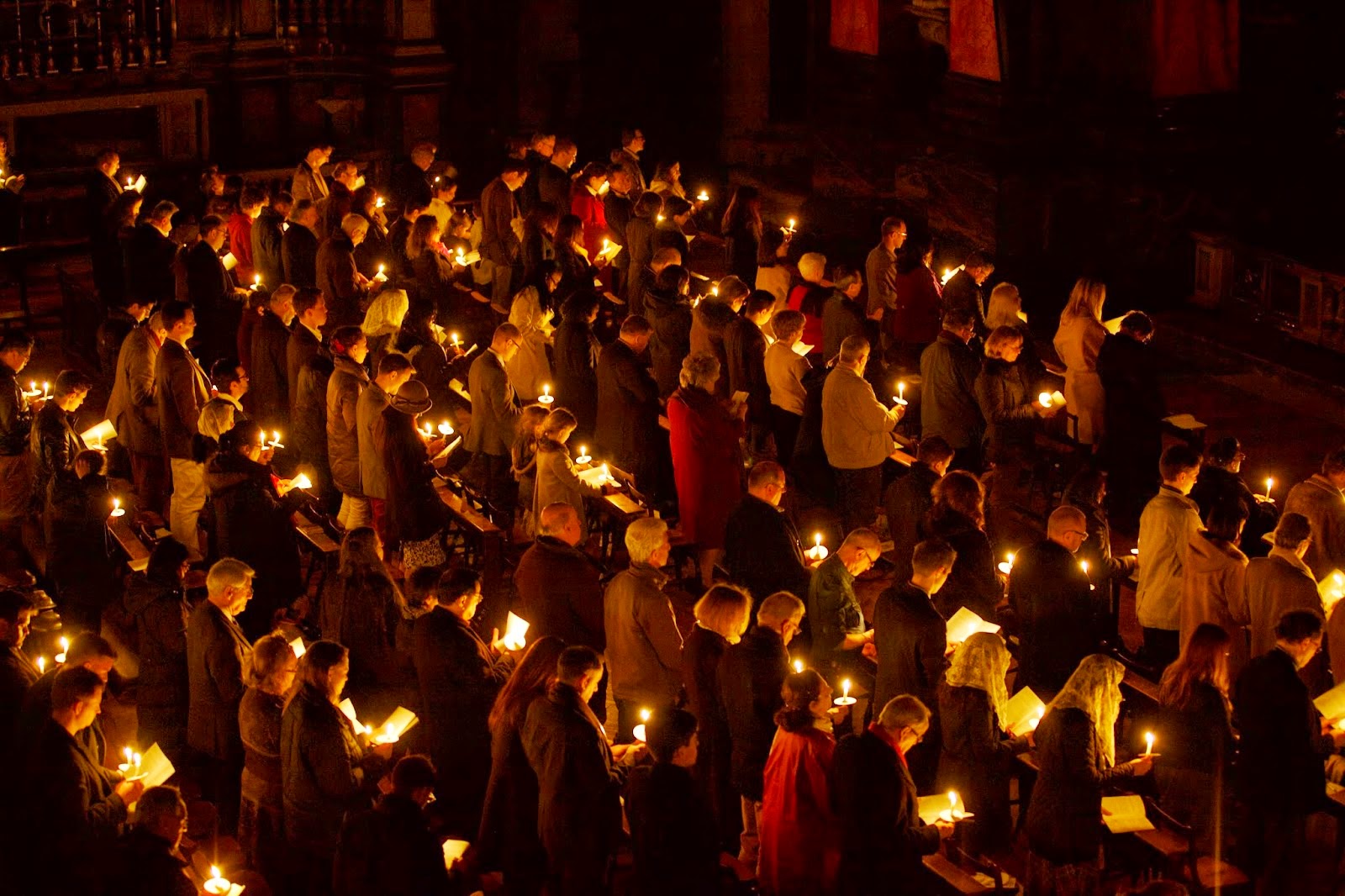
The Lumen Christi procession at the London Oratory


Introduction


All camps agree that in the ancient Church, the early Christians observed quite a few vigils: all-night observances ending with Mass before or at dawn. The otherworldly zeal which the first Christians had paid no mind to staying awake and fasting all night long, listening to one reading from Scripture after another, and singing hymns. The Easter Vigil was the most sacred of all, with a whole host of its own rites: the great fire, the Paschal candle, the singing of the Exsultet, endless readings from Scripture, and particularly, the baptisms of dozens of even hundreds of converts. As the centuries of Christianization went on and the medieval parish's boundaries approached just about a 100% rate of baptized adults in the area, there was no longer any need for the Vigil to extend from midnight to dawn. The Church's ancient rules on fasting for holy Communion, however, remained. As long as the Vigil began on Saturday night, any priest who was tasked with celebrating the Easter Vigil Mass had to fast from all food and water through the entire day until after the Vigil had ended. By then, it would be Sunday morning; therefore, the priest would have gone without eating anything for over a 24-hour period.

The medieval Church, like the Church in every other era, was faced with a "pastoral" dilemma: change the fasting rules, or change the starting time of the Vigil? The Church held the traditional Communion fast from midnight so sacrosanct that it wasn't revised until 1953 (when Pope Pius XII issued the apostolic constitution Christus Dominus, reducing the fast to only three hours). Instead, from the 7th or 8th century onward, we see evidence of the Easter Vigil being pushed, gradually, earlier and earlier until the whole rite was performed in daylight. 

Where the liturgical purists part ways is on exactly when this development took place, and whether it was a gain or a loss. I've assembled some of the most common pro-morning arguments and my answers to them below.


Antiquity vs. innovation


Pro-morning argument: Regardless of the Easter Vigil's origins as a night service, the pre-1955 starting time on Holy Saturday morning has been hallowed by time to the point that it should now be considered traditional. Bugnini's reversal is an example of the kind of "exaggerated and senseless antiquarianism" which Pius XII condemned in Mediator Dei.

Response: First, it was Pius XII himself who approved the restoration of the Easter Vigil to the night, so the move couldn't have fallen under the Pope's own definition of an antiquarianism.

Second, the question of "tradition" is tricky for many arguments extending well beyond that of the Easter Vigil. The pro-morning camp correctly point out that the Latin word traditio signifies something that's passed down from one generation to the next, without interruption. Once it's dead, it's dead; and so, a revival of a dead custom can't be said to be "traditional", strictly speaking.

In the mid-19th century, though, the monks of the abbey of Solesmes weren't satisfied with the decrepit state of liturgical music in their day. In the cathedrals and chapels of the elite, "traditional music" meant the orchestral Mass settings of Mozart and Haydn. For everyone else, they were the saccharine vernacular hymns sung over the priest at low Mass, or at best, harmonized psalm tones of the proper chants. It was only through monumental efforts by Solesmes, the first Liturgical Movement, and the backing of Rome itself that Gregorian chant enjoyed its short-lived revival until the post-Vatican II era banished it back to the album collections of classical and choral music enthusiasts. Nonetheless, all Roman Catholics who self-identify as "traditionalists" recognize that Gregorian chant is the traditional music of the Latin Rite in a greater sense than the literal. It doesn't matter whether the vast majority of chant directors at Latin Mass communities today learned chant from books and CD's, rather than a retreat at a monastery in France. In this case, the power of tradition has transcended the ignorance of succeeding generations. And, I dare say, this understanding of tradition must prevail once the last generation of people who were born before 1965 pass away. Elsewise, traditionalists must condemn themselves to calling the "traditional" Latin Mass itself as an antiquarianism, and the reformed rite the true standard of tradition.

Third, to the question of the morning Easter Vigil's own antiquity, there is surviving evidence that this wasn't a settled question until the Counter-Reformation of the later 16th century. The historian James Monti, author of my favorite biography of Saint Thomas More, has also published a number of excellent works on the historical development of the liturgy, and on the Holy Week rites in particular. Monti dedicated a few pages to the timing of the Easter Vigil in his book A Sense of the Sacred: Roman Catholic Worship in the Middle Ages. According to him, the first stage of medieval development was to bring the timing forward by beginning the Vigil's rites in the afternoon, but ensuring that they wouldn't end before nightfall. This is because Christ rested in the tomb until the some time, known only to Him, during the night of Holy Saturday.
"In fact, several texts from this period, including the late ninth-century pontifical of northern France formerly known as the Pontifical of Poitiers, speak of ensuring that the vigil Mass, beginning with the Kyrie and the Gloria, would not commence until eventide: 'Care should be taken, however, with all solicitude, that the Gloria in excelsis Deo on this night not be begun earlier than a star should appear in the sky.'"

Nonetheless, there's still a fascinating medieval precedent to the desire to restore the Easter Vigil to the ancient nighttime observance:
"An effort to restore the entire Easter Vigil to its ancient nocturnal setting was undertaken by Saint John Gualbert (+1073), founder of the Vallombrosan Order, a Benedictine congregation of Italy, as related by his biographer Blessed Andrew of Strumi (+1097): 'Who in Tuscany other than he moved from the day to the night the annual and renowned office to be done on the night of the holy Resurrection? For with stealthy negligence and gathering gluttony this office was performed at None on Saturday, that is now rightly and worthily done in the holy night, this our father John beginning and establishing in our times.' Thus the Easter Vigil rubrics of the twelfth-century customary of Vallombrosa direct that the blessing of the Easter fire with which the vigil begins is to commence only when 'the dusk of night shall have begun to appear.'"

And, Monti provides one final sign that the nighttime Vigil persisted in some places until the eve of the Reformation:
"The Holy Saturday rubrics of the 1498 missal for the Portuguese see of Braga state: 'On this day, however, None should be sung more slowly [than] usual. And this is to be observed such that the office should be drawn out, that the Mass may be said in the night.'"

The final nail in the coffin of the night Vigil was Pope Pius V's bull of 1566, Sanctissimus, which finally banned priests from celebrating Mass after noon. (As I said earlier, the first Mass of Christmas, so long as it began at or after midnight, eluded the ban.) These regulations later carried over into the Missal of 1570, which became adopted as the standard for nearly the entire western Catholic world. This was based on the reckoning of the age that the liturgical day began at midnight. However, the breviary reforms of Pope Pius X at the turn of the 20th century, whatever their other flaws, at least restored the ancient concept that a greater feast, such as a Sunday (and certainly the Vigil of Easter) began with First Vespers on the evening prior. I'm not sure why the celebration of Mass during the eves of these feasts required further permission, which didn't arrive until the 1950's.

The London Oratory again

The integrity of the Hours


Pro-morning argument: Moving the Masses of the sacred Triduum to later hours completely disrupted the traditional cycle of Tenebrae and the other hours of the Divine Office that had been long established.

Response: Conceded..... partially. Since the question of Tenebrae doesn't touch the Easter Vigil, I'll save that discussion for another day. The Holy Week revisions decree that Compline (Night Prayer) for Holy Saturday is now omitted since the Vigil takes its place. While someone could certainly pray Compline privately for devotional reasons in any case, there's no way to beat around the fact that as long as the Easter Vigil takes place at night, it's simply too taxing for us moderns to demand a public observance of Compline afterward; notwithstanding the other small fact that Compline is unlikely to be prayed publicly in any case.

The decrees state that Vespers (Evening Prayer) is "said after noon at the accustomed hour". But then, there's the problem of Matins and Lauds (Morning Prayer). As it stands now, the 1962 Missal attaches Lauds to the end of the Easter Vigil as a means of conclusion. This actually has the effect of exposing the ordinary lay faithful to Lauds in the first place; for most traddies, the mandatory inclusion of Lauds to the end of the Easter Vigil will be the only Lauds they ever attend in their lifetimes.

The purists rightfully point out that by jamming the Vigil in between Vespers and Lauds, this means Matins of Easter Sunday has been abolished. To be specific, the 1962 Breviary and its modern successor, the Liturgy of the Hours, still provide Matins of Easter Sunday, but only for those who didn't attend the Easter Vigil. Since most churches will celebrate the Easter Vigil, this means public observances of Easter Sunday Matins would be quite rare. Dom Prosper Gueranger describes how Easter Sunday Matins and Lauds were kept with the greatest of solemnity in medieval times, at least where the Vigil had slinked into Holy Saturday morning:
"Matins of Easter Sunday morning used to be celebrated in a most dramatic manner. In most of the churches of the West during the Middle Ages, as soon as the third Lesson was read, and before the Te Deum, the clergy went in procession, singing a Responsory, to the chapel where the Blessed Sacrament had been kept since Holy Thursday, which was called the Chapel of the Sepulcher. Three clerics were vested in albs, and represented St. Mary Magdalene and her two companions. When the procession reached the chapel, two deacons, in white dalmatics, representing the two Angels who were standing at either end of the tomb, thus addressed the three clerics: Whom seek you in the sepulcher, friends of Christ? The clerics answered: Jesus of Nazareth, O ye citizens of Heaven! Then the deacons: He is not here; He hath risen as He foretold: go, say that He is risen.
The three clerics here went to the altar, and raising up the cloths which covered it, they reverently kissed the stone. Then turning towards the Bishop and the clergy, they sang these words: Alleluia! This day the Lord hath risen: the strong Lion, Christ the Son of God, hath risen.
Two cantors stepped forward towards the altar steps, on which the clerics were standing, and addressed them in these words of the Sequence: Tell us, O Mary, what thou sawest on thy way?
The first cleric, who represented St. Mary Magdalene, answered: I saw the sepulcher of the living Christ: I saw the glory of the Risen One. The second cleric, who represented Mary the mother of James, added: I saw the Angelic witnesses: I saw the shroud and cloths. The third cleric, who represented Mary Salome, completed the reply thus: Christ, my Hope, hath risen! He shall go before you into Galilee. The two cantors answered with this profession of faith: It behooves us to believe the single testimony of the truthful Mary, rather than the whole host of wicked Jews. Then the whole clergy joined in this acclamation: We know that Christ hath truly risen from the dead. Do Thou, O Conqueror and King, have mercy on us!
The two deacons then opened the tabernacle. Taking the pyx, in which was the Blessed Sacrament, they laid It upon a portable throne and carried It in procession to the high altar. Clouds of incense perfumed the way while a beautiful Responsory was sung. The procession having reached the sanctuary, the deacons placed the Blessed Sacrament upon the altar. The Bishop, after offering the homage of incense, intoned the Te Deum, in thanksgiving for the Resurrection of Our Redeemer.
This touching ceremony, from which probably originated what were called The Mysteries, was not officially part of the Roman Liturgy; still, it was an expression of the lively and simple faith of the Middle Ages. It gradually fell into disuse during the 16th and 17th centuries, when men became absorbed in material things, and lost that appreciation of the supernatural which their forefathers loved to encourage by every possible means. The ceremony we have just described varied in the manner of its being carried out; but we have given its chief traits, such as we find them mentioned in the ancient Ordinaries of great cathedrals." (The Liturgical Year)

My solution for those who regret the removal of Easter Sunday's Matins is simple: keep the pre-1955 order of the Vigil, and merely delay it until just past sunset. You'll have energy enough to restore the Vigil's nocturnal character, and then (hopefully) arise early enough to celebrate Sunday Matins and Lauds with all the solemnity of former times. This might be especially worthwhile for those who chose not to attend the Vigil at all. As to the legality of using the pre-1955 ceremonies, I'm not well-read enough on that question to make an argument in favor of it, but it seems many churches of the Institute of Christ the King get away with it without stormtroopers from the Curia bearing down on their doorsteps.


The First Saturday devotion


Pro-morning argument: Moving the Vigil of Easter to the evening prevents those who have a devotion to receiving Communion on the first Saturday of every month from doing so on the month where Easter falls.

Response: This would be unworthy of even mentioning in this post if I hadn't personally run into this objection more than once. My answer is simply that this is an overly legalistic reading of the First Saturday devotion. Common sense suggests that Communion can simply be commuted to the Vigil, if not any of the Masses of Easter. For those who need complete reassurance, though, this article on the World Apostolate of Fatima, USA explains how the devotion can still be fulfilled by attending the nocturnal Easter Vigil.


The Easter fire at Clear Creek Abbey

Saturday, April 4, 2015

Holy Week at Westminster Cathedral, 1939

A friend forwarded me this old post from the Saint Lawrence Press blog. It's a snippet from a 1939 issue of The Tablet with Westminster Cathedral's Holy Week schedule for that year. See below:


Three observations:

1.) They're using the pre-1955 times, like having the Easter Vigil on Saturday morning. I'm actually not in favor of those (except for retaining Tenebrae at night), but one has to respect just how robust the services are. According to Rubricarius, this schedule is only listing the "highlights", too. All the Divine Hours were regularly observed at Westminster in these days.

2.) Westminster's schedule today seems rather paltry by comparison. See here.

3.) Easter Sunday sermon to be given by "the Rt. Rev. Mgr. Canon M. Howlett, D.D., Ph.D." I'm not sure if this species of priest even exists anymore.


All articles in my Holy Week 2015 series, short and long


Palm Sunday in Sarum

Palm Sunday 1461: the bloodiest battle of the Middle Ages in England

The kiss of peace (for Spy Wednesday)

The mandatum: Maundy Thursday and stinky feet

The Easter sepulchre

Holy Week at Westminster Cathedral, 1939

A medieval defense of the nocturnal Vigil of Easter

The Exultet and "Lucifer"

The Exultet scroll: the Powerpoint of medieval Italy

Terra tremuit! (the Offertory antiphon of Easter Sunday)

Thursday, April 2, 2015

The mandatum: Maundy Thursday and stinky feet

The kings of medieval Europe washing the feet of beggars
It's another Maundy Thursday, the first day of the Easter Triduum: it's a busy day, with the consecration of holy oils for the upcoming year by the bishop at his cathedral, the washing of feet in remembrance of Christ's new commandment ("to love one another as I have loved you"), and most importantly, to commemorate the last supper, the first Mass, on the night He was betrayed.

Maundy Thursday also means another slew of pictures of Pope Francis washing random marginalized people's feet to the fawning of his fans and eye-rolling of a tiny minority of skeptics also called traditionalists. This year, as usual, the Vatican announced well in advance that the Pope will be celebrating the Mass of the Last Supper at a prison and washing the feet of inmates. We can expect, based on previous publicity stunts in the reign of Francis, that the selection of people to be washed may include a Muslim or two.

The New Liturgical Movement just posted an article to let Catholics know that the rubrics of the modern Roman Mass make the mandatum, the rite of foot-washing, merely an option; but if it is to be used, the people to be washed must be male. It's all quite sound from a legal point of view. The article is completely correct: at the Mass of the Last Supper, only men's feet can be washed. But there's an elephant in the room: the fact that Pope Francis himself has washed women's feet on this day in the past, and has even made quite a media spectacle of it. Some apologists point out that, since Francis is the Pope, he's above the law and can do whatever he wants in the liturgy, including washing women's or Muslims' feet. Again, strictly speaking, that's true... though since he was also known to wash women's feet during his time as archbishop of Buenos Aires, while he was still fully subject to liturgical law, this entire line of argument reeks of the papal positivism; the "because he's the pope" mentality that's permeated the faith for well over a century.

The mandatum, Francis-style.
Back when I was a Seventh-day Adventist, our church, a few times a year (not Maundy Thursday), though it wasn't big on ceremonies of any kind, practiced foot-washing. Basically, a bunch of buckets were distributed, and everyone washed everyone else's feet. It wasn't just a ceremonial pouring of water, though. No, we had to get between the toes and everything. When I became a Catholic, the foot-washing rite during Maundy Thursday was something I could readily identify with. It signified to me that Catholic priests, too, were willing to bend the knee to others and show that they were ready to serve their flock, not just rule their souls. This is why the rite on Maundy Thursday is called the mandatum. Traditionally, as the priest goes to wash the first foot, the choir sings an antiphon from John's gospel: Mandatum novum do vobis ut diligatis invicem sicut dilexi vos. "A new commandment I give unto you, that ye love one another; as I have loved you." The mandatum, the commandment, is even how this day came to be called "Maundy".

Up until yesterday, I actually never thought much about the liturgical law which restricts it to men. When I first became Catholic, I learned that twelve men are chosen to represent the twelve Apostles whom Christ ordained that day as the first priests of the Church. Since only Catholic men can become priests, Pope Francis's spectacle of washing the feet of women or non-believers seemed to be a deliberate subversion of the traditional understanding.

The mandatum in the Benedict XVI era, at Saint John Lateran.
But then, in the course of my usual readings of liturgical history, I discovered that the mandatum wasn't even performed during the Mass of the Last Supper until 1950.

At that point, I came to the conclusion that all talk of what is or isn't "traditional" bears much closer investigation before issuing a verdict on the curious case of Pope Francis. I haven't been able to learn a whole lot more since then, but here's what I've been able to piece together so far:

1.) The practice of foot-washing is ancient, predating Christ to time immemorial. The first reference to it in Scripture is a mention of Abraham offering to wash the feet of the three wayfarers in Genesis 18. In a middle Eastern and Mediterranean culture, people typically wore sandals and gathered dust over their bare feet every day. The foot-washing was part of an ancient rite of hospitality, an aspect which is perhaps lost on northerners and moderns whose feet are enclosed in shoes or boots. Furthermore, the Rule of Saint Benedict, first written in the 6th century, ordered monks to receive all guests by washing their feet, as well as pouring water over their hands.

2.) Nonetheless, the rite of the mandatum wasn't always a part of Maundy Thursday ceremonies. Saint Augustine's letters suggest it wasn't universally accepted in his day. In Spain, though, the third set of canons of the Seventeenth Council of Toledo (A.D. 694) mandate its use everywhere on pain of excommunication: "Since Our Lord has not disdained to wash the feet of His disciples, why should we refuse to emulate the example He gives us? It now happens that, partly from slackness, partly from custom, in sundry churches the priests no longer wash the feet of the brethren on Maundy Thursday."

3.) The mandatum had come into use in Rome itself by the 7th century, where the Roman Ordo in Coena Domini instructs the pope to wash the feet of his attendants; though not, it seems, during Mass itself. The next mention of the mandatum among Roman sources doesn't come up again until Roman Ordo 11, dating to the 12th century. There, the pope has two ceremonies: one in public, where he washes the feet of his subdeacons... and one in private, in his apartments, where he washes the feet of thirteen poor men. It seems the medieval popes wanted to cover both bases: the sacerdotal and the servile.

4.) In imitation of the popes and archbishops, the medieval kings of Europe also washed the feet of the poor on Maundy Thursday. Saint Elizabeth of Hungary was known to wash the feet of twelve lepers. Until the 20th century, the kings and queens of Spain washed the feet of twelve poor men and twelve poor women, respectively, every year after Maundy Thursday Mass in the royal chapel. All were also provided with new clothes. James Monti's The Week of Salvation relates one story: when Queen Isabella II's diamond bracelet fell from her arm into the water, the woman being washed reached down to give it back to her, but the queen said, "keep it, mia hija; it is your luck."

Maundy money in Elizabeth II's reign
5.) The kings of Great Britain still practice the "royal Maundy" service to this day, where alms in the form of specially coined "Maundy money" are still given out; though the footwashing itself fell out of practice after the last Catholic king of England, James II, was overthrown. His successor, the Protestant William III, apparently wasn't much for smelly feet. William eventually stopped showing up to the services altogether, passing it on to the royal almoner. It was only in the 20th century, with George VI (Queen Elizabeth II's father), that the kings began to personally participate in the Royal maundies again.

6.) What about at the local parish? It seems that having a mandatum (in its own rite, apart from Mass) was widespread in the Middle Ages, but gradually waned through the Counter-Reformation (the 16th century) until, by the 20th century, it was dead (though still on the books as an official Holy Week rite).

7.) With the 1950-1955 Holy Week reforms, the mandatum was inserted into the Mass of the Last Supper itself, giving it more prominence than ever before.

And now, here we are, back in the 21st century. What did that romp through history tell us? First, while the washing of feet is a powerful sign of Christ's ordaining the first priests, that's not the original reason. We can call that a legitimate development, but the association of the mandatum with the poor has been there since its introduction. Second, including the mandatum into the Mass itself opens the rite up to a sort of criticism that wouldn't otherwise exist. The Mass of the Last Supper is bound up with the institution of the first Mass, and that significance is arguably lessened by merging it with the mandatum of the poor.

Still, omitting the mandatum entirely just to avoid the politics around excluding women at Mass is, in my mind, a case of throwing the baby out with the bathwater, just as with the omission of the kiss of peace (which I described in another article earlier this week). Traditionalists may think they're tainted with touchy-feely sentimentalism; and they are; but they're also venerable signs of what it means to be a Christian.

Father Sean Finnegan left an interesting comment on the New Liturgical Movement article I linked you to at the beginning of the post. He wrote,
"I have recently taken over a parish where washing women's feet is routinely done. So I have decided to try delving into liturgical history. In the Sarum Use, the Mandatum took place at lunch (after the Solemn Mass in those days, of course), with the High Priestly Prayer of our Lord being read. Not only would the 'presider' wash others' feet, but all would participate, washing and being washed. Finally, a loving cup was shared. I am going to try that here this year: we will have an 'agape' simple meal in the evening, long enough before the Mass to observe the liturgical fast. We will all, men and women, wash each others' feet, and share a loving cup as the account of the Last Supper is read from St John's Gospel. Then, at the Mass of the Lord's Supper, we will omit the Mandatum entirely, as the rubrics permit. Hopefully, this way everyone will be happy."
(For more info, Father Finnegan has a blog article from 2009 detailing the Sarum mandatum rite here. Like many other rites in the Sarum Missal, it was written with cathedral usage in mind and assumes that one has a chapter house.)

That seems like the perfect resolution to the problem, and I wish something like it was offered here in my city. If I can find the text of the Sarum Use's ceremony, or even the pre-1955 Roman ceremony of the mandatum outside of Mass, I'll share it with you.


All articles in my Holy Week 2015 series, short and long


The kiss of peace (for Spy Wednesday)


Terra tremuit! (the Offertory antiphon of Easter Sunday)

Wednesday, April 1, 2015

The kiss of peace


Did you know that every 31st of March is International Hug a Medievalist Day? I didn't, until a few days ago, but since hugs weren't forthcoming for yours truly, I instead thought to write about that curious public display of affection known to all of our medieval forebears: the kiss of peace. Does it sound strange and foreboding? On the contrary, many of you are already familiar with it, in a way. So before we travel back to the past, let’s take a look at our present surroundings.

On any given Sunday at your typical suburban Catholic parish down the street (or Episcopal, or Lutheran, depending), right before the moment of Communion, we’re treated to someone solemnly announcing: "let us offer one another a sign of peace". Then, to prepare to receive God almighty in the form of bread and/or wine, we turn to all the corners of the earth; north, south, east, and west; to display all around us our best Christian faces and administer the sign. In this country, we default to the venerable handshake of antiquity, but other local traditions make use of the back-pat, the first-bump, the brotherly mansqueeze, or, for the more chaste among us, the hoverhand. The traditional salute, "peace be with you", can then serve as an opening to delve further into the mysteries of Christian fellowship. "Beautiful day out, eh?", or "did you catch last night’s game?" The silent nod of understanding between two believers who know precisely which game is dwelt upon completes the preparation for modern man’s Communion.

That’s the narrative that the powers-that-be want us to believe, anyway. The "sign of peace", as we know it today, was introduced to Catholics in 1970, courtesy of the reformed order of Mass. Most ordinary believers in the pews probably had no idea what to do or even what the significance of the rite was. I can only imagine priests in those first years of the new liturgy goading their flock on by leading by example: descending from the altar of sacrifice to smack palms with everyone in the first rows. Some forty-odd years later, they still haven’t been able to convert us all. A few of the most liturgically conservative priests who still celebrate the new Mass exercise the little-known option of omitting the peace entirely. Other believers bask in the peacelessness of the traditional Latin Mass communities, gloating to the plebs stuck in Novus Ordo land that they didn’t have to make physical contact with anyone else that Sunday. Other traddies who get stuck in a modernized church to please grandma have been known to shove their hands in their pockets or kneel and play the role of the suffering servant, mentally transporting themselves onto the cross amidst the jeers and shouts of the vulgar crowds at Calvary, by all appearances as forlorn and engrossed in the great mysteries as possible.


But, what if I told you that the sign of peace is traditional? The crucial distinction is that I speak not of just any sign; not the handshake of peace, nor the bro-hug of peace, nor the fistbump of peace; but the kiss of peace. In the traditional Latin Mass's solemn form, the priest must still, after kissing the altar, embrace the deacon, who in turn embraces the subdeacon, the subdeacon the master of ceremonies, each member of the choir, and so on in a great chain of succession. It's even performed in the same place as in the modern form of Mass, after the Lord's Prayer and before the Communion. But what a difference in the spirit of the act! Gone are the awkward handshakes and jumbled "peace be with you's". In their place, the two traditional rite calls on the one giving the peace to soberly place his hands on the receiver's shoulders, lean in close to the receiver's right ear, and say, Pax tecum ("peace be with you"). The receiver answers, Et cum spiritu tuo ("and with thy spirit"), then turns to pass the peace to the next minister. And here, we learn why the rite is traditionally not called the "sign" of peace or even the "kiss" of peace, for there is no actual kiss, nor is it merely a symbol of a thing that already exists: it is an actual conferral of peace, in an unbroken line from Christ at the altar to the last receiver. It is the pax.


The origins of the pax

The kiss has been used in the Church since the first days. So Saint Paul tells the Romans, "salute one another with a holy kiss", and Saint Peter writes in his first epistle, "greet ye one another with a kiss of charity". By the second century, the kiss was a part of the liturgy. Saint Justin Martyr described divine service in his day: "when we have completed the prayers we salute one another with a kiss, whereupon there is brought to the president bread and a cup of wine". Here, and elsewhere throughout early Christendom, the kiss of peace was exchanged between the faithful before what would later come to be called the Offertory of the Mass. The reasoning is obedience to the teaching of Christ in the Gospel: "if, therefore, thou offer thy gift at the altar, and there thou remember that thy brother hath anything against thee; leave there thy offering before the altar, and go first to be reconciled to thy brother: and then coming thou shalt offer thy gift".

But in Rome, perhaps after Pope Gregory the Great’s reordering of the Canon, or even earlier, the pax was moved to its current place after the Lord’s Prayer and before Communion, and given a new significance. No longer was the pax merely an act of reconciliation to one's brother, though it was still that. But now, it led directly into the paschal mystery, forming part of the preparation for Communion. In those early medieval days, the pax was still clearly intertwined with the act of receiving the body and blood of the Lord. Michael Foley's abstract on the pax cites two examples: first, a homily from Gregory the Great of some monks who are convinced they are about to be shipwrecked, then make to exchange the pax and receive Communion in preparation for their deaths. And second, the example of Saint Mary of Egypt, who gave the monk that brought her the Eucharist the pax. Until recently, the pax was omitted at the requiem Mass and the Good Friday liturgy, probably because the Communion of the faithful, too, was absent on these days.

In those first centuries of Christianity, the pax was a kiss on the lips. The fact that such a gesture between two men in our society today is inescapably homoerotic is a major reason why the architects of the Vatican II liturgical reforms suggested the handshake in its place. But in the 1st century AD, it was not so. When the Passion says that Judas betrayed Jesus with a kiss, we can know that Christ Himself wasn't averse to the practice. But as the years went on, and the first fire, the innocency of Christians' faith waned, problems arose. The kiss on the lips was still considered an intimate act between either family members (of which the entire Church was considered one's spiritual family then) or lovers. Saint Clement of Alexandria complained of what the kiss had become in his day: disruptive and lascivious when exchanged between men and women. The pax was then forbidden to be exchanged between the sexes. By the Middle Ages, it had become customary to see this enforced by keeping men and women on separate sides of the church. I'm not sure when this practice fell out of use in the west, but the 1917 Code of Canon Law still recommends it. And, of course, many eastern rite churches maintain the separation of the sexes, with men on the right and women on the left, to this day.


The pax had a second period of decline at the turn of the second millennium, when Christians in the west gradually fell out of the habit of receiving Communion every Sunday. Whether this was out of increasing reverence for the sacrament's purity and a heightened sense of their own unworthiness, a spirit of toward the act of actually receiving the Eucharist, or a combination of both, I can't say. But as regular communing of the faithful declined, so too did the pax since, at this time, it was still viewed chiefly as an act of preparation. But, whereas the medieval Church made no serious measures to promote regular Communions, it did make great efforts to keep the people exchanging the pax. The English introduced a new way of exchanging it: the pax-brede, an icon of the lamb of God, which the people could come forward to kiss at the rood screen almost in lieu of receiving Communion. The paxbredes were typically of silver, but could also be made of ivory or other precious materials. Poorer churches that couldn't afford to order one would substitute a crucifix or book of the Gospels in its place. The English pax-brede caught on quickly and thence spread to the rest of western Europe.


Alas, man's fallen nature got the best of him yet again, and there was yet another period of abuse and decline in the 15th and 16th centuries, at the eve of the Reformation. You'll recall earlier how I described the hierarchical order of the pax in the traditional Latin Mass today: priest, deacon, subdeacon, and so on through the rest of the sanctuary according to rank. This was true in the medieval world, too; but when an entire congregation is to exchange it, now it suddenly becomes a lot more complicated. Who's to say whether the baker ought to kiss the pax before the miller's daughter? What was meant to establish peace between the members of Christ's Church instead became a point of division. So Eamon Duffy writes in his essential work, The Stripping of the Altars:
'In 1494 the wardens of the parish of All Saints, Stanyng, presented Joanna Dyaca for breaking the paxbrede by throwing it on the ground, "because another woman of the parish had kissed it before her." On All Saints Day 1522 Master John Browne of the parish of Theydon-Garnon in Essex, having kissed the pax-brede at the parish Mass, smashed it over the head of Richard Pond, the holy-water clerk who had tendered it to him, "causing streams of blood to run to the ground." Brown was enraged because the pax had first been offered to Francis Hamden and his wife Margery, despite the fact that the previous Sunday he had warned Pond, "Clerke, if thou here after givest not me the pax first I shall breke it on thy hedd."'

The pax-brede fell out of the mainstream later into the Counter-Reformation, and in the few places where it's still used today, it tends to be restricted only to the clergy or special dignitaries.


Sacralizing the secular, secularizing the sacred

Before we shake our heads at this litany of failure and consign the pax forever into the dustbin of liturgical history, I'd be remiss if I didn't at least mention how this rite transformed medieval society itself. The kiss found its highest expression in the pax, but it permeated other rites as well. The new initiate into the faith was given the kiss after baptism. The newly ordained priest, or the consecrated bishop, completed his elevation to holy orders with the kiss. But then, the secular world started to adopt it, too. Alongside the priest, the newly dubbed knight completed his oath to his lord with the kiss of peace. The kingdoms and principalities of this turbulent era also adopted the kiss of peace as an alternative to taking an oath to end hostilities. When King Henry II and Saint Thomas Becket finally came to a settlement after years of fighting over the rights of the see of Canterbury, Thomas demanded that they, and his safe passage back to England, be guaranteed not by oath, but by a kiss of peace.Even though everything was arranged, Henry backed out over this one condition, saying that he had sworn an oath never to give the kiss of peace to Becket ever again. For whatever reason, Henry wouldn't relent, even though the Pope offered to absolve the king of his oath, and so, the reconciliation was stalled for over a year over what would call a trifling matter of ceremony today. Eventually, Becket consigned himself to return to Canterbury without the kiss. Days later, without the guarantee of security that the kiss granted by sheer power of social custom, he was murdered by four of Henry's knights in his own cathedral.

In our modern world, as with so many other things, it looks like we've got this one backwards now. The medieval Church brought the truce of God to the tables of kings and sanctified diplomacy with the kiss of peace. The modern Church, following the Second Vatican Council reforms, chose to restore this tradition in a debased form by substituting the common handshake (or bow, or other secular gesture of respect) in the kiss's place. The effects, as I described in the beginning of this post, are apparently intentional. (See this article by Father Thomas Reese, who writes with approval, "The kiss at the end of the Liturgy of the Word symbolizes the community acceptance of the message they have just heard. They are 'shaking on a deal.'"

G.K. Chesterton once said, "The reformer is always right about what is wrong. He is generally wrong about what is right." The liturgical progressives were right that we couldn't possibly go back to full kiss on the lips in this culture; but they were wrong to artificially restore this rite by imposing it upon the laity in a dumbed-down fashion. Even in the Church's first years, it was spoken of as the "holy kiss", set apart from the salutations of the world. 

The pre-conciliar Church isn't entirely without fault. The rubrics of the old Missal mandated the pax by amplexus (the embrace) only at solemn high Mass, but by the 20th century, this form was rare enough that many Catholics lived and died without ever having attended one. It permitted the choir and lower ministers to receive the pax by use of the pax-brede at sung and low Mass, the more commonly attended forms, but it was rarely ever taken into action. What did the Church's leaders after Vatican II think would happen to the peace if the vast majority of laypeople had never seen it exchanged properly, other than total chaos?

My solution is simple. It's based on the premise that a venerable tradition like the pax ought to be preserved. First, for traditional Latin Mass communities, to celebrate solemn high Mass as often as possible and see that the pax is exchanged by all vested ministers and choristers in the sanctuary. But, if sung or low Mass is offered, take advantage of the old Missal's permissions and see that the pax is exchanged between the priest and all other ministers by the use of a pax-brede (or crucifix or similar icon) at all Masses, even if there's just the one lowly server present. Second, for the reformed order of Mass, omitting the pax entirely seems like a mere stopgap solution, a temporary fix for that seems good in the short term, but ultimately amounts to another total removal, just like the prayers at the foot of the altar, the Last Gospel, and a whole host of other so-called medieval accretions (as though that were a bad thing). Omit the deacon's invitation for all to "offer one another a sign of peace", yes. But let the priest and all the ministers be taught to exchange the pax just as in the traditional order of Mass, as though there were nothing abnormal about it at all. Then, after the course of years, when the people have seen the gravity and solemnity of the traditional pax as a step in the paschal mystery, emanating from Christ's peace at the altar, perhaps we would all walk away with a better understanding of those words of the liturgy: 
"O Lord Jesus Christ, who saidst to Thine Apostles, 'Peace I leave with you, My peace I give unto you': regard not my sins, but the faith of Thy Church: and vouchsafe to grant her peace and unity according to thy will"


All articles in my Holy Week 2015 series, short and long


The kiss of peace (for Spy Wednesday)


Terra tremuit! (the Offertory antiphon of Easter Sunday)