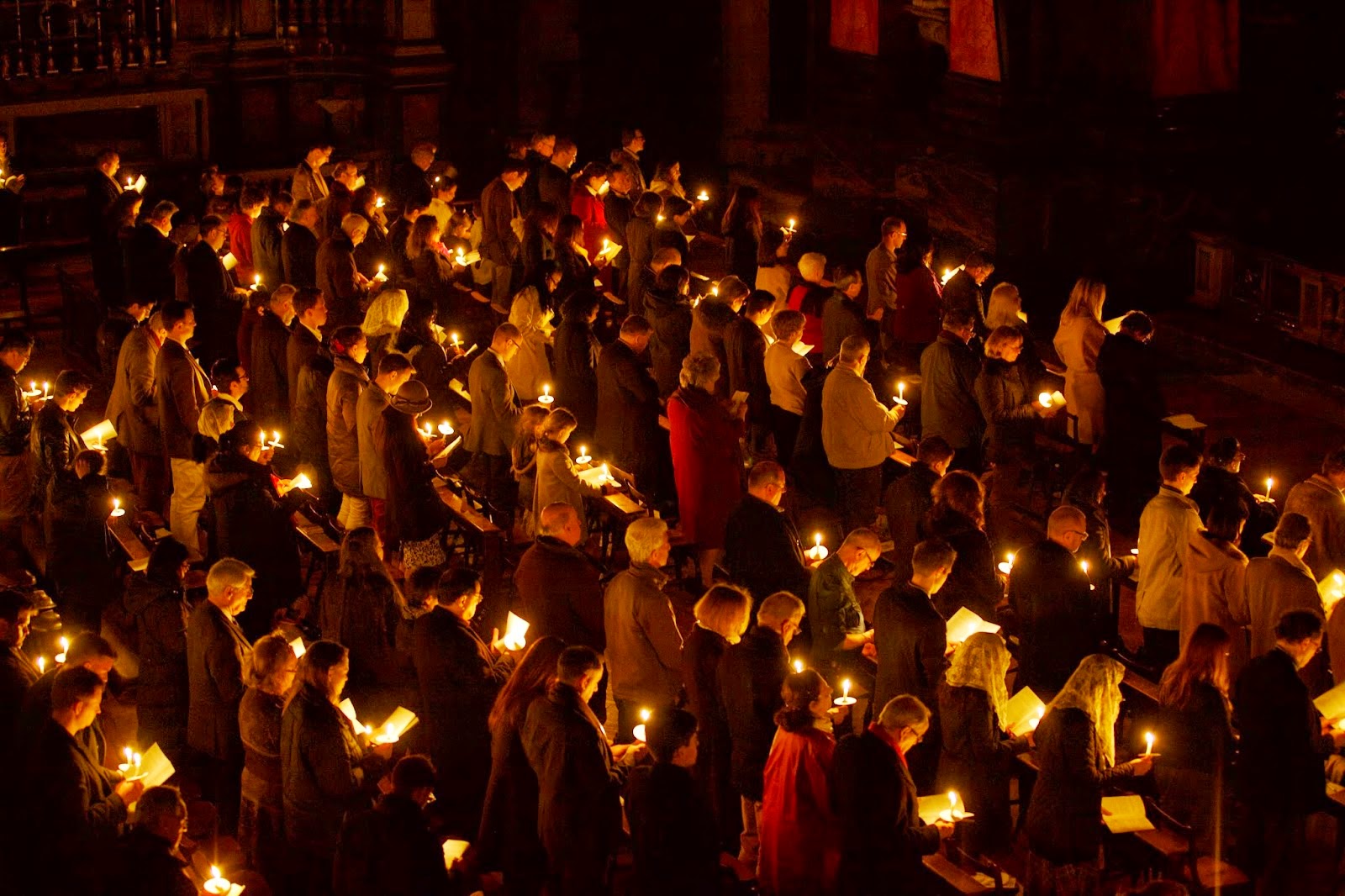
The Paschal candle, made afresh every year and inscribed with the date and the symbols alpha and omega, is a sign that Easter remains with us: not just for one day, or forty days, but all year long. After Pentecost, the Paschal candle is moved from its place in or around the sanctuary to the baptistery, where it stands beside to be burned whenever a christening is to take place. There's not much I can add to this which you can't read about in the Catholic Encyclopedia, but I wonder if any of you noticed how much larger the candles appear to be in those Exultet scrolls from yesterday's post? I highlight one passage from the Encyclopedia's article below:
"Naturally the medieval tendency was to glorify the paschal candle by making it bigger and bigger. At Durham we are told of a magnificent erection with dragons and shields and seven branches, which was so big that it had to stand in the centre of the choir. The Sarum Processional of 1517 directs that the paschal candle, no doubt that of Salisbury cathedral, is to be thirty-six feet in height, while we learn from Machyn's diary that in 1558, under Queen Mary, three hundred weight of wax was used for the paschal candle of Westminster Abbey. In England these great candles, after they had been used for the last time in blessing the font on Whitsun Eve, were generally melted down and made into tapers to be used gratuitously at the funerals of the poor (see Wilkins, "Concilia", I, 571, and II, 298)"
Thirty-six feet tall! Does anyone have a link to an illustration of these titanic candles of yore?
All articles in my Holy Week 2015 series, short and long
Yesterday, I posted two articles on the Easter Vigil: one on the glory of observing the Vigil on the night of Holy Saturday, and another on that great hymn which attests to its nocturnal character (for the deacon sings the phrase "this is the night" five times), the Exultet. Today, I bring to you a glimpse of a unique tradition that developed in southern Italy: the proclaiming of the Exultet by means of an illuminated scroll.
By the 10th century, the scroll, as a means of putting words down to posterity, fell out of fashion in favor of a handy little invention called the book. But today, we have 28 surviving, magnificently decorated scrolls from places in Italy such as Benevento and Salerno that attest to their persisting use on the holiest night of the year. What's more remarkable is that the scrolls are designed to be read vertically. Those who are familiar with the Torah scrolls still used in the synagogue know that a scroll is typically read horizontally, whether right-to-left or left-to-right. We can tell from the Exultet scrolls' structure, and some of the artworks themselves, that their holy pictures were meant to be seen by the lay faithful as the deacon sang the hymn.
There appears to have been two methods to show the scroll off to the laity. In the first, the text and neumes (the notes for the chant) were written one way, and the pictures were illustrated upside-down. The deacon sang the Exultet from the pulpit facing the people, and as he unraveled the scroll, it spilled down the face of the pulpit with the pictures correctly oriented so that the laity could see the story of salvation unfold before their eyes; quite useful in an era when the Exultet was sung in Latin to an illiterate mass.
Singing from the pulpit, or ambo
In the second method, the neumes and pictures both faced the same way. This required two deacons: one stood below the pulpit with the people, facing the same direction. The other stood at the pulpit, unraveling the scroll so that the deacon below could sing it from bottom to top.
Singing with the people below (note the two candlebearers helping the deacon below to see)
In yesterday's article, I alluded to the Exultet's role as an ode to the bees which produced the wax for the Paschal candle. Many of these scrolls appropriately have entire scenes devoted to the bees. See below:
Of course, this looks more like a horror scene than a moving religious image. All I can think of is that scene in The Wicker Man where Nicholas Cage's character is eaten alive by bees.
Below, we have the beginning of an Exultet scroll where we can easily see how the text is upside-down.
Even if we might find reading medieval script difficult, we can see that the illuminated initials are on the right.
Is the art of the Exultet scroll lost forever? So far, I've found two modern nods to this tradition on the world wide web. The first is a recreation I came across on someone's Flickr album. You can find the album here, but I'll also share a couple of images directly below. The artist began it in 2006 and the page notes that only a quarter of the text was done at the time. I wonder if she ever finished it.
The last item I found is not a scroll at all, but an attempt to bring the illuminative tradition back to the Exultet in the form of a book. I imagine that, where the Exultet is sung today, it's usually sung from a simple binder of sheet music. A few years ago, a deacon and iconographer in Alaska, awed by the Exultet scrolls of medieval Italy, set to work on illuminating a book from which to sing the hymn. The product is now for sale from under the title The Illuminated Easter Proclamation for $70 on Amazon. The version used is the revised English text for the Ordinary Form of the Roman Rite. It has 28 Byzantine-style icons throughout. Of course, since this is a book, the faithful can't see them during the liturgy itself, but the icons are also sold on a CD (here) which, I suppose, could be used to print them out onto bulletins which can be distributed to the congregation.
I've shared the first icon below: Jonah being swallowed by the whale.
Not the most obvious choice for us today, but the medieval would have remembered how Jonah had to spend three days in the darkness of the whale's belly; a foreshadowing of Christ's rest in the tomb.
All articles in my Holy Week 2015 series, short and long
One of the most spectacular rites of the Easter Vigil is the singing, traditionally by the deacon, of one very long prose called the Exultet before the Paschal Candle. While you read this entry, I invite you to listen to it below as it was sung at the "Anglican Use" parish church of Our Lady of the Atonement, where I attended the Vigil of Easter last Saturday night. The church uses a beautiful translation into hieratic English, which you may follow along with in a new tab here.
The Exultet is sung between the 3:45 and 15:50 marks
There are so many beautiful expressions of hope and rejoicing: consider the felix culpa, the "happy fault" of Adam's sin, that brought mankind to a greater good through Christ, the "blessed iniquity, for whose redemption such a price was paid by such a Saviour". And let's not forget the bees! The Exultet "waxes" poetic on the Paschal candle as the fruit of bees' labor; a creature that the medievals believed reproduced asexually and, therefore, were virgins. "For wax that melteth doth but feed the flame, for thereunto have God's creatures the bees brought it forth, that it should give light in darkness." The version we have in the Roman Rite today is much abbreviated from older versions, such as the one found on the Exultet scroll of Salerno, whose praise of the bees ends with:
"O truly blessed and wondrous bee, whose sex the males do not dishonor, the bearing of offspring does not violate them, nor do (the bearing of) children destroy their chastity. Just as the holy virgin Mary conceived and bore a child and yet remained a virgin."
I've long decided that if I were to be ordained a deacon some day in the future, I'd earnestly hope I would find some church that would allow me to sing it in the full, traditional tone every year.
Unfortunately, as a friend pointed out to me a few months ago the truth of Ecclesiastes 1:15; that is, "The perverse are hard to be corrected, and the number of fools is infinite". About half of all discussions on the Internet about the traditional Latin Exultet are conspiracy theories about the Catholic Church worshipping Satan. If you have the stomach for it, proceed to videos such as this expose of a recent Easter Vigil Mass at Saint Peter's Basilica. Or webpages such as this. (I hope you have your antacid pills at the ready.)
In the Latin version of the text, as it appears in the reformed Missal and which is sung by the deacon at Saint Peter's in those videos circulated by the conspiracy theorist hacks, it goes:
"Flammas eius lúcifer matutínus invéniat: ille, inquam, lúcifer, qui nescit occásum. Christus Fílius tuus, qui, regréssus ab ínferis, humáno géneri serénus illúxit, et vivit et regnat in sæcula sæculórum."
As you may know, the word Lucifer literally means "lightbearer" (lux for light, ferre for "to bear" or "to carry"). The ancients typically associated this word with Venus, the Morning-star.... and it also happens to be a name traditionally assigned to the adversary, Satan. Here's the official translation of the Latin phrase I posted above:
"May this flame be found still burning by the Morning Star: the one Morning Star who never sets, Christ your Son, who, coming back from death's domain, has shed his peaceful light on humanity, and lives and reigns for ever and ever. Amen."
To anyone with a modicum of common sense, not to menton those who have actually attended the ceremony and followed along with the text, the deacon is clearly singing about Jesus Christ. The conspiracy theorists are quick to accuse the hymn of enthroning Satan as messiah in place of Jesus, as Catholics have always apparently been wont to do since Saint Peter's day. Strangely, these accusers, who are probably all Protestants claiming to be speaking the Biblical truth, are unaware that Scripture itself calls Jesus the morning star:
"I, Jesus, have sent Mine angel to testify unto you these things in the churches. I am the root and the offspring of David, and the bright and morning star." (Revelation 22:16, King James Version)
The traditional text of the Exultet is a little subtler, but the message is the same. Christ is the light in the darkness, who brings us out of the gloom of the Crucifixion into the everlasting day of the Resurrection.
For those who want to see the full Latin text, this page has both the 1962 version and the revised ending for the current rite (the "1975") with a slightly different translation than the one I first linked you to side-by-side.
The Exultet sung at Our Lady of the Atonement, San Antonio, 2015
I end today's entry with another treasure: a translation of the Exultet used in Sarum. The rubric has the deacon sing it facing north at a point in between the quire and the altar. As far as I can tell, the text is the same as in the classical Roman Rite, with one little exception: along with the pope and the local bishop, it also prays for the king by name. (The king was also prayed for by name in the Canon of the Sarum Mass.) The tradition of praying for the ruler in the Exultet was maintained all the way up until 1870 in France, at the end of Emperor Napoleon III's rule. The Missal of Trent also had the curious effect of imposing a prayer at the end for the Holy Roman Emperor across the entire Roman Catholic world, regardless of nationality. That prayer was finally removed with the 1955 Holy Week revisions.
Now let the angelic host of heaven exult, let the divine mysteries be celebrated with exultation, and let the trumpet of salvation sound for the victory of so great a King.
Let the earth rejoice, irradiated with so great brilliancy, and illuminated by the splendour of the eternal King, let it perceive the darkness of the universe to have been done away.
Let mother church also be joyful, adorned with the brilliancy of so great a light, and let this court resound with the mighty voices of peoples.
Wherefore, most dearly beloved brethren, as ye stand before the so wonderful brilliance of this holy light, I beseech you invoke along with me the tender mercy of almighty God;
That he who hath deigned to enrol me, not for mine own merits, within the number of the Levites, pouring forth upon me the grace of his light, may cause me to declare fully the praise of this taper.
Through our Lord Jesus Christ his Son, who with him liveth and reigneth God in the unity of the Holy Ghost. World without end.
R. Amen.
V. The Lord be with you.
R. And with thy spirit.
V. Lift up your hearts.
R. We lift them up unto the Lord.
V. Let us give thanks unto our Lord God.
R. It is meet and right so to do.
Because it is very meet and right to proclaim with full desire of heart and mind, and through the instrumentality of the voice, the invisible God almighty, the Father, and his only-begotten Son, our Lord Jesus Christ, together with the Holy Ghost.
Who paid for us the debt of Adam to the eternal Father, and blotted out the bond of the old sin by his holy blood.
For this is the Paschal feast, in which that true Lamb is slain, and the door-posts are consecrated by his blood.
This is the night in which thou first madest our fathers, the children of Israel, whom thou leddest up out of Egypt, to pass through the Red Sea dry-shod.
This, therefore, is the night in which he cleared away the shades of sin by the pillar of light.
This is the night which, as at this day, sets apart from the vices of this world and from the darkness of sin, and restores to grace, and unites in sanctity the believers in Christ throughout the whole world.
This is the night in which Christ burst the bonds of death, and rose a conqueror from the grave.
For it had advantaged us nothing to be born except we had the advantage of redemption.
O marvellous condescension of thy loving-kindness concerning us!
O inestimable tenderness of love! thou gavest up thy Son to redeem thy servant.
O truly necessary sin of Adam and of ourselves, which was blotted out by the death of Christ!
O happy guilt, the desert of which was to gain such and so great a Redeemer!
O truly blessed night, to the desert of which alone was granted to know the time and the hour in which Christ rose from the grave!
This is the night of which it was written, And the night is as clear as the day, and, Then shall my night be turned to day.
Therefore, the hallowing of this night putteth wickedness to flight, washeth away sins, and restoreth innocency to the fallen, and joy to the sorrowful ; it banisheth hatred, and prepareth peace, and maketh sovereignties to yield.
Therefore, in favour of this night, receive, O holy Father,
Here the deacon shall put incense into the candle or into the candlestick in the form of a cross; and in the same way into the small candle, the bearer thereof approaching with it.
the evening sacrifice of this incense.
Which the holy church offereth to thee by the hands of her ministers in this solemn oblation of wax, the work of the bee.
But now we know the praise of this pillar, which the glowing fire kindleth to the honour of God.
At this point the candle shall he lit from the new fire, and not be extinguished till after Compline on the day following. And the Paschal candle shall burn continuously throughout Easter week at Matins, and at Mass, and at Vespers; and likewise on the Octave of Easter. But on all Sundays from the Octave of Easter until Ascension Day it shall be lit at Mass only, as well as on the feasts of St. Mark the Evangelist, and of SS. Philip and James the Apostles. On the Annunciation of the Blessed Mary, and on the Invention of the Holy Cross it shall he lighted as on the Octave of Easter. Then shall the candle-bearers light their candles throughout the church.
Bees!
Which although it be divided into parts of borrowed light, knoweth not loss. It is fed by the liquid wax which the queen bee produced for the composition of this precious taper.
O blessed night, which spoiled the Egyptians, and enriched the Hebrews! Night in which heavenly things are united to earthly.
We beseech thee, O Lord, that this candle, consecrated to the honour of thy name, may last unfailing for dispelling the darkness of this night.
Being accepted for its sweet odour, let it be mingled with the lights above.
May the Morning Star find it burning. That Morning Star, I say, who knoweth no setting; He who returned from the grave and shone serene upon mankind.
We, therefore, pray thee, O Lord, that thou wouldest grant unto us thy servants, all the clergy, and the most devout people, together with our father pope N., and our king N., and also our bishop N., that in quietness of time we may keep our paschal joy.
Who ever livest, reignest, rulest, and also art glorified, God alone, alone the most highest, O Jesus Christ, with the Holy Spirit in the glory of God the Father.
An Exultet scroll from medieval southern Italy
All articles in my Holy Week 2015 series, short and long
The Easter fire at (I think) the Abbey of Fontgombault
The Vigil of Easter has always been my favorite liturgical service of the entire year. There's so much I could say about any one of the many individual ceremonies, but a friend suggested that I write about the timing of this feast, so, here we go.
Most liturgical traditionalists who are familiar with the Holy Week liturgies as they were both before and after the 1950-1955 revisions of Pope Pius XII seem to agree that the changes to the rites were near universally a bad thing. About half of everyone in that camp will stop short by saying that at least the revised horarium was a good: that is, the Mass of the Lord's Supper on Maundy Thursday in the evening, the Good Friday Mass of the Presanctified at 3pm, and the Vigil of Easter on Black Saturday night. Before 1955, the Tridentine Missal required that all Masses had to take place in the morning before noon. (As long as the first Mass of Christmas, the missa in nocte, began at midnight, it avoided the ban.) The other half will say that even this change was a disaster, and that all the liturgies should occur in the morning.
At the risk of naysaying some very well-learned liturgists out there, I've always thrown in with the restored horarium crowd, especially in the case of the Easter Vigil. For me, Holy Saturday, or Black Saturday, has always been the day in which Christ rested in the tomb. It is the one day no Mass of any kind, including of the Presanctified, is celebrated; a glimpse of an alternate history in which He (if such a thing were even imaginable) proved a false messiah and never harrowed hell or escaped from Joseph of Arimathea's sepulchre. The gloom of Good Friday continues until the eve of the Resurrection. Though there's currently no rule for it, I usually try to keep the fast from Good Friday til after the Easter Vigil. The very thought of having the Vigil on Holy Saturday morning barely gives Christ any time to rest, and punctuating the air with alleluias anticipates the glory of the Resurrection too far in advance. As the 1955 Restoration of the Holy Week Order states:
"The solemn liturgy of the Easter Vigil in particular lost its original clarity and the meaning of its words and symbols when it was torn from its proper nocturnal setting. Moreover, Holy Saturday, with too early a recollection of the Easter gladness intruding into it, lost its original character as a day of mourning for the burial of the Lord."
I'm afraid that my little essay won't be able to convince the die-hard pre-1955'ers, but I hope it will at least demonstrate that one can comfortably claim to be a medievalist and a Vigil nocturnalist without any contradiction.
All camps agree that in the ancient Church, the early Christians observed quite a few vigils: all-night observances ending with Mass before or at dawn. The otherworldly zeal which the first Christians had paid no mind to staying awake and fasting all night long, listening to one reading from Scripture after another, and singing hymns. The Easter Vigil was the most sacred of all, with a whole host of its own rites: the great fire, the Paschal candle, the singing of the Exsultet, endless readings from Scripture, and particularly, the baptisms of dozens of even hundreds of converts. As the centuries of Christianization went on and the medieval parish's boundaries approached just about a 100% rate of baptized adults in the area, there was no longer any need for the Vigil to extend from midnight to dawn. The Church's ancient rules on fasting for holy Communion, however, remained. As long as the Vigil began on Saturday night, any priest who was tasked with celebrating the Easter Vigil Mass had to fast from all food and water through the entire day until after the Vigil had ended. By then, it would be Sunday morning; therefore, the priest would have gone without eating anything for over a 24-hour period.
The medieval Church, like the Church in every other era, was faced with a "pastoral" dilemma: change the fasting rules, or change the starting time of the Vigil? The Church held the traditional Communion fast from midnight so sacrosanct that it wasn't revised until 1953 (when Pope Pius XII issued the apostolic constitution Christus Dominus, reducing the fast to only three hours). Instead, from the 7th or 8th century onward, we see evidence of the Easter Vigil being pushed, gradually, earlier and earlier until the whole rite was performed in daylight.
Where the liturgical purists part ways is on exactly when this development took place, and whether it was a gain or a loss. I've assembled some of the most common pro-morning arguments and my answers to them below.
Antiquity vs. innovation
Pro-morning argument: Regardless of the Easter Vigil's origins as a night service, the pre-1955 starting time on Holy Saturday morning has been hallowed by time to the point that it should now be considered traditional. Bugnini's reversal is an example of the kind of "exaggerated and senseless antiquarianism" which Pius XII condemned in Mediator Dei.
Response: First, it was Pius XII himself who approved the restoration of the Easter Vigil to the night, so the move couldn't have fallen under the Pope's own definition of an antiquarianism.
Second, the question of "tradition" is tricky for many arguments extending well beyond that of the Easter Vigil. The pro-morning camp correctly point out that the Latin word traditio signifies something that's passed down from one generation to the next, without interruption. Once it's dead, it's dead; and so, a revival of a dead custom can't be said to be "traditional", strictly speaking.
In the mid-19th century, though, the monks of the abbey of Solesmes weren't satisfied with the decrepit state of liturgical music in their day. In the cathedrals and chapels of the elite, "traditional music" meant the orchestral Mass settings of Mozart and Haydn. For everyone else, they were the saccharine vernacular hymns sung over the priest at low Mass, or at best, harmonized psalm tones of the proper chants. It was only through monumental efforts by Solesmes, the first Liturgical Movement, and the backing of Rome itself that Gregorian chant enjoyed its short-lived revival until the post-Vatican II era banished it back to the album collections of classical and choral music enthusiasts. Nonetheless, all Roman Catholics who self-identify as "traditionalists" recognize that Gregorian chant is the traditional music of the Latin Rite in a greater sense than the literal. It doesn't matter whether the vast majority of chant directors at Latin Mass communities today learned chant from books and CD's, rather than a retreat at a monastery in France. In this case, the power of tradition has transcended the ignorance of succeeding generations. And, I dare say, this understanding of tradition must prevail once the last generation of people who were born before 1965 pass away. Elsewise, traditionalists must condemn themselves to calling the "traditional" Latin Mass itself as an antiquarianism, and the reformed rite the true standard of tradition.
Third, to the question of the morning Easter Vigil's own antiquity, there is surviving evidence that this wasn't a settled question until the Counter-Reformation of the later 16th century. The historian James Monti, author of my favorite biography of Saint Thomas More, has also published a number of excellent works on the historical development of the liturgy, and on the Holy Week rites in particular. Monti dedicated a few pages to the timing of the Easter Vigil in his book A Sense of the Sacred: Roman Catholic Worship in the Middle Ages. According to him, the first stage of medieval development was to bring the timing forward by beginning the Vigil's rites in the afternoon, but ensuring that they wouldn't end before nightfall. This is because Christ rested in the tomb until the some time, known only to Him, during the night of Holy Saturday.
"In fact, several texts from this period, including the late ninth-century pontifical of northern France formerly known as the Pontifical of Poitiers, speak of ensuring that the vigil Mass, beginning with the Kyrie and the Gloria, would not commence until eventide: 'Care should be taken, however, with all solicitude, that the Gloria in excelsis Deo on this night not be begun earlier than a star should appear in the sky.'"
Nonetheless, there's still a fascinating medieval precedent to the desire to restore the Easter Vigil to the ancient nighttime observance:
"An effort to restore the entire Easter Vigil to its ancient nocturnal setting was undertaken by Saint John Gualbert (+1073), founder of the Vallombrosan Order, a Benedictine congregation of Italy, as related by his biographer Blessed Andrew of Strumi (+1097): 'Who in Tuscany other than he moved from the day to the night the annual and renowned office to be done on the night of the holy Resurrection? For with stealthy negligence and gathering gluttony this office was performed at None on Saturday, that is now rightly and worthily done in the holy night, this our father John beginning and establishing in our times.' Thus the Easter Vigil rubrics of the twelfth-century customary of Vallombrosa direct that the blessing of the Easter fire with which the vigil begins is to commence only when 'the dusk of night shall have begun to appear.'"
And, Monti provides one final sign that the nighttime Vigil persisted in some places until the eve of the Reformation:
"The Holy Saturday rubrics of the 1498 missal for the Portuguese see of Braga state: 'On this day, however, None should be sung more slowly [than] usual. And this is to be observed such that the office should be drawn out, that the Mass may be said in the night.'"
The final nail in the coffin of the night Vigil was Pope Pius V's bull of 1566, Sanctissimus, which finally banned priests from celebrating Mass after noon. (As I said earlier, the first Mass of Christmas, so long as it began at or after midnight, eluded the ban.) These regulations later carried over into the Missal of 1570, which became adopted as the standard for nearly the entire western Catholic world. This was based on the reckoning of the age that the liturgical day began at midnight. However, the breviary reforms of Pope Pius X at the turn of the 20th century, whatever their other flaws, at least restored the ancient concept that a greater feast, such as a Sunday (and certainly the Vigil of Easter) began with First Vespers on the evening prior. I'm not sure why the celebration of Mass during the eves of these feasts required further permission, which didn't arrive until the 1950's.
The London Oratory again
The integrity of the Hours
Pro-morning argument: Moving the Masses of the sacred Triduum to later hours completely disrupted the traditional cycle of Tenebrae and the other hours of the Divine Office that had been long established.
Response: Conceded..... partially. Since the question of Tenebrae doesn't touch the Easter Vigil, I'll save that discussion for another day. The Holy Week revisions decree that Compline (Night Prayer) for Holy Saturday is now omitted since the Vigil takes its place. While someone could certainly pray Compline privately for devotional reasons in any case, there's no way to beat around the fact that as long as the Easter Vigil takes place at night, it's simply too taxing for us moderns to demand a public observance of Compline afterward; notwithstanding the other small fact that Compline is unlikely to be prayed publicly in any case.
The decrees state that Vespers (Evening Prayer) is "said after noon at the accustomed hour". But then, there's the problem of Matins and Lauds (Morning Prayer). As it stands now, the 1962 Missal attaches Lauds to the end of the Easter Vigil as a means of conclusion. This actually has the effect of exposing the ordinary lay faithful to Lauds in the first place; for most traddies, the mandatory inclusion of Lauds to the end of the Easter Vigil will be the only Lauds they ever attend in their lifetimes.
The purists rightfully point out that by jamming the Vigil in between Vespers and Lauds, this means Matins of Easter Sunday has been abolished. To be specific, the 1962 Breviary and its modern successor, the Liturgy of the Hours, still provide Matins of Easter Sunday, but only for those who didn't attend the Easter Vigil. Since most churches will celebrate the Easter Vigil, this means public observances of Easter Sunday Matins would be quite rare. Dom Prosper Gueranger describes how Easter Sunday Matins and Lauds were kept with the greatest of solemnity in medieval times, at least where the Vigil had slinked into Holy Saturday morning:
"Matins of Easter Sunday morning used to be celebrated in a most dramatic manner. In most of the churches of the West during the Middle Ages, as soon as the third Lesson was read, and before the Te Deum, the clergy went in procession, singing a Responsory, to the chapel where the Blessed Sacrament had been kept since Holy Thursday, which was called the Chapel of the Sepulcher. Three clerics were vested in albs, and represented St. Mary Magdalene and her two companions. When the procession reached the chapel, two deacons, in white dalmatics, representing the two Angels who were standing at either end of the tomb, thus addressed the three clerics: Whom seek you in the sepulcher, friends of Christ? The clerics answered: Jesus of Nazareth, O ye citizens of Heaven! Then the deacons: He is not here; He hath risen as He foretold: go, say that He is risen.
The three clerics here went to the altar, and raising up the cloths which covered it, they reverently kissed the stone. Then turning towards the Bishop and the clergy, they sang these words: Alleluia! This day the Lord hath risen: the strong Lion, Christ the Son of God, hath risen.
Two cantors stepped forward towards the altar steps, on which the clerics were standing, and addressed them in these words of the Sequence: Tell us, O Mary, what thou sawest on thy way?
The first cleric, who represented St. Mary Magdalene, answered: I saw the sepulcher of the living Christ: I saw the glory of the Risen One. The second cleric, who represented Mary the mother of James, added: I saw the Angelic witnesses: I saw the shroud and cloths. The third cleric, who represented Mary Salome, completed the reply thus: Christ, my Hope, hath risen! He shall go before you into Galilee. The two cantors answered with this profession of faith: It behooves us to believe the single testimony of the truthful Mary, rather than the whole host of wicked Jews. Then the whole clergy joined in this acclamation: We know that Christ hath truly risen from the dead. Do Thou, O Conqueror and King, have mercy on us!
The two deacons then opened the tabernacle. Taking the pyx, in which was the Blessed Sacrament, they laid It upon a portable throne and carried It in procession to the high altar. Clouds of incense perfumed the way while a beautiful Responsory was sung. The procession having reached the sanctuary, the deacons placed the Blessed Sacrament upon the altar. The Bishop, after offering the homage of incense, intoned the Te Deum, in thanksgiving for the Resurrection of Our Redeemer.
This touching ceremony, from which probably originated what were called The Mysteries, was not officially part of the Roman Liturgy; still, it was an expression of the lively and simple faith of the Middle Ages. It gradually fell into disuse during the 16th and 17th centuries, when men became absorbed in material things, and lost that appreciation of the supernatural which their forefathers loved to encourage by every possible means. The ceremony we have just described varied in the manner of its being carried out; but we have given its chief traits, such as we find them mentioned in the ancient Ordinaries of great cathedrals." (The Liturgical Year)
My solution for those who regret the removal of Easter Sunday's Matins is simple: keep the pre-1955 order of the Vigil, and merely delay it until just past sunset. You'll have energy enough to restore the Vigil's nocturnal character, and then (hopefully) arise early enough to celebrate Sunday Matins and Lauds with all the solemnity of former times. This might be especially worthwhile for those who chose not to attend the Vigil at all. As to the legality of using the pre-1955 ceremonies, I'm not well-read enough on that question to make an argument in favor of it, but it seems many churches of the Institute of Christ the King get away with it without stormtroopers from the Curia bearing down on their doorsteps.
The First Saturday devotion
Pro-morning argument: Moving the Vigil of Easter to the evening prevents those who have a devotion to receiving Communion on the first Saturday of every month from doing so on the month where Easter falls.
Response: This would be unworthy of even mentioning in this post if I hadn't personally run into this objection more than once. My answer is simply that this is an overly legalistic reading of the First Saturday devotion. Common sense suggests that Communion can simply be commuted to the Vigil, if not any of the Masses of Easter. For those who need complete reassurance, though, this article on the World Apostolate of Fatima, USA explains how the devotion can still be fulfilled by attending the nocturnal Easter Vigil.
The Easter fire at Clear Creek Abbey
All articles in my Holy Week 2015 series, short and long