Showing posts with label medieval history. Show all posts

Thursday, January 26, 2017

The Order of Malta: what it means to be sovereign

A macro I made several months ago after reading H.J.A. Sire's book The Knights of Malta: A Modern Resurrection.

It's been a harrowing week for the Modern Medievalist. Some of you may remember that my first parish church, where I was baptized and married, was the "Anglican Use" community of Our Lady of the Atonement in San Antonio: a phenomenally successful Roman Catholic parish whose unique liturgical and cultural identity is now in danger after the Archbishop of San Antonio suspended my old pastor in an attempt to keep it from joining the Personal Ordinariate (see SaveAtonement.org). The situation quickly escalated into a headline in the San Antonio newspaper's Sunday edition and exploded all over Catholic social media. I've done what little I could to help via writing a letter and doing an interview for the local paper, but the fate of the parish is now in God's hands as authorities in Rome evaluate the case and make a decision.

What happens to Our Lady of the Atonement, however, is small potatoes in the grand scheme of ecclesiastical drama compared to the situation that subsequently unfolded with the Sovereign Military Order of Malta when, after a meeting with Pope Francis, Fra' Matthew Festing tendered his abdication as Grand Master. (A general summary may be read here.) For Atonement, as special as that place is to me, is still but one parish--but the Order of Malta is a military order of the Church with a truly global presence, numbering upwards of 13,000 invested Knights and Dames, 25,000 employees, and over 80,000 volunteers including yours truly

The Order's motto outlines its twofold mission as it has always been since the time of the Crusades: Tuitio Fidei et Obsequium Pauperum, the nurturing (or defense) of the faith and the care of the poor and sick. The latter part is carried out by both local initiatives (here in Philadelphia, we partner with Aid for Friends to pack meals for the homebound, as well as assist a shelter for unwed mothers) and global projects such as Malteser International, which assists especially with disaster relief and basic medical care in the third world, and the Holy Family Hospital in Bethlehem: the only place in the very cradle of the Christian faith where women can give birth in a quality environment. There is also, of course, the Order's famous annual pilgrimage to the Lourdes shrine to assist malades from around the world to the miraculous healing waters.

A great deal of these works are made possible by the Order's status as a sovereignty by many national and supra-national bodies, despite its lack of a territory to govern. From its humble foundation by Blessed Gerard as a hospital under the patronage of St John the Baptist in the Christian Quarter of Jerusalem, the community and its scope of service both rapidly expanded after the First Crusade. In 1113, Pope Paschal II recognized the importance of the Hospital and granted it sovereign status in the bull Pie Postulatio Voluntatis. The bull guaranteed that Gerard's successors (the Grand Masters) and the work of the newly established religious order could be impeded by no king, bishop, nor any other authority. 

The Knights Hospitaller continued to serve the sick, as well as fight bravely alongside the Templars and other crusader state armies until the fall of Acre in 1291. They found a new home on the island of Rhodes, transforming the Order from an army into a naval power--and, in the process, taking on the responsibility of governing the island, complete with their own currency, trade agreements, and all the other trappings of an independent state. The heroic siege of 1523 against the forces of Suleiman the Magnificent forced the Order to surrender Rhodes and wander stateless for a time until they acquired the island of Malta, where the Order's role as a bulwark against Turkish naval aggression in the Mediterranean resumed with accolades (especially in the famous siege of 1565) until the arrival of Napoleon's Egyptian expedition. Then, it was not defeat on the battleground but a needless surrender, perhaps at the behest of a small faction of French Knights, that caused the Order to at last surrender its territory.

Relocated to Rome and granted the Magistral Palace as a shadow of its former possessions (much like the Vatican City today as a vestige of the old Papal States), the Order's sovereign status somehow lived on. The Grand Masters continued to be recognized as Princes. The Order still issues commemorative stamps and passports to its highest officials, and it enjoys observer status in the United Nations. These are, however, but symbols of something greater: the Order of Malta's unchallenged reputation as a provider of humanitarian aid, and even as a moral authority amongst powers that grow ever more skeptical of the Catholic Church's place in the table of world affairs. The Knights defy all those who proclaim the death of chivalry and the irrelevance of religion by their very existence, daily keeping to their roots as a religious order devoted to defending the faith and caring for the poor and sick. It would be a mistake to dismiss, as even some faithful Catholics have, the Knights as just another religious order. (Last I checked, even the august Franciscans and Dominicans don't have ambassadors to foreign countries. Advantages like that in practicing the works of mercy, as emphasized by the recent Jubilee Year of Mercy, are forever gone once lost.)

Christ said "a house divided against itself cannot stand". Just as Anglicans who may have been tempted to swim the Tiber and enter full communion with Rome have watched aghast at the situation surrounding Our Lady of the Atonement, the whole world is watching as one venerable old sovereignty challenges another's. Should the Order's sovereignty be compromised in the eyes of the world, its mission to care for "our lords the sick" will suffer in the years and generations to come. As canonist Edward Condon suggests in his latest column, who's to say that, when the dust settles and the Holy See's honor has been satisfied, the long knives of state won't come for them next?

The Order's Sovereign Council convenes on Saturday to decide whether or not to accept the Grand Master's resignation. Should he abdicate, the Order will lose the leadership of a man who, from my listening to his speeches (such as his radio interview here) and from anecdotes from Knights and Dames, is truly devout (he regularly leads the recitation of Vespers in Latin for the Knights in community in Rome) and an unimpeachable gentleman in every sense of the word.... and there will be one fewer sword standing between us and the forces gathering in Mordor for the great battle to come.

I took this photo of His Eminent Highness myself last year while attending a Mass of solemn profession for a new Knight of Justice (one of the members fully professed to poverty, chastity, and obedience). It was a rare occasion for the Grand Master to come to the United States.

The Grand Master in an outdoor procession in Dublin prior to the first solemn profession of a Knight of Justice in Ireland since the Reformation. The profession was made during a solemn high Mass in the traditional Latin rite. Full photo gallery here.

Thursday, July 9, 2015

Same-sex unions and interracial marriage: does one really follow from the other?

The only "anti" people of interest in any debate are invariably Amerifats with ill-fitting clothes and redneck accents. True story.
Nothing wakes me up from my usual break-of-day stupor like reading an article as insidiously misleading as the Weekly Sift's "You Don't Have to Hate Anybody to Be a Bigot". Until today, I judiciously refrained from directly commenting upon last week's U.S. Supreme Court ruling on gay marriage because I didn't think I could contribute anything to that debate beyond what I had already said in "Why Oklahoma's House Bill 1125 should make everyone happy (or equally mad)" last March; that anything further would be merely agitprop or preaching to the choir.

The Modern Medievalist as Hollywood villain.
Of course, what you and I both know is that, at least for the foreseeable future, history will not look back kindly on those who have resented the idea of same-sex marriage as anything other than a constitutional right that naturally follows the path of social progress. The Onion, that most truthful of media outlets (and I say that completely unironically), published the headline "Scalia, Thomas, Roberts, Alito Suddenly Realize They Will Be Villains In Oscar-Winning Movie One Day" back in 2013! I add to it my own prediction that Thomas will be played by a white actor to more easily categorize the forces of good and evil into, pardon the pun, black-and-white terms. My only consolation is that, when the said movie premieres, I won't have to watch myself caricatured onscreen by the next generation's Keanu Reeves because I, as a "homoskeptic" who is neither a redneck nor above the age of 50, will be written out of the accepted narrative entirely.

Up to this point, the author of the offending Sift article will nod his head in agreement. In his comparison of today's great gay debate to yesterday's controversy over interracial marriage and racial equality, Doug Muder isn't interested in the cross-burning Klansmen, the white trash throwing hot coffee and screaming obscenities at black patrons occupying a lunch counter, or other such extreme outliers of their day. He's speaking of the "sedate and thoughtful people who were not aware of hating anyone", the bigots who were wholly rational in their opposition to otherness and who were doomed to be forgotten by history because, most likely, they were our grandparents: in Muder's words, "The thoughtful, intellectual, devout defenders of an unjust status quo are forgotten, because their memory embarrasses their heirs."

I would even go so far as to agree with Muder that he builds a strong case against the idea of social conservatism itself. The word "conservative" inherently suggests a desire to preserve the status quo. The trouble with that for someone concerned with the capital-T Truth above all is that, if the social mores of, say, 1950's America were bankrupt (and they were), then today's conservative is merely yesterday's liberal, and conservatism is really part of the problem. The Modern Medievalist's goal here has always been to analyze problems with a mind to the greater picture of western history, thereby liberating ourselves from the prison of seeing everything in terms of the past ten, thirty, or even three hundred years. 

So, let's get down to business: is the right for a man to wed another man, or a woman to wed another woman, truly on the same continuum of social progress and conservative resistance as was interracial marriage, civil rights for people of color, or even slavery itself? Muder wants us to believe so, and in all honesty, that version will win the day. But for those interested in the facts of history, this simply isn't the case; and while I have no qualm with drawing from my own Christian worldview to make the case if I feel it necessary, a simple outlining of facts suffices below.

First, why did the United States have laws against interracial marriage to begin with? Was it an established doctrine of Christianity? Was it even a latent prejudice that always existed in western society, backed up by out-of-context prooftexts from holy writ? In truth, the opposition to miscegeny is of a much later vintage; even an innovation in the greater story of the west. In 1944, the California Law Review journal published an excellent essay on "Statutory Prohibitions Against Interracial Marriage", which you may read for yourself here. The comment eruditely points out that "at common law there was no ban on interracial marriage". The first laws against interracial marriage in the entire English-speaking world didn't come about until 1661 in Maryland.

Saint Maurice as patron of the Holy Roman (German) Empire, complete with imperial flag!
Let me make this as clear as possible: laws against interracial marriage did not exist in medieval Christendom. They had to be invented, and even then, only two full centuries after the re-introduction of slavery in the west. I assure you as well that their late arrival isn't merely because there were no black people in medieval Europe, because there were, even if they were few and far between. But common law, the body of English jurisprudence which the United States inherited, had no place for either slavery or bans on interracial marriage. Lord Mansfield, one of the greatest judges in the history of Anglo/American law, is attributed with saying "the air of England is too pure for any slave to breathe". In any case, Mansfield's ruling in Somerset vs Stewart (1772) was that slavery had no basis in common law, nor had Parliament or any other body ever legalized it in the realm. On the contrary, in 1102, the church synod of Westminster, convened under Saint Anselm, archbishop of Canterbury, explicitly outlawed the slave trade as inconsistent with Christianity: "Let no man, for the future, presume to carry on the wicked trade of selling men in markets, like brute beasts." The consequence of Somerset vs Stewart was that all 15,000 slaves in England and Wales at that time were to be immediately emancipated, though its effect on the other domains of the British Empire was uncertain.

Muder's article admits that in our own country's debate over slavery, there was a split among the churches between abolitionists in the north and slavery apologists in the south; but is that in any way comparable to that of liberal and conservative Christians today over same-sex unions? Liberals will concede that 50 years ago, it was unimaginable for any church, even the Unitarian Universalists, to endorse same-sex marriage. By contrast, Christians were divided over the morality of slavery from the very moment in 1493 when Christopher Columbus brought men from Hispaniola back to Spain in chains, beginning the triangular trade. Reflect, for a moment, how extreme it must have been for Queen Isabella, of all people; who had grown up in a culture of intermittent warfare against the Moors for over five centuries--more closely resembling the nightmare of George R.R. Martin's Westeros than the comparably idyllic kingdom of England--who led her realm in the final act of the reconquista, the capture of Granada, just two years prior, and accepted that there were conditions in which Moors on the losing side of war who also refused to convert to Christianity could be enslaved; nevertheless rejected Columbus's gift of native American slaves and had him return them to their homes in the West Indies in 1498, on the basis that the the natives too were now citizens of Castile and immune to enslavement.


From there, Christian outrage against the slave trade continued with Dominican friars such as Bartolomé de las Casas returning from the plantations of the new world with one horror story after the next, demanding immediate reform and recognition of native Americans as humans with equal rights and dignity as Spaniards. These theologians and moral authorities persuaded Charles V, Holy Roman Emperor (whose rule also included the Spanish Empire), to pass the New Laws of the Indies for the Good Treatment and Preservation of the Indians in 1542. The Leyes Nuevas abolished slavery in the Spanish colonies and provided for the gradual abolition of the encomienda system. Unfortunately, they stood in the way of profit, spurring plantation owners to open revolt against the viceroys and royal agents; as a result, the laws ultimately had little lasting effect. With the passing of time, slavery had become a "new normal".

Another hundred years would need to go by in order for laws against interracial marriage to even be conceived. Unlike the Spanish Empire, where miscegenation was widely practiced and accepted from the beginning, the English colonists in north America gradually came to see skin color as the most useful differentiator between "free" and "slave". Even in Virginia's earliest days at Jamestown, the first twenty black laborers who arrived in 1619 were regarded only as indentured servants because English law acknowledged no slavery. They joined one thousand white indentured servants on equal terms. 

1662 was a watershed moment for the institution of slavery as we know it in America. In direct contradiction to the received common law, Virginia passed a law whereby the children of slaves would take on the mother's condition in law, not the father's (common law does just the opposite). In this, fathers were now lifted from the past obligation of regarding their slave-born children as free.... and since most sexual affairs between slave and free were, by far, between free men and enslaved women, this ensured the perpetuation of slavery among mixed-race children. Again, a "new normal" had been attained, which was important to keep up by the passage of laws against interracial marriage that would have seemed nonsensical in any other place and time in the course of Christian civilization. By the time of the Constitutional Convention in 1787, slavery was so entrenched in the culture and economy that any talk of abolition threatened to abort the Union.

Still, people like Muder would mistake the widespread acceptance of slavery for an endorsement by the tenets of the Christian faith. One might even be tempted to see the abolitionists of the north as the forefathers of our generation's gay-friendly Christian denominations (such as the modern Episcopal Church), who also happen to be concentrated in the north today. Appearances can be deceiving; for just as the Democratic Party was once the party of slavery and the "solid south", so too was the north, not the south, the hub of fundamentalist Christianity. 

Now, naturally, even the mildest and least committed of 19th century Christians could easily come off as zealots if they were transplanted to the year 2015. But in broad strokes, Americans of the antebellum South had a more lax approach to their religion than their Yankee counterparts. It was a genteel kind of religion which, as in Europe, played its part in the ceremony of statecraft but was awkward at the parlor and dinner table. The religious justifications for slavery in the South, in other words, were very much a liberal view to accommodate the spirit of the times and counter the firebrand arguments against it by the "fundamentalists" of the north. Compare the secular, freespirited lyrics of Dixie ("There's buckwheat cakes and Injun batter,/Makes you fat or a little fatter") to the apocalyptic militancy of the Battle Hymn of the Republic ("Mine eyes have seen the glory of the coming of the Lord/He is trampling out the vintage where the grapes of wrath are stored"). 


When I look at our present time, I see, among the most ardent, secular supporters of same-sex unions a kind of evangelical zeal that's very distinctly American and would make our Puritan forefathers in Massachusetts Bay proud, though perhaps for entirely different reasons. Here, their fight for "LGBT equality" has taken on the form of a crusade with corporate sponsorships, banners of war, and a sustained media campaign, wholly unrecognizable from the ways in which gay marriage has been legalized with more of an apathetic shrug in the nations of Europe (France being, as always, an odd exception). And, of course, one can't escape the irony that gay marriage is still couched in the ethics of a Christian framework: we speak of a man's right to wed another, singular man, not two or three. 

Nonetheless, to compare conservative resistance to same-sex unions in 2015 as being somehow on par with attitudes to racial equality in 1965 or slavery in 1865 is intellectually dishonest and absurd. Interracial marriage was regularly practiced in areas of medieval Europe, such as Moorish Spain, where cultures and ethnicities collided. The people of Malta, where the Knights Hospitaller made their headquarters and turned it into a bastion of Christian resistance to Ottoman incursions in Europe, were descended from miscegeny between Italians and Arabs. Same-sex unions or even the desire to establish them, on the other hand, have no precedent whatsoever in western history, even in those societies such as ancient Athens where homosexuality was widespread. No, Muder's "new normal", to the historian, is much more aptly compared to the social changes, the "new normals", that led to the re-establishment of slavery and the creation of new classifications of people, backed by the interests of commerce above all else, at the end of Europe's Middle Ages. Unfortunately, even though a column on Slate, of all places, has made a critical distinction between the two, this uncomfortable conclusion will not be permitted in polite company within a few years, if it even is now. The only thing I ask is this: to all you casting directors out there, if you absolutely must cast someone to play as me in the role of Rational Homoskeptic #4 for your upcoming, Oscar award-winning biopic on Obergefell v. Hodges and the triumph of marriage equality for all, I think Benedict Cumberbatch would be a good fit if you can't get Rufus Sewell or James Frain. I'll even take Keanu. Just, whatever you do, don't choose Rob Schneider just because you saw him on a list of half-Asian actors and he was the cheapest option. Then I would be forced to write a bad review for your movie.


P.S. Earlier this week, I published an article for Independence Day on English liberty and common law, which is of some relevance to today's discussion and which you may read here: English liberty: the tradition of rebellion, America as it could have been, and America as it should be.


P.P.S. The article I linked to on interracial marriage laws from the California Law Review early in this article was published just a few years before Perez vs. Sharp (1948), where the California Supreme Court ruled anti-miscegenation laws unconstitutional in that state. Interestingly, one of the arguments used to strike the laws down was that they infringed upon the couple's First Amendment freedom of religion. The couple, a black man and Mexican woman, were both Catholic. Since the Catholic Church was willing to witness their marriage complete with Mass, the miscegenation laws were deemed to impede their right to marry in the Church. Bet no one saw that coming.


P.P.P.S. In one of the comments to Muder's article, someone shared this thought-provoking op-ed titled A Really, Really, Really Long Post About Gay Marriage That Does Not, In The End, Support One Side Or The Other By Jane Galt. I recommend it if you still have time after reading everything else up to this point.

Tuesday, April 7, 2015

A medievalist defense of the nocturnal Vigil of Easter

The Easter fire at (I think) the Abbey of Fontgombault

The Vigil of Easter has always been my favorite liturgical service of the entire year. There's so much I could say about any one of the many individual ceremonies, but a friend suggested that I write about the timing of this feast, so, here we go. 

Most liturgical traditionalists who are familiar with the Holy Week liturgies as they were both before and after the 1950-1955 revisions of Pope Pius XII seem to agree that the changes to the rites were near universally a bad thing. About half of everyone in that camp will stop short by saying that at least the revised horarium was a good: that is, the Mass of the Lord's Supper on Maundy Thursday in the evening, the Good Friday Mass of the Presanctified at 3pm, and the Vigil of Easter on Black Saturday night. Before 1955, the Tridentine Missal required that all Masses had to take place in the morning before noon. (As long as the first Mass of Christmas, the missa in nocte, began at midnight, it avoided the ban.) The other half will say that even this change was a disaster, and that all the liturgies should occur in the morning.

At the risk of naysaying some very well-learned liturgists out there, I've always thrown in with the restored horarium crowd, especially in the case of the Easter Vigil. For me, Holy Saturday, or Black Saturday, has always been the day in which Christ rested in the tomb. It is the one day no Mass of any kind, including of the Presanctified, is celebrated; a glimpse of an alternate history in which He (if such a thing were even imaginable) proved a false messiah and never harrowed hell or escaped from Joseph of Arimathea's sepulchre. The gloom of Good Friday continues until the eve of the Resurrection. Though there's currently no rule for it, I usually try to keep the fast from Good Friday til after the Easter Vigil. The very thought of having the Vigil on Holy Saturday morning barely gives Christ any time to rest, and punctuating the air with alleluias anticipates the glory of the Resurrection too far in advance. As the 1955 Restoration of the Holy Week Order states:
"The solemn liturgy of the Easter Vigil in particular lost its original clarity and the meaning of its words and symbols when it was torn from its proper nocturnal setting. Moreover, Holy Saturday, with too early a recollection of the Easter gladness intruding into it, lost its original character as a day of mourning for the burial of the Lord."

I'm afraid that my little essay won't be able to convince the die-hard pre-1955'ers, but I hope it will at least demonstrate that one can comfortably claim to be a medievalist and a Vigil nocturnalist without any contradiction.

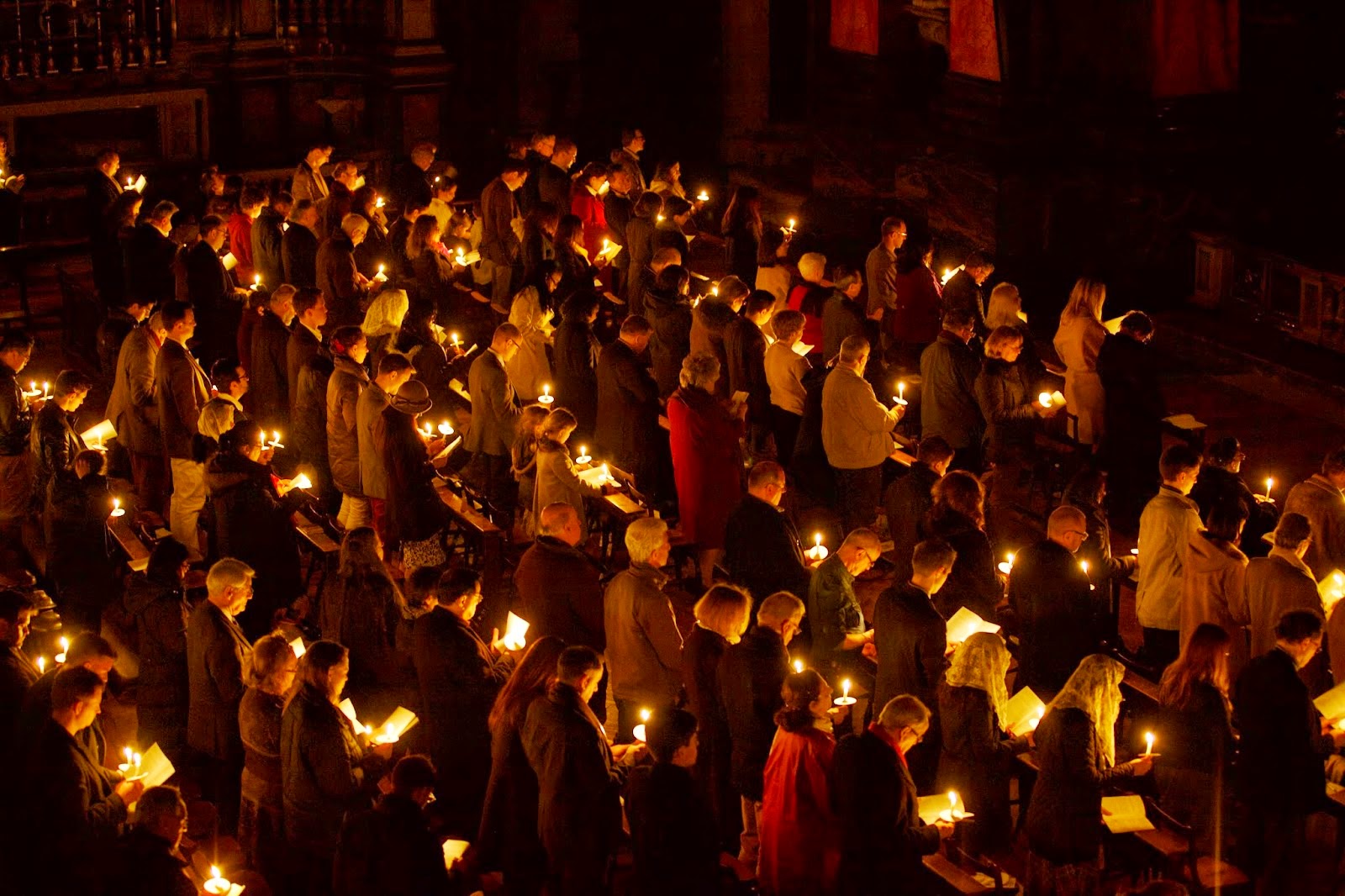
The Lumen Christi procession at the London Oratory


Introduction


All camps agree that in the ancient Church, the early Christians observed quite a few vigils: all-night observances ending with Mass before or at dawn. The otherworldly zeal which the first Christians had paid no mind to staying awake and fasting all night long, listening to one reading from Scripture after another, and singing hymns. The Easter Vigil was the most sacred of all, with a whole host of its own rites: the great fire, the Paschal candle, the singing of the Exsultet, endless readings from Scripture, and particularly, the baptisms of dozens of even hundreds of converts. As the centuries of Christianization went on and the medieval parish's boundaries approached just about a 100% rate of baptized adults in the area, there was no longer any need for the Vigil to extend from midnight to dawn. The Church's ancient rules on fasting for holy Communion, however, remained. As long as the Vigil began on Saturday night, any priest who was tasked with celebrating the Easter Vigil Mass had to fast from all food and water through the entire day until after the Vigil had ended. By then, it would be Sunday morning; therefore, the priest would have gone without eating anything for over a 24-hour period.

The medieval Church, like the Church in every other era, was faced with a "pastoral" dilemma: change the fasting rules, or change the starting time of the Vigil? The Church held the traditional Communion fast from midnight so sacrosanct that it wasn't revised until 1953 (when Pope Pius XII issued the apostolic constitution Christus Dominus, reducing the fast to only three hours). Instead, from the 7th or 8th century onward, we see evidence of the Easter Vigil being pushed, gradually, earlier and earlier until the whole rite was performed in daylight. 

Where the liturgical purists part ways is on exactly when this development took place, and whether it was a gain or a loss. I've assembled some of the most common pro-morning arguments and my answers to them below.


Antiquity vs. innovation


Pro-morning argument: Regardless of the Easter Vigil's origins as a night service, the pre-1955 starting time on Holy Saturday morning has been hallowed by time to the point that it should now be considered traditional. Bugnini's reversal is an example of the kind of "exaggerated and senseless antiquarianism" which Pius XII condemned in Mediator Dei.

Response: First, it was Pius XII himself who approved the restoration of the Easter Vigil to the night, so the move couldn't have fallen under the Pope's own definition of an antiquarianism.

Second, the question of "tradition" is tricky for many arguments extending well beyond that of the Easter Vigil. The pro-morning camp correctly point out that the Latin word traditio signifies something that's passed down from one generation to the next, without interruption. Once it's dead, it's dead; and so, a revival of a dead custom can't be said to be "traditional", strictly speaking.

In the mid-19th century, though, the monks of the abbey of Solesmes weren't satisfied with the decrepit state of liturgical music in their day. In the cathedrals and chapels of the elite, "traditional music" meant the orchestral Mass settings of Mozart and Haydn. For everyone else, they were the saccharine vernacular hymns sung over the priest at low Mass, or at best, harmonized psalm tones of the proper chants. It was only through monumental efforts by Solesmes, the first Liturgical Movement, and the backing of Rome itself that Gregorian chant enjoyed its short-lived revival until the post-Vatican II era banished it back to the album collections of classical and choral music enthusiasts. Nonetheless, all Roman Catholics who self-identify as "traditionalists" recognize that Gregorian chant is the traditional music of the Latin Rite in a greater sense than the literal. It doesn't matter whether the vast majority of chant directors at Latin Mass communities today learned chant from books and CD's, rather than a retreat at a monastery in France. In this case, the power of tradition has transcended the ignorance of succeeding generations. And, I dare say, this understanding of tradition must prevail once the last generation of people who were born before 1965 pass away. Elsewise, traditionalists must condemn themselves to calling the "traditional" Latin Mass itself as an antiquarianism, and the reformed rite the true standard of tradition.

Third, to the question of the morning Easter Vigil's own antiquity, there is surviving evidence that this wasn't a settled question until the Counter-Reformation of the later 16th century. The historian James Monti, author of my favorite biography of Saint Thomas More, has also published a number of excellent works on the historical development of the liturgy, and on the Holy Week rites in particular. Monti dedicated a few pages to the timing of the Easter Vigil in his book A Sense of the Sacred: Roman Catholic Worship in the Middle Ages. According to him, the first stage of medieval development was to bring the timing forward by beginning the Vigil's rites in the afternoon, but ensuring that they wouldn't end before nightfall. This is because Christ rested in the tomb until the some time, known only to Him, during the night of Holy Saturday.
"In fact, several texts from this period, including the late ninth-century pontifical of northern France formerly known as the Pontifical of Poitiers, speak of ensuring that the vigil Mass, beginning with the Kyrie and the Gloria, would not commence until eventide: 'Care should be taken, however, with all solicitude, that the Gloria in excelsis Deo on this night not be begun earlier than a star should appear in the sky.'"

Nonetheless, there's still a fascinating medieval precedent to the desire to restore the Easter Vigil to the ancient nighttime observance:
"An effort to restore the entire Easter Vigil to its ancient nocturnal setting was undertaken by Saint John Gualbert (+1073), founder of the Vallombrosan Order, a Benedictine congregation of Italy, as related by his biographer Blessed Andrew of Strumi (+1097): 'Who in Tuscany other than he moved from the day to the night the annual and renowned office to be done on the night of the holy Resurrection? For with stealthy negligence and gathering gluttony this office was performed at None on Saturday, that is now rightly and worthily done in the holy night, this our father John beginning and establishing in our times.' Thus the Easter Vigil rubrics of the twelfth-century customary of Vallombrosa direct that the blessing of the Easter fire with which the vigil begins is to commence only when 'the dusk of night shall have begun to appear.'"

And, Monti provides one final sign that the nighttime Vigil persisted in some places until the eve of the Reformation:
"The Holy Saturday rubrics of the 1498 missal for the Portuguese see of Braga state: 'On this day, however, None should be sung more slowly [than] usual. And this is to be observed such that the office should be drawn out, that the Mass may be said in the night.'"

The final nail in the coffin of the night Vigil was Pope Pius V's bull of 1566, Sanctissimus, which finally banned priests from celebrating Mass after noon. (As I said earlier, the first Mass of Christmas, so long as it began at or after midnight, eluded the ban.) These regulations later carried over into the Missal of 1570, which became adopted as the standard for nearly the entire western Catholic world. This was based on the reckoning of the age that the liturgical day began at midnight. However, the breviary reforms of Pope Pius X at the turn of the 20th century, whatever their other flaws, at least restored the ancient concept that a greater feast, such as a Sunday (and certainly the Vigil of Easter) began with First Vespers on the evening prior. I'm not sure why the celebration of Mass during the eves of these feasts required further permission, which didn't arrive until the 1950's.

The London Oratory again

The integrity of the Hours


Pro-morning argument: Moving the Masses of the sacred Triduum to later hours completely disrupted the traditional cycle of Tenebrae and the other hours of the Divine Office that had been long established.

Response: Conceded..... partially. Since the question of Tenebrae doesn't touch the Easter Vigil, I'll save that discussion for another day. The Holy Week revisions decree that Compline (Night Prayer) for Holy Saturday is now omitted since the Vigil takes its place. While someone could certainly pray Compline privately for devotional reasons in any case, there's no way to beat around the fact that as long as the Easter Vigil takes place at night, it's simply too taxing for us moderns to demand a public observance of Compline afterward; notwithstanding the other small fact that Compline is unlikely to be prayed publicly in any case.

The decrees state that Vespers (Evening Prayer) is "said after noon at the accustomed hour". But then, there's the problem of Matins and Lauds (Morning Prayer). As it stands now, the 1962 Missal attaches Lauds to the end of the Easter Vigil as a means of conclusion. This actually has the effect of exposing the ordinary lay faithful to Lauds in the first place; for most traddies, the mandatory inclusion of Lauds to the end of the Easter Vigil will be the only Lauds they ever attend in their lifetimes.

The purists rightfully point out that by jamming the Vigil in between Vespers and Lauds, this means Matins of Easter Sunday has been abolished. To be specific, the 1962 Breviary and its modern successor, the Liturgy of the Hours, still provide Matins of Easter Sunday, but only for those who didn't attend the Easter Vigil. Since most churches will celebrate the Easter Vigil, this means public observances of Easter Sunday Matins would be quite rare. Dom Prosper Gueranger describes how Easter Sunday Matins and Lauds were kept with the greatest of solemnity in medieval times, at least where the Vigil had slinked into Holy Saturday morning:
"Matins of Easter Sunday morning used to be celebrated in a most dramatic manner. In most of the churches of the West during the Middle Ages, as soon as the third Lesson was read, and before the Te Deum, the clergy went in procession, singing a Responsory, to the chapel where the Blessed Sacrament had been kept since Holy Thursday, which was called the Chapel of the Sepulcher. Three clerics were vested in albs, and represented St. Mary Magdalene and her two companions. When the procession reached the chapel, two deacons, in white dalmatics, representing the two Angels who were standing at either end of the tomb, thus addressed the three clerics: Whom seek you in the sepulcher, friends of Christ? The clerics answered: Jesus of Nazareth, O ye citizens of Heaven! Then the deacons: He is not here; He hath risen as He foretold: go, say that He is risen.
The three clerics here went to the altar, and raising up the cloths which covered it, they reverently kissed the stone. Then turning towards the Bishop and the clergy, they sang these words: Alleluia! This day the Lord hath risen: the strong Lion, Christ the Son of God, hath risen.
Two cantors stepped forward towards the altar steps, on which the clerics were standing, and addressed them in these words of the Sequence: Tell us, O Mary, what thou sawest on thy way?
The first cleric, who represented St. Mary Magdalene, answered: I saw the sepulcher of the living Christ: I saw the glory of the Risen One. The second cleric, who represented Mary the mother of James, added: I saw the Angelic witnesses: I saw the shroud and cloths. The third cleric, who represented Mary Salome, completed the reply thus: Christ, my Hope, hath risen! He shall go before you into Galilee. The two cantors answered with this profession of faith: It behooves us to believe the single testimony of the truthful Mary, rather than the whole host of wicked Jews. Then the whole clergy joined in this acclamation: We know that Christ hath truly risen from the dead. Do Thou, O Conqueror and King, have mercy on us!
The two deacons then opened the tabernacle. Taking the pyx, in which was the Blessed Sacrament, they laid It upon a portable throne and carried It in procession to the high altar. Clouds of incense perfumed the way while a beautiful Responsory was sung. The procession having reached the sanctuary, the deacons placed the Blessed Sacrament upon the altar. The Bishop, after offering the homage of incense, intoned the Te Deum, in thanksgiving for the Resurrection of Our Redeemer.
This touching ceremony, from which probably originated what were called The Mysteries, was not officially part of the Roman Liturgy; still, it was an expression of the lively and simple faith of the Middle Ages. It gradually fell into disuse during the 16th and 17th centuries, when men became absorbed in material things, and lost that appreciation of the supernatural which their forefathers loved to encourage by every possible means. The ceremony we have just described varied in the manner of its being carried out; but we have given its chief traits, such as we find them mentioned in the ancient Ordinaries of great cathedrals." (The Liturgical Year)

My solution for those who regret the removal of Easter Sunday's Matins is simple: keep the pre-1955 order of the Vigil, and merely delay it until just past sunset. You'll have energy enough to restore the Vigil's nocturnal character, and then (hopefully) arise early enough to celebrate Sunday Matins and Lauds with all the solemnity of former times. This might be especially worthwhile for those who chose not to attend the Vigil at all. As to the legality of using the pre-1955 ceremonies, I'm not well-read enough on that question to make an argument in favor of it, but it seems many churches of the Institute of Christ the King get away with it without stormtroopers from the Curia bearing down on their doorsteps.


The First Saturday devotion


Pro-morning argument: Moving the Vigil of Easter to the evening prevents those who have a devotion to receiving Communion on the first Saturday of every month from doing so on the month where Easter falls.

Response: This would be unworthy of even mentioning in this post if I hadn't personally run into this objection more than once. My answer is simply that this is an overly legalistic reading of the First Saturday devotion. Common sense suggests that Communion can simply be commuted to the Vigil, if not any of the Masses of Easter. For those who need complete reassurance, though, this article on the World Apostolate of Fatima, USA explains how the devotion can still be fulfilled by attending the nocturnal Easter Vigil.


The Easter fire at Clear Creek Abbey

Wednesday, April 1, 2015

How to kill a king: archaeology and history meet to tell us of Richard III's last moments


This day in Holy Week is called Spy Wednesday, for on this night, Judas Iscariot made his fateful deal with the Temple priests to betray his master. Today, I'll tell you another story of betrayal: the fate of Richard III, the last king of England to die in battle. For centuries, historians have had to rely chiefly on the official histories of the battle written years after the fact, during the height of the Tudor regime, such as Polydore Vergil's Anglica Historia; but after Richard's remains were recovered under the car park in Leicester, archaeologists, in the course of identifying them, were able to piece forensic evidence together to determine just how the last Plantagenet king died. The conclusions are remarkable: a visceral end to an age marked by brutality, yes.... but also one that demanded their rulers to show superhuman courage and lead their soldiers to victory from the front.


Lead-in to the battle

By 1485, the Wars of the Roses had killed off most of the House of Lancaster. Their claim to the throne came down to a young man who had never even lived in England: Henry Tudor, the son of Margaret Beaufort, who was a great-granddaughter to John of Gaunt (father of King Henry IV, the first Lancastrian king) and his mistress, Katherine Swyneford. This unlikely adventurer, who grew up alternately in Wales and Brittany, France, is a classic case of being a contender for power by sheer virtue of being anyone other than the guy in charge. Henry raised a challenge to Richard III held up by three pillars: the Woodvilles (Richard's enemies at home), the French, and the Welsh. To the first, on Christmas of 1483, Henry pledged to marry Elizabeth of York, the eldest daughter of King Edward IV and Elizabeth Woodville, sister to the two assumed-dead princes in the Tower, and (for Yorkists considering Richard to be a usurper) the heir to Edward V's crown. To the second, Henry gained troops and supplies from the queen regent of France, where he had lived the last 14 years of his life. And to the third, when he landed in Wales with his army of French mercenaries, he capitalized on his Welsh birth and descent from local legend Rhys ap Gruffydd. Henry found an invaluable ally in Rhys ap Thomas, who brought 500 men with him.

How could this 28-year old man who never lived in England, never seen combat, and whose last ancestor king was a thrice-great grandfather, lead an army of five or six thousand mostly non-English soldiers right to London unopposed?

Lord Thomas Stanley: the face of pragmatism
Richard III knew the answer to that question: treachery in the ranks. His warden in the west marches was Sir William Stanley, who as Chamberlain of Chester and north Wales, was bound by his office to stop Tudor's forces from crossing. Richard demanded that William and his more powerful brother, Thomas, the Lord High Constable of the realm, raise forces to intercept Tudor. This would have put Lord Stanley in an awkward position since he also happened to be Margaret Beaufort's husband... and, therefore, Henry Tudor's stepfather. Stanley excused himself on account of "sweating sickness", but not before Richard could arrest Stanley's eldest son and heir, George, as a surety for the father's loyalty. George confessed that he and his family had been in correspondence with Tudor the entire time, and that they had allowed Tudor to march on London without a fight. All Richard could do now was raise up as many loyal lords as possible on short notice and hope it was enough. The king placed his most loyal supporter, John Howard, Duke of Norfolk, at the head of the Yorkist army, and ordered all allies to assemble at the village of Leicester.


Betrayal at Bosworth

Three armies met outside Leicester, at Bosworth, on the 22nd of August:
 
-Henry Tudor's 5,000 or 6,000 troops made up of French mercenaries, Welshmen led by Rhys ap Thomas and a few (no more than a thousand) English exiles from Buckingham's rebellion and other Lancastrians. These men fought in Henry's name, but since Henry had no battlefield experience, they were truly at the command of the Earl of Oxford, a grizzled veteran of the Wars of the Roses, and Henry's own uncle/foster father, Jasper Tudor.
 
-Richard III's army of between 8,000 and 10,000. His personal army numbered about 3,000 infantry, with the rest split between the Duke of Norfolk and the Earl of Northumberland. The king had the advantage of numbers and cannons at his disposal, but whereas Tudor had a lot of professional soldiers to rely upon, Richard had to make do with a host of hastily summoned militia fighters and other conscripts.
 
-And then, there were the Stanley brothers. Their forces together numbered perhaps 6,000, but they parked themselves casually upon a hill to the south, committed to neither side. Though they were both officers of Richard's court, the brothers actually had a long history of fence-sitting. They always calculated having at least one brother on the winning side to have the other pardoned; unsurprisingly, this strategy ensured their accumulation of unsurpassed wealth and influence across three tumultuous changes in dynasty, all the while other leading families of England slaughtered each other to extinction.
 
After the initial cannon volley from Richard and storms of arrows from both sides, Tudor's men charged up the hill held by Richard's and Norfolk's men, taking heavy losses but holding their ground. No one knows exactly why, but when Richard signaled Northumberland to send in his forces to sweep the field and take the day, Northumberland didn't engage. We don't know if it was treason, since there's no evidence of correspondence between him and Henry Tudor prior to Bosworth or any reward for services after the battle, or if he was merely tactically hindered by his position on the field; or, perhaps, if he truly considered the king a usurper and unworthy of defending. Whatever the case, Northumberland's uninvolvement meant the king's superior numbers were for naught.


The last gallant charge of an era

From the corner of his eye, Richard saw his rival, Henry, make for Lord Stanley's army, still in reserve to wait until there was a clear victor to side with. We can only guess that Richard assumed Henry was going to appeal to his stepfather, join forces, and ensure defeat for the Yorkists.... for at this point, Richard makes one last charge. Suicidal by our standard, but a gallant display of chivalry and courage in his day, Richard and his royal household knights split off from his main force to make a death-defying charge straight at Henry. Did the king think cutting the serpent off at the head was the only way to rout the enemy? Or was he resigned to defeat, determined to go down in history as a warrior who fought for his birthright?
 
From the 2013 re-enactment of Richard's charge at Bosworth
The entire course of history came down to the crossing of lances and swords, as Richard's cavalry charge actually broke through Henry's defense. The king personally unhorsed Henry's champion, Sir John Cheyne, and slew the Welshman's standard-bearer, William Brandon. Richard came up to a sword's length of Henry Tudor's person. Victory was almost at hand... until Sir William Stanley's forces swooped down behind Richard's men and attacked. The king was unhorsed and killed, and his army fled in short order. The Stanleys, still fresh, now engaged in favor of the Lancastrians and began the slaughter in earnest while the Yorkists were in retreat. The Duke of Norfolk perished with the king on the field. Richard's bannerman, Sir Percival Thirwell, also goes down in history as having held the Yorkist banner aloft even without his legs, until he was hacked to death. This bloody episode of England's story closed in a moment straight from the tropes of Shakespearean fiction: Lord Stanley picked up Richard's crown, which tumbled off his helmet, and placed it upon his stepson's head. Henry Tudor was now Henry VII, King of England and Lord of Ireland.
 
As to the mortal remains of his predecessor, Henry had Richard entombed at a poor friary in the nearby village of Leicester. The Franciscans, or Greyfriars as they were known in England, buried him in the quire of their small church, there to remain until Henry's son, Henry VIII, broke from the Roman Church and ordered the dissolution of the monasteries. The friary was sold to local landowners in 1538 and demolished shortly thereafter. And, as we all know now, urban development eventually covered the site of this old friary with a parking lot until 2012, when the Richard III Society and the University of Leicester uncovered it and found the king's grave only two hours into the dig.


500 years later

Courtesy of LiveScience!
The discoveries made by the University of Leicester from some half-millennium old bones are nothing short of magical to my mind. There was, of course, the obvious: major spine curvature that confirmed that Richard III did indeed have scoliosis, that the myth of "Richard Crookback" was based on at least a grain of truth. Samples of carbon and nitrogen isotopes in his bones determine that he had a major change in diet within the last three years of his life. It was one of the many facts that established those bones as that of Richard: only a king could have afforded to feast on fish and flesh virtually every day of the last two or three years of his life, coinciding with the historical record (Richard was crowned king in 1483, two years before his death). They could even tell from the amount of oxygen in his lungs that Richard must have consumed an average of one bottle of wine a day in his last years.
 
But what of the cause of death? Upon examination, the University's researchers found barely any combat wounds on Richard's body. Rather, nine were found on his skull. Dr. Sarah Hainsworth of the University said,
"Richard's injuries represent a sustained attack or an attack by several assailants with weapons from the later medieval period.
"The wounds to the skull suggest that he was not wearing a helmet, and the absence of defensive wounds on his arms and hands indicate that he was otherwise still armoured at the time of his death." (The Guardian, 16 Sept. 2014)
 
The nine wounds were delivered from a combination of bladed and blunt weapons, probably including a poleaxe. Since Richard's arms and legs went unscathed, the likely conclusion is that after being unhorsed, the king was pinned by either Tudor's or Stanley's soldiers, his helmet removed, and then bludgeoned to death. There was one major wound to the body, at the pelvis. But judging by the upward angle of the blow, and the likelihood that Richard's rear would have been well-armored, archaeologists have posited that this was a posthumous wound. Most likely, as the chroniclers wrote, Richard's dead body was stripped naked and thrown over a horse. One of his enemies probably stabbed his corpse on the buttocks, piercing the pelvis, as a show of further humiliation.


How could a hunchback fight like that?

Meet Dominic Smee, Richard's body double
As I said, the bones show that Richard had scoliosis, but no historical record that I know of mentions it until Sir Thomas More's History of King Richard III, begun under Henry VII's reign. While it's also possible that Richard or his elder brother, Edward IV, suppressed any mention of the former's condition in their lifetimes, I believe the Tudors didn't even know about it until they stripped the fallen king's armor and saw his unusual spinal curvature protrude from his uncovered flesh.
 
During the studies performed on Richard III's remains, Channel 4 produced a fantastic documentary, raising this very question. To find the answer, a 27-year old teacher by the name of Dominic Smee, who has the same degree of scoliosis as Richard, volunteered to take a series of tests to see if his condition would affect a medieval warrior's battle prowess. Though Mr. Smee fatigued on foot, he performed quite admirably on horseback at the joust. The suit of armor crafted just to his measurements betrayed no suggestion of any unusual stature whatsoever, and in fact, the armor, combined with the sturdy medieval-style wooden saddle, ensured that Smee was positioned comfortably upright through all mounted tests.
 
If we take into account that Mr. Smee trained in the arts of medieval combat for only a brief time, while Richard Plantagenet was raised from birth to fight for his title, it's no surprise that this "hunchbacked" king was able to kill his enemies on the lance, and even unhorse Henry Tudor's champion: a mountain of a man, estimated to have stood at 6' 8". Mounted combat evened the playing field. Whatever else Shakespeare got wrong, we can agree with him that Richard's kingdom truly was lost for want of a horse.
 
Channel 4's documentary is below: I highly recommend watching it when you get a chance!


Reburying a medieval king

I dedicated a slew of posts last week to Richard III's reburial in Leicester last week. Though I missed the live broadcast of his official reinterment service at Leicester on account of work and living in another country and time zone, I was finally able to watch a recording of the entire event later on Youtube. The rest of Holy Week will delay my ability to proffer my full thoughts on that ceremony until next week at the earliest, but I am glad for one thing, at least: that the people of England assembled by the thousands in Leicester to see their last medieval king now buried in solemnity. The troglodytes of the Internet hawed and huffed about the ceremonies being a waste of money, or a pageantry of irrelevance. But we see by the crowds, and all the ensuing discussions throughout the world; my blog being one small part; that the Middle Ages live on in our memories. Whether he was a tyrant and usurper, or a courageous warrior-king who went down fighting with his people, Richard III still touches us today, even as far away as the United States.
 
Let's close this entry with the words of Polydore Vergil, who, I remind you, was Henry VII's official court historian. Even in that position, Vergil conceded what must have been agreed upon by all:
 
"King Richard, alone, was killed fighting manfully in the thickest press of his enemies." (Anglica Historia)
 
My thoughts on this service are still in the works....


Other articles from "Richard III Week":

-Today in history: Henry IV: the man whose claim to the crown started the troubles that led to the Wars of the Roses

-The first day: Richard on tour: select photos from the procession on Sunday, and the cardinal-archbishop of Westminster's Compline homily

-The Bible in Richard's day, and, was Richard a proto-Protestant?: on the king's reading habits and what to make of his Wycliffe New Testament

-A requiem for Richard: on the Requiem Mass, the king's faith, his book of hours, the cult of purgatory, and the chantry chapels of Richard's age

-Of hearses and hearse cloths: looking at Richard III's funeral pall and dressing the dead in medieval times

-Richard III's claim to the throne: sanguinity, statue, or sacrament?: Examining Richard's dynastic claims and what makes a king the king

-O God of Earth and Altar: a hymn by G.K. Chesterton, used at the reinterment on Thursday

-The poet laureate on Richard III: the poem at the reinterment. Also, Benedict Cumberbatch.

 -Anatomy of a prayer: a look at one of the prayers used at Thursday's reinterment, versus its original medieval text.

Friday, March 20, 2015

Today in history: Henry IV

Today in history, in 1413, King Henry IV of England died from an unknown affliction, aged 46. Unlike most of his fellow kings who are buried at Westminster Abbey, you may find Henry's body at Canterbury Cathedral, near the former shrine of Saint Thomas Becket. Henry was known to be a great devotee of the holy blisful martir, or at least, deeply wanted to be associated with him as a boost to his legitimacy as sovereign.

Known in his youth as Henry Bolingbroke, his cousin, King Richard II banished him from the realm for provoking a duel. The following year, Henry returned in force to claim his just-deceased father's titles and lands, but soon mustered enough support to just take over the entire country. Richard II was thrown in prison and died, shortly thereafter, probably by starvation or neglect. Henry IV spent virtually the entire rest of his reign putting down one rebellion after another; ironically, his very act of usurping the crown from Richard inspired many other lords throughout the land to try their luck doing the very same thing. Perhaps the only highlight of the reign was in hosting Manuel II Palaiologos, the only Byzantine emperor to ever visit England, with a joust in 1400. He was succeeded by his eldest son, Henry V, of Agincourt fame.

By upsetting the line of succession, Henry Bolingbroke's coup set the stage for the later Wars of the Roses; as such, Richard II and Henry IV (in two parts) are the first two plays in Shakespeare's history cycle. Henry was recently played by one of my favorite actors, Jeremy Irons, in BBC's Shakespeare series The Hollow Crown.

"Canst thou, O partial sleep, give thy repose
To the wet sea-boy in an hour so rude,
And in the calmest and most stillest night,
With all appliances and means to boot,
Deny it to a king? Then happy low, lie down!
Uneasy lies the head that wears a crown."


Other entries during "Richard III Week":

-Today in history: Henry IV: the man whose claim to the crown started the troubles that led to the Wars of the Roses

-The first day: Richard on tour: select photos from the procession on Sunday, and the cardinal-archbishop of Westminster's Compline homily

-The Bible in Richard's day, and, was Richard a proto-Protestant?: on the king's reading habits and what to make of his Wycliffe New Testament

-A requiem for Richard: on the Requiem Mass, the king's faith, his book of hours, the cult of purgatory, and the chantry chapels of Richard's age

-Of hearses and hearse cloths: looking at Richard III's funeral pall and dressing the dead in medieval times

-Richard III's claim to the throne: sanguinity, statue, or sacrament?: Examining Richard's dynastic claims and what makes a king the king

-O God of Earth and Altar: a hymn by G.K. Chesterton, used at the reinterment on Thursday

-The poet laureate on Richard III: the poem at the reinterment. Also, Benedict Cumberbatch.

Saturday, August 10, 2013

A look into the medieval parish church's vestry: on vestments

This article is written by request of a good friend (a seminarian) who wanted to read more about church vestments in the Middle Ages.

In truth, my title is misleading because from what little I've gleamed on such an obscure subject, medieval parish churches didn't have vestries (or sacristies); or at least, they were uncommon outside of cathedrals and abbeys. Perhaps the idea to partition a space to hold vestments and vessels didn't seem necessary until the Renaissance. At any rate, without a vestry, a priest dressed for holy rites within the sanctuary, or perhaps his vestments were laid upon a side altar as when a bishop vests.


Why have vestments?

Before we begin, it's worth asking: why should priests or their assistants wear any special kind of clothing in the first place? I've spent a long enough time in the evangelical faith to think a pastor's service dress was a power suit, perhaps also a cross lapel pin. If we to ask your average Catholic in the pew today why a priest wears vestments, I'd bet he wouldn't have really thought about it at all. "That's just the way it's done." It's true, insofar as that a priest is required by liturgical laws to wear vestments.

A more savvy sort of Catholic (the EWTN-watching kind who likes to read apologetic works) might say, "it's to obliterate the priest's personal identity because he acts not a man, but in the person of Christ Himself. The vestments are blessed and set apart for sacred services only, because the Mass is an otherworldly experience." Also not wrong, but that doesn't appear to have been the idea all along. Vestments arose from the street dress of the ancient Church, as fashions evolved but the clergy stubbornly insisted upon wearing the same old styles of clothing for liturgy. This would be like if Christ founded the Church in the 1920's, and a hundred years from now, only priests ever wore neckties and fedoras, but only at Mass, and only in very stylized or "Hollywood" forms.

The medieval liturgist might have said, "our clergy wear vestments because they were handed down to us from the clothing worn by the priests of the Old Testament, who in turn wore them by the express command of God in the law of Moses." This is a tall tale or at least a mistake because ancient Jewish and Christian vestments have only superficial similarities; and by the time the Church made use of vestments (after the end of Roman persecutions and the rise of Constantine, say) Jews and Christians had near zero cultural exchange. Indeed, it was more likely that a Christian would change his habits solely not appear like a Jew, and vice versa.


If we could synthesize all these strains of thought into a greater idea, then, I'd say that a priest wears vestments to: 1.) conform to the rule of the Church (liturgical law), 2.) symbolically erase his own identity by taking up the cloak of Christ, and 3.) emphasize continuity between the religion of the Old Testament and of the New. Each reason may seem questionable on its own, but together, they refute the idea held by cynical nonbelievers that vestments are worn for priests to vainly adorn themselves in rich fabric sewn by the blood, sweat, and tears of a peasant class kept in ignorant darkness by their ecclesiastic overlords. No, friends, it's just the opposite: the priest wears vestments as an act of obedience, to conform himself to the will of God. In theory, at least. This is true for the medieval priest just as much as for the modern one.


The alb

The alb (from the Latin word alba for "white") may not necessarily be the first thing a cleric reached for, but it's the foundation of all the other vestments and must be mentioned before all else. The big white gown evokes all sorts of negative emotions from the modern man: to the skeptic, it ranges from the uniform of fools being baptized in the river after a euphoria of preacher-induced excitement, down to the image of hundreds of robed believers drinking cyanide-laced Kool-Aid in the anticipation of a better world (even if, at such cult suicides as the one in 1978, no robes were actually involved). Traditional Catholics likewise often deride the alb simply because they see it worn on altar servers, perhaps with ugly sneakers peaking from the bottom, at their local temple of banality (your average Catholic parish) instead of the usual pre-Vatican II practice of wearing a surplice.

In my experience, it's a small matter to say the alb represents purity. It's another thing to stress that an all-white garment in the ancient or medieval world was a challenging thing to make, and even more difficult to maintain. Like teeth in the age before modern dentistry, clothes were most likely to range from shades of yellow to brown. The Roman citizen's toga candida ("bright toga") was only bright white because it was powdered in chalk, in order to draw attention to him while he sought political office; hence he was a candidate for office. Queen Victoria kickstarted the fashion of the white wedding dress, but at that time it was a garment fit for royalty precisely because of its purity, thus any cinematic depictions of medieval peasants or even lesser noblewomen marrying in a white dress are very unlikely.

The alb is also unique in that it's not a vestment for clerics alone, but the uniform of all Christians. Every Christian earns the alb in baptism. I don't know if the Church provided them or if believers had to bring their own, but at least since the time of Saint Augustine, who mentions the custom in a sermon, converts who were baptized on Easter were supposed to wear the albs until the following Sunday. This is why you'll see, in some missals, the Sunday after Easter called Dominica in albis depositis ("the Sunday in which the white is put away").

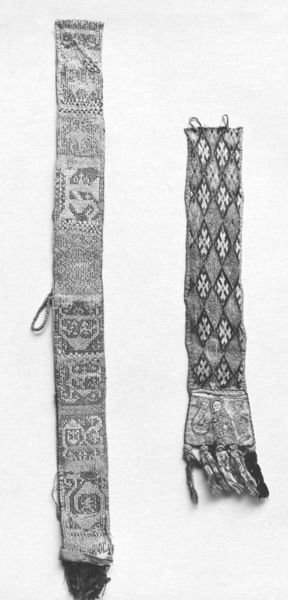
The alb's form in the Middle Ages was mostly the same as it was in Roman times, from the common tunic worn by men of the old Empire. Lacemaking techniques were very primitive before the Renaissance and unknown in ecclesiastic arts, so don't expect to find any medieval vestments resembling anything like the sheer "liturgerie" of the later centuries. Any decoration was made in the form of embroidery around the cuffs or head opening, or from the 13th century onward, in apparels. The first form, embroidery, can be seen below, dated to the 13th century:


Apparels are strips of fabric that are pinned to the alb's cuffs or the bottom, and can be exchanged with others. This is one very fine example from the Victoria & Albert Museum, London, made between 1320 and 1340:


I can't post an image directly, but this model shows how apparels would be worn on the alb today.


Another apparel is shown on the back of this alb.

The amice

The amice (from the Latin amictus for "covering" or "dressing") is a rectangular cloth that the priest and his ministers put on before anything else. The idea is to completely cover any sign of the priest's street clothes, including the Roman collar; again, fitting with the idea of obliterating the priest's identity. But since medieval clergy didn't wear anything resembling collars as we know them today, the question of where the amice came from is trickier. A pre-Vatican II rubric had the priest wrap the amice around his head for a moment before pulling it back over the shoulders. The prayer he had to recite while putting it on called the amice "the helmet of salvation". Was this some vestige of when clerics used them as a hood to protect their ears against the cold, like the white hood you might see on a portrait of Dante? But again in the old rites, when a subdeacon was ordained, the bishop would say, "Receive the amice, by which is signified the discipline of the voice". Was it supposed to protect the throat? The Catholic Encyclopedia presents a whole host of theories: 

"Early liturgical writers, such, e.g. as Rabanus Maurus, were inclined to regard the amice as derived from the ephod of the Jewish priesthood, but modern authorities are unanimous in rejecting this theory. They trace the origin of the amice to some utilitarian purpose, though there is considerable difference of opinion whether it was in the beginning a neck cloth introduced for reasons of seemliness, to hide the bare throat; or again a kerchief which protected the richer vestment from the perspiration so apt in southern climates to stream from the face and neck, or perhaps a winter muffler protecting the throat of those who, in the interests of church music, had to take care of their voices. Something may be said in favour of each of these views, but no certain conclusion seems to be possible (see Braun, Die priesterlichen Gewänder, p. 5). The variant names, humerale (i.e. "shoulder cloth", Germ. Schultertuch), superhumerale anagologium, etc., by which it was known in early times do not help us much in tracing, its history."
We can take that as a sign that the Encyclopedia had no idea precisely where the amice came from, either, though the medieval belief that the vestment came from Old Testament times resurges once again. My own bet is that the amice protected the alb and other vestments from getting stained by sweat, and was a lot easier to launder. Anyone with experience in laundering vestments could probably back me up. Nonetheless, by the ninth century, it was considered an essential garment for the liturgy.

The medieval amice was the same as it is today, except that it, like the alb, was frequently apparelled. I was unable to find pictures of surviving examples from the era, but here are some reconstructed forms today:


Vesting Priest with Apparelled Amice by Charles Blamey. Remarkable that an artist would bother to paint this subject in the first place, and even more remarkable that this painting dates only to 1991. Blamey, however, was an altar server for Saint Pancras Old Church in London and liked to paint what he called "ecclesiastical" (as opposed to religious) art.

All these representations admittedly look silly until you see the apparelled amice in its final form, pulled back over the chasuble. Then it looks quite splendid.


The cincture

The cincture (from the Latin word cingulum for "girdle", also often just called a girdle) is a cord with knotted or tassled ends that the minister uses to keep his alb and stole together. Over time this has come to represent chastity, but cinctures were probably used from very early times onward for no other reason than to keep the priest from stepping on and tripping over his own alb. All medievals wore belts over their long tunics or dresses for the same reason.


The stole

The stole (from the Latin word stola for "garment", as in the Roman woman's counterpart to the toga) is the sash that deacons, priests, and bishops wear as a sign of their authority. Outside of the strictly liturgical context, even most Catholic priests today will put on the stole during confession to represent their authority to absolve sin. In older times, there was also the concept of a "preaching stole" for priests who gave sermons outside of Mass, or for priests at Mass who were visiting or simply attending in choir. Since it's hard enough these days for priests to get people to come even to Sunday Mass, and since visiting priests now pretty much always concelebrate rather than attend in choir (and thus are already wearing a stole under the chasuble), the idea of a "preaching stole" has now vanished from the Church. Ironically, it may live on in Protestant denominations which formerly condemned the stole as vain popery, but now see it as a useful symbol.

Deacons wear the stole diagonally across the chest. It seems that in the earlier Middle Ages, deacons wore the stole over the dalmatic, as Eastern deacons do today. From the later Middle Ages until Vatican II, priests wore the stole with the ends crossed one over the other. At other times, they wore it with the ends hanging straight down, as bishops do.

The stole seems to have been used in Rome since the sixth century, possibly earlier. Even then, it was conferred upon someone to show that he had entered the ranks of the clergy. In many places, particularly the Frankish lands, priests were supposed to wear the stole not just in the liturgy, but as part of daily dress (that may be why in the movie Becket, you see Thomas wearing the stole even over his usual robes). Indeed, it was the Franks who gave the stole its current name. Before, it was called the orarium, and the Eastern clergy know their form of it as the orarion even today. Later on, some medievals stated that it had a common origin with the Jewish prayer shawl, but as with other theories relating to vestments' origins in Judaism, this one isn't true, either.

Returning to Becket, we're very fortunate to have some of the saint's own vestments preserved at the cathedral of Sens, France. You can see how the stoles from his age were very long, narrow, and generally of uniform width except for a little widening out at the ends. No medieval stoles ever fattened out like spades at the ends as Rococo stoles do, however.
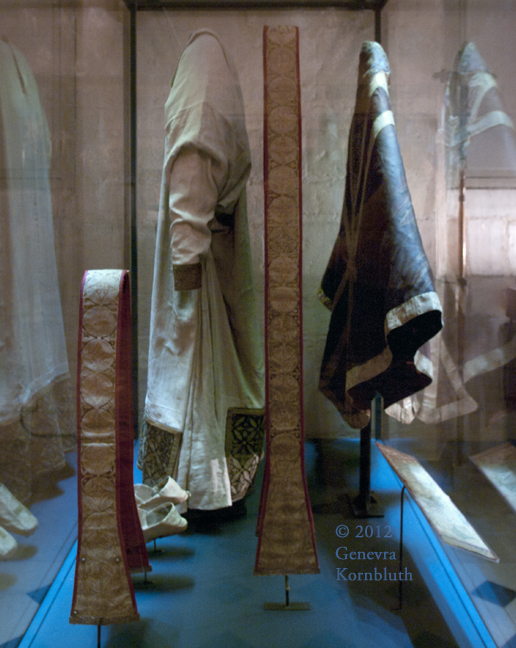
The photo also shows an alb with apparels as I described before, a maniple, and a conical chasuble which I'll bring up again in a bit. Photo courtesy of Genevra Kornbluth.


The maniple

The maniple (from the Latin word manipulum for "handful" or "bundle") is a strip of fabric, often made out of the same material as the stole, that hangs over the cleric's left forearm. This one will be strange to anyone not familiar with the traditional Latin Mass, because it's hardly ever seen outside of that context. After Vatican II, the maniple was no longer required by the rubrics for Mass, and with no practical purpose to justify it, that meant it was as good as abolished for the post-conciliar Church.

Saint Alphonsus Liguori, in language typical of the 18th century pious, wrote: 
"It is well known that the maniple was introduced for the purpose of wiping away the tears of devotion that flowed from the eyes of the priest; for in former times priests wept continually during the celebration of Mass."
I'm not so sure about that. The maniple was also referred to as the sudarium, which literally means a sweat cloth. The liturgical maniple, then, probably descended from ornamental handkerchiefs that upper-class people in Roman times used to wipe off their sweat. Before it took its current form as a strip of cloth around the forearm, it was folded and carried in-hand. One can easily imagine Cassius, the fat games announcer from Gladiator, using it to wipe his brow in between bouts. 

The oldest surviving example I know, the maniple of Saint Cuthbert on display at Durham Cathedral, is of the folded handkerchief kind. Predatng the Norman Conquest, it was a gift from Queen Aethelflaed to the bishop of Winchester. 

The world's finest sweat rag ever made depicts Saint Sixtus II. I'm not sure how Sixtus feels about that.

A 14th century German maniple at the Victoria & Albert Museum. By this time, the maniple has been worn as a band around the forearm.

Considering the maniple's aristocratic origins, I can see why the maniple, which in its earliest days was used even by acolytes, gradually became restricted to subdeacons and higher. What I still don't know is how the maniple came to be used strictly for Mass and no other liturgical function.


The tunicle and dalmatic

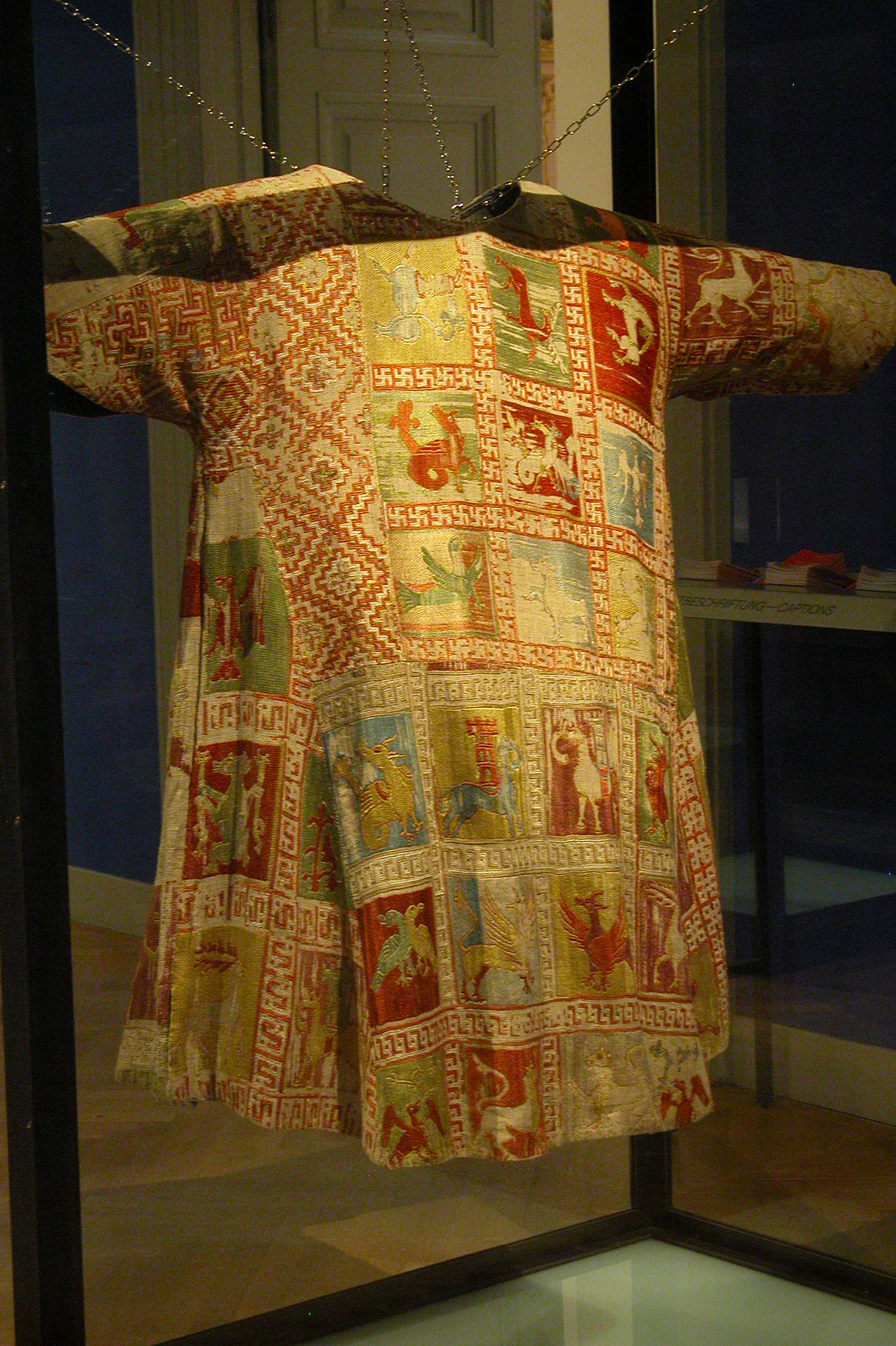
The tunicle (from the Latin word tunicula for "little tunic") and the dalmatic (literally "Dalmatian", as in a robe made of Dalmatian wool) are the outer vestments for the subdeacon and deacon respectively. I group them together because in traditional Latin Mass communities today, they're basically interchangeable garments. This is because the medievals wanted the subdeacon and deacon to appear more symmetrical when assisting the priest. In theory, the subdeacon's tunicle is supposed to appear shorter and plainer, but I can't say I've ever seen any meaningful distinction in practice.

The tunicle, in Roman times, was a fine gown to be worn around the villa like a lounge suit. Subdeacons were already wearing tunicles by the time of Pope Gregory the Great, who wrote in a letter that he abolished the custom and had them wearing chasubles as before. (For those of you who are really in-the-know, you may remember that subdeacons and deacons wore folded chasubles during Advent and Lent until 1960. Perhaps this was an attempt to honor Gregory's rule halfway.) But that likewise was overturned, and subdeacons were wearing tunicles again until Vatican II, when the order was abolished entirely.

The dalmatic likewise was a garment worn by the late Roman aristocracy, only even more richly adorned. Deacons began wearing them in Rome as an honorific at the time of Pope Sylvester I, who was contemporary to Emperor Constantine. Both the tunicle and the dalmatic have luxurious, festive origins which help to explain why they were put away during the penitential seasons of Advent and Lent, as I mentioned before. The noble connotations remain today in the secular world because the British monarch still wears a dalmatic during the coronation rite.

In the early Middle Ages, dalmatics reached nearly to the floor and were always white. In the succeeding centuries, the length shortened a bit and colors were introduced at the same time that the system of prescribed colors for the chasuble came into play. 

In this famous mosaic of Emperor Justinian, I believe those two on the right of Bishop Maximianus are deacons in white dalmatics. They don't wear the chasuble (which was very cumbersome in early medieval times) as the bishop does because the deacons, being the bishop's servants, need their hands free to work.

A southern German dalmatic dating to c.1260, part of a set called the Göss Vestments. By this time the sleeves are shorter, but the sides are not yet cut with high slits like the Baroque dalmatics.

This dalmatic was a gift from the Byzantine emperor to Pope Eugene IV in the 15th century. It's the only medieval vestment left in the treasury of Saint Peter's Basilica. Sad. Perhaps the gentlemen in the Vatican thought "LOL, where's the lace?"

Left: how the dalmatic should look on a person.


The chasuble

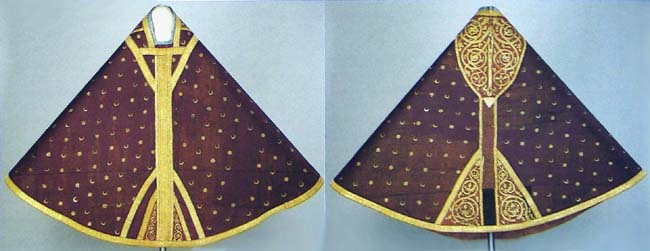
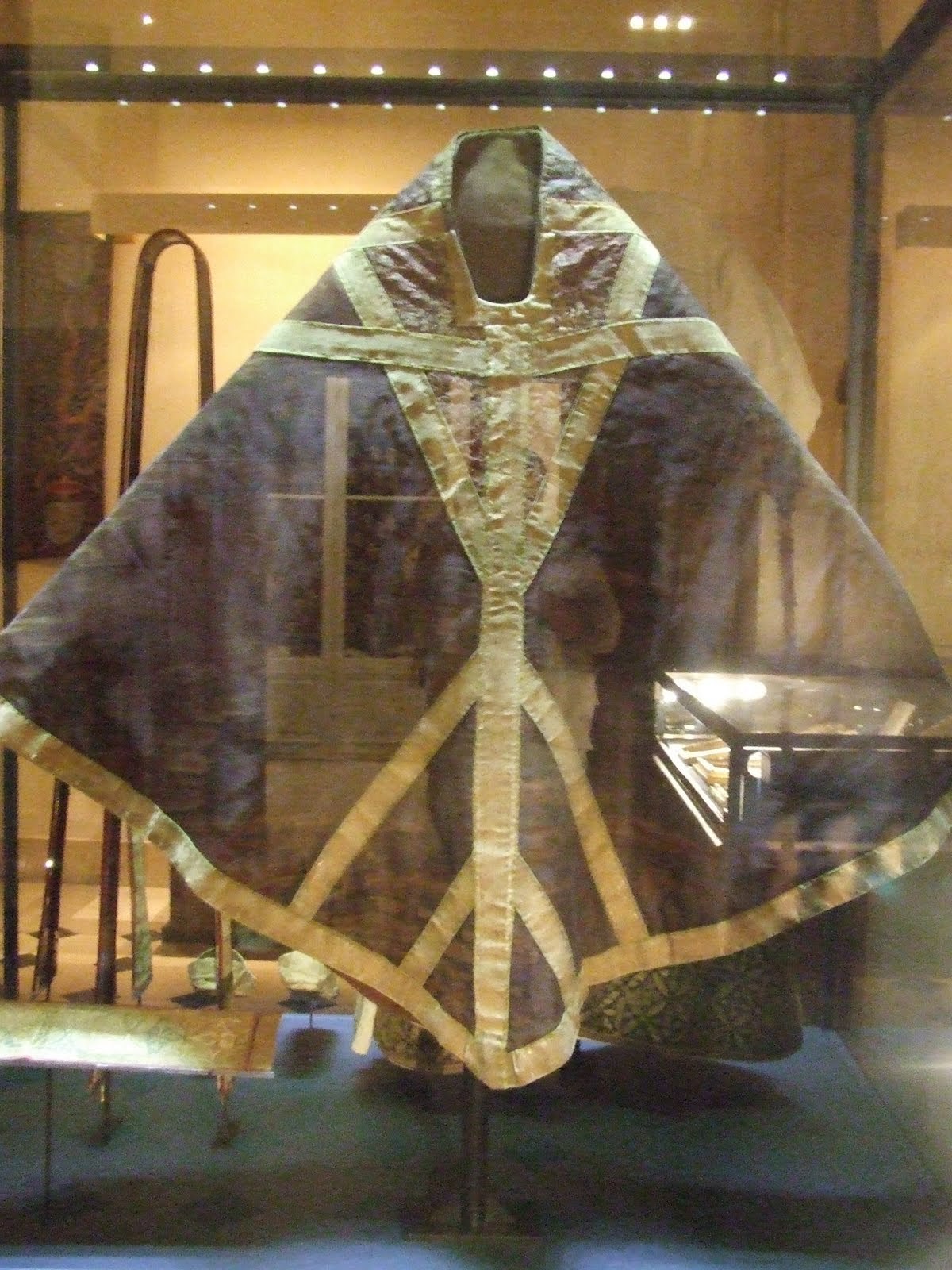
Though this article could go on for nearly twice the length by just talking about copes and episcopal vestments, I'd like to end here with the priest's outer vestment, the chasuble. Called in Latin the casula ("little house"), it descends from a much humbler garment than the tunicle or dalmatic, despite the priest being higher in rank. The chasuble's ancestor in Roman times was a traveling poncho, serving the same purpose as the modern trenchcoat. The chasuble "housed" its wearer completely because the fabric extended from the neck all the way down to the ankle in the shape of a cone; in other words, basically a cope that's sewn shut in the middle.

Many details about the chasuble's evolution can be found elsewhere in plenty, so it suffices to say here that the medieval chasuble was very bulky, encumbering vestment that virtually required the deacon's and subdeacon's assistance to help the priest move around. This is why in the Latin Mass, the deacon and subdeacon are required to hold up the edges of the priest's chasuble when he ascends the altar steps, moves from side to side while incensing, or when he elevates the Eucharist. Without their help in lifting the material, it would have very difficult, if not impossible, for an elderly priest to elevate the Chalice without making an unholy mess.

All these inconveniences caused liturgical "fashion" to cut down the chasuble's length, inch by inch, until eventually, in the 18th century, we were left with the absurdity known as the fiddleback. Such chasubles are like the sleeveless t-shirt, or perhaps the g-string of vestments, and makes the gesture of the deacon pinching the sides of the priest's chasuble pointless, if not ridiculous. That is not to say that a priest's chasuble must be of the full conical form, but the vestment should at least be long and voluminous enough to suggest nobility, dignity, gravitas. The Gothic style attempts to do that while still allowing the priest some mobility. The fiddleback style does none.


The Wolfgangskasel (chasuble of Saint Wolfgang) dates c.1050. It's currently displayed in Regensburg. One of the oldest surviving chasubles out there, but much of the fabric is also reconstructed.

The chasuble of Bishop Bernulf, c.1150.

Another view of Saint Thomas Becket's chasuble at Sens.

An illustration by Augustus Welby Pugin of chasubles and copes as depicted on real effigies (such as on tombs). These are mostly from the later Middle Ages or the Renaissance.