Showing posts with label Sarum Mass. Show all posts

Thursday, April 2, 2015

The mandatum: Maundy Thursday and stinky feet

The kings of medieval Europe washing the feet of beggars
It's another Maundy Thursday, the first day of the Easter Triduum: it's a busy day, with the consecration of holy oils for the upcoming year by the bishop at his cathedral, the washing of feet in remembrance of Christ's new commandment ("to love one another as I have loved you"), and most importantly, to commemorate the last supper, the first Mass, on the night He was betrayed.

Maundy Thursday also means another slew of pictures of Pope Francis washing random marginalized people's feet to the fawning of his fans and eye-rolling of a tiny minority of skeptics also called traditionalists. This year, as usual, the Vatican announced well in advance that the Pope will be celebrating the Mass of the Last Supper at a prison and washing the feet of inmates. We can expect, based on previous publicity stunts in the reign of Francis, that the selection of people to be washed may include a Muslim or two.

The New Liturgical Movement just posted an article to let Catholics know that the rubrics of the modern Roman Mass make the mandatum, the rite of foot-washing, merely an option; but if it is to be used, the people to be washed must be male. It's all quite sound from a legal point of view. The article is completely correct: at the Mass of the Last Supper, only men's feet can be washed. But there's an elephant in the room: the fact that Pope Francis himself has washed women's feet on this day in the past, and has even made quite a media spectacle of it. Some apologists point out that, since Francis is the Pope, he's above the law and can do whatever he wants in the liturgy, including washing women's or Muslims' feet. Again, strictly speaking, that's true... though since he was also known to wash women's feet during his time as archbishop of Buenos Aires, while he was still fully subject to liturgical law, this entire line of argument reeks of the papal positivism; the "because he's the pope" mentality that's permeated the faith for well over a century.

The mandatum, Francis-style.
Back when I was a Seventh-day Adventist, our church, a few times a year (not Maundy Thursday), though it wasn't big on ceremonies of any kind, practiced foot-washing. Basically, a bunch of buckets were distributed, and everyone washed everyone else's feet. It wasn't just a ceremonial pouring of water, though. No, we had to get between the toes and everything. When I became a Catholic, the foot-washing rite during Maundy Thursday was something I could readily identify with. It signified to me that Catholic priests, too, were willing to bend the knee to others and show that they were ready to serve their flock, not just rule their souls. This is why the rite on Maundy Thursday is called the mandatum. Traditionally, as the priest goes to wash the first foot, the choir sings an antiphon from John's gospel: Mandatum novum do vobis ut diligatis invicem sicut dilexi vos. "A new commandment I give unto you, that ye love one another; as I have loved you." The mandatum, the commandment, is even how this day came to be called "Maundy".

Up until yesterday, I actually never thought much about the liturgical law which restricts it to men. When I first became Catholic, I learned that twelve men are chosen to represent the twelve Apostles whom Christ ordained that day as the first priests of the Church. Since only Catholic men can become priests, Pope Francis's spectacle of washing the feet of women or non-believers seemed to be a deliberate subversion of the traditional understanding.

The mandatum in the Benedict XVI era, at Saint John Lateran.
But then, in the course of my usual readings of liturgical history, I discovered that the mandatum wasn't even performed during the Mass of the Last Supper until 1950.

At that point, I came to the conclusion that all talk of what is or isn't "traditional" bears much closer investigation before issuing a verdict on the curious case of Pope Francis. I haven't been able to learn a whole lot more since then, but here's what I've been able to piece together so far:

1.) The practice of foot-washing is ancient, predating Christ to time immemorial. The first reference to it in Scripture is a mention of Abraham offering to wash the feet of the three wayfarers in Genesis 18. In a middle Eastern and Mediterranean culture, people typically wore sandals and gathered dust over their bare feet every day. The foot-washing was part of an ancient rite of hospitality, an aspect which is perhaps lost on northerners and moderns whose feet are enclosed in shoes or boots. Furthermore, the Rule of Saint Benedict, first written in the 6th century, ordered monks to receive all guests by washing their feet, as well as pouring water over their hands.

2.) Nonetheless, the rite of the mandatum wasn't always a part of Maundy Thursday ceremonies. Saint Augustine's letters suggest it wasn't universally accepted in his day. In Spain, though, the third set of canons of the Seventeenth Council of Toledo (A.D. 694) mandate its use everywhere on pain of excommunication: "Since Our Lord has not disdained to wash the feet of His disciples, why should we refuse to emulate the example He gives us? It now happens that, partly from slackness, partly from custom, in sundry churches the priests no longer wash the feet of the brethren on Maundy Thursday."

3.) The mandatum had come into use in Rome itself by the 7th century, where the Roman Ordo in Coena Domini instructs the pope to wash the feet of his attendants; though not, it seems, during Mass itself. The next mention of the mandatum among Roman sources doesn't come up again until Roman Ordo 11, dating to the 12th century. There, the pope has two ceremonies: one in public, where he washes the feet of his subdeacons... and one in private, in his apartments, where he washes the feet of thirteen poor men. It seems the medieval popes wanted to cover both bases: the sacerdotal and the servile.

4.) In imitation of the popes and archbishops, the medieval kings of Europe also washed the feet of the poor on Maundy Thursday. Saint Elizabeth of Hungary was known to wash the feet of twelve lepers. Until the 20th century, the kings and queens of Spain washed the feet of twelve poor men and twelve poor women, respectively, every year after Maundy Thursday Mass in the royal chapel. All were also provided with new clothes. James Monti's The Week of Salvation relates one story: when Queen Isabella II's diamond bracelet fell from her arm into the water, the woman being washed reached down to give it back to her, but the queen said, "keep it, mia hija; it is your luck."

Maundy money in Elizabeth II's reign
5.) The kings of Great Britain still practice the "royal Maundy" service to this day, where alms in the form of specially coined "Maundy money" are still given out; though the footwashing itself fell out of practice after the last Catholic king of England, James II, was overthrown. His successor, the Protestant William III, apparently wasn't much for smelly feet. William eventually stopped showing up to the services altogether, passing it on to the royal almoner. It was only in the 20th century, with George VI (Queen Elizabeth II's father), that the kings began to personally participate in the Royal maundies again.

6.) What about at the local parish? It seems that having a mandatum (in its own rite, apart from Mass) was widespread in the Middle Ages, but gradually waned through the Counter-Reformation (the 16th century) until, by the 20th century, it was dead (though still on the books as an official Holy Week rite).

7.) With the 1950-1955 Holy Week reforms, the mandatum was inserted into the Mass of the Last Supper itself, giving it more prominence than ever before.

And now, here we are, back in the 21st century. What did that romp through history tell us? First, while the washing of feet is a powerful sign of Christ's ordaining the first priests, that's not the original reason. We can call that a legitimate development, but the association of the mandatum with the poor has been there since its introduction. Second, including the mandatum into the Mass itself opens the rite up to a sort of criticism that wouldn't otherwise exist. The Mass of the Last Supper is bound up with the institution of the first Mass, and that significance is arguably lessened by merging it with the mandatum of the poor.

Still, omitting the mandatum entirely just to avoid the politics around excluding women at Mass is, in my mind, a case of throwing the baby out with the bathwater, just as with the omission of the kiss of peace (which I described in another article earlier this week). Traditionalists may think they're tainted with touchy-feely sentimentalism; and they are; but they're also venerable signs of what it means to be a Christian.

Father Sean Finnegan left an interesting comment on the New Liturgical Movement article I linked you to at the beginning of the post. He wrote,
"I have recently taken over a parish where washing women's feet is routinely done. So I have decided to try delving into liturgical history. In the Sarum Use, the Mandatum took place at lunch (after the Solemn Mass in those days, of course), with the High Priestly Prayer of our Lord being read. Not only would the 'presider' wash others' feet, but all would participate, washing and being washed. Finally, a loving cup was shared. I am going to try that here this year: we will have an 'agape' simple meal in the evening, long enough before the Mass to observe the liturgical fast. We will all, men and women, wash each others' feet, and share a loving cup as the account of the Last Supper is read from St John's Gospel. Then, at the Mass of the Lord's Supper, we will omit the Mandatum entirely, as the rubrics permit. Hopefully, this way everyone will be happy."
(For more info, Father Finnegan has a blog article from 2009 detailing the Sarum mandatum rite here. Like many other rites in the Sarum Missal, it was written with cathedral usage in mind and assumes that one has a chapter house.)

That seems like the perfect resolution to the problem, and I wish something like it was offered here in my city. If I can find the text of the Sarum Use's ceremony, or even the pre-1955 Roman ceremony of the mandatum outside of Mass, I'll share it with you.


All articles in my Holy Week 2015 series, short and long


The kiss of peace (for Spy Wednesday)


Terra tremuit! (the Offertory antiphon of Easter Sunday)

Monday, March 30, 2015

Palm Sunday in Sarum

From the Benedictional of Saint Aethelwold.
Yesterday was Palm Sunday, the first day of Holy Week. For most people, the most memorable aspect is the blessing and distribution of palms. It commemorates Christ's entry into Jerusalem a week prior to the Resurrection, with the faithful laying palm branches; a symbol of victory (and of sacrifice); at His feet. It's a powerful message that even many mainstream Protestant churches have either maintained or, perhaps, revived after several centuries of suppression on the basis of it being seen as idolatrous pomp. When the English Reformation began under Henry VIII, even though pilgrimages were suppressed and saints' shrines destroyed, the lusty king did not feel he could go so far as to take the palms away from the people: 
"On Palme Sunday it shall be declared that bearing of palmes renueth the memorie of the receivinge of Christe in lyke manner into Jerusalem before his deathe"
So widespread and cherished was the custom of bearing palms that it was said in England, "he who hath not a palm in his hand on Palm Sunday must have his hand cut off".

For me, though, the first thing that always comes to mind first on Palm Sunday is not the vegetation, but the reading of the Passion. You're always going to be in for a long day at church because, even if the procession is omitted, the entire account of the Passion will be read (traditionally, that of Saint Matthew). The custom of reading the Passion on Palm Sunday goes back at least as far as Saint Augustine, so we're talking about a tradition that precedes even the fall of the western Roman Empire!

The first Palm Sunday Mass I ever attended was at my neighborhood Catholic parish church, shortly after my conversion to Catholicism. One of my very best friends was considering converting, too, but I felt that I had to be honest with him and take him to church at an "average" suburban parish where Mass is offered as it is in about 99% of Catholic churches in this country today, rather than one of the few preserves of liturgical sanity that I had hitherto showed him exclusively. The reading was divided between the celebrating priest, a couple of laypeople, and the congregation reciting the parts of the crowd. This arrangement was pretty tame compared to some other wacky configurations I've heard, though since the Passion at this church was recited and not sung, the entire thing felt like it just went on and on unto the ages of ages, amen. (It was also a little unnerving for the entire congregation to say "crucify Him! Crucify Him!" But that's another story.)

Later, I found out that the Passion is traditionally sung in three voices: the Chronista (narrator) in a middle voice, the Christus (all the words of Christ) in a bass, and the Synagoga (the "synagogue", but truly, all the dialogue lines other than Christ's) in a tenor. Hearing them together, at once we see a glimpse of the medieval Church's flair for the dramatic, for it was around the 12th century that the Passion began to be divided among several voices, in the same period that mystery plays and other religious dramas were coming to the fore. The deep voice of the Christus shows forth the sheer masculinity of a God-man ready to sacrifice Himself without complaint, like all dutiful fathers who go endure the travails of daily life to provide for their loved ones without once complaining of their lot or seeking thanks. It contrasts with the whiny trill of the Synagoga: the cowardly shrieks of Peter denying any association with his master, the fickleness of the crowd, a governor's meek surrender to injustice. Not to mention, the variety of voices also makes a very long text go by faster in an already-prolonged Mass.

The Palm Sunday Passion with three deacons at Saint Peter's Square, in the Benedict XVI era.

The Roman Missal supposes that three deacons are present to sing the Passion (and sometimes, the schola cantorum would sing the parts of the turba, the crowd). Even at the height of clerical vocations in medieval Europe, it's hard to imagine that this arrangement was ever possible save for the great basilicas of the eternal city. The Sarum Missal, as in Rome, held the three-deacon arrangement. The rubric goes:
"Then followeth the Passion. And it is to be noticed that it is to be sung or recited in three tones—high, low, and middle. Because all the contents of the Passion are either the words of the Jews, or the disciples, or the words of Christ ; or the words of the Evangelist who tells the story. Therefore know that where you find the letter (a) prefixed, the words following are the words either of the Jews or the disciples which are to be recited in a high [alto] tone. Where you find the letter (b) prefixed, the words following are the words of Christ, which are to be recited in a low [bass] tone. Where you find the letter (m) prefixed, the words following are the words of the evangelist, which are to be read or sung by a middle [tenor] voice. This rule is to be observed in all the recitations of the Passion."

The Sarum tradition adds another dramatic touch. At the words "yielded up the ghost", the Roman Rite only has everyone kneel for a moment. In Sarum, the chronista prostrated before the altar at that point and was directed to pray the Pasternoster, Ave Maria, and the words, "Into Thy hands, O Lord, I commend my spirit ; Thou hast redeemed me, O Lord, Thou God of truth".

What other peculiarities can we see in the Sarum observance of Palm Sunday? First of all, there were no palms as far north as England. This isn't to say that the English didn't know what palms were; for, especially in pre-Reformation times, they were a well-travelled people and made pilgrimages to Rome, Spain, or Jerusalem, where the traditional leaf abounded. Still, back home, provisions for alternate flora had to be made, so the Sarum Missal instructs the priest to bless "flowers and leaves". (The Roman Missal liberally phrased the blessings as palmarum [seu olivarum aut aliarum arborum] ("palms [or olives or other trees]".) So for the English, the day was also sometimes called Willow, Yew, or Blossom Sunday.

Many folks in the traditional Catholic community lament Pope Pius XII's revisions of the Holy Week services in 1955, which cut out a tremendous number of prayers, antiphons, readings, and other ceremonies. With the exception of the revised times (like having the Mass of the Last Supper and the Easter Vigil at night), I too share their laments. I can't imagine, for instance, why anyone would think it was a good idea to strike out the rite whereby the procession would end upon arriving at the door of the church by knocking upon it with the foot of the processional cross. But the Sarum order of Palm Sunday was even richer than its Roman counterpart. The blessing of palms began with an exorcism:
"I exorcise thee, O creature of flowers and leaves, in the name of God the Father almighty, and in the name of Jesus Christ His Son our Lord, and in the power of the Holy Ghost. Henceforth all power of the adversary, all the host of the devil, all the strength of the enemy, all assaults of demons, be uprooted and transplanted from this creature of flowers and leaves, that thou pursue not by subtlety the footsteps of those who hasten to the grace of God. Through Him who shall come to judge the quick and dead, and the world by fire. R. Amen."

From the Hours of the Duc de Berry.
The processional order could clearly only be used in full at Salisbury Cathedral itself, since it describes a detailed path through the cloisters and a total of four stations where readings pertaining would be proclaimed. I'm unsure of how lesser churches would have adapted them for their own use. Nonetheless, the Missal calls for two processions at the start. The first, larger procession was led by the celebrating priest and his ministers, and a large, red cross. The bulk of the congregation would follow this path. The second procession was made up of a smaller band of clerks, lifting high a pyx carrying the Blessed Sacrament. Thus, the first procession represented the crowd awaiting Christ in Jerusalem, and the second stood for Christ Himself, surrounded by His small group of disciples. The two processions began going in opposite directions, but then met together at the first station. The two processions then joined together, as the first escorted the second in triumph through the other three stations around and within the church. A special scaffold or platform was erected over the great portal of the cathedral so that choir of boys could sing the hymn Gloria laus (as in the Roman Mass) as the procession came to the door, with the crowd responding in turn.

In the last few editions of the Sarum books, we see a curious new addition: a boy designated to play the part of a prophet, complete with sackcloth robes, fake beard, and wig, to signal to the larger procession that the smaller procession, bearing Christ in Eucharistic form, was in sight. He sang, "O Jerusalem, look to the East and see; lift up thine eyes, O Jerusalem, and see the power of thy King". This was really the culmination of a century-old tradition, not sanctioned by the liturgy but prevalent nonetheless, of adult men playing the parts of prophets to herald the arrival of the Eucharistic procession. Many records survive of churches hiring these men for the part, and furnishing them with costumes. What's fascinating is how these prophets, which would surely be considered bizarre and condemned as a liturgical abuse today, were actually the product of a surge in devotion to the Eucharist. The prophets first cropped up in the 1400's in response to the Lollards, who accused the Catholics of committing idolatry by worshipping the Eucharist, treating the elements as though they were God Himself. And here we have the prophets, ordinary men rising up to emphasize that worship, directing the people to turn east and acclaim the Lord in triumph: Hosanna in the highest.

The Lenten array in action: the veil falling from the great rood of the Anglican Saint Mary's, Primrose Hill. See more here.

One last bit of dramatic flair. From the beginning of Lent, the people's view of the high altar and sanctuary has been further obscured by the curtain hanging over the rood screen. This formed part of the "Lenten array" where all images in the church were covered not only from the start of Passiontide (beginning the week before Palm Sunday) but the entire period of Lent. On Palm Sunday, the great rood, the cross suspended over the screen separating the choir and the people, was to be unveiled. The procession stopped at the entrance to the choir, under the rood. The priest began the hymn Ave, Rex noster ("Hail, our king") by singing "Hail" three times. Each time was louder than the last, and at the last, the veil, suspended by hooks, would suddenly be tugged down to the astonishment of the people, revealing the cross which had been hidden away for so many weeks. The choir would then resume the rest of the hymn: 
"our King, Son of David, Redeemer of the world, whom the prophets have proclaimed to be the Saviour of the house of Israel that is to come. For thee the Father sent into the world to be the saving victim, whom all the saints expected from the beginning of the world, and now expect. Hosanna to the Son of David. Blessed is he that cometh in the name of the Lord. Hosanna in the highest."


All articles in my Holy Week 2015 series, short and long


The kiss of peace (for Spy Wednesday)


Terra tremuit! (the Offertory antiphon of Easter Sunday)

Monday, August 19, 2013

My Sunday at a Russian Orthodox church


My girlfriend has been struggling for some time with the Catholic Church's current situation as a haven for banal liturgy, pedophilic clergy, and effeminacy (or so it would seem when one is frustrated). It's hard to blame her, as I sometimes feel embarrassed to be associated with the Roman church myself. The easy solution, you may think, is to recommend her to the local Latin Mass community, but her "brand" of medievalism shares Orthodoxy's consternation against the angel-on-a-pinhead-counting type of rationalization and legalism that has pervaded the Catholic world's intellectual circles since the age of scholasticism. True that these words don't mean anything to your average Catholic in the pew, but Latin Mass communities are practically built by eggheads whose idea of a good time is reading a commentary on Aquinas. Being an egghead herself, she does what most disaffected, liturgy-loving Catholics in her situation do: turn to the East.

This past Sunday morning, we visited a Russian Orthodox church in the outskirts of the city. "Tiny" would be an understatement, as it was established in a converted house well within a residential neighborhood. I don't think the congregation numbered above 20. And why the Russian church, as opposed to a larger Greek church in the city? Lauren is a bit of a Russophile and has some Russian ancestry. We both spent the summer reading Dostoevsky's The Brothers Karamazov too, a tome chock-full of Russian Orthodox themes. I also knew that the celebrating priest was an expert on the Sarum Use of the Roman Rite (which I've blogged about extensively last year) with many articles about it on the web, so I wanted to see him in person.


Modern Medievalism and Orthodoxy

First, what does this have to do with the theme of "modern medievalism"? The answer is simple: as much as the Roman church embodies the word "medieval" as we think of it today, the Orthodox do a much better job of bringing medievalism to the modern world than we westerners do. Every Latin Mass is "compromised", if you will, by the newfangled Gregorian calendar and its artificial Easter dating. Most are celebrated in the trappings of Rococo barbarism branded as traditional because, in the literal sense, they were still fashionable in the 1950's. Baroque music is at least as likely to be heard as plainchant. If the Roman liturgy is truly older than that of Saint John Chrysostom, as certain apologists claim, it's only by accident on the part of westerners. The Orthodox, on the contrary, seem hellbent on giving their believers the impression that they've stepped into a time warp peering back to the apex of Byzantium's hold on the Christian world.

Now that I've set the story, I'll narrate to you my thoughts as I entered the church and pondered what made our eastern brethren different from us.


Attending Divine Liturgy, step by step

We were ten minutes late, but the Divine Liturgy being as long as it is, they were just getting started. A lot of regulars showed up much later than we did. I'm told that the Orthodox are not given to punctuality, and many come in and out of the church throughout the Liturgy without batting an eye; already one point in their favor, in my book. Ten minutes in, and the congregation was only a little more than half what it would become later in the day. Also of note: when we entered, I observed that women and men had segregated themselves into opposing sides of the church. I split off from Lauren after that, but when some families came in, they stayed together on what I understood to be the "men's side", so perhaps I made up that rule in my head entirely based off of a coincidence. Moving on....

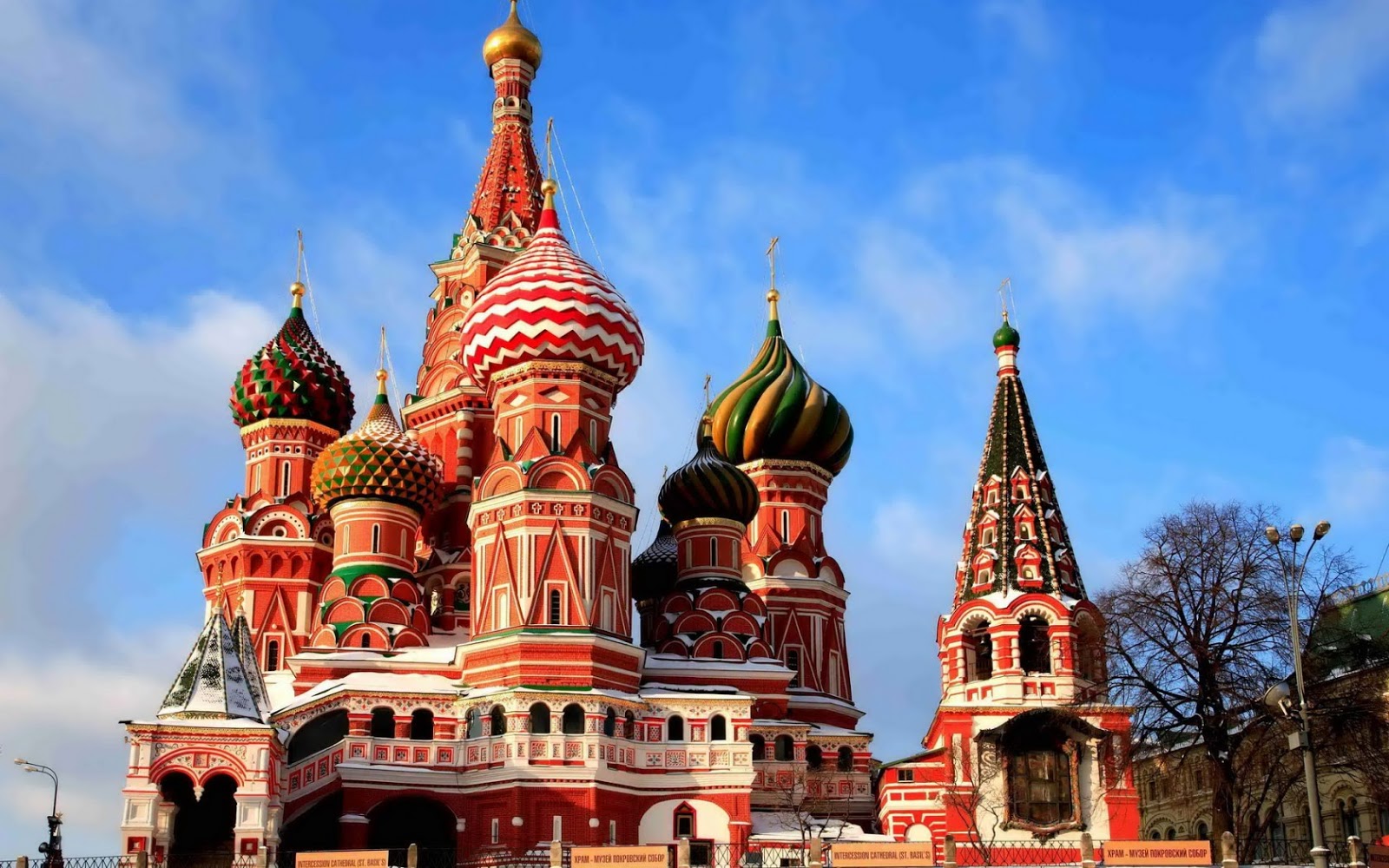
Aside from what I perceived to be sex segregation, the first thing that struck me when I walked in was that the entire nave and sanctuary of the church, all in what was perhaps some guy's living room once upon a time, still looked "churchier" than most Catholic churches I've been to. Icons decked out all sides, and the sanctuary was sectioned off by an impressive iconostasis (considering the surroundings). These were definitely not a people who were concerned about offending their Protestant neighbors' sensibilities. They would probably not think whitewashing their walls or getting rid of their fine vestments would make them any more humble than they already are. (After all, they were worshipping in a house like the early Christians, or like underground Catholics in China. I doubt they need any more reminders about their position in society.)

After what felt like something six times longer than our fore-Mass (here I mean the preparatory prayers, Kyrie, Gloria), a lector in cassock stepped from the choir in the back to the center of the nave to chant the Epistle in English. Another gentleman stood beside him, following the English version immediately with a re-chanting in Russian. The church didn't have a deacon, so the priest chanted the Gospel. This was the first time I got a good look at him. He was a hieromonk (the word easterners use to describe a monastic priest), and appeared in the flesh as I imagined all priests should: clad in the finest vestments a church can afford, with a great beard and unclipped hair, just as virtually all our depictions of Christ have it. I've never bought the idea that a western priest should shave just because that was the fashion during the late Roman Empire. Do we want a priest to be an alter Christus, or a mock Roman senator? Another argument I've heard is that a priest with long hair and a big beard would scandalize people. (Who, your grandmother?) But then, why wear a cassock outside of the church? Indeed, why bother with the Roman collar at all? In the first world of the 21st century, a Roman collar is going to scandalize a lot more people than a beard if for no other reason than because the collar has become the universal sign of the pedophile.

Bishop Nikon
After the gospel, the priest gave his sermon. A kind middle-aged guy who knew I was visiting and helped me follow along in a service book invited me to sit on a bench resting against the wall. As there were no pews and only a couple other benches beside the one I was sitting on, everyone else sat on the floor, Woodstock-style while the priest spoke. He wanted to expound upon a sermon of Bishop Nikon (Rklitsky's) on the Transfiguration and passed out printouts of that sermon to everyone (the following day was to be the feast of the Transfiguration in the old Julian calendar, which this church observes). The priest was very engaging and personable without having to resort to lame jokes, as one Latin Mass priest I know does. For a moment, I imagined I was really there with Peter, James, and John as Jesus revealed His divine nature to them. Most of the time, I can't wait for a sermon to be over, but I was sad when this priest ran out of things to say. 

Following the sermon, the priest began the "Litany of Fervent Supplication", which corresponds to the prayers of the faithful in the Novus Ordo Mass. Latin Mass purists may get irritated when I say that I believe restoring the prayers of the faithful was one of the (very few) legitimate improvements of the Novus Ordo. I use the word "improvement" loosely because intercessions used to exist in the Roman liturgy (and continue to exist in the famous intercessions of Good Friday), but I can't go so far as to say "restoration" because I don't think the early medieval West had middle-aged women in pantsuits rasp the prayers out from the lectern. A handful of western churches, such as my Anglican Use parish, pray them in a sensible manner with a deacon, but it's a needle-in-haystack situation. (For further reference, I posted an example of the intercessions, or "bidding prayers", that existed in pre-Reformation England near the end of this article.)

Anyway, I smirked when the litany used charmingly old-fashioned phrases like "again we pray for our great lord and father, His Holiness Patriarch Kirill" and for "pious kings and right-believing queens" as though any still existed. After that, the priest said "as many as are catechumens, depart". The Eucharistic portion of the liturgy hadn't even started yet, but if I had gone to a Roman Mass, it would already be well into coffee hour by now. I had gotten a little tired of standing and contemplated taking the liturgy's cue to leave, but I then resolved to restrain by pathetically short westerner's attention span and see it through to the end. I also concluded that as a validly baptized Christian, I wasn't really a catechumen by Orthodox reckoning, just a schismatic. And so I stuck around.

A word on the music: one of Lauren's beefs with the western church, which I heartily agree with, is what some call the "low Mass mentality". Don't get me wrong, I like low Mass... in its proper context. But when it was developed in the later Middle Ages, it was supposed to allow a monastic priest to celebrate an additional Mass for his own and other intentions, beside the conventual solemn Mass that he and his brothers all attended. Later on, during the Church's great missionary age, the low Mass was very useful for priests stuck by themselves in strange lands without the resources to recreate Notre-Dame in the middle of Indian territory, or say in Ireland when priests were on the lam during the penal days. And even today, low Mass is great for weekdays when the pious faithful want to get in and get out for a boost of holiness before the start of the work day. I get it, truly. But at no point was the low Mass ever supposed to replace the solemn Sunday liturgy. Every Sunday is a feast, and a feast implies singing. Somewhere down the line, we in the west have supplanted "festivity" with "obligation", so it's no wonder we want to punch our timecards at church as quickly as possible and get back to football season. 

So I was struck that at this tiny Divine Liturgy I was observing, attended more sparsely than even some weekday low Masses, everything was still sung from beginning to end. I'll hasten to add that the Divine Liturgy would probably take a long time even if it ever occurred to a priest to just recite the entire thing in the spoken tone. The choir was a mix of men and women singing the responses and other liturgical texts in harmony, but by no means dragging them out. They went through the Nicene Creed much faster than it would take us westerners to chant Credo I or III. I don't know if the Divine Liturgy has anything analogous to our long, melismatic Proper chants like the Gradual, but I didn't hear anything like that here. In truth, I was disappointed that I didn't hear anything like the deep all-male Russian chants you might find on YouTube with the droning, but I'm told those sorts of choirs are rare outside of Russia itself. Or perhaps it's just beyond this tiny parish's resources. Either way, the choir here seemed to exist just to lead the congregational singing. In America, though the schola I belong to actively tries to foster as much congregational singing as possible, sung Latin Masses tend to be showpieces for the choir as the congregation listens in admiration. (I've actually heard the line, "if you were at a symphony, you wouldn't climb into the orchestra pit to perform with the musicians, would you?")  

An iconostasis
The priest withdrew behind the iconostasis for the anaphora/Eucharistic prayer, and for at least part of it, he closed an additional screen so that you couldn't see even the top of his head. My mind wandered for a while so I don't recall all the details, but I think the entire anaphora was sung aloud. There was no silent Canon as we have in the old Mass. Later, Lauren remarked to me that in the west, after the Counter-Reformation, we seem to have discarded visual veiling in favor of verbal veiling. We got rid of the rood screens to appease Protestant objections, but retained the silence, and the Latin language, to preserve a sense of mystery. The east, I would venture to guess, didn't see the need for a silent Canon or any problem with the common tongue because they already had the iconostasis. In my opinion, it'd be great for the Mass to make use of all of the above, but according to Cardinal Newman, you might as well celebrate Mass in the sacristy if no one can see the action. Apparently, most traditional Catholics agree with the sentiment, so rood screens won't make a comeback anytime soon.

Communion eastern-style
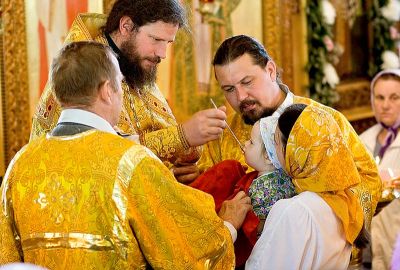
Naturally, just being a visitor, I refrained from Communion. Many people in attendance, who I assume are regulars, also refrained from receiving. I'm not sure if it's because this is normal for Orthodox churches the world over, or because the congregation is made up of "trads". (Nearly all the women also wore headcoverings like in trad Catholic churches, but not a mantilla in sight.) Again to the consternation of my friends who are 1962 purists, I admired the Divine Liturgy's use of both species and wished I could receive both in the context of the old Mass. The priest addressed the communicants by name, saying "the servant/handmaid of God, N., partaketh of the precious and holy Body and Blood of Our Lord and God and Savior Jesus Christ, for remission of sins and for life everlasting." 

An aeon later, after the dismissal, the priest informally spoke to the congregation about things like Russian traditions regarding Communion, the vigil for the Transfiguration to be held that evening, and about the current attacks on Christian churches in the Middle East. Finally, he asked if anyone had any birthdays or name days coming up. One guy did, so the whole church sang "God Grant You Many Years" or something similar. When that was done, everyone dispersed to either the "parish hall" (another room in the house) or to receive a blessing from the priest. The guy who helped me follow along in the service book invited me to receive a blessing from the priest along with everyone else, but for the same reason I decided not to make signs of the cross Eastern-style, I decided not to go up for fear of mucking things up. 

The fellow who had a birthday was, I think, also the choir director. He warmly welcomed me to the church and asked if I was a musician. I don't know what prompted him to ask since I didn't even sing the congregational parts, but I said I was, and he responded along the lines of, "if I had known, I would've invited you to join us in sightreading some of the parts." To which I replied, "thanks, but I'm not Orthodox." He continued, saying, "that's okay, I wasn't Orthodox when I began singing here, either." He then invited me to stay and eat lunch with the other parishioners. I would've taken him up on it if I didn't feel so awkward, but instead, Lauren and I left.


The ride home

Lauren enjoyed the Liturgy quite a bit, and I had a very positive experience about it and the community myself. In fact, if you've read up to this point, you might be wondering if I've thought of "going Dox" by the end of it all. In a word, no. And although I mused that I unwittingly tossed Lauren headfirst into Patriarch Kirill's clutches by indulging her with this visit, she actually came through it more comfortable with her Catholic identity. Although our proverbial pilgrimage to Moscow affirmed in both us everything we disliked about western spirituality, there was still something missing. Lauren iterated the four marks of the Church (one, holy, catholic, and apostolic) and said she believed the Orthodox came up short on the "catholic" part. After all, we visited a Russian Orthodox church, as distinct from a Greek or Serbian one. While it's true that the Roman Church also has eastern rites, and in the not-too-distant past also had ethnic Irish, Italian, Polish, and Korean parishes in America, these are all window dressing by comparison to the distinct ethnic character of the various Orthodox churches out there.

An Orthodox reading this will quickly object by saying that there's no ethnic requirement to joining the church. Indeed, I believe the priest at the church I visited was of Irish descent (just based on name and appearance; I didn't talk to him), and I'm led to believe that it's quite normal for Orthodox clergy in America to be of Anglo, Irish, German, or otherwise non-Eastern European origin. But still, just speaking personally as a non-Slav, I feel like even if I did have the urge to convert to Orthodoxy, I wouldn't feel completely integrated into the Orthodox world unless I went above and beyond, and became a cleric in the faith. Otherwise, I'd perpetually be a hanger-on, a token half-Anglo, half-Indonesian guy (if not the only half-Anglo, half-Indonesian guy in all of Orthodoxy). As a convert to the Roman church, while I do still feel like a bit of an outsider, this is more because I'm just a single person going to church without any family ties or little ones trailing behind me, rather than because of ethnicity. 

In spite of all the eye-rolling induced whenever I read about the latest media stunt or soundbite surrounding Pope Francis, or my general cynicism about anything related to Vatican politics, I have to admit that the bishop of Rome somehow still supports a unity and catholicity you just can't find anywhere else in Christianity. I can look at photos of Japanese people attending Mass in Nagasaki after the bombs fell and think it makes sense, but think it would be bizarre if it were a Divine Liturgy instead. I can be irritated as hell looking over photos of the Eucharist being tossed like candy at World Youth Day in Brazil, but still feel the event is somehow relevant to me because I'm Catholic. I can have absolutely nothing in common with the average pew-warmer at the Catholic parish down the street, but what happens at his Novus Ordo Mass still matters to me more than what happens at an aesthetically perfect solemn Mass at Saint Clement's Episcopal in downtown Philly (though they are more Tridentine than Puginesque, but I digress). Much as I'd like to ignore the daily doings of Francis, his office somehow ties the ordinary Joe Catholic pew-warmer's fate to mine more than that of the most zealous Anglo-Catholic medievalist.


A Western Orthodox world

If I could build my own church, it would look like the Sainte-Chapelle and have daily solemn Mass and Office in the Sarum Use with a rood screen, choir stalls in the sanctuary, Communion under both species, less scholasticism and legalism, and some odd combination of both married secular clergy and celibate canons; and somehow still have a very active role in social justice and ministering to the poor of the area. As a young male convert to Catholicism with just enough education to enjoy armchair pontificating and not enough to be wise and content with what I have, I have the bizarre daily temptation to re-imagine the Church as I want it to be. Lauren, being a more masculine thinker than most women (don't tell her I said that, but honestly, when was the last time you heard of a single young female who thought of converting to Orthodoxy because Catholicism is too effeminate?), sought solace in the East but came through with a reassurance of Catholicism's catholicity, despite itself.

My imaginary church will never exist under the auspices of Pope Francis or (probably) any of his successors in my lifetime. The closest it's ever come would be under the extremely niche communities of Anglo-Catholics (such as Saint Clement's, as I mentioned above) or in so-called Western Orthodox communities. The priest of the Russian Orthodox parish I visited is an expert on the Sarum Use and, I imagine, has celebrated it many times before if he doesn't now. These communities are havens for thinkers such as Lauren and myself, and I'm sure some of them even read my blog. 

This Western Orthodox bishop (?) is precisely what I imagine all western churchmen ought to look like

My last thought for this entry: if reincarnation were true, I'm pretty certain I would have been Henry VIII in a past life. No other historical figure so embodies the "if I could build my own church" sentence I wrote better than he. Contrary to popular belief, Henry didn't create the Church of England just because he was randy. Any other king in his position would have just taken Anne Boleyn as a mistress and carried on with life. But before Henry became king, he was a young man groomed for a career in the clergy while his older brother, Prince Arthur, was set to be king. Indeed, his father named his firstborn "Arthur" out of a belief that he, the first of a union between the feuding houses of York and Lancaster, would lead England to a new golden age just like the king of myth. Young Henry, some said, would serve the realm as Archbishop of Canterbury beside his elder brother. 

Henry VIII before he was fat
So when Arthur died and Henry became heir, it's no surprise that his background as a potential churchman shaped his approach to the kingship. Henry's piety led him to come to the Papal States' defense during the Italian Wars. With the aid of Saint Thomas More, he published the Defense of the Seven Sacraments against Luther and was named by the Pope a "defender of the faith". When the continuation of the Tudor line came into question, it wasn't enough for Henry to just take a mistress as any other king would have done. He had to have his union validated by the Church, and if the Church wouldn't acquiesce (and honestly, if Katherine weren't the Holy Roman Emperor's aunt, the annulment probably would have gone through), he would have to take matters into his own hands.

Still, for the average Englishman, nothing changed under Henry's Church of England at all. At most, he introduced the "for thine is the kingdom" doxology to the Lord's Prayer, but that was already in Eastern usage, not a Protestant innovation. Lutheranism was still condemned in Henry's church. So ironically, I don't see Henry VIII as a Protestant at all. He was instead, perhaps, the first Western Orthodox; for if every king had followed his example, the West would have broken into national churches while otherwise remaining completely apostolic. The Pope would have remained "patriarch of the west" but with no real power outside the see of Rome.

And therefore, every day in between brushing my teeth and flossing, I look into the mirror and ask myself, "have I become Henry VIII?" The answer remains no, and it's not just because I decided to lay off the enchiladas. No, friends. Lauren and I will remain where we are, loving the Roman church despite Her best efforts to eject medievalists to the dustbin of history. Apologies if I offended anyone in the process.


Tuesday, October 30, 2012

The Sarum High Mass: Mass of the Faithful

The previous articles in this series:

-The Use of Sarum: A Brief History, and Why It Matters
-The Sarum Low Mass: Mass of the Catechumens
-The Sarum Low Mass: Mass of the Faithful
-The Sarum High Mass: Mass of the Catechumens

At last, we come to the Sarum's summit: the Eucharistic sacrifice as seen in high Mass. This last comparison is short, though, because the rubrics for the Mass of the Faithful concern mostly the celebrant himself, and there are few differences between high and low Mass for him from the Offertory onward. The deacon and subdeacon, who may be said to be the "stars" of the Mass of the Catechumens, now step aside to humbly assist the priest as he fulfills his vocation upon the high altar.


The Offertory

As in the Mass of Trent, the Offertory begins after the celebrant says Dominus vobiscum, then Oremus. I said before that in a parish Mass, the Sarum rubrics place the bidding prayers "after the Gospel or Offertory". I placed my account of them after the Gospel, or after the Creed when the Creed is said. "After the Offertory" is a very awkward place for bidding prayers, but on closer thought, I offer the possibility that the rubric means after the Oremus. The reason? Because this was the place where the oratio fidelium, the prayers of the faithful, were made in Rome prior to the reforms of Pope Gregory the Great. This, at least, is the argument made by the Rev. Father Adrian Fortescue which can be found in the Catholic Encyclopedia's article on 'Liturgy of the Mass':

'The "Oremus" said just before the Offertory is the fragment of quite another thing, the old prayers of the faithful, of which we still have a specimen in the series of collects on Good Friday.'
And:
'At Rome the prayers of the faithful after the expulsion of the catechumens and the Intercession at the end of the Canon have gone. Both no doubt were considered superfluous since there is a series of petitions of the same nature in the Canon. But both have left traces. We still say Oremus before the Offertory, where the prayers of the faithful once stood, and still have these prayers on Good Friday in the collects. And the "Hanc Igitur" is a fragment of the Intercession.'
It may have been the case, then, that Sarum preserved this ordering, or at least the option of it.

Now, as the celebrant reads the Offertory sentence privately, the choir sings it. There are some days (ferial days in Advent and from Septuagesima to Easter) in which the Offertory has a verse and response, like in the Tridentine's Requiem Offertory or in the Offertoriale Triplex. However, the rubrics state these are not to be said outside of these days. (I see no reason why the verses can't be sung by the choir ad libitum to cover additional time, however, if they can be found in the Offertoriale or elsewhere.)

The usual position of the ministers when the celebrant reads from the middle, though I'm unsure about the northward-facing acolyte there.
The deacon presents the chalice and the paten with the Host to be consecrated to the celebrant, "kissing his hand each time". As in low Mass, the celebrant offers the Host and chalice at the same time with the prayer Suscipe, sancta Trinitas. After placing the gifts properly upon the altar, he receives the thurible from the deacon and censes the gifts "thrice, making the sign of the cross over it; then thrice round and on either side: then thrice between himself and the Altar". While doing so, he recites the prayer:

Dirigatur, Domine, ad te oratio mea, sicut incensum in conspectu tuo.
Let me prayer, O Lord, be set forth in Thy sight as the incense.

He then returns the thurible to the deacon, who, if the Creed has been said, censes him. The subdeacon brings the celebrant "the Text" to kiss, but I'm not sure what text is being referred to here; perhaps the Missal. While the celebrant steps to the right of the altar to wash his hands as at low Mass, the deacon is incensing the left of the altar "and the relics in order". The rubrics don't specify if the deacon ever censes the altar's right.

One of the acolytes is tasked with incensing the choir, differing with the practice of Trent which has the deacon do so. The order prescribed is for the acolyte to first cense the rulers, then the dean, then those on the "upper grade" of his stall on the north side. Then he censes the precentor and the upper grade on the south side. He then goes back and forth to cense the middle and lower grades of the stalls in what must have been a lengthy ritual. The subdeacon, meanwhile, follows the acolyte and presents the Text for each member of the choir to kiss after they've been censed. If the Creed has not been said, then the incensing of anything but the gifts upon the altar is omitted.

After the handwashing, the celebrant returns to the middle of the altar and continues as he would at low Mass, while his ministers assume their places behind him. As in Trent, he sings per omnia saecula saeculorum aloud at the end of the Secret and continues with the Preface.

The Canon

During the versicles of the Preface, the deacon gives the paten and humeral veil to the subdeacon, who holds the paten with the veil until the Lord's Prayer. At the Sanctus, if there are rulers, the rubrics instruct the choir to exit their stalls at the ringing of the bell and stand outside the first stalls in the center of the quire. They do not kneel, except on ferial days.

There are no instructions throughout the Canon which differ from low Mass, except that after the consecration, the cerofers assist the deacon with washing his hands, and toward the end, at per ipsum et cum ipso, "let the Deacon stand at the right of the Priest, having first washed his hands, and assist him in raising the corporals; and as he retires let him kiss the Altar and the right shoulder of the Priest."

As at low Mass, the priest extends his arms in a cross after the consecration of the wine.

From the Lord's Prayer to Communion

As the celebrant begins the Lord's Prayer with Præceptis salutaribus moniti, the deacon takes the paten from the subdeacon and stands to the celebrant's right, holding the paten uncovered with both hands, arms extended out. At Libera nos, the deacon hands the paten to the celebrant, kissing his hand. The celebrant makes a curious gesture here which I neglected to mention in the low Mass article. Taking the paten from the deacon, he kisses it, then holds it over his left, then his right eye before signing himself with it.

At the Kiss of Peace, the deacon receives the peace from the celebrant and gives it to the subdeacon. The deacon also gives it to the rulers of the choir, who then give it to their respective sides.

As with low Mass, there are no instructions in the Missals for the people's Communion. I've done a bit more research into this subject, and it seems that there are no surviving rubrics for administering Communion to the people in any book whatsoever; largely because by the end of the Middle Ages, it seems the common practice was for the laity to receive Communion only a few times a year, and in those cases, usually outside of Mass.

The Rev. Seán Finnegan, who was involved with the Sarum Candlemas liturgy at Oxford in 1997, wrote of their difficulties in handling precisely how to approach the people's Communion "accurately". I'll quote from his series of posts on this:
"This was one part of the ceremony where we really had to wing it. We had gleaned that the confiteor was said before Communion, because there is a record of one king of England saying it on his own before his coronation. So we gave the Sarum Confiteor to the Deacon to recite, as in the Roman Use. There was a lot of agonizing about whether we should have Ecce Agnus Dei and Domine non sum dignus, but we could find no evidence for either (which is not the same as it never existing) so in the end, though we printed it in the booklets, we omitted it in the ceremony, probably correctly, I think. The formula for Communion we had, from the order for the visitation of the sick: Corpus Domini nostri Jesu Christi custodiat corpus tuum et animam tuam in vitam æternam, it goes. We knew that there was the custom of the 'houselling cloth' —the long cloth you can see being used — in many places, and that unconsecrated wine was given after the host to cleanse the mouth. We had no formula for administering that, so the acolyte simply presented a chalice with the wine, saying nothing."
The houseling cloth, which is held under the communicant's chin to prevent dropping the Host, is still used at some Tridentine Masses I've attended in the past. Father Finnegan also mentions the interesting custom of administering unconsecrated wine to "wash down" the Eucharist. This may have been a remnant of the late medieval Church's transitional period, when it withdrew Communion via the Chalice from the people. Perhaps unconsecrated wine was still administered as a matter of habit. Other reasons given were that it made swallowing the Host easier, and that it prevented anyone from spitting out any small particle of the Host later on.

Illustration of Communion from the Coronation Book of King Charles V of France, c.1365. (I believe the Tridentine form doesn't allow a bishop to distribute Communion with the mitre on.)

From the ablutions to the end of Mass

At the ablutions, the rubrics have the subdeacon pour the water and wine into the chalice (a few sources contradict and have the deacon here). At the third and last ablution, all sources have the deacon pour the water. The subdeacon ministers to the celebrant in washing his hands, while the deacon folds up the corporals, places them in the burse, the burse over the chalice, and gives them to the acolyte (wearing the humeral veil), who returns them to the credence or shelf.

The subdeacon assisting with the ablutions.
All else follows as in the Mass of Trent, but after the dismissal, the Mass is truly ended. As with low Mass, there is no final blessing, and the Last Gospel is recited privately by the celebrant on his way back to the sacristy. (The medieval priest may have recited it at the altar, though, if he were in one of those churches that had no sacristy to speak of.) The choir remain in their places and proceed with None, or the appropriate Divine Hour, immediately after Deo gratias.

Saturday, October 20, 2012

The Sarum High Mass: Mass of the Catechumens


A Sarum Missal, dated around 1418. A mention of the Pope in the far right column has been scratched out by order of Henry VIII.
 In case you've missed previous articles, please check those out first:

-The Use of Sarum: A Brief History, and Why It Matters
-The Sarum Low Mass: Mass of the Catechumens
-The Sarum Low Mass: Mass of the Faithful


If you've been following my series in the Sarum Use, we've so far covered its general history and what a spoken, or low Mass would have looked like in most of England before the Reformation. Low Mass is useful for seeing the substance of the liturgy, but the rubrics presume that high Mass is the norm. We saw how the Sarum low Mass appears to have been only a slight variation of the Roman Mass with a few medieval "accretions" here and there. The high Mass will show the pageantry of the medieval spirit in full.

High Mass is defined here as Mass sung with a deacon and subdeacon. In the Middle Ages, there was no such thing as a missa cantata with a priest and servers only. The rubrics as explained by Pearson's The Sarum Missal Done into English seem to have been intended for the cathedral of Salisbury itself; it presumes an abundance of canons and a very spacious church. I believe it's safe to say that the parishes modified these rubrics liberally to suit their resources.


The Sunday Procession and Aspersion

In our Tridentine form of the Mass, the "principal" Mass of a church on Sunday is supposed to be preceded by an aspersion: the priest, vested in cope, goes down the nave sprinkling the people with holy water as Asperges Me is sung. Its counterpart in Sarum is nearly a service in itself. (though unlike Trent, this rite in Sarum is omitted if a double feast falls on a Sunday.)

These directions are taken from the Sarum Processional. The priest, "after Prime and Chapter", is at the step of the quire (or, we could say, at the sanctuary gate) in alb and cope. The deacon and subdeacon are with him, holding his book. There are also a thurifer, crucifer, and acolytes, all wearing albs and amices (the Tridentine form prescribes only surplices for anyone not one of the three sacred ministers). Finally, there are "the boys with salt and water and the Book, who are in surplices". It's possible that these very junior positions of service were allowed to boys, while the higher serving positions had to be filled by men or older boys ordained to the minor orders.

Before starting with Asperges Me, Sarum has the celebrant bless the holy water. I believe these prayers are also in the Tridentine books. I'll provide only the English translation of this portion for now. He first exorcises the salt:
I exorcise thee, O creature of salt, by the living God, + by the true God, + by the holy God, + by the God Who commanded thee to be cast into the water by Elias the prophet, that the barrenness of the same might be healed, that thou become salt for the preservation of them that believe, and be to all who take thee salvation of soul and body; and from the place wherein thou shalt be sprinkled let every delusion and wickedness of the Devil and all unclean spirits, when adjured, fly and depart, by Him; Who shall come to judge the quick and the dead, and the world by fire. 
Amen.

Let us pray. We humbly implore Thy boundless loving-kindness, Almighty and everlasting God, that of Thy bounty Thou wouldst deign to ble+ss and sanc+tify this creature of salt, which Thou hast given for the use of mankind; let it be unto all who take it healthy of mind and body; that whatsoever shall be touched or sprinkled with it be freed from all manner of uncleanness, and from all assaults of spiritual wickedness. Through Christ our Lord. 
Amen.
Then the exorcism of water:
I exorcise thee, O creature of water, in the Name of God + the Father Almighty; and in the Name of Jesus Christ, + His son, our Lord; and in the power of the Holy + Ghost; that thou mayest become water exorcised for the chasing away of all the power of the enemy; that thou mayest have strength to cast out the enemy himself and his apostate angels, by the power of the same, our Lord Jesus Christ, Who shall come to judge the quick and the dead, and the world by fire. 
Amen.

Let us pray. O God, Who for the salvation of mankind hast hidden one of Thy greatest sacraments in the element of water, graciously give ear when we call upon Thee, and pour upon this element, prepared for divers purifications, the power of Thy blessing; let Thy creature serve in Thy Mysteries, by Divine grace be effectual for casting out devils and for driving away diseases, that on whatsoever in the houses or places of the faithful this water shall be sprinkled, it may be freed from all uncleanness, and delivered from hurt. Let not the blast of pestilence nor disease remain there; let every enemy that lieth in wait depart; if there be ought which hath ill-will to the safety and quietness of the inhabitants, let it flee away at the sprinkling of this water, that they being saved by the invocation of Thy Holy Name, may be defended from all that rise up against them. Through Christ our Lord. 
Amen.
The rubric then says "Here let the Priest cast salt into the water in the form of a Cross, saying":
Let this become a mixture of salt and water, in the Name of the Father, + and of the Son, + and of the Holy Ghost. + Amen.

V. The Lord be with you.
R. And with thy spirit.
And this last prayer before the sprinkling really caught my attention. Read it carefully:
Let us pray.
O God, Author of invincible might, King of a dominion which cannot be moved and ever a Conqueror, Who puttest down the strength of all that rise up against Thee, overcomest the rage of the adversary, and by Thy power dost cast down his wickedness; we, O Lord, with fear, humbly entreat and implore Thee mercifully to look upon this creature of salt and water; after Thy loving-kindness graciously illumine and sanctify + it, that wheresoever it shall be sprinkled, by the invocation of Thy holy Name all unclean spirits which lie in wait may be cast out, and the dread of the serpent be chased far away; and let the presence of the Holy Ghost vouchsafe to be with us who ask Thy mercy in every place. Through Christ our Lord. 
Amen.
I don't know if that prayer originated in Rome, Normandy, or England first, but it beautifully captures the best of the Gothic spirit. Here, God described as the God of Battles, as in the days of the Old Testament. War, plague, famine, and death were everyday realities for those who attended the Sarum Mass, just as they were for the ancient Israelites. Yet we also see here that, contrary to the stereotypes of medieval religion as being totally distant from the hearts of the everyday peasant, God has a direct, earthy presence in the lives of the people. The priest asks Him to empower the everyday substances of salt and water ("this creature", it says) with His love so that whoever uses that holy water may count upon the name of Jesus as a surefire ward against the defilement of evil spirits. Superstitious? The Protestant Reformers certainly thought so, but I see a spirituality that uses everyday items to bring faith to a people who had neither the ability nor the inclination to read a book. Furthermore, it reflects the spirit of the Gothic age, which achieved a perfect balance in emphasizing God as both warrior and peacemaker: not too mushy, and not too distant.

After that collect, the celebrant sprinkles the altar, then his assistants, then the choir: first the north side, then the south, while Asperges Me is sung (or Vidi Aquam from Easter to Trinity Sunday). He then exits the chancel in procession via the north entrance (remember, these rubrics assume sanctuaries are enclosed, elongated spaces with three points of entry), turns right, and begins sprinkling the side altars in all the chapels around the east end of the church. 

The procession according to Chambers in Divine Worship in England in the Thirteenth and Fourteenth Centuries, is arranged as such: first, a beadle, clearing the way with a mace or staff in hand. A beadle, by the way, is a lay official who acts as a bodyguard and keeper of the peace. (The name comes from an Anglo-Saxon word, bydel, meaning "to bid". The beadle does his master's bidding.) Our modern counterpart is the usher, though our ushers rarely have ceremonial significance now. The only time I've ever seen a beadle in modern Catholic practice is photos of ceremonies by the Institute of Christ the King in Europe, typically involving Cardinal Burke. Other Sarum sources call him a verger, which means nearly the same thing. He carries a rod called a virge, or virga.

Illustration from the Sarum Procession showing who stands where.

After the beadle/verger follow the asperger (boy in surplice carrying the holy water), the crucifer with the processional cross (only on double feasts or higher), two cerofers (candlebearers) side by side, thurifer, subdeacon, deacon, and celebrant. Interestingly, there's never any mention of a master of ceremonies, which leads me to wonder if that position is of more recent vintage. (It's possible to omit the MC in the Tridentine high Mass if everyone knows exactly what they're doing, but the MC is still a standard practice at every Tridentine high Mass I've ever been to.)

The procession, after sprinkling all the side altars, goes up the nave to sprinkle the people. I've also seen several sources state that the procession went to every side altar in the church to incense them, but I haven't seen a specific rubric for it, nor do I see how the priest could use the holy water and the incenser at the same time unless, perhaps, one or the other is delegated to the deacon. In any case, when the procession returns to the chancel, they stop underneath the rood, and the priest sings the versicle Ostende nobis, followed by the prayer Exaudi nos, Domine, just as in the 1962 Missal.

The rubrics next have the bidding prayers (like the intercessions of the faithful in the Novus Ordo Mass) are prayed in the common tongue, but for whatever reason, only in the cathedral. The practice for the parishes is to have the bidding prayers later in the Mass, so that's where I'll explain them.


The Beginning of Mass: the Office (Introit), Kyrie, Gloria

After the aspersion rite, the ministers retreat to the sacristy to vest for Mass "whilst the Choir is saying Terce". For the smaller parishes that didn't have sacristies in the first place, it's likely that the vesting and preparatory prayers were made before the altar. 

The Mass vestments are the same as we know them today, except that the acolyte who bears the processional cross is allowed to wear a "mantle", which is supposed to be like the subdeacon's tunicle, just shorter or less apparelled. The other servers, aside from the boys who are allowed to go in merely surplice, still wear alb and amice. Meanwhile, the two cantors of the choir, who were presumed to be priests and canons, also put on copes and bear staves symbolizing their office, thence becoming "rulers" of the choir. It's also said that in those days, the directors of choirs actually slammed the staves onto the floor to measure time in figured music; a practice which would no doubt be completely obnoxious to see and hear today. On double feasts, we would see four rulers! The rulers were certainly envisioned for cathedral practice and ignored in parishes that couldn't provide them.

The choir, already in place in the chancel, begins singing the Office, as Sarum calls the Introit, the rulers intoning the first words. On Sundays and feasts, the Office is supposed to be sung three times rather than just two: the antiphon, verse, antiphon, doxology, then antiphon again. At hearing the words Gloria Patri, the ministers line up to process back to the altar. The order, again according to Chambers, is: (crucifer), two cerofers, thurifer, subdeacon carrying the Gospel-book, deacon carrying the Missal, and celebrant.
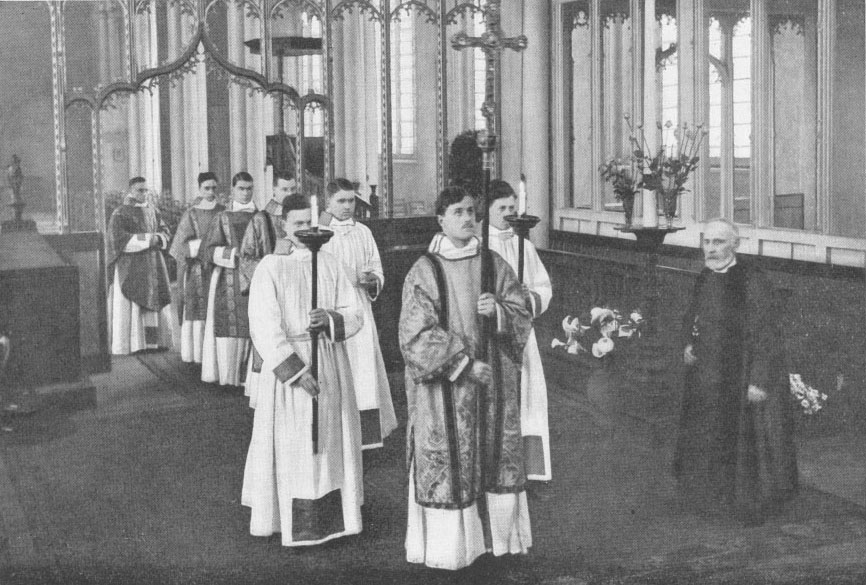
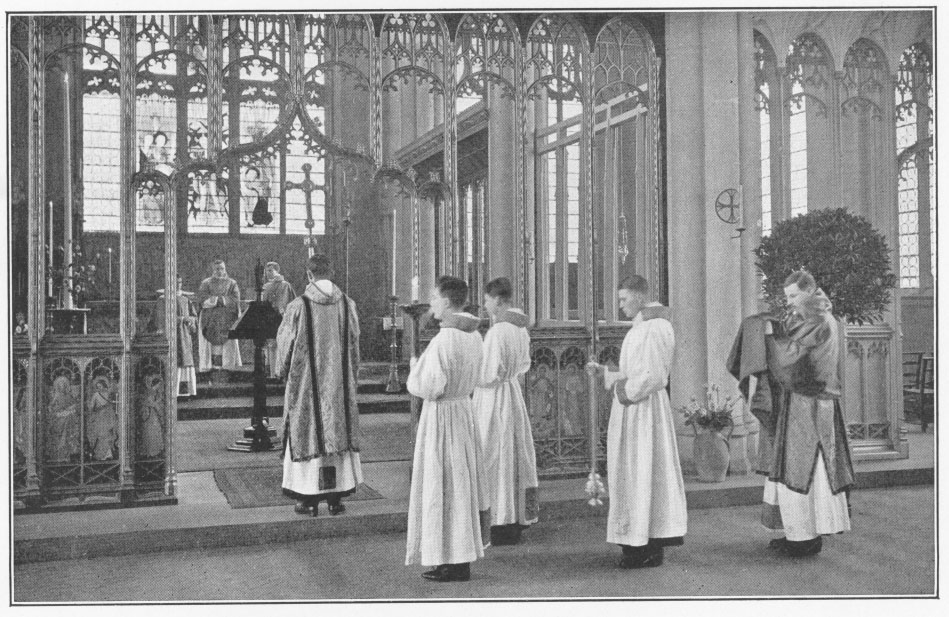
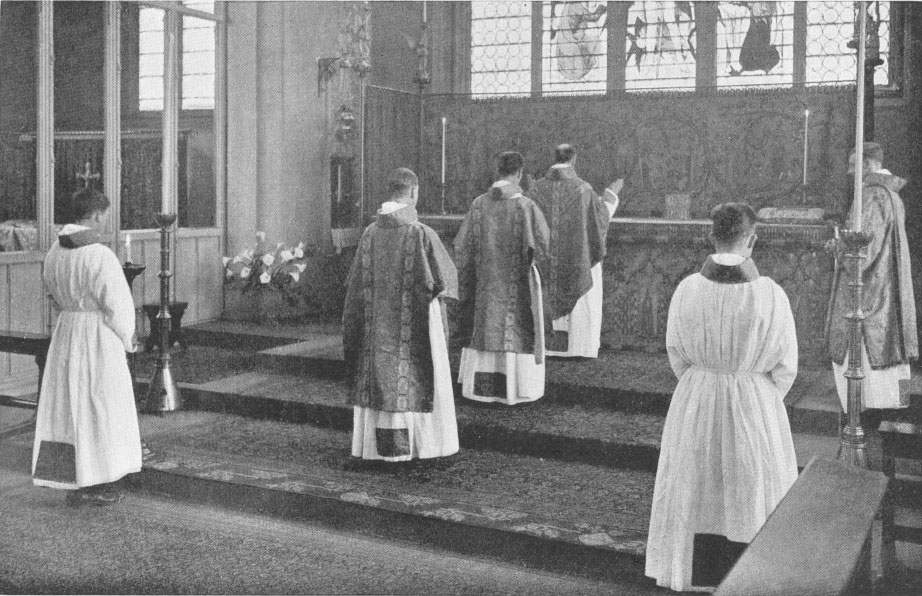
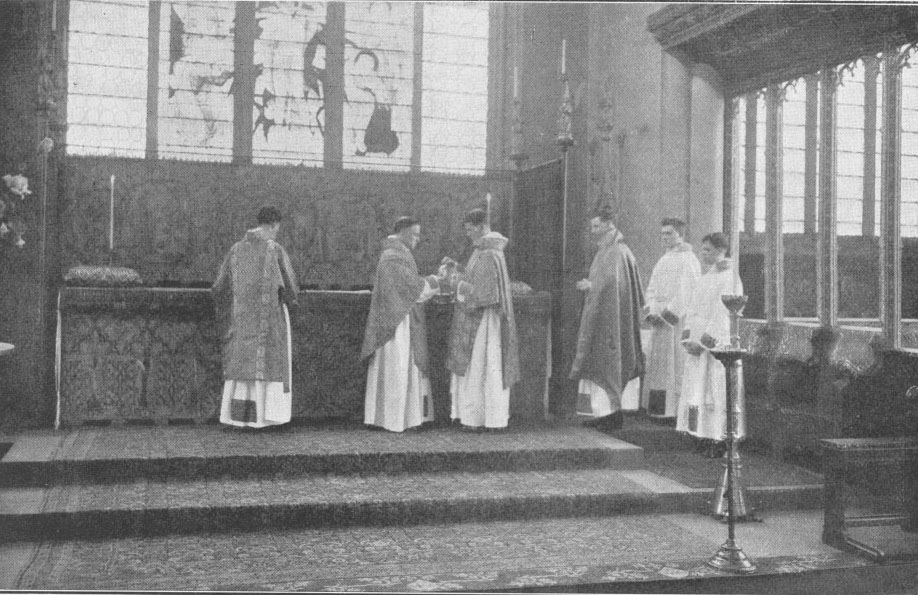
These pictures are from an old publication by the Alcuin Club, an Anglo-Catholic organization. The man in black to the right is the beadle/verger. Bear in mind that these are actually photos of the Anglican Prayer-book Communion service, dressed to resemble the Sarum Mass as much as possible.
The ministers stop at the foot to recite the last words of the Lord's Prayer, then the veriscle Confitemini Domino and response, then the Confiteor.  After the absolution, the celebrant gives a kiss of peace to the deacon, then to the subdeacon. This peace is brief and given to no one else, but it's also prescribed for every day of the year, save for the three days before Easter.

The celebrant ascends the altar, prays Aufer a nobis, then kisses the altar and makes the sign of the cross with In Nomine Patris. He is then given the thurible by the deacon, who says:


Deacon. Benedicite.
Celebrant. Dominus. Ab ipso benedicatur hoc incensum in cujus honore cremabitur. In Nomine Patris, etc.
D. Bid a blessing.
C. The Lord, in Whose honour this incense shall be burnt, by Him be it blessed. In the Name of the Father, etc.

He incenses the right side, then the middle, then the left. He then returns the thurible to the deacon, who incenses him before returning it to the thurifer. The subdeacon presents the Gospel-book for the celebrant to kiss. Meanwhile, the cerofers have placed their candles at the foot of the altar; perhaps atop two tall stands on either side of the foot.
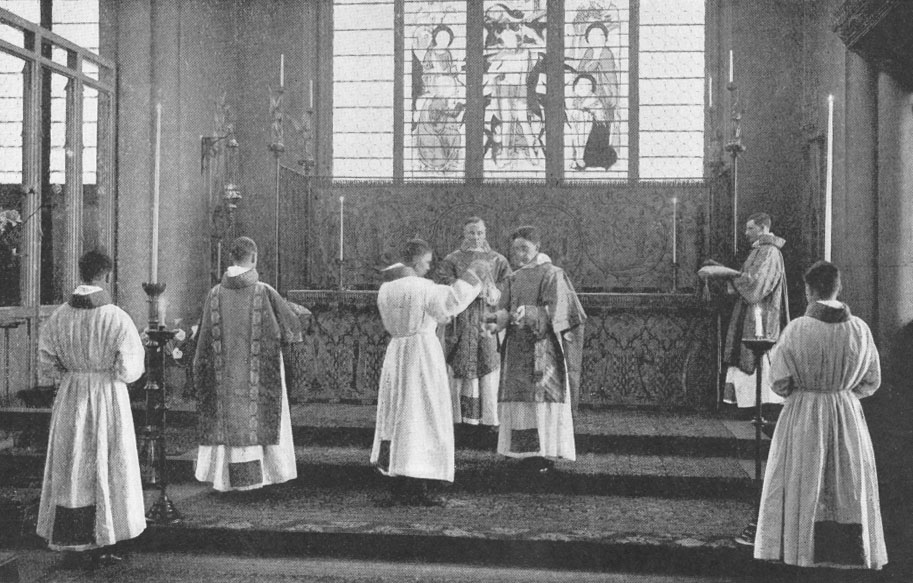
The thurifer hands the thurible to the deacon. It appears the subdeacon is removing the Missal from the altar, which is resting on a cushion rather than a stand.

While the celebrant goes on privately reciting the Office and Kyrie at the Epistle side of the altar, the choir has been singing the Office and probably gone on to chant the Kyrie by now. On many days, the Kyrie is "farced" or has tropes, so in these cases, it's likely that the ministers will have time to sit at the sedilia even before starting the Gloria. 

The cerofers, meanwhile, depart after the celebrant has read the Office. They go to the sacristy to fetch the gifts. One brings the cruets of wine and water, as well as the pyx with the bread; the other carries the ewer and towel for the hand-washing. Both return to the sanctuary and place these "on the shelf over the piscina". Medieval churches typically had these built into the wall, east of the celebrant's seat in the sedilia. In the absence of these, we can take it to mean the credence table, though Sarum assumes the presence of the credence as a distinct piece of furniture. The cerofers then take up their candles and meet the mantled/tunicled acolyte, who has brought the chalice, paten, and burse, all covered in a veil. The acolyte provides a further degree of protection by carrying them in the humeral veil. After setting the chalice down on the credence, he removes the two corporals from the burse (or corporal and pall) and lays them on the altar, kissing it afterward. He then returns to the credence. 
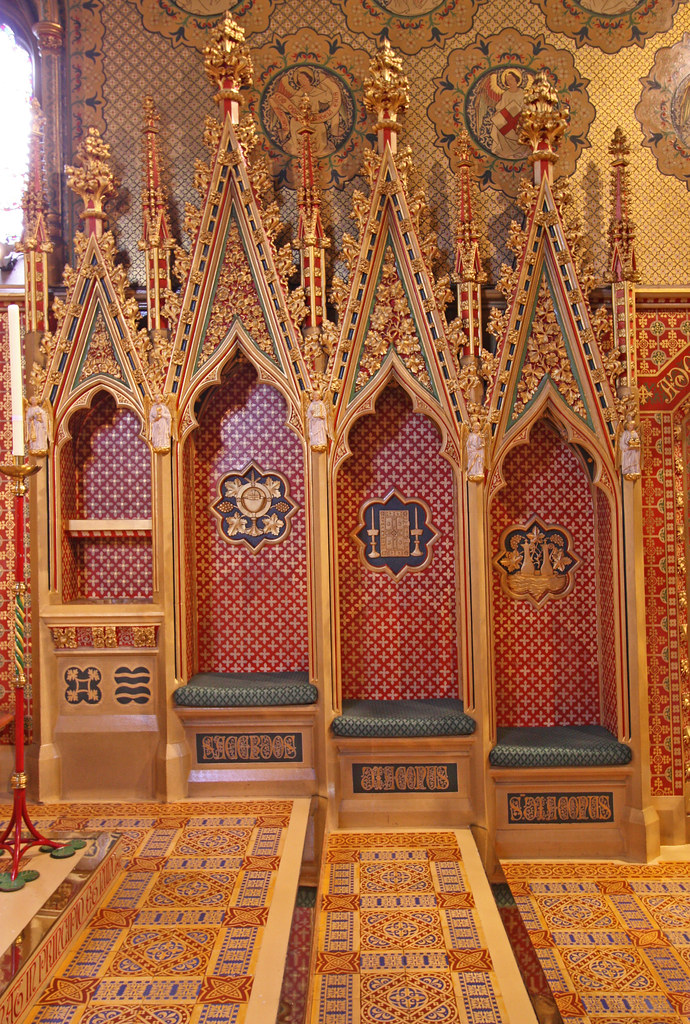
The shelf and piscina are to the left of the priest's seat in this sedilia by Augustus Pugin at Saint Giles, Cheadle.


This shows the mantled acolyte bringing the chalice in with a humeral veil, but the photo was intended to have this take place during the Offertory for the Prayer-book service, rather than during the Office/Kyrie as I described above.

When the celebrant starts the Gloria, the rubrics say that he's given the tone for the first words, which varies by the occasion, from the precentor or a cantor. The modern practice is usually for the organist to play the starting pitches, but in the old, old days, the cantor would actually sing the words first, which the celebrant would then imitate. As mentioned in my article on low Mass, there are a handful of occasions where even the Gloria is modified with additional phrases for the Virgin Mary.


Collect, Epistle, Gradual, Alleluia/Tract, Sequence

While the celebrant is singing the Collect, which on certain days there might be three, five, or even seven (the rubrics stipulate the number of collects must always be odd, as God likes an odd number), the subdeacon prepares to chant the Epistle. On Sundays and feasts with rulers of the choir, the subdeacon chants from the pulpit or ambo. If there are two, as some medieval churches had, he stood at the one on the south or Epistle side. On all other days and on days of penitence, he would read it at the chancel step. Something I failed to mention in the low Mass article, by the way, is that there are no responses for the Epistle or Gospel in Sarum (Deo gratias or Laus tibi, Christe). They seem to have been of later invention.

The subdeacon reading the Epistle from the chancel entrance.

Once finished, he goes to the piscina where the cerofers assist him in washing his hands. The mantled acolyte then gives the subdeacon the cruets so that he can mix the water and wine in the chalice. He pours the wine first, but before applying water, he goes before the celebrant to have the water cruet blessed. I'm having trouble finding the Latin text of the blessing, but in English, the subdeacon says Benedicite/"Bid a blessing". The celebrant replies, "The Lord. By Him be it blessed from Whose side came forth blood and water. In the Name of the Father, etc."
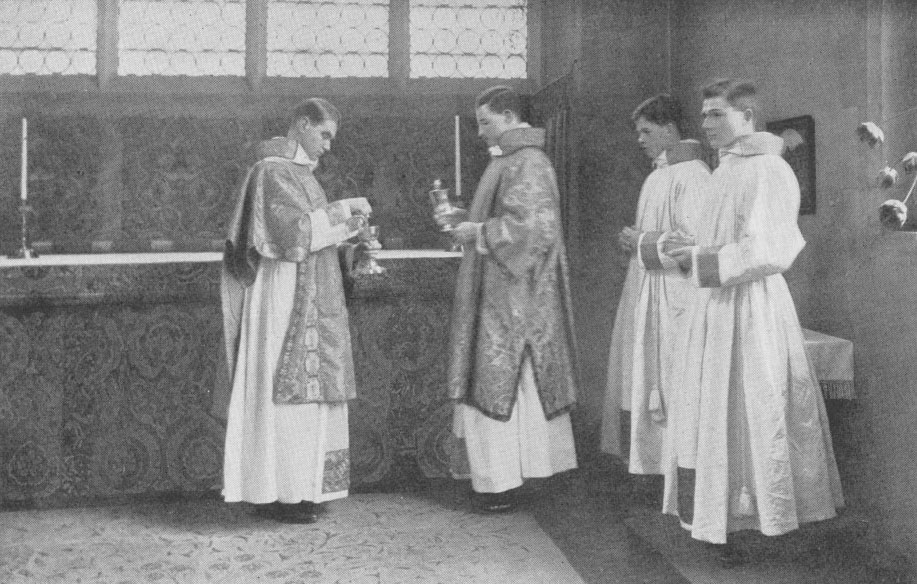
The subdeacon prepares the chalice before a mantled acolyte. In this photo, they're standing before a side altar arranged for this purpose, rather than a credence.

During this whole time the subdeacon has been preparing the chalice, the Gradual is sung. The Gradual got its name from this medieval practice still present in Sarum, which called for two boys in surplice to sing it from the step, or gradus, of the pulpit. It seems that when sung, they would repeat the first portion after finishing the verse except on doubles and days when there was a Tract. It's possible the choir joined in singing, and the boys only cantored the first words and the verse.

The Alleluia enjoyed a special solemnity which is gone in the Tridentine form. While the boys sing the Gradual, there are also two cantors, who are supposed to be canons in copes, who wait at a higher step in the pulpit. The Gradual finished, they sing the Alleluia. The rubrics have the choir and clergy all stand when the Alleluia begins. Only the celebrant and his two ministers may remain seated.

While Trent suppressed all the sequences save for the "five best" in the interest of shortening the liturgy, the Sarum Use had many more; somewhere in the range of 80 sequences, in fact. If there's a Sequence, the canons in copes begin it, and the choir join after. It's likely that the Sequence was sung in alternation. In the event of a sequence, the subdeacon waits until it begins to present the chalice to the celebrant.

If there's a Tract in place of the Alleluia, the Gradual is sung in the choir or at the chancel step. Then the Tract is sung by the rulers in the choir.


The Gospel, Creed, Homily

While the last chant is sung, the deacon goes to the piscina, where the cerofers assist him in washing his hands. Before he prepares the Gospel, he takes the thurible and incenses the altar: only the midst, for though there's no specific direction stating it, it seems the Gospel-book was placed at the north horn of the altar after the first incensing. Thus, by incensing only the middle of the altar, the deacon avoids incensing the Gospel-book before the proper time. (I wonder if this is also one of the reasons why the Missal rests on the south side of the altar up until this point: to allow the Gospel-book to rest on the opposite side.)

The deacon takes the Gospel-book and presents it to the celebrant for a blessing with the words Jube, domne, benedicere, just as in the Tridentine Missal. The procession goes out from the choir as such: thurifer, cerofers, (crucifer if on a double feast), subdeacon, deacon. If the Epistle has been read from the pulpit, the Gospel is read there too. The rubrics say that the deacon chants the Gospel facing north in the pulpit, while the subdeacon stands to his left holding the book in place on the lectern. The two cerofers are also there, standing on either side of the deacon and turned towards him. The crucifer also stands to the deacon's right. The problem is that in nearly every pulpit I've ever seen, it's impossible to fit so many people at once. Even having two would be a bit crowded for comfort. I suspect that in a modern celebration of Sarum, even if a parish had a pulpit, it would probably have to put the Gospel at the edge of the sanctuary (the normal Tridentine practice these days), or in the nave. 
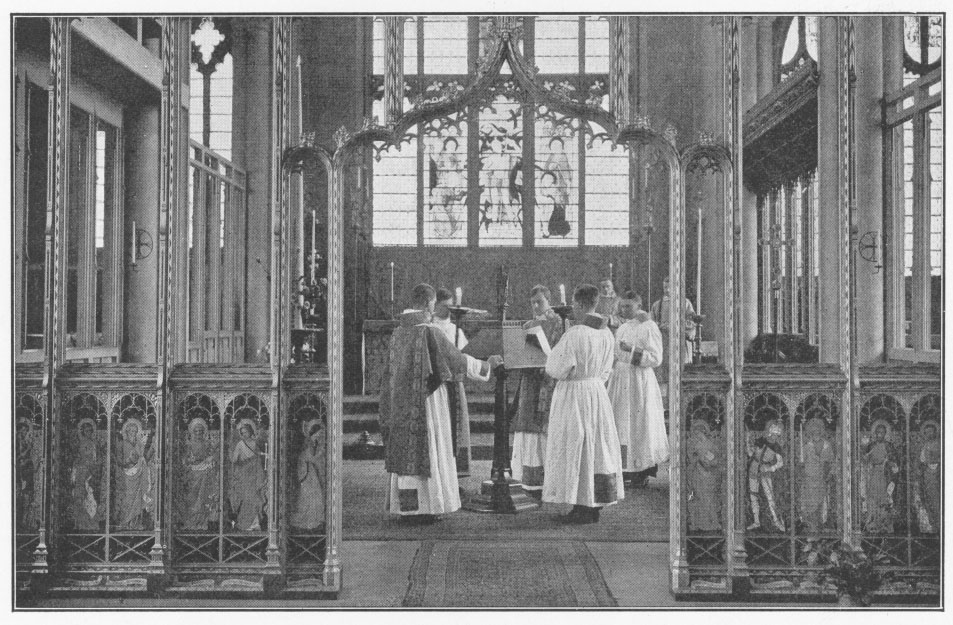
The Gospel: one way to do it, at least.


Now, something that took me a while to figure out was determining the proper place of the homily, or sermon. The standard practice today is to preach the sermon immediately after the Gospel. The Sarum rubrics say absolutely nothing about the sermon whatsoever; neither does Trent, for that matter. It simply followed the custom of Rome that placed the sermon after the Gospel. The problem I saw was that the Sarum rubrics instruct the deacon to carry the Gospel-book in procession back to the altar for the celebrant to kiss after he intoned the Credo. The sense of that rubric would be broken if it were interrupted by the sermon, but after some research, I discovered that the custom in medieval England and France in the Middle Ages was to have the sermon after the Creed, at the halfway point between the Mass of the Catechumens and the Mass of the Faithful! I also see now that, at least until recently, having the sermon and announcements after the Creed was part of the rubric of the Book of Common Prayer since its first edition. Furthermore, I've also read that the sermon takes place after the Creed in the traditional Dominican Rite, which shares many customs with Sarum. I've also seen a practice in the Anglican Use bridging the two practices by having the sermon after the Gospel, and announcements or notices after the Creed.


The reason for the discrepancy in practice may result from the fact that the Creed was introduced into the liturgy much later than the other portions here, but adopted in other parts of Europe long before it came into use in Rome itself (1014). Another complication is in the Tridentine pontifical Mass, which has the deacon chant the Confiteor and the bishop grant an indulgence before the Creed. This practice may also have varied in history. I'll have to look into it later.


The Bidding Prayers

The bidding prayers, if they were not prayed in the procession before Mass, were done "after the Gospel or Offertory". It's difficult to imagine them being made at any point in the Offertory without breaking its order, so I've decided to simply describe them here. They were read either from the pulpit (a 1928 Book of Common Prayer mentions bidding prayers made with the announcements, notices, and/or banns of marriage before the sermon, though that would place them after the Creed, in the place where the Intercessions of the Faithful are now found in the Novus Ordo Mass) or at the chancel step. 

What made these bidding prayers peculiar in Sarum was that they were directed to be prayed in the vernacular, or "mother tongue". They vary a bit depending on which manuscript you find them. Here's one version:
Let us make our prayers to God, our Lord Jesus Christ, to our Lady S. Mary, and all the Company of Heaven, beseeching His Mercy for all Holy Church, that God keep it in good estate, especially the Church of England, our Mother Church, this Church, and all others in Christendom.
For our Lord the Pope, for the Patriarch of Jerusalem, for the Cardinals.
For the Archbishops and Bishops, and especially for our Bishop N., that God keep him in his holy service. For the Dean/Rector, or all other ministers, that serve this Church. (One variation of this: "For your ghostly father, and for Priests and Clerks that herein serve or have served, for all men and women of religion, for all other men of Holy Church.")
For the Holy Land and the Holy Cross, that God deliver it out of the hand of the heathen.
For the Peace of the Church and of the earth.
For our Sovereign Lord the King, and the Queen, and all their children.
For Dukes, Earls, and Barons, and for all that have the peace of this land to keep, all that have this land to govern.
For the welfare of N. and N., and all this Church's friends.
For all that live in deadly sin.
For our brethren and sisters, and all our Parishioners, and all that do any good to this Church or foundation. For yourselves, that God for His mercy grant you grace so to live as your soul to save, and for all true Christian people.
The priest then turns to the altar and the choir begins Psalm 66 (Deus misereatur) "without note". After the doxology, the choir continues:
Lord, have mercy.
(Priest) V. Christ, have mercy.
R. Lord, have mercy.
V. Our Father, etc... And lead us not into temptation.
R. But deliver us from evil.
V. O Lord, shew thy mercy upon us.
R. And grant us Thy salvation.
V. Let Thy priests be clothed with righteousness.
R. And let Thy Saints rejoice.
V. O Lord, save the King.
R. And hear us in the day we call upon Thee.
V. Give Salvation unto Thy people.
R. Govern them, and lift them up for ever.
V. Let there be peace in Thy strength, O Lord.
R. And plenteousness in Thy towers.
V. O Lord, hear my prayer.
R. And let my crying come unto Thee.
V. The Lord be with you.
R. And with thy spirit.

Let us pray.
God, Who with the Grace of Thy Holy Spirit dost pour the Gifts of Charity into the hearts of Thy faithful people, grant to Thy Servants and handmaidens, for whom we beseech Thy clemency, health both of mind and body, that they may love Thee with their whole strength, and with entire affection may perform those things which are pleasing unto Thee, and grant us Thy peace in our time, through Christ our Lord. 
Amen.
Then, turning to the people, the priest says:
Let us pray. (kneeling)
For the souls of N. And N., Archbishops, Bishops, Clergy, Benefactors, etc., who have served this Church, or done any good thereto, or to this foundation, and for all souls whose bones rest in this Church and Churchyard, and all those who have given to this Church or foundation, rents, vestments, or other goods, whereby God is better worshipped in this Church, and the minister thereof better sustained; for all our Fathers' and Mothers' souls, our Godfathers' and Godmothers' souls, Brethren and Sisters' souls, all our Parishioners' souls, and for all the souls that have done any good to this Church, and for all Christian souls.
The priest turns again to the altar and the choir begins Psalm 129 (De Profundis) without note. After the doxology and Our Father, etc.:
V. Grant them eternal rest, O Lord.
R. And may perpetual light shine upon them.
V. From the gate of Hell.
R. Deliver their souls, O Lord.
V. I believe to see the good things of the Lord.
R. In the land of the living.

Absolve, we beseech Thee, O Lord, the souls of Thy servants and handmaidens, our relations, our neighbours, our friends, our benefactors, as well as the souls of all the faithful departed, from all the chains of their sins, that in the glory of the Resurrection they may be raised up to life, and breathe again among Thy Saints and Elect: Through, etc. May they rest in peace.
Amen.

The series continues with the Sarum High Mass: Mass of the Faithful.