Wednesday, October 17, 2012

The Missal Stand

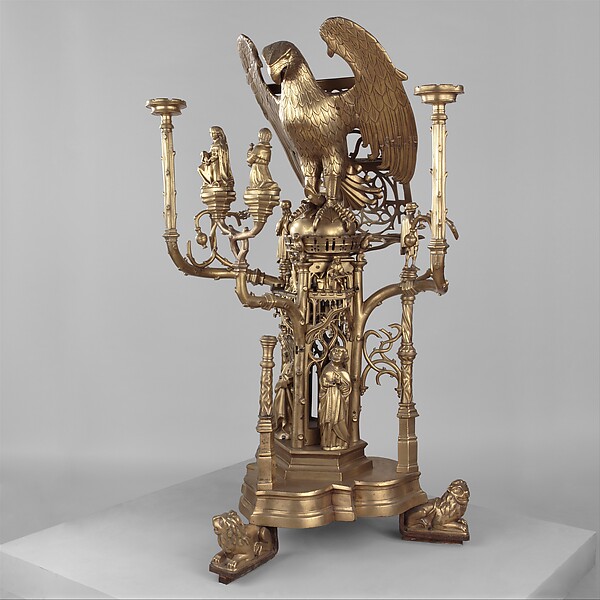
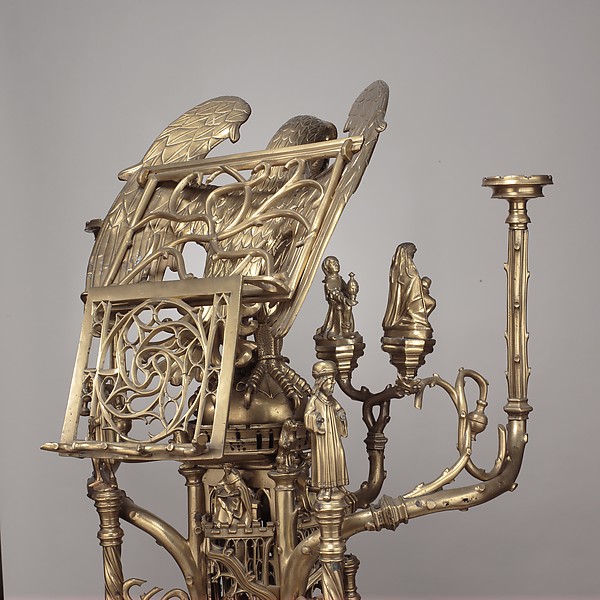
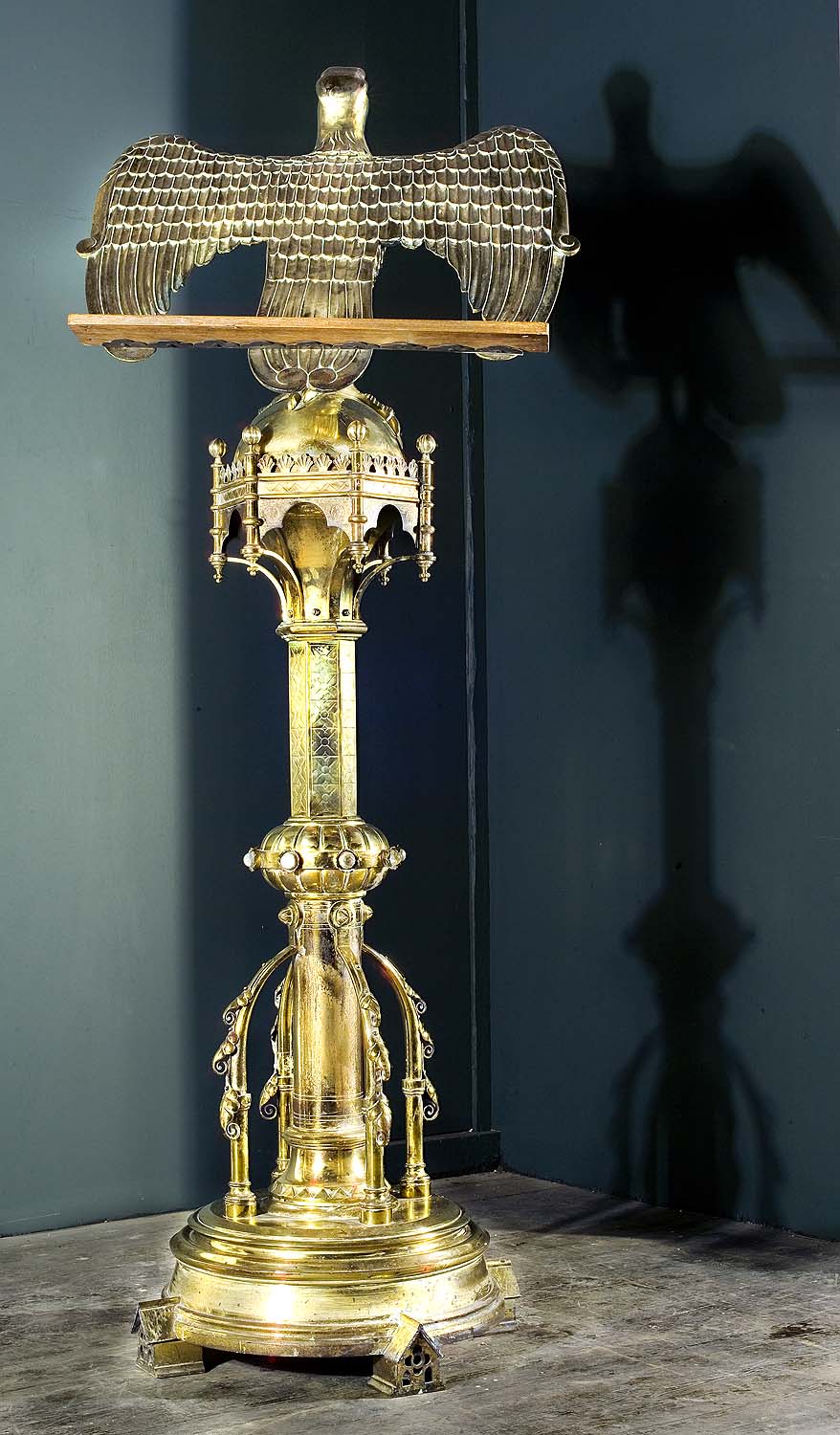
In my post just prior to this, I lamented the traditional community's overall lack of worthy lecterns and pulpits. There is one sort of lectern that's still ubiquitous among trad communities: the Missal stand. I just wanted to share a couple of amazing Missal stands I saw on the Met's website, but I felt they would just bloat the previous, already bloated article.

The first is a silver creation of the Gothic revival from late 19th-century France. It was made by Louis Marcy, who apparently made a living off of making medievalesque items and actually selling them as "antiquities".


This one is made of iron in the shape of a fortress, probably from Spain as it bears the arms of Castile and Leon. On the bookrest, it read In principio erat verbum ("In the beginning there was the Word") and along the base, et verbum caro factus est ("and the Word was made flesh").


That one is probably the most awesome Missal stand I've ever seen.

Two lost arts: singing from oversized books, and using lecterns


Add this to the list of medieval practices that ought to be restored: the art of chanting from oversized books. Today I revisit a pet subject of mine: medieval plainchant.

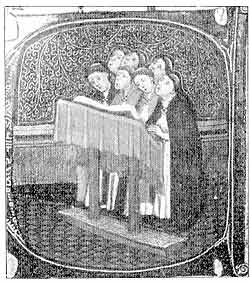
My schola's current practice is for everyone to have a copy of the Liber Usualis, a compendium of chants about the size of a brick, which conveniently has all the chants for the 1962 Mass and Office for the entire year. It's a wonderful little invention, but it's relatively new in the grand scope of sacred music history. The first edition of the Liber was published by the Abbey of Solesmes in 1896. Before then, chanters had the wearisome task of sorting through several books at once. Granted, it was still a better lot than that of the monks in the Church's much younger days, who had to simply memorize everything they had to sing. The further back in time you look, the harder it would have been for choirs to provide music books for every singer due to cost and technology. I believe the Middle Ages found a happy solution in between: to end the trouble of brute memorization, the monasteries first developed a system of notation (which would eventually grow into our modern sheet music)... and to save the trouble and expense of copying so many books for each individual monk, they would create a single, large book that could be read by the entire choir. 

A 16th-century Spanish antiphonal.

I was browsing through the website of Ensemble Organum, one of my favorite early music performance groups, and found this page for a project called Lectern International. They purport to have a network of locations where singers can chant from original medieval manuscripts grouped around a lectern. The page reads:
"An international network of locations where it is possible to sing from original documents (manuscripts or printed material of the era) grouped together around a lectern.

The venture consists of reliving medieval music by initiating singers to the practise of the lectern chant. Thus one of the essential aspects of the recreation of music prior to the XIX century is their context of execution. The size of the books, their position on the lectern, the spatial and acoustic conditions of the execution are fundamental elements which are lost when one sings using small-format modern transcriptions.

For close to eight centuries, the lectern was fundamental in the transmission of musical know-how for both voice and instrument. Yet the musical and pedagogical value of this object, its role in the conceptualisation and creation process of the music is widely ignored nowadays.

Singing polyphony or monody around a lectern radically transforms the musical interpretation, but singing from an medieval manuscript has an even greater significance. The tempi become slower, the listening of the other singers is totally modified, the memorisation processes are different as well.

Places where it is possible to do this are rare. More often than not the manuscripts are preserved in libraries where their use for their original purpose is met with disapproval. Lectern International federates places where this sort of practise is encouraged."

I emailed them over a week ago to ask about it but never got a response. I imagine there aren't any churches in the United States which have giant chant books in the first place, but I did have the pleasure of seeing one right here in Texas a few weeks ago. When I visited the Bowld Music Library in Fort Worth to look at their copy of Pugin's Earnest Appeal for the Revival of the Ancient Plain Song, they actually had a giant antiphonal from the 15th century or so behind a glass case. It's just a pity that these books will likely remain solely behind glass cases around the world for the rest of time, rather than be used for their original purpose.

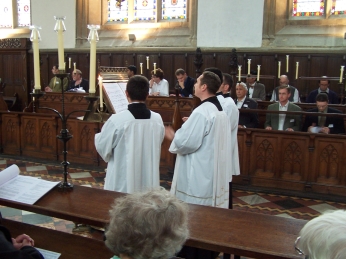
In any case, Ensemble Organum's premise is that the style of plainchant will sound different when everyone is singing from one book. I can't say I've done it before, but I can imagine it: all the chanters, including the director, are facing the same direction. The director is presumably at the front, waving his hands right before the book so that all the chanters see the notes and his direction at the same time. More than any other method, it forces the choir to chant as a unit. This leaves one question, though: how does it work if the choir is divided in half facing each other in the traditional stalls? Are there two books and two lecterns?

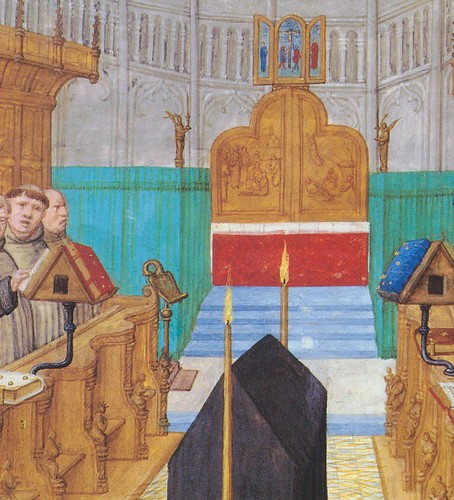
This image from a 16th century Book of Hours has one choir lectern for each stall, plus an eagle lectern on the Gospel side.

This brings me to the second topic I wanted to write on: the proper use of reading desks, lecterns, ambos, and pulpits. The vast majority of churches in which I've attended the traditional Latin Mass are arranged in what we might call a "Tridentine style" that has, for some reason, completely eschewed the use of reading desks and platforms. They have a single speaking platform on the Gospel side of the sanctuary: a wooden box which more closely resembles a politician's podium in a press conference, rather than one of the glorious pulpits of the medieval age. This platform is used for everything, from sermons to mundane announcements: though rarely, if ever, for actually proclaiming Scripture or any other sort of liturgical usage. The contemporary trad practice at solemn Mass (on the few times it's to be had in the first place) is for the subdeacon to hold up the book with his own hands when singing the Epistle, and to hold the book as the deacon sings the Gospel.

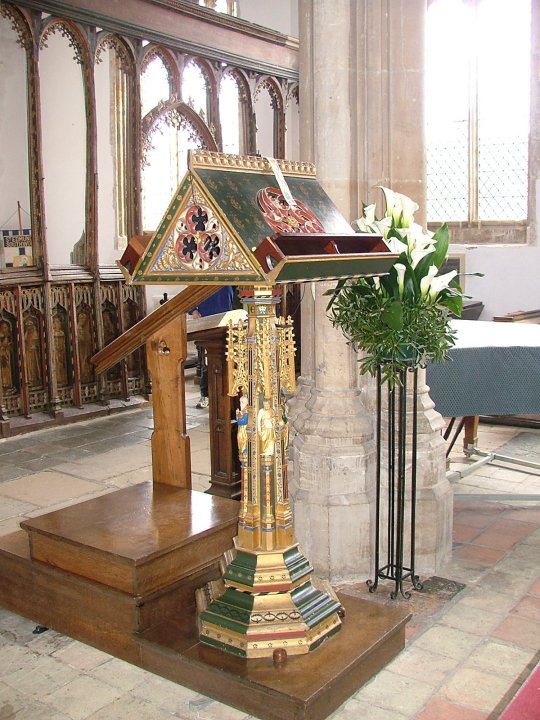
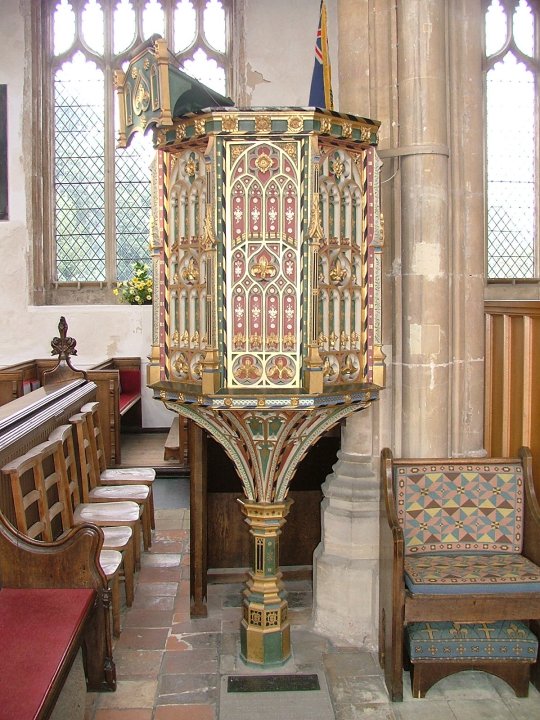
The craftsmanship of the medieval masters in fashioning reading desks, lecterns, and pulpits should be a testament to our lack of imagination. This first example is of a lectern from the 15th century, repainted in the 1930's. It's housed in the church of Saint Edmund, a pre-Reformation church in Suffolk. Notice the popular double-desk style, which I suppose could have allowed for a cantor on either side (the Sarum Use's rubrics propose two cantors for the Graduals and Alleluias of Mass).

15th-century lectern at Saint Edmund, Southwold

The same repainting is featured on a pulpit in the same church:

In my book, a pulpit can't be properly called by that name unless you have to climb a set of stairs to speak from it.

A great many lecterns of the later Middle Ages, especially the ones used for reading the Gospels, were fashioned in the shape of eagles. The eagle was said to be the bird that flew the highest, and therefore the closest to heaven. The eagle was also supposed to have been able to gaze directly into the bright light of the sun without harm. The faithful Christian, likewise, could stare at the sight of the deacon proclaiming the Gospel from this eagle-shaped lectern without flinching.

16th century brass lectern at the church of Saint Mary, Redenhall.

The most splendid eagle lectern of all is this one fashioned by Aert van Tricht, also in the 16th century. It was bought by Pugin's wealthiest patron, John Talbot, Earl of Shrewsbury, for Augustus Pugin's Cathedral of Saint Chad, Birmingham: the first Catholic cathedral built in England since the Reformation. The eagle holds a dragon under its talon.

It's decorated with figures of Christ, the three Magi, Saint Barbara, and the Old Testament prophets, among others.

 I believe it was Pugin and his brassmaker, John Hardman, who replaced the missing Saint Barbara figure.

Sadly, the lectern currently resides in a museum. I don't know how it got there, but I wouldn't be surprised if it was sold by the Vatican II vandals. At least it has the honor of being housed at the Met in New York City. 

Pugin, of course, proved that these lecterns could be made for in the modern age and be used in the modern liturgy (which, in his day, was the Tridentine Mass). Here's a drawing he made in his book, Designs for Iron and Brass in the Style of the 16th and 17th Centuries

I believe this page shows the same lectern in physical form, though the images are very small.


Another lectern by Pugin, in the eagle style.


An eagle lectern at Pugin's church of Saint Giles, Cheadle, on the Gospel side. I don't know if Pugin actually made it or not.


This is a very elaborate lectern by Pugin's son-in-law and pupil, John Hardman Powell, currently at the church of Saint Paul, Brighton.

The base depicts the angels of the Apocalypse.

Now we come to the pulpits, from which sermons are preached. The medievals favored high pulpits because they signified the scaling of a mountain to proclaim the Gospel truths from the highest heights. According to the Catholic Encyclopedia, Pope Innocent III's treatise on the Mass quoted Isaias in reference to the deacon's scaling of the ambo to read the Gospel: "Get thee up upon a high mountain, thou that bringest good tidings to Sion: lift up thy voice with strength".

England is fortunate to have many surviving examples of pulpits. They endured the Reformation, probably because the Protestant commissioners, for once, didn't find them objectionable. Ironically, the Counter-Reformation on the continent gradually saw these pulpits dismantled or de-emphasized in what I see as a misguided effort to direct all visual focus toward the altar.

A 15th-century pulpit (heavily restored by Victorians) at the church of the Holy Trinity, Long Sutton.

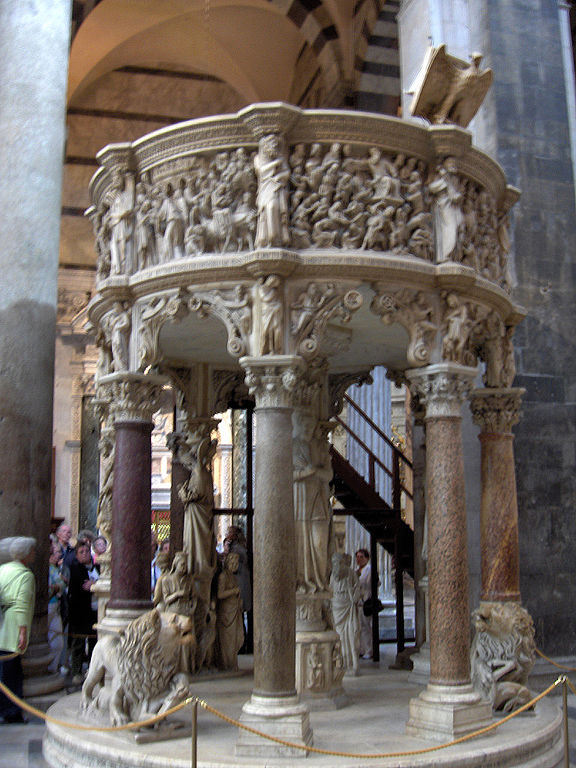
A massive stone pulpit, with eagle lectern within, at the Duomo in Pisa.


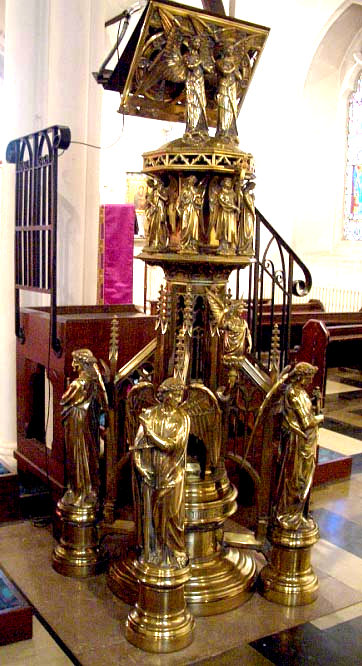
Perhaps the finest pulpit of all. This one is at Canterbury Cathedral. Though it currently rests in the chief church of Anglicanism, one of the carvings depict Pope Gregory the Great sending Saint Augustine of Canterbury in a mission to establish the church in England.

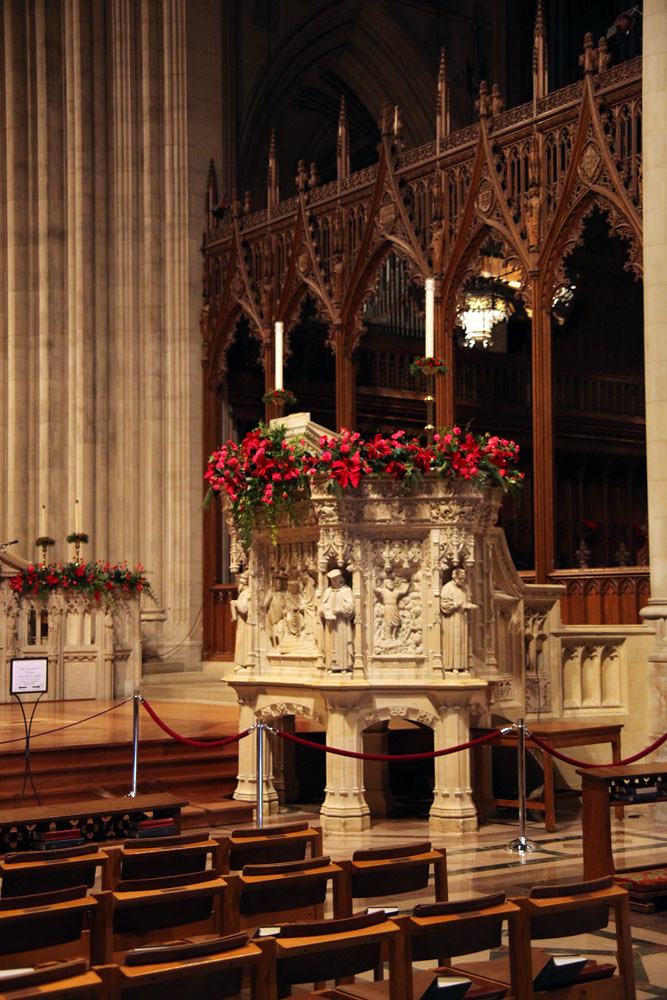
A fine modern example is the pulpit in the Washington National Cathedral, which was carved less than a century ago. It was given by the Archbishop of Canterbury to the new cathedral in D.C. as a gift, and was remarkably fashioned out of stone from Canterbury Cathedral itself.


The central relief depicts a medieval Archbishop of Canterbury, Stephen Langton, urging King John to sign Magna Carta. Not a subject I would've chosen for a pulpit, but there it is.

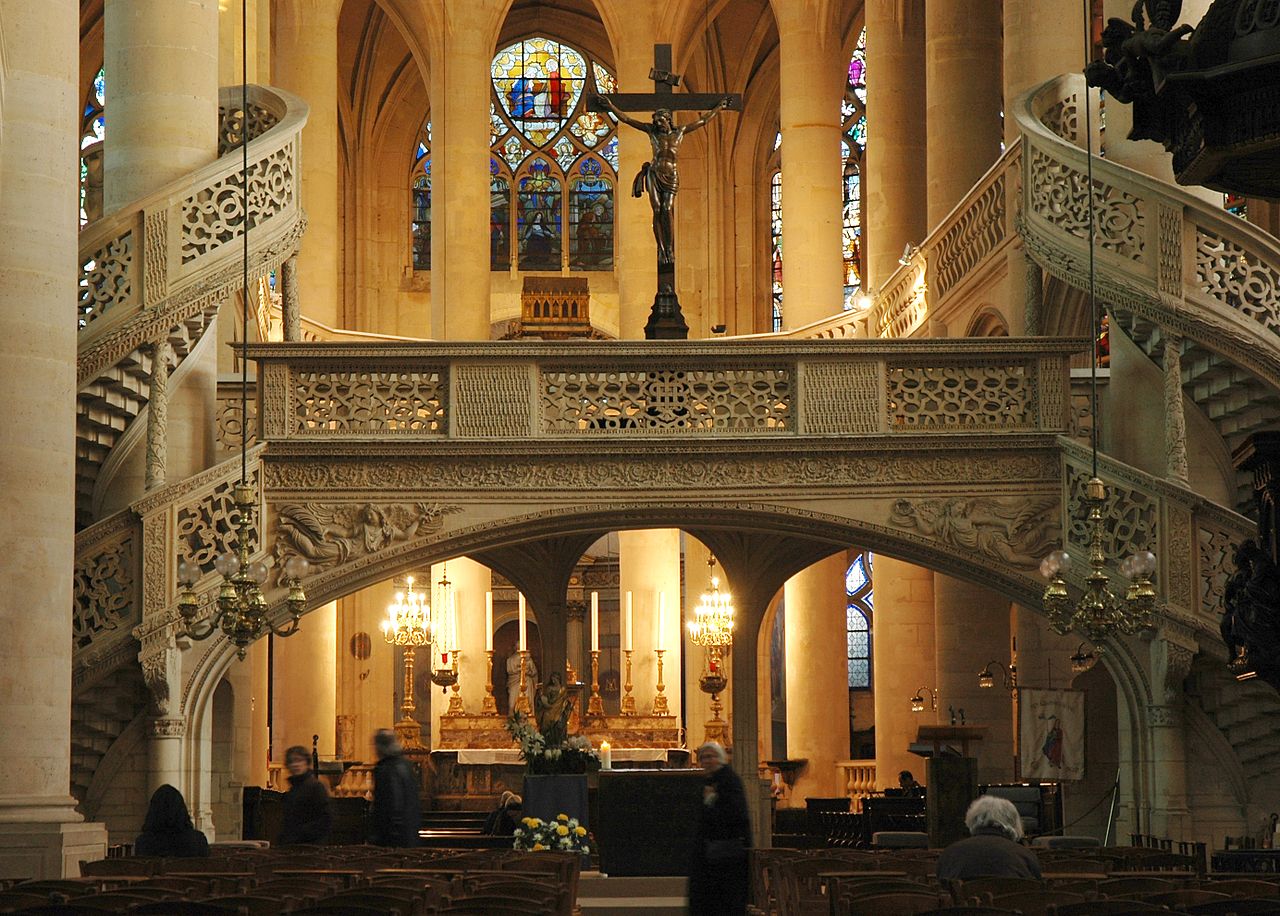
Finally, here are some photos of yet another kind of platform that was in use in the Middle Ages: the jube. The jube was the name given to rood lofts in France. While it's unclear whether the Scriptures were read from the top of the English rood lofts (the staircases may have been only to allow acolytes to light the candles at the top), the French jubes were certainly used for readings: probably at the right for Lessons and Epistles, and the left for Gospels.

The jube of the church of Saint-Étienne-du-Mont.
The name "jube" comes from the Mass. Before the deacon sings the Gospel, he approaches the celebrant and asks for his blessing with the words jube, domne, benedicere ("pray, sir, a blessing").

The one pictured above is the last surviving jube in France. It was built in the mid-1500's, in what was perhaps the very last Gothic work of art in that country before the total onslaught of the Classical and Baroque. The church of Saint-Étienne-du-Mont, by the way, has a colorful history. In the French Revolution, it was temporarily closed and re-dedicated as "the Temple of Filial Piety". We have Napoleon Bonaparte to thank for its restoration as a church, due to the Concordat of 1801. Saint-Étienne was also the site of an assassination. In 1857, the Archbishop of Paris, Marie-Dominique-Auguste Sibour (who also witnessed the marriage of Napoleon's nephew, Napoleon III), was murdered by an excommunicated priest who, in the act, cried out "Down with the goddesses!". The priest, Jean-Louis Verger, killed the Archbishop for promulgating the dogma of the Immaculate Conception in Paris, which had been declared by the Pope just a few years before. I believe that would make Archbishop Sibour the only person ever to have been martyred specifically over a dogma declared ex cathedra by the Pope.

Monday, October 15, 2012

Saint Edward the Confessor: the death of a tradition

Two days and 849 years ago, the incorrupt body of Edward, last of the Anglo-Saxon kings of England [Update: penultimate if you count the brief reign of Harold Godwinson], was translated from its original tomb and re-interred at a special shrine in Westminster Abbey. The event was presided over by Thomas Becket, Archbishop of Canterbury, in the presence of King Henry II. The occasion: earlier that year, Edward had been canonized in Rome as a saint, an act which (whether by coincidence or otherwise) strengthened Henry II's legitimacy to the throne by associating him with the Saxon monarchs, as well as greatly contributing to the Abbey's wealth and prestige.

On October 13, 1163, Edward was also officially granted the epithet of "the Confessor". He was given this title to distinguish him from his predecessor, King Edward the Martyr, while still recognizing his service and suffering on behalf of Christendom. He gave generously to the poor people of the realm and kept England out of war the entire length of his reign: no mean feat for the Middle Ages. Edward the Confessor's feast day also made me realize that we've lost the art of referring to our heads of state and other important figures by epithet. True, the first Norman king is known best as William "the Conqueror", or "the Bastard". A few English monarchs have since gained nicknames like "Edward Longshanks", "Bloody Mary", and "Good Queen Bess" for the sisters Mary I and Elizabeth I (though a second look at history might require a reversal of those monikers). But otherwise, the Norman Conquest imposed the ordinal system: an impersonal number beside a name.

The Saxon kings, to the contrary, all earned epithets based on their deeds, for good or ill. The Confessor's father was Aethelred the Unready, so-called for his stubborn refusal to heed his ministers' advice. Before him, there were Edward the Martyr, Edgar the Peaceful, Eadwig All-Fair, Eadred the Excellent, Edmund the Deed-doer, and Aethelstan the Glorious.

The shrine of Saint Edward the Confessor at Westminster Abbey, restored by Mary I during her brief reign


So today, I've decided to establish an epithet system for dead Presidents of the United States. Yes, I've come up with possibilities for all 38 of them; not counting Reagan, because his predecessor Carter isn't dead yet. [Update: since my first posting of this article, I was asked by several friends to finish the list, so I've come up with some epithets for the rest of them, too.]


1. George the Devourer. Washington is an obvious candidate for "the Great", "the Conqueror", "the Magnificent", but he already has a nickname given by history. Our first President was bestowed the title of Conotocaurious, or "Devourer of Villages", by the Iroquois Confederacy during the American Revolution. A Seneca religious figure by the name of Handsome Lake went so far as to declare that Washington was the only white man allowed to enter the Indians' heaven.

2. John the Fat. When Adams was Vice President under the Washington Administration, he was dubbed "His Rotundity" by his opponents, who mocked him for proposing that the President be addressed as "His Majesty" or even "His High Mightiness". Also known for his stubbornness, Adams could be called "the Unready" or "Redeless".

3. Thomas the Apostate, or perhaps Doubting Thomas, for his work on the Jefferson Bible, which attempts to excise the gospels of all miracles and "superstition". Also Thomas the Tinkerer for inventing the swivel chair and a cipher wheel, among many other devices.

4. James the Lawgiver. Madison is best-known for drafting the Constitution. Or, James the Short for being the shortest of all Presidents at 5 feet 4 inches.

5. James the Beloved; not for any of Monroe's actual deeds, but because he was lucky enough to be elected during the Era of Good Feelings. His rivals' party, the Federalists, completely disintegrated, making Monroe perhaps the last president to govern without a substantial opposition.

6. John the Abolitionist. Quincy Adams was as stubborn as his father and constantly brought up the subject of slavery on the floor of Congress, despite there being a gag rule against the topic. He's also famous for having defended the Africans of the Amistad case in the Supreme Court, notably after having served as President.

7. Andrew the Widowmaker. Known as Old Hickory in his own time for being so tough, Jackson fought as many as a dozen, or even more, duels in his life, killing at least one man. After surviving an attempt on his life, he beat the would-be assassin nearly to death with his cane. Then there's the whole Trail of Tears affair.

8. Martin the Wrymouth. Van Buren was remarkably courteous to his political opponents. He also engineered much of the New York political machine via power groups such as the Albany Regency and Tammany Hall. Still, considering he was a one-term president, it didn't seem to work out for him there. Martin Van Ruin, as his enemies called him, has the pleasantly contradictory distinction of being both the first President to have been born natively in the US (after the Declaration of Independence), yet also the only President whose native language was not English. His first tongue was Dutch.

9. William the Brief. W.H. Harrison had the shortest term of office of any President. He died of pneumonia 30 days after taking his oath. In attempting to treat him, Harrison's doctors applied leeches, showing that the practice lasted for centuries after the close of the Middle Ages.

10. John the Virile. Tyler had 15 children: 8 with his first wife, 7 with his second. His opponents had another nickname for him: "His Accidency" (a play on "His Excellency" which was used to address the President in that century), for being the first vice president to become president on account of the incumbent's death. What especially blows my mind is the fact that Tyler currently has two grandsons who are still alive.

11. James the Conqueror. Polk's lasting legacy is in annexing Texas to the Union, waging the Mexican-American War, and enlarging the country's landmass by a third. He was known to be even more zealous in the quest for manifest destiny than most. He achieved an incredible lot of work for only one term, promised to serve only one term, and actually abstained from seeking re-election when the time came. Alas, he died three months later of cholera, prompting Sam Houston to remark that he died "a victim of the use of water as a beverage".

12. Zachary the Bold. Taylor was a general of the Mexican-American War whose decisive victories against Santa Anna paved his way to become President. He never expressed political opinions until his presidential campaign, then died after 16 months in office, so he isn't remembered for much else.

13. Millard the..... hmm, I honestly can't think of an epithet for this guy. Last of the Whigs, maybe? Who names their son Millard? [Update: a reader suggested Milliard the Mediocre, which is as good an epithet as any.]

14. Franklin the Handsome. Pierce was actually called "Handsome Frank" during his term for his classical Roman face and dark, wavy hair.

15. James the Chaste. Buchanan was the only President to have never married. Before he moved to the White House, he shared his house with William Rufus King (Vice President under Pierce), for 15 years. Not an unusual arrangement for ordinary men today (including myself), but it does seem mighty bizarre for a grown man with a roommate to be elected to the highest office in the nation.... even today, not to mention the Victorian age.

16. Abraham the Martyr. Though I'm sure those of a more southern persuasion could think of alternate names for Lincoln, history is written by the victors. Lincoln, like King Charles I (also called "the Martyr" by some), has been effectively canonized by popular acclaim. But unlike Charles, people still care about Lincoln today.

17. Andrew the Tailor. Whatever Johnson's failures as President, I give him props for making it into the Oval Office from such humble origins. Johnson was raised in poverty, ran away from home at 16 to become a tailor, married at only 18, and was self-educated. His enemies called him "white trash" even back then.

18. Hiram the Drunkard. Who's Hiram, you say? The man we know as Ulysses S. Grant was born from a clerical error. When he was 17, Hiram Ulysses Grant was nominated by his Congressman to the U.S. Military Academy at West Point... but for whatever reason, his Congressman mistakenly entered his name as Ulysses S. Grant. Not to jeopardize this opportunity for advancement, Grant actually changed his name to match the mistake. The S. doesn't actually stand for anything! And here's another interesting fact: when Grant was born, his family couldn't decide on a name for him, so each member of the family wrote a name on a piece of paper and dropped it into a hat. The name drawn from said hat was Hiram Ulysses.

19. Rutherford the Usurper. The election of 1876 was perhaps the most contested in American history. Congress created an Electoral Commission to resolve it, and Hayes won by just one electoral vote. His enemies called him "His Fraudulency", and some simply refused to recognize his legitimacy.

20. James the Wise. Garfield was committed to battling illiteracy and providing education to the less fortunate, especially blacks. He had a 3,000-book library that would make any liberal arts major envious, and developed a trapezoid proof of the Pythagorean theorem. I've always thought his assassination at the hands of a complete madman was the most tragic of all Presidents'.

21. Chester the Walrus. "Walrus" was a nickname given by children for Arthur's peculiar choice of facial hair. His slick New York sense of fashion also earned him the nickname "Prince Arthur".

22 and 24. Stephen the Interrupted. Better known by his middle name, Grover Cleveland was the only president to serve nonconsecutive terms. He entered the presidency as a bachelor, and his sister served as First Lady for two years. Cleveland married a 21-year old girl by the name of Frances Folsom, becoming the only President to have ever married in the White House.

23. Benjamin the Frostbitten. Harrison, grandson of William Henry, was called a human iceberg for his chilly disposition when talking to individuals.

25. William the Merchant Prince. The McKinley Administration's policies on business, industry, and expansion can be credited for putting America on the track to becoming an economic and imperialist powerhouse.

26. Theodore the Lionheart. Teddy and King Richard I have a surprising lot in common. Both achieved lasting celebrity not so much for their political policies, but because, whether it's San Juan Hill or the Third Crusade, they lived larger-than-life in the eyes of their people.A hole in the wall of the Menger Bar in downtown San Antonio marks where Teddy fired his pistol while recruiting Rough Riders.

27. William the Merry. "Fat" is too mild a word for Taft, so let's use "Merry" as a euphemism for obese. Taft was so fat, he got stuck in the White House's bathtub and required his aides to use butter to dislodge him. He then famously ordered the current Presidential bathtub, which is large enough to fit four comfortably. It's said that Taft hated being President, but found fulfillment in his later career as Chief Justice of the Supreme Court.

28. Thomas the Professor. T. Woodrow Wilson was a professor and president of Princeton University prior to Washington. As President (of the US), he lectured visitors to the White House on history and other academic subjects. His academic background, unfortunately, displayed itself in a frightening commitment to "making the world safe for democracy" with no regard for the art of politics.

29. Warren the Unlucky. Harding kicked off the Roaring Twenties with a reputation for drinking, gambling, and adultery. I call him the Unlucky for having lost all the White House's china in one hand of poker, as well as dying suddenly in the middle of a conversation with his wife. I still think either his wife or one of the powerful mobs of the era poisoned him.

30. John the Silent. Dorothy Parker made a bet with J. Calvin Coolidge, saying: "Mr. Coolidge, I've made a bet against a fellow who said it was impossible to get more than two words out of you." Coolidge's response was, "You lose". Despite Coolidge's reputation for being a quiet man, he actually gave interviews with reporters more frequently than any other President in history, possibly including Obama.

31. Herbert the Builder. Hoover actually started quite a few building projects, including the famous Dam. Unfortunately, FDR would end up taking the credit for all the success Hoover started to recover from the Great Depression.

32. Franklin the Lame. If FDR were a medieval king, he'd inevitably be defined mainly by his inability to walk. In truth, he was extremely conscious of his disability and took care never to be seen in public while in a wheelchair.

33. Harry Four-eyes. Not Harold or Harrison; Truman's parents formally named him just Harry. Like Grant, his middle initial S. also doesn't stand for anything, but Truman's parents did so deliberately. Truman wasn't the first president to wear glasses, but I believe he was the first president to wear glasses every waking moment of the day, and from a young age. His childhood dream of going ot West Point was never realized on account of poor eyesight. He was only able to pass the eyesight exam and join the Missouri National Guard because he memorized the letters on the eye chart.

34. Dwight Martel. Martel, meaning "the hammer", for Eisenhower's role in planning the invasions of France and Germany during World War II. Though he was a warrior, I dare say Eisenhower could be called Dwight the Pacific. He ended the Korean War and kept America out of any other ears during his two terms.

35. John the Beloved. Kennedy's successful combination of charm, good looks, speeches, and his assassination have all ensured his place as most-loved president of the 20th century. Perhaps his enemies would have called him Jack the Papist or Johnny Foreigner on account of religion or Irishness.

36. Lyndon the Spacefarer. Of course LBJ didn't actually go to space; nor did Prince Henry the Navigator actually sail around the world. But for all Johnson's faults, he put a man on the moon, which is more than can be said of any of us in the 21st century, despite the fact that we all use computers that are far more advanced than the ones used on the Apollo missions.

37. Tricky Dick is the only presidential nickname I think really stands on par with the monikers of the medieval kings. I leave this one as is. It can't be topped.

38. Gerald the Affable. Pardoning Nixon really did a number on Ford's reputation, but he deserves the epithet "Affable" for maintaining a relatively nonpartisan image and even eventually overcoming the stigma of the Nixon years. Perhaps it was because he had the luxury of being the only President to not have to run for either President or Vice President. (Ford's birth name, by the way, was actually Leslie, but it was changed early on in his life.)

39. James the Farmer. Like "Farmer George" III, Carter was praised or mocked for his passion for agriculture. Alternately, James the Pious, as Carter was a Sunday school teacher and was known to pray multiple times a day even as President.

40. Ronald the Diviner. Reagan may be a favorite president of the so-called religious right in our times, but he also made frequent recourse to the advice of astrologers. Joan Quigley, who may perhaps be called our first Court Astrologer, said: "Not since the days of the Roman emperors—and never in the history of the United States Presidency—has an astrologer played such a significant role in the nation's affairs of State."

41. George the Spymaster. Bush the Elder, before becoming President, served for a short time as Director of the CIA. Espionage had never been so reviled as during the Middle Ages in Europe, so if Bush the Elder had ever been a medieval king, he would have forever been caricatured as a shifty, paranoid intriguer with a dagger hidden under his cloak.

42. William the Wanton. We remember Clinton's presidency mainly for his extramarital affairs, though they would've gone without notice, or even been accepted as normal, during medieval times. As we live in an age where even the highest members of society marry "for love" rather than political alliance, we are not so forgiving anymore.

43. George the Stutterer. Bush the Younger had no gift for oratory. In the past, kings and presidents could overcome this flaw by the use of heralds or the printing press to disseminate their ideas. In the era of radio, television, and the Internet, a poor public speaker is ripe for a media-induced beating.

44. Barack the Blackamoor. For an allegedly post-racial generation, our current president is still accounted, even or especially by his supporters, primarily for being black. With less than a month until the next election, time will tell how, or even if, he'll be remembered for anything else.

Saturday, October 13, 2012

The Sarum Low Mass: Mass of the Faithful

Low Mass: The Offertory

For the more theologically astute believers out there, the richness of the Tridentine offertory prayers is one of the main "selling points" for the Extraordinary Form. There's really no end to the polemical articles you can find on the Internet about how the Vatican II fathers stripped the old offertory down to a skeleton. The Sarum offertory's formula is actually even simpler because the priest has already mixed the water and wine into the Chalice before Mass. 

Just as the Tridentine priest, he turns to the people and says Dominus vobiscum, followed by Oremus. Then he reads the Offertory antiphon. After that, in the Tridentine Mass, he would make two separate offerings: one for the Host, where he prays Suscipe, sancte Pater, and one for the Chalice, praying Offerimus tibi, Domine. In the Sarum, the priest uncovers the Chalice and makes a single offering by lifting the Chalice, over which lays the paten and Host, up with both hands, praying Suscipe, sancta Trinitas. A form of this prayer to the Trinity also appears in 1962 after the handwashing. Below, we can compare the two:


Sarum
Suscipe, Sancta Trinitas, hanc oblationem, quam ego indignus peccator offero in honore tuo, beata Mariæ et omnium Sanctorum tuorum, pro peccatis et offensionibus meis: et pro salute vivorum et requie omnium fidelium defunctorum. In Nomine Patris et Filii et Spiritus Sancti acceptum sit Omnipotenti Deo hoc sacrificium novum.
Receive, O Holy Trinity, this oblation which I, and unworthy sinner, offer in Thy honour, Blessed Mary's, and all Thy Saints, for my sins and offences; for the salvation of the living and the repose of all the faithful departed. In the Name of the Father, and of the Son, and of the Holy Ghost, let this new Sacrifice be acceptable to Almighty God.
Tridentine
Súscipe, Sancta Trínitas, hanc oblatiónem, quam tibi offérimus ob memóriam passiónis, resurrectiónis, et ascensiónis Jesu Christi Dómini nostri, et in honórem beátæ Maríæ semper Vírginis, et beáti Joánnis Baptístæ, et sanctórum Apostolórum Petri et Pauli, et istórum, et ómnium Sanctórum: ut illis profíciat ad honórem, nobis autem ad salútem: et illi pro nobis intercédere dignéntur in cælis, quorum memóriam ágimus in terris. Per eúndem Christum Dóminum nostrum.
Receive, O Holy Trinity, this oblation which we make to Thee in memory of the Passion, Resurrection and Ascension of our Lord Jesus Christ; and in honor of Blessed Mary ever Virgin, of blessed John the Baptist, the holy Apostles Peter and Paul, of these and of all the Saints. To them let it bring honor, and to us salvation, and may they whom we are commemorating here on earth deign to plead for us in heaven. Through the same Christ our Lord.

The Sarum priest sets the Chalice back down on the altar and covers it again. He takes the paten, places the Host on the corporal in front of the Chalice, then places the paten to the Chalice's right, "under the cloths". Now, it's already time for the handwashing. The priest goes to the Epistle side of the altar, where his server pours water over his fingers as he prays:


Munda me, Domine, ab omni inquinamento mentis et corporis; ut possim mundus implere opus sanctum Domini.
Cleanse me, O Lord, from all pollution of mind and body, that I may in purity perform the holy work of the Lord.

The prayer is short enough to easily memorize without the use of an altar card (you'll recall, as said before, that altar cards were not in use during the time of Sarum). The Tridentine priest, however, recites Psalm 25, which is long enough that a card becomes very convenient in the absence of a Missal.

He returns to the center of the altar, inclined his head forward and prays (in place of where, according to Trent, he would pray Suscipe, sancta Trinitas):


In spiritu humilitatis et in animo contrito suscipiamur, Domine, a te; et sic fiat sacrificium nostrum in conspectu tuo, ut a te suscipiatur hodie, et placeat tibi, Domine Deus meus.
In the spirit of humility and with a contrite heart let us be accepted of Thee, O Lord; and let our sacrifice be in such wise in Thy sight that it may be accepted of Thee this day, and please Thee, O Lord, my God.

He then kisses the altar to the right of the sacrifice, stands erect, crosses it, then crosses himself, saying In nomine Patris, etc. At this point, he then turns toward the people and says:


Orate, fratres et sorores, pro me, ut meum pariterque vestrum acceptum sit Domino Deo nostro sacrificium.
Pray, brothers and sisters, that my sacrifice and likewise yours may be acceptable to our Lord God.

In Trent, the rubrics specifically direct the priest to say Orate, fratres in an elevated voice and then the rest quietly as he turns back to the altar. Sarum has him say it in a uniformly "low" voice, presumably all while facing the people. What's especially interesting here is that Sarum has the priest address women specifically (et sorores).

The response of the server or ministers is not the familiar Suscipiat Dominus, but:


Spiritus Sancti gratia illuminet cor tuum et labia tua, et accipiat Dominus digne hoc sacrificium laudis de manibus tuis pro peccatis et offensionibus nostris.
The grace of the Holy Ghost illuminate thy heart and lips, and the Lord graciously accept this sacrifice of praise at thy hands for our sins and offences.

The priest ends this portion with the Secret prayer(s), just as in 1962.


The Canon of the Mass

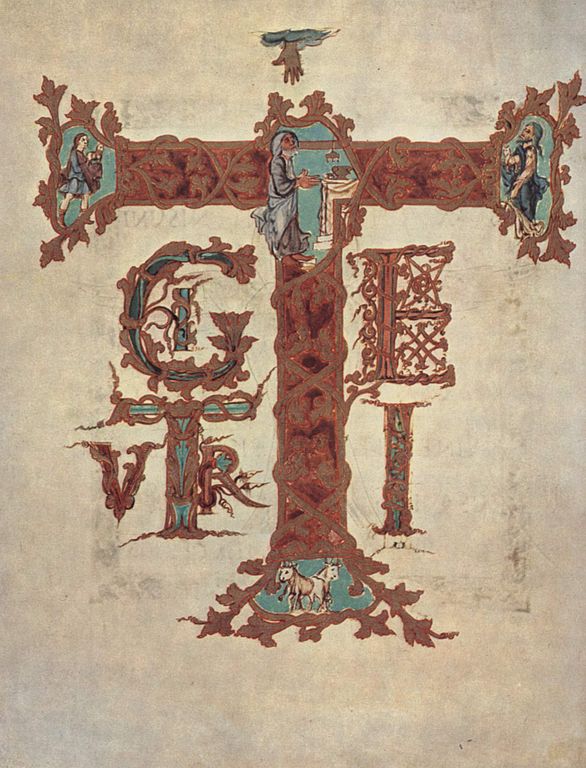
A 9th century rendering of Te igitur, the first words of the Canon
The priest and the server or people alternate the versicles (Dominus vobiscum, Sursum corda, etc.) as usual. The two Missals have a similar collection of prefaces. Sarum and Trent both use the Preface of the Holy Trinity for Trinity Sunday and all Sundays to the end of the liturgical year. They both also have the same common preface, naming the ranks of angels, for ferial days.

The priest continues with the Sanctus, where Sarum offers one change. On certain days, a Mass of the Blessed Virgin Mary modifies the Sanctus so it says "Blessed is the son of Mary that cometh".

The words of the Roman Canon are exactly the same in Sarum and all the other local uses of England as they were in Rome during the Middle Ages. The name of Saint Joseph, having been added by Pope John XXIII shortly before Vatican II, is not here. After the prayers for the Pope (Papa nostro N.) and the local bishop (Antistite nostro N.), Sarum also has the priest pray for Rege nostro N.: "N. our King". As far as I can tell, praying for the King or Emperor by name in the Canon was standard practice on the Continent as far back as Charlemagne's empire. The King is absent in the Missal of 1570, the first edition of the Mass of Trent, but an additional complication is raised in the fact that according to this hand Missal dated to 1806, printed in England for the Tridentine Mass, the King's name is still there in the Canon.

This raises a dilemma for any would-be restorations of the Sarum Mass in a republic like the United States: did the American Revolution declare a permanent sede vacante, freeing us from naming the King in the Canon forever? Or do we simply adjust it to correspond to our political situation? A book on medieval "ruler worship" in the liturgy by E.H. Kantorowicz notes that in the Republic of Venice, the Doge, though an elected official, was mentioned by name in the Roman Canon from 1296 onward (et duce nostro N.). Could a Sarum Mass celebrated in the US in the year 2012 then say et presidente nostro Barack?

At Memento, Domine, famulorum famularumque tuorum N. et N., the priest prays for the living. Pearson's edition of the Sarum Missal gives a special instruction for the priest here:
"... in praying for whom a due order dictated by charity should be observed. Let the Priest pray five times--first, for himself; secondly, for his father and mother, carnal and spiritual, and other relations; thirdly, for special friends, his parishioners and others; fourthly, for all present; fifthly, for all Christian people; and here the Priest can commend all his friends to God: with the caution, however, that no one should pause there too long, both for fear of distraction of mind, and of suggestions which may be made by evil angels, as well as other dangers..."
There are contradicting rubrics among the various editions of Sarum for what the priest is to do immediately before, during, and after the consecration. Canon J. Robert Wright's essay on Sarum observes that some missals tell the priest to break the Host at the uttering of the word fregit ("brake"). Pearson's Missal acknowledges this custom and attempts to refute it with this rubric: "Here let him touch the Host but not so as to break it, as some do; for although the order of the words seems to imply that Christ brake before consecrating, tradition teaches the contrary".

The rubrics instruct the priest to bow before elevating the Host and before elevating the Chalice, but nothing is said of a bow after setting the Chalice down again. As I said before, though, it seems some modern celebrations of Sarum simply adopt the Roman genuflections here and elsewhere.

After setting down the Chalice, with his thumbs and forefingers enjoined, the priest continues the Canon with his arms stretched out in the form of a cross until he has to make the sign of the cross over the elements. The Canon continues as usual, though there is no minor elevation at the end. A server lights two candles. Pearson notes: "the Constits. Woodlake, 1308, grant an indulgence to all who hold lights at the Consecration."


The Lord's Prayer and Kiss of Peace

The Pater Noster and Libera nos continue as in Trent, but the Sarum priest waits until after reciting the Agnus Dei to mix the fractioned Host into the Chalice. Before the Kiss of Peace, the priest makes an additional prayer for peace which is different in the two missals. Sarum's is addressed to the Father, and Trent's to the Son:


Sarum
Domine, Sancte Pater, Omnipotens æterne Deus, da mihi hoc sacrosanctum Corpus et Sanguinem Filii tui Domini nostri Jesu Christi ita digne sumere ut merear per hoc remissionem omnium peccatorum meorum accipere et tuo Sancto Spiritu repleri; et pacem tuam habere; Quia tu es Deus solus, et præter te non est alius, cujus regnum et imperium gloriosum sine fine permanet in sæcula sæculorum. Amen.
O Lord, Holy Father, Almighty, everlasting God, grant me so worthily to receive this most holy Body and Blood of Thy Son our Lord Jesus Christ that I may thereby receive forgiveness of all my sins, and be filled with Thy Holy Spirit and have Thy peace; for Thou only art God, and there is no other beside Thee, Whose kingdom and glorious dominion abideth ever world without end. Amen.
Tridentine
Dómine Jesu Christe, qui dixísti Apóstolis tuis: Pacem relínquo vobis, pacem meam do vobis: ne respícias peccáta mea, sed fidem Ecclésiæ tuæ; eámque secúndum voluntátem tuam pacificáre et coadunáre dignéris: Qui vivis et regnas Deus per ómnia sæcula sæculórum. Amen.
O Lord, Jesus Christ, Who didst say to Thine Apostles: Peace I leave you, My peace I give to you: look not upon my sins, but upon the faith of Thy Church; and deign to give her that peace and unity which is agreeable to Thy will: God Who livest and reignest world without end. Amen.
  
In current practice, the Kiss of Peace in the 1962 form is usually only performed at solemn Mass, because it's required there by the rubrics. However, the Kiss is still an option for low and sung Mass if a pax-brede can be had. The vast majority of Latin Mass attendees have likely never seen or heard of one, and since few have even attended a solemn Mass, we have the unfortunate circumstance that many traditional Catholics assume the Peace was entirely invented for the Novus Ordo. 

Sarum instructs the priest to give the Pax, even at low Mass, first kissing the corporal, then the top of the Chalice. The formula and response is:

V. Pax tibi et Ecclesiæ Dei.
R. Et cum spiritu tuo.
V. Peace be unto thee and to the Church of God.
R. And with thy spirit.

The rubrics don't specify whether he gives the Pax to his server by an embrace or the pax-brede, but the server does present the pax-brede to the people regardless of whether Mass is high or low.

The pax-brede, by the way, is an icon that the priest kisses after kissing the Chalice. Medieval pax-bredes were ideally made of gold, silver, or ivory, but in the poorer parishes, wood was also used. It often has an image of the Lamb of God, but any holy image is acceptable. It has a handle on the back so a server may hold it and present it to the people to kiss at the sanctuary rail. The pax-brede was introduced sometime in the 13th century as a more orderly alternative to the previous practice of just having everyone in the congregation embrace one another (a sight which perhaps may not be so different from the average Catholic parish today). Nevertheless, the pax-brede was, by all accounts, a big deal in the Middle Ages. It was, in fact, often a convenient replacement for receiving Communion, as receiving the pax doesn't require confession and fasting. 

Just as the rubrics prescribe a certain order for the pax to be given within the sanctuary (deacon, then subdeacon, then any prelates in choir according to rank, etc.), the laity also fought among themselves for who would kiss the pax-brede first. Eamon Duffy, in his book The Stripping of the Altars: Traditional Religion in England 1400-1580, cites recorded instances of violence breaking out over this issue:

'In 1494 the wardens of the parish of All Saints, Stanyng [England], presented Joanna Dyaca for breaking the paxbrede by throwing it on the ground, "because another woman of the parish had kissed it before her." On All Saints Day 1522 Master John Browne of the parish of Theydon-Garnon in Essex, having kissed the pax-brede at the parish Mass, smashed it over the head of Richard Pond, the holy-water clerk who had tendered it to him, "causing streams of blood to run to the ground." Brown was enraged because the pax had first been offered to Francis Hamden and his wife Margery, despite the fact that the previous Sunday he had warned Pond, "Clerke, if thou here after givest not me the pax first I shall breke it on thy hedd."'


The Priest's Communion

The priest's Communion prayers are completely different in Sarum. There are three in Sarum and two in Trent, though Sarum doesn't have the priest recite Domine, non sum dignus at all. The Sarum priest is holding the Host while reciting all of these:


Sarum
Deus Pater, fons et origo totius bonitatis, qui ductus misericordia Unigenitum tuum pro nobis ad infima mundi descendere et carnem sumere voluisti, quam ego indignus hic in manibus meis teneo: Te adoro, te glorifico, te tota mentis ac cordis intentione laudo: Et precor ut nos famulos tuos non deseras, sed peccata nostra dimittas, quatenus tibi soli vivo ac vero Deo, puro corde et casto corpore servire valeamus; Per eundem Christum Dominum nostrum. Amen.


Domine Jesu Christe, Fili Dei vivi, qui ex voluntate Patris, co-operante Spiritu Sancto, per mortem tuam mundum vivificasti, Libera me, quæso, per hoc sacrosanctum Corpus et hanc Sanguinem tuum a cunctis iniquitatibus meis et ab universis malis: Et fac me tuis semper obedire mandatis: Et a te nunquam in perpetuum separari permittas, Salvator mundi; Qui cum Deo Patre et eodem Spiritu Sancto vivis et regnas Deus, per omnia sæcula sæculorum. Amen.


Corporis et Sanguinis tui, Domine Jesu Christe, Sacramentum, quod licet indignus accipio, non sit mihi judicio et condemnationi; sed tua prosit pietate corporis mei et animæ saluti. Amen.
O God the Father, Fount and Source of all goodness, Who moved by Thy loving kindness didst will Thine Only Begotten to descend for us to this lower world and to take Flesh, Which I unworthy here hold in my hands, I worship Thee, I glorify Thee, I praise Thee with the whole purpose of my mind and heart, and beseech Thee not to forsake us Thy servants, but forgive us our sins, that so we may be enabled to serve Thee, the only Living and True God, with a pure heart and chaste body. Through the same Christ our Lord. Amen.

O Lord Jesus Christ, Son of the Living God, Who by the will of the Father and the co-operation of the Holy Ghost hast by Thy death given life to the world; deliver me, I beseech Thee, by this Thy most holy Body and Blood, from all my iniquities and from every evil; make me ever obedient to Thy commandments, and suffer me not to be for ever separated from Thee, O Saviour of the world. Who with God the Father and the same Holy Ghost livest and reignest God, world without end. Amen.

Let not the Sacrament of Thy Body and Blood, O Lord Jesus Christ, which I albeit unworthy receive, be to me for judgment and condemnation, but by Thy goodness be profitable to the health of my body and soul. Amen.
Tridentine
Dómine Jesu Christe, Fili Dei vivi, qui ex voluntáte Patris, cooperánte Spíritu Sancto, per mortem tuam mundum vivificásti: líbera me per hoc sacrosánctum Corpus et Sánguinem tuum ab ómnibus iniquitátibus meis, et univérsis malis: et fac me tuis semper inhærére mandátis, et a te numquam separári permíttas: Qui cum eódem Deo Patre, et Spíritu Sancto vivis et regnas Deus in sæcula sæculórum. Amen.


Percéptio Córporis tui, Dómine Jesu Christe, quod ego indígnus súmere præsúmo, non mihi provéniat in judícium et condemnatiónem: sed pro tua pietáte prosit mihi ad tutaméntum mentis et córporis, et ad medélam percipiéndam: Qui vivis et regnas cum Deo Patre in unitáte Spíritus Sancti Deus, per ómnia sæcula sæculórum. Amen.
O Lord Jesus Christ, Son of the living God, Who, by the will of the Father and the co-operation of the Holy Ghost, hast by Thy death given life to the world: deliver me by this, Thy most sacred Body and Blood, from all my iniquities and from every evil; make me cling always to Thy commandments, and permit me never to be separated from Thee. Who with the same God, the Father and the Holy Ghost, livest and reignest God, world without end. Amen.

Let not the partaking of Thy Body, O Lord Jesus Christ, which I, though unworthy, presume to receive, turn to my judgment and condemnation; but through Thy mercy may it be unto me a safeguard and a healing remedy both of soul and body. Who livest and reignest with God the Father, in the unity of the Holy Ghost, God, world without end. Amen.

Then, immediately before receiving the Host, he says:


Sarum
Ave in aeternum, sanctissima Caro Christi, mihi ante omnia et super omnia summa dulcedo. Corpus Domini nostri Jesu Christi sit mihi peccatori via et vita, in Nomine + Patris et Filii et Spiritus Sancti. Amen.
Hail for evermore, most holy Flesh of Christ, to me before all and above all the highest source of joy. The Body of our Lord Jesus Christ be unto me, a sinner, the Way and the Life, in the Name + of the Father, and of the Son, and of the Holy Ghost. Amen.
Tridentine
Corpus Dómini nostri Jesu Christi custódiat ánimam meam in vitam ætérnam. Amen.
May the Body of Our Lord Jesus Christ preserve my soul unto life everlasting. Amen.

The cross marks where the priest, in Sarum, would sign himself with the Host. He also signs himself with the Chalice before drinking from it:


Sarum
Ave in aeternum cælestis potus, mihi ante omnia et super omnia summa dulcedo. Corpus et Sanguis Domini nostri Jesu Christi prosint mihi peccatori ad remedium sempiternum in vitam æternam. Amen. In Nomine + Patris et Filii et Spiritus Sancti. Amen.
Hail for evermore, Heavenly Drink, to me before all and above all the highest source of joy. The Body and Blood of our Lord Jesus Christ be unto me a perpetual healing unto everlasting life. Amen. In the Name + of the Father, and of the Son, and of the Holy Ghost. Amen.
Tridentine
Quid retríbuam Dómino pro ómnibus quæ retríbuit mihi? Cálicem salutáris accípiam, et nomen Dómini invocábo. Laudans invocábo Dóminum, et ab inimícis meis salvus ero. Sanguis Dómini nostri Jesu Christi custódiat ánimam meam in vitam ætérnam. Amen.
What return shall I make to the Lord for all the things that He hath given unto me? I will take the chalice of salvation, and call upon the Name of the Lord. I will call upon the Lord and give praise: and I shall be saved from mine enemies. May the Blood of Our Lord Jesus Christ preserve my soul unto life everlasting. Amen.

After receiving from the Chalice, the Sarum priest has a prayer of thanksgiving without counterpart in the Tridentine Missal.


Gratias tibi ago, Domine, Sancte Pater, Omnipotens æterne Deus, qui me refecisti de sacratissimo Corpore et Sanguine Filii tui Domini nostri Jesu Christi: Et precor ut hoc sacramentum salutis nostrae, quod sumpsi indignus peccator, non veniat mihi ad judicium neque ad condemnationem pro meritis meis; sed ad profectum corporis mei et animae saluti in vitam æternam. Amen.
I give thanks unto Thee, O Lord, Holy Father, Almighty, everlasting God, Who hast refreshed me with the most sacred Body and Blood of Thy Son our Lord Jesus Christ; and I pray that this Sacrament of our salvation of which I, unworthy sinner, have partaken, turn not to judgment nor condemnation according to my deserts, but be profitable to the preservation of my body and soul unto everlasting life. Amen.


The People's Communion

In both liturgies, the Communion of everyone else besides the celebrating priest was considered part of a separate rite which was inserted into the Mass because Communion was not presumed to be given every time. At the moment, I can't find a rite for the people's Communion according to Sarum. We'll simply have to get back to this later. That being said, it was probably very unlikely that Communion would have been distributed at a Sarum low Mass in any case, since Communion was reserved mainly for solemn feasts.


The Ablutions

The Sarum priest goes to the Epistle side of the altar and has the server pour wine and water (as opposed to just wine, as in Trent) into the Chalice over his fingers, praying Quod ore sumpsimus. The second ablution applies wine only, with this prayer:


Hæc nos communio, Domine, purget a crimine, et cælestis remedii faciat esse consortes.
Let this communion, O Lord, cleanse us from sin, and make us partakers of a heavenly healing.

A third and final ablution with water is performed, the priest saying afterward:


Adoramus crucis signaculum per quod salutis sumpsimus sacramentum.
Let us adore the sign of the Cross, whereby we have received the Sacrament of salvation.

Sarum describes the priest washing his hands after having set the Chalice down. He then recites the Communion antiphon from the Missal, which the server has transferred back to the Epistle side. He returns to the middle for Dominus vobiscum, then back to the Missal to pray the Post-communion.


The Dismissal

The priest turns to the people for Dominus vobiscum, then says Ite, missa est (or Benedicamus Domino). In Sarum, the priest turns back to the altar to pray Placeat tibi, but unlike 1962, he doesn't give the people a blessing at all. He only signs himself at the end. He also doesn't recite the Last Gospel from the altar, but recites it from memory as he processes back to the sacristy.

The Last Gospel as it appears in the Black Book of Hours