
Applying old-world solutions to new-world problems
Wednesday, September 23, 2015
OnePeterFive: Why we hate beauty and enshrine ugliness
Steve of OnePeterFive invited me to expand my thoughts on the ideas behind the "papal chair" meme. Here it is: a diagnosis on why we hate beauty and enshrine ugliness. Gird your loins!

Thursday, September 3, 2015
Gotham's reckoning: Bane, Burke, and the French Revolution

Last month, I managed to nab the Dark Knight Trilogy "Ultimate Collector's Edition" Blu-ray set for a steal: lightly used for $35. I introduced my mother-in-law to the series, who hadn't seen anything Batman-related since the Adam West days, and had a blast all over again.
Those of you who've been around my blog since the beginning recall that my very first post was about Batman's themes, especially in response to The Dark Knight Rises's release in 2012. This latest reviewing took me back to that first experience of the film, a 3:30am opening night premiere at the largest IMAX theater in the region. The first scene: America's dumbest CIA agent loads a nuclear physicist and three terrorists, tied up with bags on their heads, onto a plane without bothering to look at their faces. As the plane is in mid-flight over the gorgeous Scottish highlands, the agent interrogates one of the men about their leader's plans. Even before he lifts the bag off the guy's head, we hear that voice. Where every other actor's speech was piped in left or right of the screen, corresponding to where they were standing in the shot, the mesmerizing voice of Tom Hardy's Bane seemed to emanate not from any conventional speaker, but from the floor itself, penetrating your brain until all you could think about was "the fire rises!"
Like any good Bat-fanatic, I ended up watching The Dark Knight Rises twice over in other theaters, but neither establishment's sound system gave the Bane voice the justice it got when I heard it the first time around. I have a friend who even refuses to watch the movie in part because he thought the voice sounded so silly and unthreatening... tragic, because Hardy's Bane manages to match the nigh-impossible feat of outdoing Heath Ledger's Joker as one of the most brilliant, terrifying, visceral villains to ever hit the silver screen. For the Modern Medievalist, it's not just the bone-crunching, death-dealing carnage Bane channels into every punch that makes him the icon of terror; for in the real world, a well-placed bullet stops a strong man just as quickly as a weak one. It's not even the possibility of Bane destroying civilization; the Joker sought to sow chaos and total anarchy throughout Gotham's streets, but for all his cleverness, I doubt Nolan's take on the clown prince of crime could sustain a perpetual cycle of madness over an entire city. The institutions of man (if not the police, then federal or military intervention) would eventually take someone like the Joker down with or without the Batman's help.
Bane stands apart because, where the Joker is content to rob a few banks and burn his pile of money to ash, Bane pulls a heist on Wall Street itself (or whatever Gotham's equivalent is called) and harnesses the entire Wayne fortune for his own ends. While Bane certainly doesn't have faith in the power of money or law and order, he doesn't just smash them (until the end, of course)--he rebuilds them in his own image and convinces an entire city to actually buy the deal. The Joker offered no pretense of hope, forcing society to take extreme measures against him if Batman failed. Bane brings about a worse evil: he strings people along with false doctrine and hope, both in Gotham and the prison whence he came, like a carrot at the end of a stick to corrupt and torment their souls.
Gotham: a microcosm of history
In the sewer under Wayne's armory, Bane exclaims, "I am here to fulfill Ra's al Ghul's destiny!" As new head of the League of Shadows, he ties the trilogy together to an overarching plot which was neglected in the second film, The Dark Knight. In Batman Begins, Ra's explains that his league's mission was to restore balance to civilization:
"Gotham's time has come. Like Constantinople or Rome before it, the city has become a breeding ground for suffering and injustice. It is beyond saving and must be allowed to die. This is the most important function of the League of Shadows. It is one we've performed for centuries. Gotham... must be destroyed."
As in the general course of history, the city of Gotham has had its periods of growth and decline, order and decadence, reaction and revolution. We know from Batman's comics canon that in its early years, the Wayne family, through successive generations of wealthy business owners and philanthropists, guided the city of Gotham to prosperity as a modern metropolis. Like the Medici of medieval and Renaissance Florence, the Waynes rarely held political office, but were always in the background, pulling the strings to secure the city's growth. At the opening of Batman Begins, during Bruce's boyhood, his parents help the city get through a recession by engaging in public works like the building of the monorail until their senseless murder by a lowlife. Ra's eventually reveals that the economic depression of Bruce's youth was actually engineered by the League to bring Gotham down from its apex of decadence and corruption, perhaps like the Protestant Reformers' whirlwind against the statues and shrines of the Renaissance Church. But the League's measures to destroy the city, which spurred scumbags like Joe Chill to hold the Waynes up for their money in an alley behind the opera house, also sewed the seeds for reaction: for a son to dedicate his life to ensuring his fate wouldn't be shared by anyone else in Gotham again--taking up the mantle of the Batman.
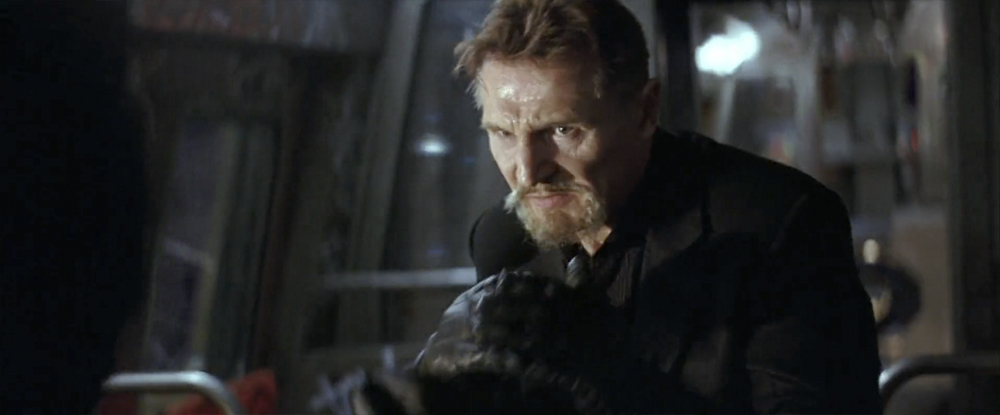 |
| "Over the ages, our weapons have grown more sophisticated. With Gotham, we tried a new one: Economics. But we underestimated certain of Gotham's citizens... such as your parents. Gunned down by one of the very people they were trying to help. Create enough hunger and everyone becomes a criminal. Their deaths galvanized the city into saving itself... and Gotham has limped on ever since. We are back to finish the job. And this time no misguided idealists will get in the way. Like your father, you lack the courage to do all that is necessary. If someone stands in the way of true justice... you simply walk up behind them and stab them in the heart." |
The Dark Knight opens with a Gotham City in which Bruce's crusade against crime has been ongoing for several years. Ra's al Ghul has been defeated, the last dregs of the breakout at Arkham Asylum have been cleaned up, and gangsters flee when the Batman's signal floods the night sky. The mob, pushed to desperation as their cash reserves disappear before their eyes, turn to an "expert" to exterminate their hated foe once and for all: the Joker. As Harvey Dent says, "the night is darkest just before the dawn". Things must get worse before they get better.... and man, do they get worse. We never actually see that dawn Harvey alluded to until The Dark Knight Rises, which reveals that the framing of Batman for Dent's death bought a tenuous peace: outrage over the law's ineffectiveness empowered the government to pass the Dent Act, strengthening the police and denying parole for any of the hundreds of mobsters arrested by Dent's prosecution in the events of The Dark Knight for over eight years running. In a moment alone with Gordon, Officer Blake jokes that they'll soon have nothing left to do but chase down overdue library books. Little did they know that the security bought by the Dent Act was merely an armistice preceding the gathering storm of Bane's revolution.

The history of Europe, too, has its counterpart to Gotham's Dent Act. I earlier compared the League of Shadows and its rejection of both the corruption of Gotham and the benevolence of the Waynes to the Protestant Reformation. The challenge of the Luther, Calvin, and their thugs were eventually met in Rome by the Counter-Reformation. The popes put their building projects and nepotism aside (more or less) to convene the Council of Trent, reinforcing the Church's doctrine and institutions, matching the Luthers and Calvins of the north blow for blow with an army of Jesuit and Franciscan missionaries. The war of priests and preachers gave way, soon enough, to armies of soldiers and mercenaries, as religious tensions flared to intermittent warfare between Protestant and Catholic for nearly a hundred years: the Pilgrimage of Grace, the French Wars of Religion, and the Thirty Years' War. In 1648, after German soil had been watered with the blood of more than 8 million dead, the kings and princes of Europe established the Peace of Westphalia. Its term established that territorial boundaries (lines on a map, if you will) were to be respected. Religious policies were to be determined by the maxim cuius regio, eius religio: whatever the faith of the local king or prince would be the established religion of that country, though minorities would be permitted to practice their faith privately at home or publicly within designated times and places. The pope and the leading Protestant figures both found anything less than total victory unacceptable, but the Westphalian system ultimately prevailed until, at least, the onset of the French Revolution.
Gotham is yours: Bane's Revolution
I hope it's understood that in no way did I mean to suggest that Nolan, Goyer et al. ever consciously thought to mirror the history of Gotham after western Europe's march to modernity... with one critical exception. Bane's takeover of the city was explicitly inspired by the French Revolution, and in particular, Dickens's A Tale of Two Cities. This is, after all, the book Commissioner Gordon reads from at the end of The Dark Knight Rises during Bruce's "funeral" (the Penguin Classics edition, to be precise!). Though, instead of the more oft-cited beginning, he reads snippets from the end:
"I see a beautiful city and a brilliant people rising from this abyss... I see the lives for which I lay down my life, peaceful, useful, prosperous and happy... I see that I hold a sanctuary in their hearts, and in the hearts of their descendants, generations hence... It is a far, far better thing that I do, than I have ever done; it is a far, far better rest that I go to than I have ever known."

Nolan's Bane, of course, ditches the lucha libre mask and the other fantastical aspects of his character in order to fit in with the Nolan vision of "heightened reality", but the most important characteristics remain: namely, that Bane is both physically and intellectually a match for Batman. Bane's nationality and even the prison he comes from is made more abstract for the film, with the added flourish of a background with the League of Shadows. (In the comics, however, Bane does eventually encounter Ra's al Ghul and eventually impresses him to the point where Ra's names him heir to the League and proposes that he marry Ra's daughter, Talia.) The greatest difference of any real distinction for us between comic and film is not how much muscle mass Bane has, but the villain's motivations. In 1993, Bane had grown obsessed with stories of Batman even while still in prison and dedicated himself to "breaking the Bat" simply to prove that he could. After realizing his goal, Bane was content to bask in a luxury penthouse over Gotham's skyline with a pile of riches and dominance over the criminal underworld.
For the film, it just wouldn't do for Bane to have such a mundane goal in mind. No, he was given the unenviable task of outdoing even Ledger's Joker in sheer terror. The Bane of 2012 had to be an idealist. Though his true purpose is to instill total despair and destruction, Bane finds it convenient to play the part of the demagogue to further his plan. He is no sans-culotte himself, but finds it easy to harness the rage of a million Madame Defarges against everything Bruce Wayne represents in Gotham: power, privilege, and wealth. He gives his call to arms on live television before the doors of Blackgate prison as though it were the Bastille: rightly or wrongly a symbol of the old regime's power to crush dissent.
"We take Gotham from the corrupt! The rich! The oppressors of generations who have kept you down with myths of opportunity, and we give it back to you... the people. Gotham is yours. None shall interfere. Do as you please. Start by storming Blackgate, and freeing the oppressed! Step forward those who would serve. For an army will be raised. The powerful will be ripped from their decadent nests, and cast out into the cold world that we know and endure. Courts will be convened. Spoils will be enjoyed. Blood will be shed. The police will survive, as they learn to serve true justice. This great city... it will endure. Gotham will survive!"
Bane harnesses the mob's anger for his own ends, but he doesn't actually believe in the rhetoric himself. On a personal level, every murder and execution Bane commits is cool, rational, and directed toward a higher purpose. Bane's last words to Dr. Pavel before snapping his neck are "thank you, doctor". The last thing Daggett, too, hears before dying at Bane's cusped, reassuring hand is "I'm necessary evil." He's not so well compared to the angry Madame Defarge or "The Vengeance" as he is to Maximilien Robespierre. Lest you think it's a stretch, I point out that the design of Bane's overcoat was a deliberate reference. Costume designer Lindy Hemming said:
"Chris Nolan thought there was an element about Bane that was of the French Revolution. There was kind of a romanticism about him, as well as being very bad. So I tried to combine the jacket with a French Revolutionary-style high-standing collar, which goes up and then comes back down."

The short version is that, when King Louis XVI was put on trial for treason after attempting to flee the country, Robespierre came to the conclusion that "desperate times called for desperate measures": in order for the new Republic to live, the king had to die, despite Robespierre's personal opposition to the death penalty... or, as Bane put it, it was necessary evil. In turn, by 1793, he concluded that a reign of terror had to be applied to preserve the common good and save the Revolution from being reversed by its enemies. Indeed, properly applied, terror was merely the fast-tracked application of justice. It was never anything personal against those doomed to die. In his own words:
"Terror is only justice prompt, severe and inflexible; it is then an emanation of virtue; it is less a distinct principle than a natural consequence of the general principle of democracy, applied to the most pressing wants of the country."
Of course, a strong parallel can also be drawn from Robespierre and the Terror to Ra's al Ghul and any one of his plots to purge civilization of corruption, both in Batman Begins and in his various comic incarnations. Bane meant it when he said, "I am the League of Shadows! I'm here to fulfill Ra's al Ghul's destiny!"
Batman: the Burkean hero
Many of my, err, left-leaning friends like to characterize the Batman as a fascist who keeps the people of Gotham down by perpetuating a broken system: criminals break out of Arkham, and all Batman does is throw them back in the revolving door, only to break out and kill a dozen more victims, making a mockery of the Dark Knight's rigid adherence to his no-killing rule. This is ultimately the Bat falling afoul of bad writers or, perhaps, the nature of comics themselves. To keep a continuity running for years or decades, the villains have to break out of prison over and over again so that DC can sell more stories and more comics. The Nolan films, on the other hand, are safely in the confines of a defined story arc. Batman doesn't feel the need to save Ra's al Ghul a second time, when the monorail careens into the parking garage in front of Wayne Tower at the end of Batman Begins. Once the Joker is in custody at the end of The Dark Knight, he (presumably) has never been able to bust out ever since.
In the hands of a good writer, Batman isn't a useful idiot for a broken legal system. He respects the rule of law in general, but has no qualm with acting above the law when it falls short; whether it's running a few red lights during a high-speed chase in the Batmobile, or attacking cops when they get in his way of acting for the greater good. As Bruce Wayne, the unofficial prince of Gotham, he'll also use his influence behind the scenes to get worthy men in political office, find jobs for the able-bodied, and give charity to the not-so-able. If Bane is Robespierre, Batman is Edmund Burke.


Burke was a member of the House of Commons in Britain during the French Revolution. In 1790, though he was a Whig (the liberal party at that time), Burke came out with a scathing attack, Reflections on the Revolution in France:
"What sort of a thing must be a nation of gross, stupid, ferocious, and at the same time, poor and sordid barbarians, destitute of religion, honor, or manly pride, possessing nothing at present, and hoping for nothing hereafter? I wish you may not be going fast, and by the shortest cut, to that horrible and disgustful situation. Already there appears a poverty of conception, a coarseness and vulgarity in all the proceedings of the assembly and of all their instructors. Their liberty is not liberal. Their science is presumptuous ignorance. Their humanity is savage and brutal."
Of the British system, by contrast, with its tradition of common law and gradual evolution, he wrote:
"Our political system is placed in a just correspondence and symmetry with the order of the world, and with the mode of existence decreed to a permanent body composed of transitory parts; wherein, by the disposition of a stupendous wisdom, moulding together the great mysterious incorporation of the human race, the whole, at one time, is never old, or middle-aged, or young, but in a condition of unchangeable constancy, moves on through the varied tenour of perpetual decay, fall, renovation, and progression. Thus, by preserving the method of nature in the conduct of the state, in what we improve we are never wholly new; in what we retain we are never wholly obsolete."
Although we now see Regency Britain as an avowed enemy of the French Revolution, it's important to point out that Burke's fellows in the Whig Party were rather supportive of the Revolution at first. Burke came out with his Reflections even before the execution of the King and Queen, the Reign of Terror, the massacre of the Vendee, and the foreign wars. The Tories, meanwhile, didn't wholly trust Burke, either because earlier in his career, Burke supported the American side of their revolution in the colonies, emancipation and civil liberties for Catholics, and spent years trying to get the Governor-General of India impeached for judicial murder and other crimes during his colonial administration. His unpopularity among both parties for seemingly contradictory views caused him to resign from Parliament. As there's no greater praise to be had on earth than the ire of Karl Marx, it's worth citing the communist author's feelings about Burke's loyalty to his conscience over party lines:
"The sycophant—who in the pay of the English oligarchy played the romantic laudator temporis acti against the French Revolution just as, in the pay of the North American colonies at the beginning of the American troubles, he had played the liberal against the English oligarchy—was an out-and-out vulgar bourgeois. 'The laws of commerce are the laws of Nature, and therefore the laws of God.' No wonder that, true to the laws of God and Nature, he always sold himself in the best market."
One can easily imagine Edmund Burke at the charity gala early in The Dark Knight Rises, scoffing with Bruce at the luxurious assortment of food on the table while the city suffers. Nonetheless, being born in the Regency Room or driving to the party in a Lamborghini isn't the evil. The sin is in refusing to fulfill the responsibilities attached to power and privilege: using your gifts and virtue to better your fellow man. Noblesse oblige.
When the screen goes to black and the credits roll, the average moviegoer walks away with the lesson that Batman became a hero for sacrificing his name, fortune, body, and his whole life for the sake of his city. And while that's all true, the casual viewer might miss a greater significance: that Batman also inspired ordinary men to be heroes with him. The best counter to Bane and the League of Shadows's designs is not anarchy or even enlightened despotism under Batman's mailed fist, but the co-operation of virtuous men. Good government. Civilization.
At the final film's climax, Batman has finally regained the trust of law and order. Captain Foley, who has spent Bane's revolution hiding behind his wife at their townhouse, wakes up from complacency and leads the Gotham police, clad in full dress, in a march toward Bane's heavy guns and certain death, all to give Batman a chance to strike. He gets mowed down by a Tumbler in the execution of his office, sprawled over the pavement with all the symbols and badges of his station like a fallen soldier in a romantic painting looking back to the Napoleonic wars. Batman hasn't destroyed a corrupt government. He's restored faith in good government and redeemed the western civilization that the League sought to overthrow. In death, Captain Foley realizes Burke's unheeded lesson on unchecked evils such as those which arose in France, which is often misquoted as "evil triumphs when good men do nothing" but remains substantially true below:
"When bad men combine, the good must associate; else they will fall, one by one, an unpitied sacrifice in a contemptible struggle."

Friday, August 14, 2015
The Pugin brothers: Saint Mary's, Warrington
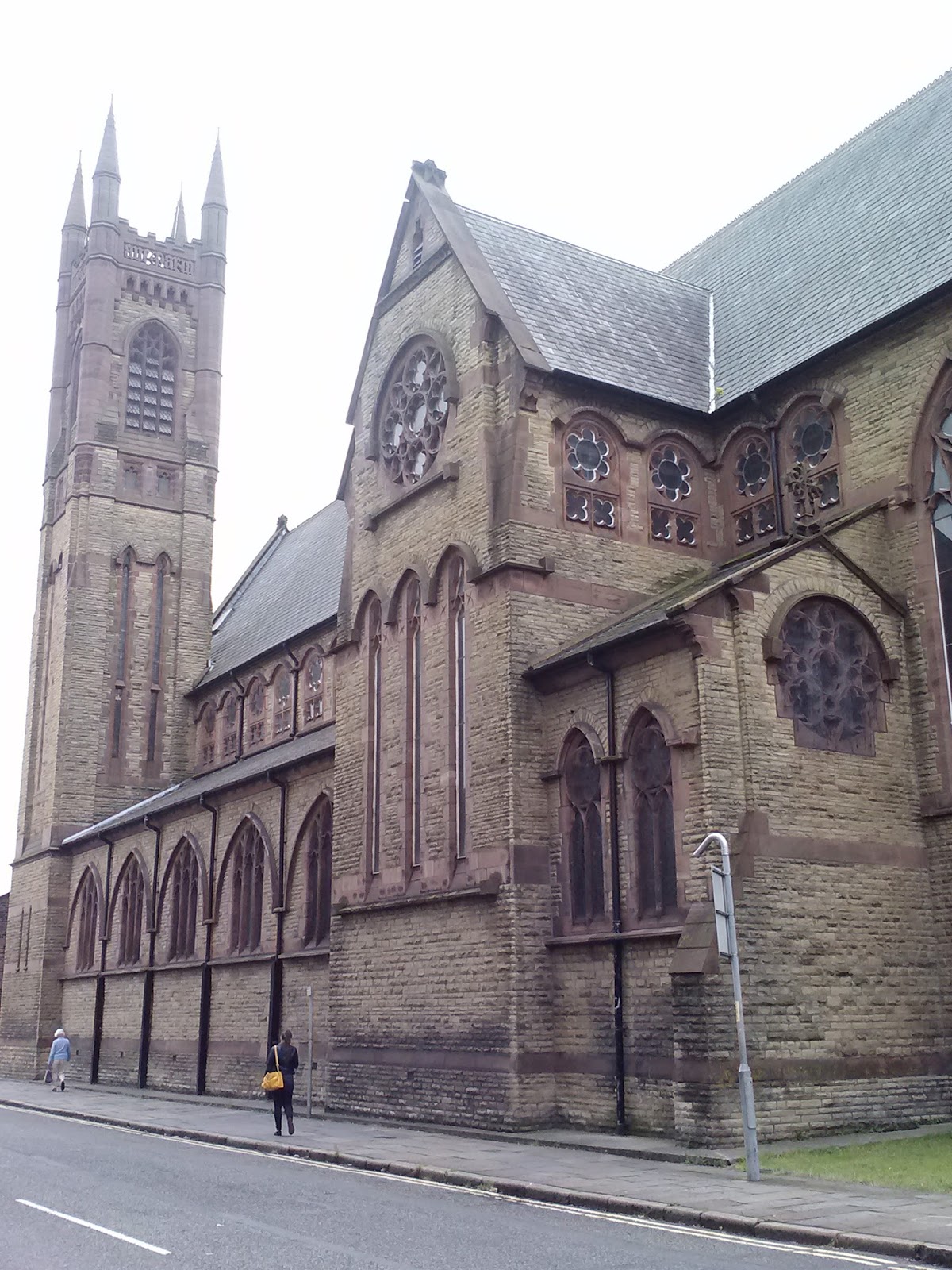
I'm jealous of a friend of mine, a seminarian of the Priestly Fraternity of Saint Peter, who lately had the opportunity to visit that Fraternity's latest acquisition: a splendid Gothic revival church in Cheshire (the archdiocese of Liverpool): the church of Saint Mary's, Warrington. The church was built by the Benedictine monks of Ampleforth Abbey beginning in 1875, which they managed to operate continuously all the way up to 2012! The church was designed by Edward Welby Pugin, Augustus's oldest son and successor to the business. Unfortunately, Edward died shortly after breaking ground (at 41, just one year longer than his father), but his younger brother, Peter Paul Pugin, assumed the project and took it to completion in 1877.
Here are some pictures my friend took. You'll see that Edward's style gradually diverged from Augustus's, particularly after 1859. Augustus's churches were usually of "country parish" proportions with very deep and narrow chancels, while Edward eventually addressed some of Cardinal Newman's criticisms against his father's work and brought the Gothic revival in line with "Tridentine" norms: smaller chancels, wider altars, and no rood screens to obscure the people's view of the high altar, to name a few. At the same time, Edward greatly enhanced the "vertical" aspect so that, in true Gothic style, even a common city parish was sure to make you feel like an ant inside it.


Thursday, July 30, 2015
The king of the jungle
The Internet outrage factory is once again in full swing. The unlucky lottery winner this week: Walter J. Palmer, a Minnesota dentist who paid a pretty penny to go on a lion-hunting safari in Zimbabwe and ended up killing the subject of a University of Oxford study by the name of Cecil. Two Zimbabweans, whose names only matter as much to us as Cecil's did to the Zimbabweans, led the lion out of Hwange National Park by loading a dead animal onto the back of a truck, whereupon Palmer shot the lion with a crossbow. Cecil escaped and limped on for another 40 hours until his hunters finally caught up with him and shot him dead. In typical white-guilt fashion, the Rhodesians are of no account, but Palmer has already had people here in the States swamp him with death threats, personal house calls, and have flooded his practice's Yelp page with bad reviews.
Though these keyboard warriors' stirrings of rage are certainly misplaced, some conservatives and traditionalists have taken it upon themselves to play the caricature: if liberals are mad about something, it must be good. I came across the following comment by a fellow traditionalist earlier today, for instance:
"Funny how liberals and the population at large throw themselves into such a tizzy over THIS, a stupid irrational animal being killed by some guy. But the murder of 1.5 million human babies per year in this country, by their own friggon mothers, does not move them.
"I'm fairly certain that hunting for sport has been a hobby of the wealthy for centuries. Weren't there many kings who hunted for fun? And I seem to recall during the colonial era, privileged men paid big money then for the opportunity to hunt exotic big game.
"Another element of traditional life being deplored by libs I say!"
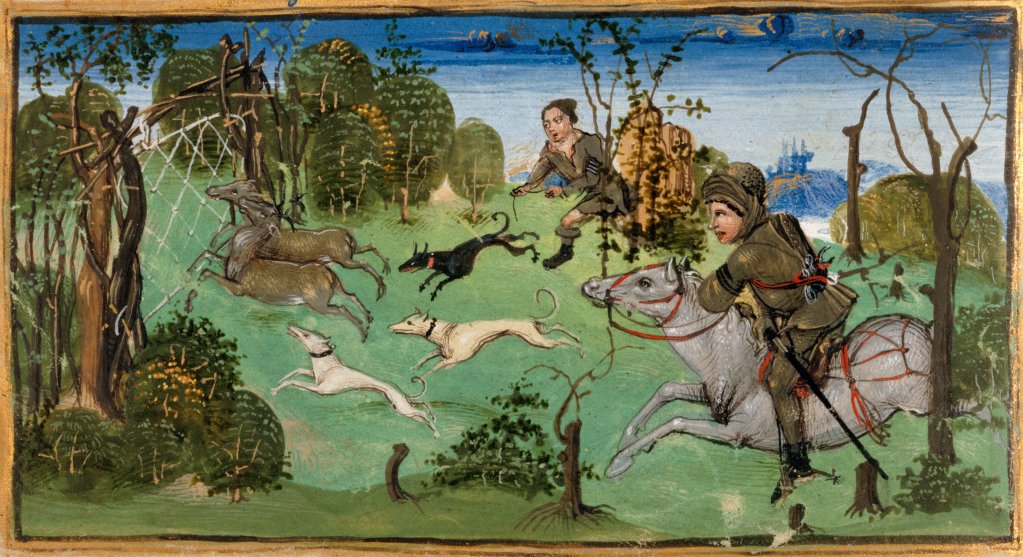
But a greater evil, such as rampant abortion in this country and elsewhere, doesn't make a lesser one, such as poaching exotic animals, now good. In any case, the Modern Medievalist points out that poaching was once punishable by death, or worse; Richard the Lionheart's Assize of 1198 threatened deer-hunters with blinding and castration. The Norman kings' draconian game laws were reviled by the commons because they reserved hunting in the royal forests to the king alone, or his tenants by permission. Deforestation, or even the cutting of individual tree-branches were also subject to harsh penalties. Though the bottom line, as with most other things in this world, was about the vast sums of money that the royal treasury could collect with these laws, there is nonetheless a conservationist streak to their logic. So the court said:
"The king's forest is a safe abode for wild animals, not of every sort, but of the kind that lives in woodland and not everywhere but only in suitable places... in the wooded counties, where wild beasts have their lairs and abundant feeding grounds. It makes no difference who owns the land, whether the king or the barons of the realm; the beasts have freedom and protection, and wander wherever they will."

The exploitative "hunts" of the colonial period in Africa and Asia bore little resemblance to those practiced by the kings and princes of medieval Europe. In one, all the real work is done by local bushmen until the man paying for the expedition steps in to take a last shot. In the other, the greatest honor was accorded to nobles who could kill boars with close-combat weapons during their mating season, when the males were like to be most vicious. There, the boar was both meat for the feast, and an opportunity for warriors to hone their martial skills; not only English kings, but even Byzantine emperors sometimes perished in the chase. Palmer's latest excursion, as with most hunts from the colonial period to the present, amounts to a $50,000 photo op... but we can credit him, at least, for his insistence on using bowed weapons in most of his past hunts.
There is one thing we can learn from westerners' passioned, if also manufactured, outburst at the unfortunate dentist: that we are still monarchists at heart. Why does one lion, who lived most of his life in a natural state in the wild, matter more than the millions of livestock we raise every day within our own borders, never to see the light of the sun, born only to die and be served up as fast food? Thousands of us are paid to kill animals all day long without the slightest need to worry about death threats or bad Yelp reviews.
The answer to this contradiction is simple: because Cecil was, in our hearts, the king of the jungle. The lion is the heraldic symbol of the kings of England, the tribe of Judah, and Christ Himself. The people of Zimbabwe have responded to all this hubbub with "what lion?" They're confused that we care more about Cecil than the fact that the vast majority of people in that country are unemployed and sometimes even suffer from wild animal attacks. They kill lions and other exotic animals all the time, but when a westerner does it, it's international news. What the Zimbabweans don't understand is that the lion, to us in the west, is a majestic beast, one we humans have seen fit to ascribe more value to than other animals. Like Adam, we have given all the beasts of the earth a name and place in the world. The Modern Medievalist is quite comfortable with this. But let's not also forget that our first parents were appointed stewards and guardians of creation, not just its masters.
Thursday, July 23, 2015
The Anglican Ordinariate and the gift of sacral English worship

Two weeks ago, I wrote my impressions of an Ordinariate community I visited for Sunday Mass. For some reason, that article ended up being one of the most widely shared pieces I've ever done; so much that when I came to see Blessed John Henry Newman's sister community in Mount Airy (a northwest section of Philadelphia) this past Sunday, at least three people there recognized me as the Modern Medievalist.
To the people of Saint Michael's consternation, I won't do a full-fledged review because there's not too much I could add which hasn't already been said for Newman. This community, which is slightly larger than Newman, was formed a couple years earlier. The two groups share the same priest and organist. Most of the liturgical practices are the same, though I observed that Saint Michael's omits the sign of peace and adds the Last Gospel at the end of Mass. As at Newman, everyone uses their "The Hymnals" to full effect. I was a tad surprised when we used a recessional hymn set to the Old Hundredth (I believe it was "All People That on Earth Do Dwell"); I don't remember singing anything to that tune since I was in my mother's Seventh-day Adventist church.
The community borrows the parish church of Holy Cross, a sturdy stone building in the Gothic revival style. I wasn't able to find anything online about its history, but it fits in surprisingly well with the Gothic churches of the old Protestant establishment. That is to say, there isn't any of that Continental/Baroque fru-fru when you step inside. Everything from the reredos, to the confessional booths, to the wonderful, wooden crossbeam ceiling falls in sync with the Gothic revival and Pugin's "true principles of Christian architecture". They even remembered to paint the doors red. The edifice is marred only by (as you could expect) an unsightly marble freestanding altar that must have been placed there following Vatican II.

Saint Michael's isn't the only community to borrow this church. As I later discovered, Holy Cross is now also home to two other nearby parishes whose churches have closed down. The Archdiocese of Philadelphia has been hemorrhaging since the Council, and paired with sexual abuse lawsuits, has been obliged to shut down scores (hundreds?) of churches over the past few years. This is a foretaste of what's in store for Catholic dioceses around the country, even the so-called healthy ones in the Midwest. I suspect even with all the consolidating, these churches are merely forestalling the inevitable. The institutional Church's lack of willpower to pass the faith on to the next generation will cause even Holy Cross, now home to three parishes and an Ordinariate community, to be shuttered or turned into apartment space before I bite the dust.
I chatted with virtually every member of the community in the basement after Mass, hearing their stories and struggles. As at Newman, nearly all were former Episcopals. I learned that the founding members originally came from an Episcopal church called Saint James the Less. That parish actually separated from the Episcopal Church over a decade ago and finally lost a bid against the Episcopal Diocese to keep their property in 2006. They had floated adrift for a time until 2012, when they were received into the Catholic Church and their leader was ordained as a Catholic priest. I hope the current pontiff hasn't been giving them too much buyer's remorse.

Looking back, the most valuable thing I learned about this entire visit was that people who drive long distances to church for a specific liturgy or community (and here, I mainly have some, though thankfully by no means all traditional Latin Mass groups in mind) have no excuse for being standoffish and disinterested in newcomers. The usual excuse is that Latin Massers are cranky because they drive a long way and spend most of their lives besieged by modernists or whatever other negative influences there might be out there. Which is true, but at Saint Michael's, I talked to an elderly woman who drives over a hundred miles each way to make it to this church, and she still made a point to say hello to us and personally pour us coffee. Quite a few members drive in from other states. These people had to endure the realization that something was horribly wrong with their previous church, leave that sect and all their property behind, and float in limbo for years until arriving home in the Catholic Church, still to be treated like second-class citizens among many parties in the hierarchy and elsewhere.... and despite all that, it's not too much of an obstacle to make a visitor feel welcome.
 |
| Confessional booths |
At last, let's ask ourselves: why does the Ordinariate even matter to those of us non-Anglicans or Episcopals? And what does this have to do with your theme of Modern Medievalism?
The Personal Ordinariate and other Anglican Use communities are among the only people in the Catholic Church willing to give English-speaking people beautiful worship in a common, though sacralized, tongue. While I certainly prefer the traditional Latin Mass and maintaining the use of Latin in the western liturgy as far as possible, I need to make an uncomfortable reality check for fellow "traddies": no one else cares. We can't revive Latin the way that Jews were able to bring Hebrew back from the dead and make it the functional language of an entire country because, frankly, they just care about it more than we do. Hebrew in Israel comes from a culture which, since its beginning, insisted that all young men learn the rudiments of the ancient tongue as a rite of passage into adulthood. Could a man dare call himself a rabbi without having learned Hebrew? Could a Muslim call himself an imam or Islamic scholar without even bothering to read the Koran in Arabic?
But a Christian priest isn't really the equivalent of a rabbi or imam, is he? The latter two are scholars and interpreters of their holy books, but they're not priests. The Christian priest could be a scholar as well, but for most of Church history, the average parish priest presumed no such role. They trained to offer the sacrifice of the Mass and celebrate the sacraments. The priest's job is chiefly a sacramental one. And so, it sufficed for so many centuries for priests to be trained to fulfill their vocations by rote memorization or reading prayers from a book. This shouldn't imply that most medieval country priests could actually compose letters in Latin or freely translate verses from Scripture on demand. No, the priest needed to know his Latin only enough to "say the black, do the red". Most priests in these Middle Ages weren't even authorized to preach sermons or hear confessions. Those pastoral duties, which we now take for granted, were formerly assigned to specialists.

The Protestant Reformation, of course, challenged the old expectations of a priest's duty to his flock and found them wanting. Guildsmen in Germany, for instance, took to suing their chaplains for not providing them with "evangelical" sermons; the priests cited their contractual obligations, which only ever expected them to offer Masses and prayers at the appointed times (the Office). Yet the people of northern Europe decided it was no longer good enough. Entire nations revolted against the Latin Mass and all it stood for. In those kingdoms which remained faithful, seminaries were established to reform the clergy into a body of scholarly professionals that could go toe-to-toe against the likes of "Dr. Luther" and his followers. Latin was taught in these institutions to bolster their defenses. And yet, it never really left seminary grounds. There was never a concerted effort to make the study of Latin a universal precept for all young men; even for altar servers and choristers, their parts were learned by rote or reading, but without much emphasis on understanding or translating. Meanwhile, the common people grew further and further apart from the liturgy and the culture that built it until, finally, in the 1960's, Pope Paul VI and nearly all the bishops in the world said goodbye to the Latin Mass with nary a peep of protest from either clergy or congregation; not even in Italy itself! It was almost as though a few non-Catholic intellectuals, writers, and classical musicians were more perturbed by the jettisoning of nearly two thousand years of tradition than the faithful themselves.
We can walk away from Vatican II with one of three conclusions: either,
a.) the gates of hell prevailed against the Church after all;
b.) Paul VI wasn't a true pope, and the real Church is actually in hiding, or;
c.) Latin was never really that important to begin with.
A sounds flippant, but I know of, and have personally spoken to more than a handful of old-timers who gave up being Catholic altogether because they believed all of the liturgical and social changes that followed the Council proved that the Church was no longer the infallible institution it had spent so long cultivating itself as. B is, of course, the "sedevacantist" option. But for the rest of us, we have to concede with C to some degree or another. Therefore, if Latin was never absolutely integral to Catholic worship, then traditional Catholics are doing outsiders a disservice by insisting such things as "only the Latin Mass matters", "Mass in the vernacular is displeasing to God", or "if you want to pray in the vernacular, go to the Novus Ordo". These dichotomies make the great the enemy of the good, and when the dust has settled, no one wins except the devil.
Latin isn't analogous to Hebrew for Jews and Arabic for Muslims because traditional Christians aren't "people of the book". Scripture is just one, not the sole source of revelation. The Latin liturgy is worth preserving because it represents a nearly two-thousand year tradition in the West... but it's not worth making an idol of, and certainly not posing as an obstacle to conversion or a barrier to entry. This is where the Anglican tradition comes in. Whereas the Catholic Church went directly from Latin to the most plebeian, uninspiring form of English it could concoct (and I understand the Church's translations of the Mass to nearly all other languages are just as bad, if not worse), as though it held back from total mediocrity solely by the pains of canon law rather than any real sense of reverence, the Church of England, at least, had a real interest in using its native language to uplift its flock as far as possible. Cranmer was, if a heretic, still also one of the greatest wordsmiths in the history of English; his version of the Lord's Prayer persisted even in English-speaking Catholics' private prayers and survived in the Novus Ordo Mass as a sole anachronism of sacral prose in a sea of contemporized banality. The King James Bible sounded antiquated even in 1611, for it was composed not for absolute fidelity to the text, but to sound beautiful when read from the pulpit or during the liturgy.
 |
| Holy Cross is one of the only western churches I've seen with Greek, rather than Latin lettering over the entrance. |
Today, the Catholic Church has a crisis of ugliness and irreverence in her worship. The traditional Latin Mass, despite its resurgence in recent years, will unfortunately never be restored as the normative rite because Pope Paul VI already drove the last nail in the coffin by forever breaching us from the continuity of earlier Christian civilization. It's like that butler in the PBS documentary on Highclere Castle who prides himself on setting the Earl of Carnarvon's table exactly as his predecessors had done for so many generations: because he knows that as soon as he lets standards slip, the tradition will be gone forever. Now, in 2015, we have a generation of younger people who can see past the foolishness of the hippie Masses, clown Masses, and other "experimentations" of the later 20th century and yearn for a serious approach to God, but most will never get past the hurdle of a Mass entirely in Latin. We would have better luck rebuilding the Roman Empire first.
Fortunately, the Ordinariate can show us another way. It shows that we can have God-centered worship facing the altar together. We can take the Gospel seriously, adore the Blessed Sacrament, and sing to the Lord all in a sacral English that commands awe and respect, yet is accessible enough for the seeker or long-lapsed Catholic unexpectedly walking through the door one Sunday. By the time our prelates figure out how sensible (how English!) a model this is, it'll be too late for all but a sliver of what the Church once was; but at least the Ordinariate communities, who by then will boast some of the largest and most faithful congregations around, will be able to say, "we knew we were on to something good all along. Now, would you like to join us for some coffee after Mass?"
 |
| A view of the neighborhood around the church |
Friday, July 17, 2015
The Latin Mass in Pennsylvania's capital

Last weekend, we sojourned out to central Pennsylvania to visit my grandmother-in-law, so while we were out there, we thought it would be a good idea to visit the Priestly Fraternity of Saint Peter's (FSSP's) chapel in Harrisburg for Sunday Mass.
The chapel of Saint Lawrence is situated beside the muddy--err, mighty Susquehanna River, as well as the foot of a grand avenue leading up to the steps of the Pennsylvania State Capitol building. The Capitol looks quite magnificent from the outside (when President Teddy Roosevelt dedicated it in 1906, he called it "the handsomest building I ever saw"), and I intend to visit it the next time we're in the city. It bewilders me that Madame, a lifelong Pennsylvanian, hasn't yet done her duty as a loyal citizen of the Commonwealth and toured the place. (A native Texan wouldn't dare dream of reaching their 20's without visiting the State Capitol building in Austin.)
Pennsylvania's Capitol complex is so big, in fact, that the Commonwealth bought up the old Saint Lawrence, a parish church built by a German Catholic community, and demolished it for expansions. The current Saint Lawrence was finished in 1918 in the same Gothic style as its predecessor, but as far as I can tell, was never returned to parish status. It became a chapel for the nearby cathedral of the Harrisburg diocese. Over the years, that old German community fizzled out and the chapel collected dust until 2005, when the bishop that year gave the building to the FSSP. Unofficially, I've read that the primary motive was mostly to allow the diocese to compete with an independent priest in York rather than for altruism, but I can't confirm it. Whatever the reasons were, the Fraternity has made good use of the property and placed the old Latin Mass right in the middle of a busy metropolis; a refreshing change from the usual state of affairs, where bishops or the laws of economics sentence Latin Mass communities to death by suburbia.
 |
| Wonderful iconography around the Mary altar. |
 |
| Yes, these signs are here for a reason! |
To be honest, I spent the greater part of Mass in the narthex holding our daughter, who was by far the noisiest person there. From what I could tell going in and out, though, Mass proceeded just as you would expect from a society of priests dedicated to preserving the traditional liturgy; no funny business whatsoever. Another priest, not the celebrant, preached the homily. The substance was a solid, hold-no-punches tour of the errors of religious liberty and the French Revolution, probably timed to precede France's annual celebration of that jailbreak in 1789; perhaps so punchy and replete with quotes going back to Pope Pius VII that one who wasn't already well-formed in the Church's traditional teachings would lose a tooth. I didn't have the heart to ask my mother-in-law, who Madame dragged out with us (and hadn't even attended a TLM since Vatican II), what she thought of the homily afterward. In fact, if such homilies are a normal occurrence at this chapel, I'm surprised the bishop still allows them to operate at all.
 |
| The beautiful, but small, sanctuary. |
 |
| Servers putting the sanctuary in order after Mass. |
 |
| Look at this excellent wooden ceiling! |
 |
| It's not every day that you see even the organ's pipes adorned in Gothic at an American Catholic church. |

Thursday, July 16, 2015
Who made the first résumé?

Settling into a wholly new area, as I have, presents a host of challenges, such as figuring out what a "hoagie" is (a northeastern term for a sub sandwich), remembering that it's not always legal to turn right on a red light, and being careful not to run over Amish buggies. (I just looked up why you never see Amish people ride on horseback. It's apparently considered immodest; I actually see the rationale behind that.) Fortunately, I can at last dispense with the southern pretense of asking of how your day is, because as you and I both know, no one actually cares.
I recently crossed off another item on the to-do list: I finally gave in to corporate America and created a profile on LinkedIn. I'll be honest, even to those prospective employers out there who are, even now, scanning my blog for reasons not to hire me, that I find the entire site's philosophy irksome, not least because of all the articles I had to read in order to "maximize my hireability". Add a picture to increase your chances of being clicked on by 14 times. Make sure you're smiling, but don't look too happy. A slight scrinching of the eyes is best. See that your chosen photo features you alone; this isn't Facebook, and we wouldn't want to think you have anything to live for beyond the company.

Perhaps I'm too skeptical of my fellow man to be a hiring manager, because I don't understand why they wouldn't see right past all the corporate jargon, e.g. résumé fluff:
-Whenever I look at someone's page, if their job title has the word "engineer" but isn't preceded by "electrical", "mechanical", or "petroleum", my mind instantly replaces it with "lackey".-I mentally cross out all instances of the word "professional" (for instance, LinkedIn's default headline for me was "education management professional"), no matter the context. No one would sign up for a LinkedIn account in the first place if they didn't imagine themselves to be a "professional" of some sort or another. Would you rather describe yourself as amateur?-If you "think outside the box", you're actually well within the box and just don't know it.-Everyone's likelihood of getting a job is directly proportional to how many obfuscating words with Greek or Latin roots they can use to make their pastjobspositions anddeedsaccomplishments look more important than they really were. All these "innovative" thinkers with their "solutions" for "managing multiple projects" makes me want to take up Anglo-Saxon to cast these foreign loan words out of our tongue and speak in full barbarian from here on out. But in the meantime, at least it looks like there is some use for all the fancy book-learnin' in that classical liberal arts degree, after all.
Anyway, feel free to email me if you want to add me to LinkedIn. Or, if you find me on the site directly, be sure to say it's because you read my blog.
And now, to where I meant to start: as I off-handedly mention somewhere on my LinkedIn profile, "Did you know, for instance, that the first person to use something akin to a résumé as we know it was Leonardo da Vinci?" It was more a cross between a résumé and a cover letter, but it's true nonetheless. When our favorite ninja turtle was but 30 years of age, he wrote to Ludovico Sforza, Regent (and later, Duke) of Milan in the hope of getting a job. What's interesting is that, although he had already accomplished more in many disciplines in 1482 than most of us get around to in our whole lifetimes, Leonardo's letter only references his artistic acumen in passing, at the end:
"I can carry out sculpture in marble, bronze, or clay, and also I can do in painting whatever may be done, as well as any other, be he who he may."
The rest of the letter focuses on what Leonardo could do for the Sforzas as a military engineer and inventor of weapons of moderate destruction. Here's the full piece in translation:
Most Illustrious Lord, Having now sufficiently considered the specimens of all those who proclaim themselves skilled contrivers of instruments of war, and that the invention and operation of the said instruments are nothing different from those in common use: I shall endeavor, without prejudice to any one else, to explain myself to your Excellency, showing your Lordship my secret, and then offering them to your best pleasure and approbation to work with effect at opportune moments on all those things which, in part, shall be briefly noted below.
1. I have a sort of extremely light and strong bridges, adapted to be most easily carried, and with them you may pursue, and at any time flee from the enemy; and others, secure and indestructible by fire and battle, easy and convenient to lift and place. Also methods of burning and destroying those of the enemy.
2. I know how, when a place is besieged, to take the water out of the trenches, and make endless variety of bridges, and covered ways and ladders, and other machines pertaining to such expeditions.
3. If, by reason of the height of the banks, or the strength of the place and its position, it is impossible, when besieging a place, to avail oneself of the plan of bombardment, I have methods for destroying every rock or other fortress, even if it were founded on a rock, etc.
4. Again, I have kinds of mortars; most convenient and easy to carry; and with these I can fling small stones almost resembling a storm; and with the smoke of these cause great terror to the enemy, to his great detriment and confusion.
5. And if the fight should be at sea I have kinds of many machines most efficient for offense and defense; and vessels which will resist the attack of the largest guns and powder and fumes.
6. I have means by secret and tortuous mines and ways, made without noise, to reach a designated spot, even if it were needed to pass under a trench or a river.
7. I will make covered chariots, safe and unattackable, which, entering among the enemy with their artillery, there is no body of men so great but they would break them. And behind these, infantry could follow quite unhurt and without any hindrance.
8. In case of need I will make big guns, mortars, and light ordnance of fine and useful forms, out of the common type.
9. Where the operation of bombardment might fail, I would contrive catapults, mangonels, trabocchi, and other machines of marvellous efficacy and not in common use. And in short, according to the variety of cases, I can contrive various and endless means of offense and defense.
10. In times of peace I believe I can give perfect satisfaction and to the equal of any other in architecture and the composition of buildings public and private; and in guiding water from one place to another.
11. I can carry out sculpture in marble, bronze, or clay, and also I can do in painting whatever may be done, as well as any other, be he who he may.
Again, the bronze horse may be taken in hand, which is to be to the immortal glory and eternal honor of the prince your father of happy memory, and of the illustrious house of Sforza.
And if any of the above-named things seem to anyone to be impossible or not feasible, I am most ready to make the experiment in your park, or in whatever place may please your Excellency - to whom I comment myself with the utmost humility, etc.

Subscribe to:
Posts (Atom)