(This is technically a day late, but I started on it yesterday.)
Happy Memorial Day, medievalists. I have to confess that, despite being a former soldier, if I couldn't go to work today or go back to my university to do an errand, I would've forgotten Memorial Day even happened. This is probably the real reason why we have state-sanctioned holidays.
Before I show you these photos I assembled (some from my own camera, but most from elsewhere on the Internet), I'll share with you something I learned from my southern history class last semester. Did you know that southerners didn't commonly celebrate the Fourth of July until after World War II? I didn't, and I'm from a centuries-long line of southerners. You see, it took two world wars, suffering and bonding with men from the North and the West in godforsaken trenches and foxholes, in order for us southerners to feel truly a part of this nation again. Before that, southerners observed Memorial Day. In those days, it was called Decoration Day because families would decorate the graves of loved ones who died for the ill-fated Confederacy. The tradition of honoring the fallen of the "lost cause" continued even after anyone who had personally known those soldiers had died. In every single county of the South, you'll see a monument of a young man in Confederate dress, perhaps looking away into the distance. What about these fallen soldiers was so potent, so powerful that it would cause 3rd and 4th generation southerners after the war to venerate men they had never known?
Because there is power in sacrifice. Whether the cause was actually righteous or not is irrelevant; the simple truth is that in the Civil War, as in most modern wars, those who died were chiefly the nation's youngest, ablest-bodied men. The monuments show young men looking away into a life they never had. Now imagine nearly a million men with entire lifespans, dreams, and ambitions ahead of them, all put into the meat grinder of politics at the behest of the wrinkled politicians who have already lived theirs, whose greatest discomfort is the sweat soaking their over-starched Victorian suits as they look over war briefs behind a desk. That, I believe, is the tragedy which made Decoration Day the surrogate national holiday of southerners for a century. Sadly, the situation is not much different today. You may have noticed the memorial pages on your favorite news websites: so-and-so killed in the line of duty in Iraq or Afghanistan sometime between 2001 and the present, age 20. 24. 19. Perhaps, as you read this, you realize you've lived twice or even three times longer. If it were up to me, I'd pass a constitutional amendment requiring the President and at least 10% of all the members of Congress at any given time to take to the field of battle in person, whenever a war must be waged. Since no president wants to spend his entire term in a bunker in some remote wasteland, fearful of a suicide bomber charging in at any given moment, wars would end a lot more quickly. Though that, of course, is a debate for another time. For now, let's look at a unique monument to soldiers from an even earlier war.
Upon the hills of Valley Forge, Pennsylvania, where General George Washington's troops spent the winter of 1777, there stands a chapel in his memory, as well as those of the soldiers who died in the Independence War. Now, you may be well aware that our "national architecture" usually consists of classical knockoffs designed to make America look like the Roman Republic reborn. Abraham Lincoln looks over the National Mall, enthroned like Jupiter in a Greek temple. Thomas Jefferson stands proudly in a new Pantheon. But you may have never seen our national history (or "civic religion" as it called it in my previous post) given the Gothic treatment until now.
I had the pleasure of visiting the Washington Memorial Chapel, built between 1903 and 1917, last year. For a building that was raised, brick by brick, in the 20th century (and completed in the middle of World War I, no less) it is a magnificent edifice. It defies the modern man who says "we have forgotten how to build great temples" or "there is no money to build these wasteful things".
The chapel itself has a modest seating capacity (about 200) but is quite well-furnished. The photo below is from the back of the nave in HDR so you can see all the little details. For example, the coats of arms of all the states studded amidst the wooden ceiling.
This one is in natural lighting.
I believe all the flags are of the original 13 colonies, and the one on the right, furthest from the camera, is George Washington's coat of arms. (For those curious, that design has been used by Washington's family ever since his ancestor, William de Wessyngton, took possession of Washington Old Hall in Durham in the 12th century! It appears on a 15th century window in Selby Abbey
here.) I also seem to recall a tour guide saying that a flag of each of the 50 states is placed upon the altar every week so that prayers are made for the people of that state. The remaining two weeks are given to the territories and the District of Columbia. If that's not right, it's because I mixed it up with what a tour guide said when I visited the National Cathedral in DC, or because I just made it up. Moving on...
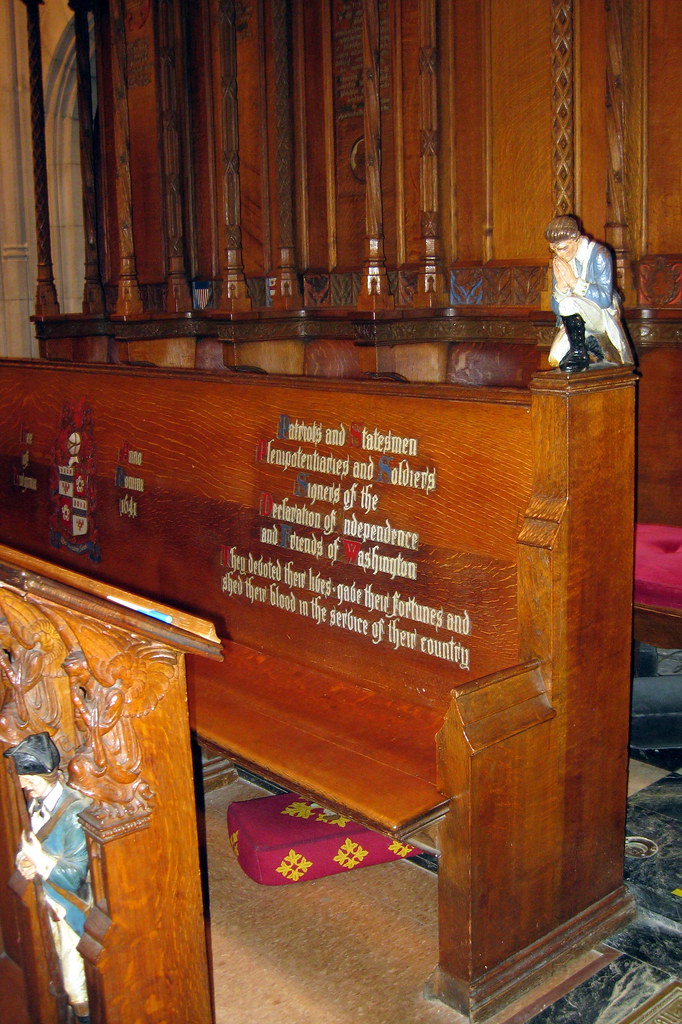
The details on the woodwork behind the choir stalls are especially remarkable. The choir is guarded by statuettes of soldiers in the uniforms that would have been seen in Valley Forge. I can't tell what's written below them, under the coats of arms.
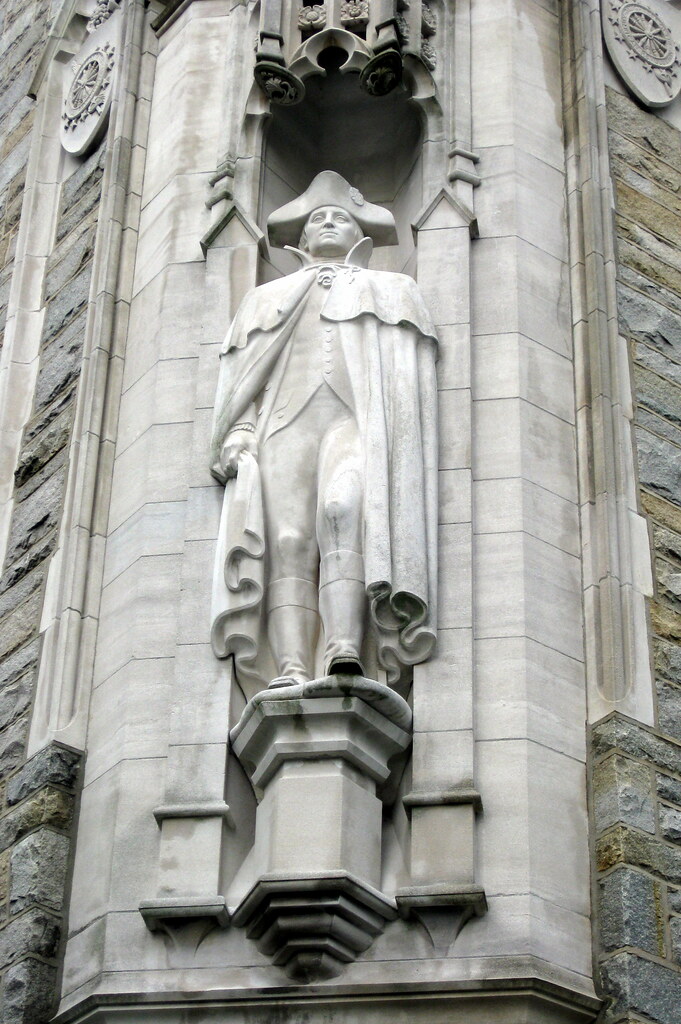
"Idols" of Washington:
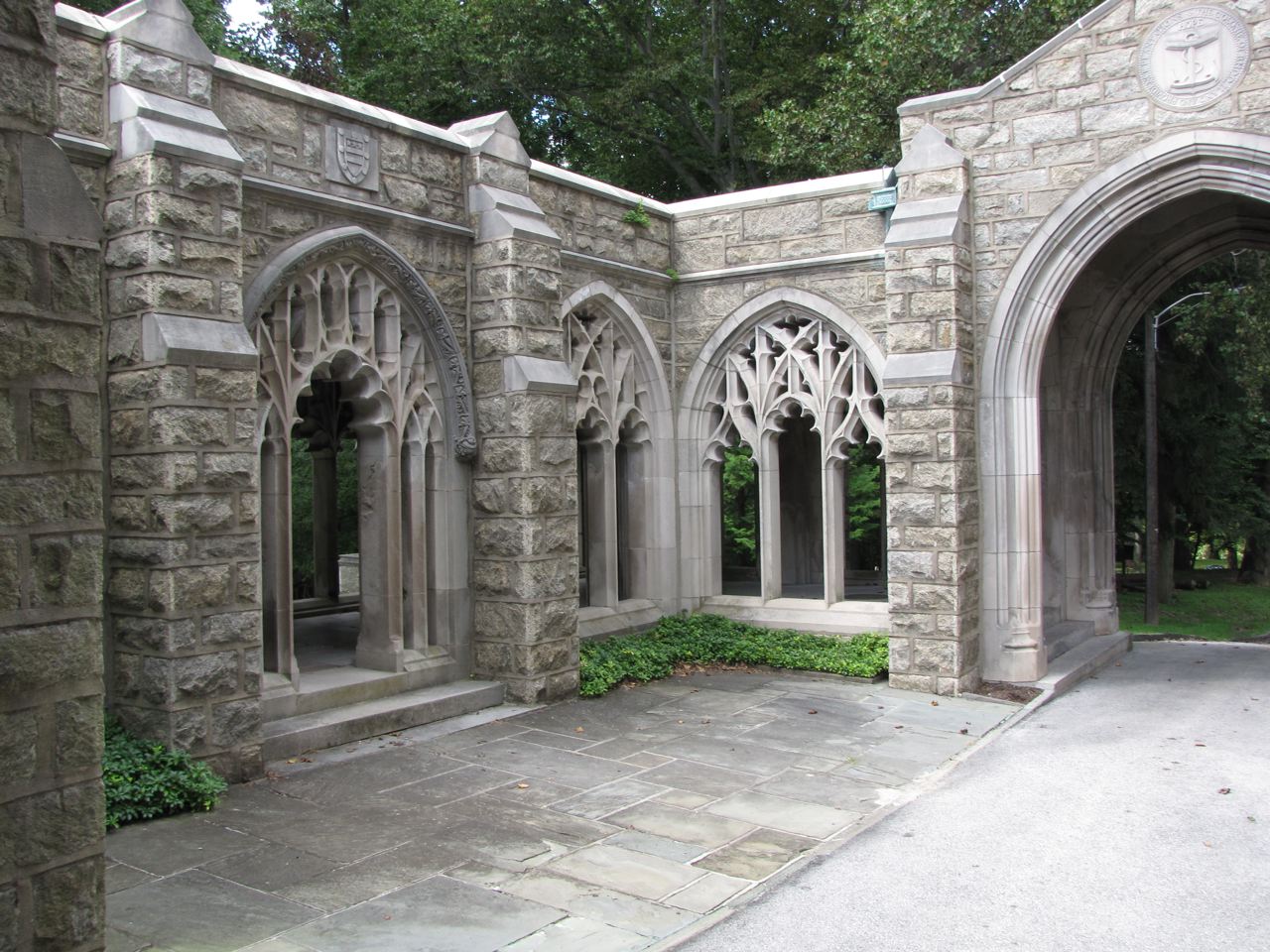
The chapel also sports a monk-less cloister:
Though a national shrine, there are many memorials for the foreign generals who trained the colonials at Valley Forge or otherwise fought in the war. This floor seal names Casimir Pulaski, a Polish noble who saved Washington's life and commanded one of only a few cavalry regiments in the entire Continental Army. He was mortally wounded in the Battle of Savannah and is one of only seven people to have ever been awarded "honorary American citizenship". Similar seals exist beside this one for the Marquis de Lafayette, the Comte de Rochambeau, and Baron von Steuben, among others (in case anyone forgot that the American Revolution was an international endeavor).
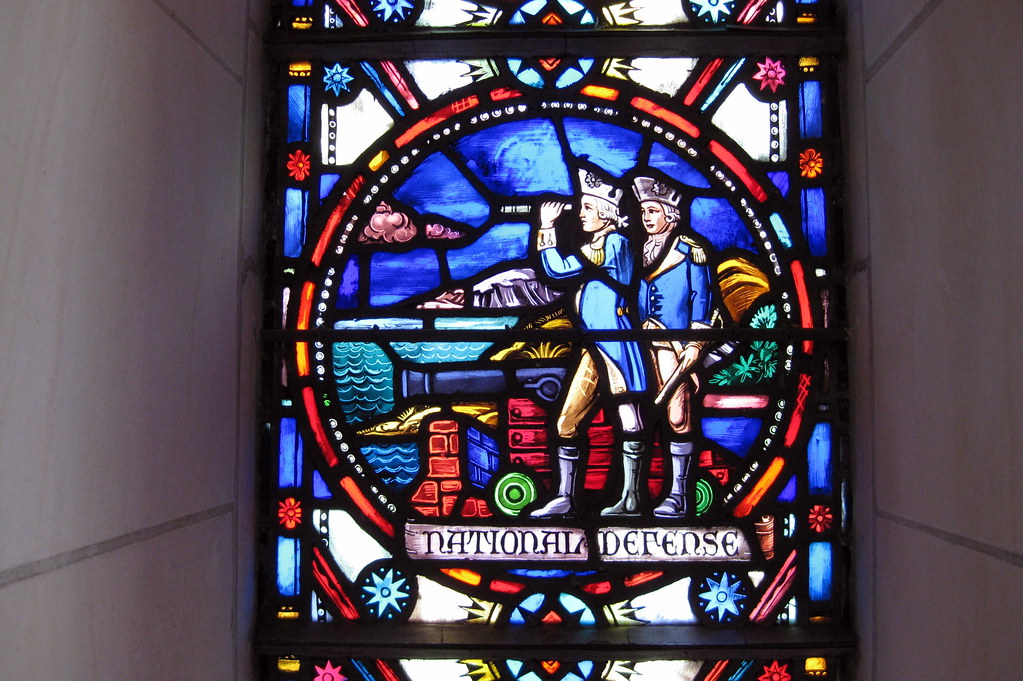
Detail of a stained-glass window in the "Patriot Tower".

The Washington Chapel is such a charming, Gothic edifice that it's no wonder it's a popular wedding destination. I'd get married there myself if it weren't Episcopal and wouldn't require an Episcopal's bank account to rent out. But as an experiment on conforming Americana to a romantic medieval aesthetic, I give it high marks. And for the skeptics out there, please be aware that the Gothic royal chapels of Europe (such as
Saint George's Chapel at Windsor Castle) are no less works of propaganda to boost the egos of their kingly patrons. By contrast, the Washington Chapel was built entirely by donations from private citizens. It was built upon the romanticism of the American citizenry; the same which allows fallen servicemen and women to be revered in this country more than any other in the world, and which raised up a thousand monuments in a post-war South. The phenomenon is not really so different from that which created so many saints by popular acclaim in the early medieval world, and that which built the great shrines of Santiago de Compostela and Thomas Becket from the offerings of pilgrims. With due respect to American canonized saints like John Neumann and Kateri Ketakwitha, they just don't occupy the same space in even a pious American Catholic's heart, much less an average American who has certainly never heard of them. For good or ill, our soldiers and generals are the closest thing we in the United States have to saints. And if the cult of the American warrior is not an example of modern medievalism, I don't know what is.