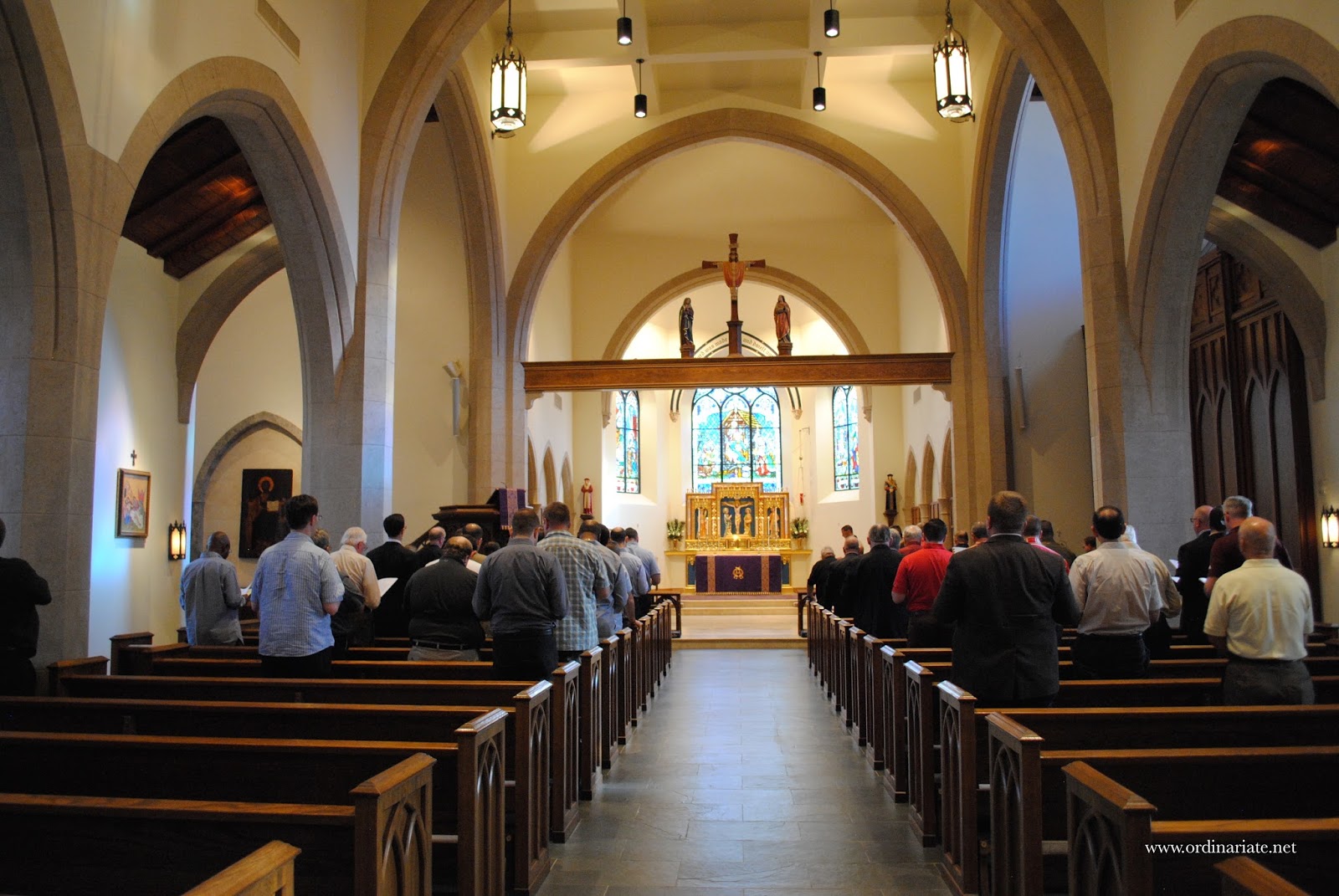
This upcoming Sunday (or, in the old Roman calendar and the BCP, last Sunday) is "Good Shepherd Sunday": the day on which the Gospel is read of Christ telling the Pharisees, "I am the Good Shepherd: and I know mine, and mine know me". It's fitting, then, that I took this week to visit a grand little neo-Gothic gem right along the main thoroughfare of the Main Line west of Philadelphia: the Church of the Good Shepherd, Rosemont.
Good Shepherd belongs to the Episcopal Diocese of Pennsylvania, but is of massive consequence to Roman Catholics for a few reasons. Unlike S. Clement's church in center city (which was originally built as a "preaching barn" and only later became a famous Anglo-Catholic shrine), Good Shepherd was built from day 1 to import the ideals of the Oxford Movement to these quiet Quaker suburbs. I'm connected to Good Shepherd by proxy in that, when I moved here from Texas a couple years ago, I happened to join the (Roman Catholic) Ordinariate parish here which received a former rector of Good Shepherd along with many members of his old flock. It's no surprise that, in the course of fellowshipping with parishioners, I hear a lot of stories about this place which they called home for decades. I've recently taken an interest in getting more familiar with the history of the Episcopal Church, especially the two parishes to which my fellow-parishioners belonged and their liturgical traditions--and since you can only learn so much by verbal accounts, I decided to introduce myself to the current rector of Good Shepherd by email and ask for a tour of the grounds, which he was very glad to do.

Before I share more pictures and commentary, it behooves me to give (as impartially as I can with my very limited knowledge of the subject), a brief introduction to Good Shepherd's history. The current building was raised during the 1890's as an admirable imitation of the English country churches of the 14th century. It's along the Main Line: the most affluent suburban region of greater Philadelphia. At the turn of the 20th century, Italian and other immigrant laborers who built the railroad out of the city set up Catholic parishes around here which, I'm sure, were packed with back-to-back low Masses around the clock in those days. Their employers, meanwhile, worshipped in more modestly sized congregations within finely appointed Protestant churches of near-invariably Gothic revival designs. The primary benefactor for Good Shepherd's building was Harry Banks French, president of a pharmaceutical company which exists now as the massive GlaxoSmithKline in London.
Good Shepherd was Anglo-Catholic not only liturgically, but socially. In other words, they knew you could have solemn high Mass every Sunday AND serve the poor and sick with no contradiction. Indeed, for them, the one naturally led to the other. In an age where railroad magnates and robber barons were dividing the world's wealth among themselves, it was the Anglo-Catholics--those who worshipped with the most splendid vestments, candlesticks, and other fineries of all--who issued a firm "no" to this culture of exploitation. Good Shepherd made waves for rejecting the system of pew rentals (yes, you were expected to pay for your seat back then) that other Protestant churches commonly used to keep the roof up. Even before the current building was up, Good Shepherd, living up to its name, started what was the only hospital on the Main Line at the time. I quote from a short history written by a fellow-parishioner:
"The Home and Hospital operated for fifty years. It took in children, both boys and girls, who needed extra care and attention and kept them until they were able to be on their own again. It was residential, and most of the children were not confined to their beds or even to the premises; they attended classes at the local public school less than a mile away. The Hospital was run by the Parish, but cooperation and involvement from other parishes were invited, as well as from the community at large."
When you drive by the church, as probably thousands of people do daily, you'll see its motto written out in Latin on a sign in testament to this legacy: non ministrari, sed ministrare ("not to be served, but to serve").
 |
| Fr Rutler as 7th rector of Good Shepherd |
In the 1970's, massive changes in the Episcopal Church at large came crashing down on Good Shepherd--which, by now, had been upholding the idea of the seven sacraments for a hundred years.
Fr George Rutler is now a famous Catholic priest for his appearances on EWTN, writing for Crisis magazine, and celebrating the traditional Latin Mass in New York City... but he got his start in ministry as the 7th rector of Good Shepherd, then the youngest rector in the whole Episcopal Church. Back then, Fr Rutler was one of the loudest voices in opposition to ordaining women. Not long after women's ordination was voted in, Fr Rutler left. He was subsequently ordained as a Catholic priest in the early '80s.
This pattern of catching the "Roman bug" was maintained by several other Episcopal priests who served at Good Shepherd in successive years. Another former rector, Fr Jeffrey Steenson, is well-known for having become the first Ordinary of the Personal Ordinariate of the Chair of St Peter (the predecessor of my current bishop, +Steven Lopes). The rector from 1991-2011, after a protracted legal battle with the Episcopal Diocese which is beyond me to summarize here, eventually entered the Ordinariate as a layman and remains a simple parishioner. One former curate is now pastor of
Mount Calvary, Baltimore: one of only a few Ordinariate parishes I know of which successfully managed to transfer their buildings from the Episcopal to the Catholic Church, along with rector and congregation. I also recently discovered that a curate in the early '90s left the Episcopal Church not for Catholicism, but Orthodoxy. He now serves as pastor of a western rite Orthodox parish in Maryland.
 |
| The Lady Chapel. The altarpiece was made by local liturgical artist Davis d'Ambly. The altar frontal is fabric from the famous Watts & Co, London. |
The current rector is Fr Montgomery: like myself, a total outsider to the controversies surrounding Good Shepherd. Despite my affiliation with the Ordinariate, he was quite willing to get to know me and give a tour of the property. When I arrived, it was just about time for Evening Prayer. It was a simple affair led by Fr M and assisted by a young fellow I met once before at a SCKM event--turns out he works nearby and so heads over to Good Shepherd on weekday afternoons like a dutiful parish clerk to ring the tower bell and assist with the evening Office. (My dream job, if ever I had one.) There was the Phos Hilaron, two psalms, a hymn sung to the tune of Vexilla Regis, the Mag and Nunc with antiphons, and a collect for St Monica. Since I was there, Fr M added a prayer intention for the Ordinariate towards the end.
 |
| Whether by coincidence or providence, this window in the chapel to St Monica stood out to me since it was her feast day. |
The three of us chatted a bit afterward and walked around so I could get a good feeling of the place. It was immediately apparent to me why anyone with Anglo-Catholic sentiments would have a hard time leaving the place: every stone and glimmering of light from the windows called out to the innermost depths of my English heritage and Sarum-ite, Puginquese spirituality. It's a place that's immortalized as a hymn tune in the 1940 Hymnal. The place made its mark on the Episcopal Church even as recently as the 1990's when it published the
Anglican Service Book: an adaptation of the 1979 BCP to restore traditional English and supplement the book with many Catholic additions like the Stations of the Cross, absolutions for the dead at Requiems, and importantly, the Roman Canon. The Anglican Service Book is wedged into the back of every pew at GS. As I made my way out, the rector kindly let me take a copy on an indefinite loan to study. My hope is to take everything I learned from this trip to help my parish preserve the best of their traditions.
 |
| The baptistery is in a separate chamber with its own roof. The lid over the font, which can be raised or lowered by a pulley, is exquisite. |
 |
| A double-desk in the chapel for reading the lessons. |
 |
| The base has a coat of arms for each person of the Trinity: Father, Son, and Holy Ghost. |
 |
| View from the nave. No architect in turn-of-the-century Philadelphia would have been asked to build a Catholic church in an arrangement like this with an elongated chancel and choir stalls.... yet this is the Catholic tradition, inherited from us to the Anglicans, and how it should be once again. |
 |
| The rood screen, which divides the nave from the chancel, was added some time after the parish's initial construction. May every Ordinariate parish some day have one of these! |
 |
| The Epistle-side choir stalls. Each coat of arms is from some Anglican institution or another (one is, I think, from the Royal School of Church Music). The canopy over the rector's stall was a late addition. |
 |
| The traditional Roman Rite supposes the three ministers of Mass all sit on a bench with no back. But the medieval English tradition was for them to sit in a sedilia, so recessed as to be entirely out of view of the people. It bears mentioning that, far as I know, solemn Mass with three ministers was the every-Sunday norm at Good Shepherd in reality, not just theory, for most of its history. |
 |
| The high altar. Note the great care given in the English Gothic tradition for covering the altar with a proper frontal, matching the liturgical color of the day. An uncovered altar is a nude altar. |
 |
| The sacristy table with the opening text of Psalm 42 in large print ("I will go unto the altar of God: even unto the God of my joy and gladness.") I'm happy to say we use these prayers at my parish. |
 |
| I asked Fr M to show me one of his favorite vestment sets. He pulled out this low Mass set for Requiems. As he put it back, he picked up a maniple that accidentally got on the floor which had a hanging scale embroidered on the base. "Just in case you didn't believe in the Last Judgment", he said. |
 |
| Old photo, maybe from the 1930's? Good Shepherd maintained a traditional boys' choir until relatively recently. |
 |
| View facing the front door and the street. |
 |
| This magnificent window above the portal was, I believe, commissioned in thanksgiving of victory after World War I. The archangels are accompanied by allegorical figures of Victory and Faith. |