
 |
| The Princes in the Tower, by Sir John Millais. |
With the earthly remains of England’s last Plantagenet king, Richard III, seemingly discovered underneath a parking lot in Leicester and discussions brewing on how or where to reinter them,
whether or not to have a state ceremony, we have a good opportunity to
re-evaluate the man’s legacy. Today, Richard III, or “Dickon” as some called
him, is known for usurping the crown and having his royal nephews imprisoned
and murdered in the Tower of London. Richard was then killed on the field of
battle at Bosworth, paving the way for his rival, Henry Tudor, to become
crowned Henry VII, founder of the Tudor dynasty. Henry declared Richard to
blame for the princes’ murders, and that was the end of the discussion.

The popular imagination on Richard has
been informed almost entirely by Shakespeare’s play, which depicts him as a
deformed hunchback with an insatiable thirst for acts of depravity. We can
forgive the bard for taking artistic license, as being a propaganda minister
for the Tudor dynasty was essentially in his job description. What’s more
awkward is the fact that Shakespeare’s main source of inspiration was a work by my patron saint,
Sir Thomas More, called The History of King Richard III (which you can read here). It was unfinished
and never published, but on the surface, is a scathing attack on Richard’s
brief reign. The History is definitely a product of the Renaissance: rather
than dryly retell facts (or “facts”) as medieval chroniclers were wont to do,
More revived a tradition of historiography founded by ancient Greeks and Romans
such as Thucydides and Sallust. In this tradition, a Thucydidian historian is
not concerned with presenting facts so much as he is with telling a moral
story: how a civilization decays, and how to avoid the mistakes of fallen
princes. It is as much drama as it is history, and the historian is expected to
put full-blown speeches in the characters’ mouths at the appropriate times.
In this, More is a master storyteller,
but it leaves the question of whether he intended it to be merely a story or
not. For if it were intended to be a true retelling of history, and Richard III
was not actually as bad a king as More suggests, then More was a Tudor
propagandist of the highest degree, and therefore a liar. Sadly, a lot of “Ricardian” historians
have, in fact, taken it upon themselves to absurdly slander the name of More in
defense of Richard. But there is a third possibility: that More’s History is a
satire. He was, after all, a master of wit, and his most famous book, Utopia,
is an excellent example of the genre. This argument is made in chapter 12 of
Jeremy Potter’s book, Good King Richard?: More Myth-making. Check it out here. It's definitely worth a read.
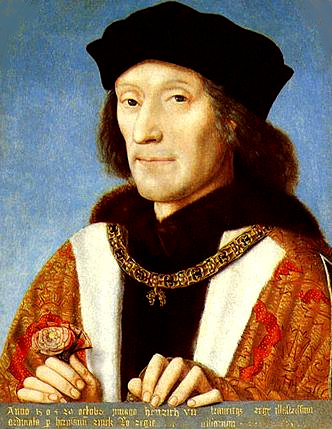 |
| Henry VII, a royal jerk. |
The points are these: first, that More
had no reason to hate Richard. He was only seven years old during the Battle of
Bosworth. In fact, Richard was known for his fairness in law even well into the
Tudor years, and More, as a lawyer during the time he wrote the History, would
no doubt have recognized that. On the contrary, More had a very good reason to
despise Henry VII. In 1504, More was elected to Parliament. The same year, he
led the opposition to one of King Henry’s bills which called for even more
oppressive taxation. The bill didn’t pass, so Henry, in a fit of spite, sent
More’s father, Sir John, to the Tower. More bailed his dad out for 100 pounds
(which would be more like a hundred grand in today’s terms) and was expelled
from Parliament until Henry VII’s death, so More wasn’t going to forget that
anytime soon.
At the point where More would have to
start writing at length about Henry VII’s deeds, he abandoned the work and left
it unpublished. But the acts of tyranny that More placed on Richard III’s
shoulders could easily be put on Henry as well. Potter argues that the History,
in fact, makes Richard a safe stand-in for Henry. In any case, the whole
History is an attack on tyranny itself, regardless of whether it comes from
Plantagenet or Tudor hands. The most interesting observation I’ve seen so far
about More’s History comes from this essay by Gerard Wegemer. He points out
that no person in the city of London is called by More a “subject”. He
invariably refers to them as “citizens” or “the people”. He refers to the
aldermen of London as the “senate”, states that Parliament’s “authority in
England is supreme and absolute”, and stresses how Richard needed to gain the
support of the citizens of London because he required their consent to
legitimately rule. I couldn’t stress enough how opposed this line of thought is
to the entire Tudor line’s record of wholesale oppression and top-down authoritarian
decrees. I suspect that when Henry VII’s mad son finally sent More to the
chopping block, More was relieved to be free of the Tudor kings’ lunacies once
and for all.
 |
| The Battle of Bosworth |
As for what to do with Richard III’s
remains, now that we (probably) have them… some Englishmen are saying he should
be given a state burial at Westminster Abbey! Others, such as this blogger, say
that as a Yorkist, he should be buried in the north at Leicester Cathedral.
Though he was a king, perhaps even a decent one in some ways, I’m not sure he
deserves a state funeral. Even if we could prove that Richard didn’t murder the
princes in the Tower, they were still his responsibility to protect. Children,
especially princes of royal blood, don’t just disappear from the Tower of
London. And Richard didn’t do much to deny his involvement in their
disappearance, either.
What he does deserve, more than honors
or scorn, is prayer. Richard’s body, after Bosworth, was originally taken in by
some Franciscan friars and interred in one of their crypts. A perfect example
of Christian mercy for a disgraced man. Here's something that none of the columnists and commenters have pointed out so far: Richard Plantagenet
died in the faith of the Roman Church. It would be fitting if, rather than be
taken in by Anglicans of any sort, his body were given to the care of some
modern Franciscans or other monks and reinterred with a traditional Requiem
Mass for the repose of his soul. In fact, I’m going to write to a number of
Latin Mass communities in England and see if I can get a petition going.
 |
| Illustration of a Requiem Mass by Augustus Pugin. |
And just for fun, watch this clip from the 1995 movie adaptation of Shakespeare's Richard III, set in a 1930's fascist Britain. Watch out for what McKellen's Richard says when his Jeep gets stuck.
