Showing posts with label Pope Francis. Show all posts

Monday, March 20, 2017

Thought experiment: married "simplex" priests to strengthen the celibate clergy

What did Pope Francis say this time?

I was particularly ruminating on this during the recently past feast of Saint Patrick: a bishop who was born to a clerical family, his father having been a deacon and his grandfather a priest (a fact which is curiously omitted from Patrick's biography in the 1913 Catholic Encyclopedia). The latest papal kerfluffle was over the Pope's answers to some questions in an interview in the German newspaper Die Zeit. To quote a CNS article:
He was also asked about the possibility of allowing married "viri probati" -- men of proven virtue -- to become priests.
"We have to study whether 'viri probati' are a possibility. We then also need to determine which tasks they could take on, such as in remote communities, for example," Pope Francis said.
The remarks caused enough waves that I even overheard the kind old ladies who come to my workplace to knit once a week talk about it! Of course, there was no discussion on what Pope Francis meant by the phrase viri probati. (That would be "proven men", presumably of advanced age and known piety such as older married deacons, who would be ordained as supply priests to help the established clergy.) In most people's imaginations, whether they're for or against it, any talk of opening the priesthood to married men is taken to mean that seminaries will soon be flooded with young newlywed guys. That may well be the fate of the old Latin discipline by the end of my natural lifetime, but in the spirit of my blog's tagline, "Applying old-world solutions to new-world problems", you dear readers will indulge me in the following thought experiment about a model of priesthood which has passed into obscurity but may find renewed usefulness in the not-too-distant future....

First, I tack on my disclaimer that, of course, as "there are those who make themselves eunuchs for the kingdom of heaven's sake", the path of celibacy is a higher calling than that of marriage. Obligatory celibacy for priests has been a part of the Latin tradition for a thousand years. Even the so-called "Anglican" Personal Ordinariate of the Chair of St Peter to which I belong, which uniquely relies on a mostly married presbyterate of former Anglican clerics, still affirms that the model of celibate priests formed in the traditional seminary system is preferred. The Ordinariate places high hopes on its four traditional seminarians (one of whom is a longtime friend of mine), and so do I. 

Now with that out of the way....


There are two kinds of arguments against the use of married priests: spiritual and pragmatic. People in the first camp pride themselves on the idea that the priest, as an alter Christus, is "married" to the Church as our Lord and living more closely to the ideal of celibacy as proposed by St Paul. There is simply no room for the idea of married priests in this ecclesiology--indeed, many people in this camp have a visceral reaction against the idea of a married man, especially one who may still be sexually active, in celebrating Mass or administering the holy Eucharist. A few traditionalists might be so repulsed by the idea that they'd rather attend a diocesan Ordinary Form Mass or drive to a traditional Latin Mass in another state, rather than attend a Latin Mass celebrated by a married priest. For these folks, no argument suffices, and I don't bother convincing them otherwise.

The pragmatists are the sort who question the applicability of married priests, not the idea in principle. They ask, "how do we pay for them and their families? Will we need to renovate the rectories to accommodate family life? How can a priest be attentive to his wife, children, and needs of his flock all at once? What about the psychological affects of being raised as a PK [pastor's kid]?" concerns are alleviated easily enough by rediscovering what being ordained as a priest exactly entailed during the medieval centuries of the Church. In short: simplex priests.

A sacerdos simplex is a priest who is ordained for celebrating Mass, and little else (beyond the usual obligation of praying the Divine Office). No confessions, no preaching, no pastorships of parishes. To be "simplex" is to exercise only the core of the presbyteral ministry, which is offering the holy sacrifice of the Mass. The rest, while certainly integral to the priest's mission on earth, is not essential to it. Imagine if, in large parishes that stretch their priests thin, the bishop says to the pastor: 

"I want you to approach your deacons and your three most devout, older laymen (no younger than 45) and ask them if they'd be willing to apprentice under you for three years and then be ordained priests. Their sole duties, other than praying the Office, would be celebrating Masses that you can't cover yourself, helping distribute Communion, and bringing Communion to the sick. Other things such as teaching catechism are up to them, but they can't hear confessions except in danger of death, and they won't perform baptisms or weddings unless you specifically delegate them. They can only preach if they were already formed as deacons beforehand. Finally, they do this service only for love of God, with no expectation of income."

In a stroke, these simplex priests, some of whom are perhaps married, will have already resolved all the pragmatists' objections:

  • They're mature in both age and faith, and if they're married, their children are older or out of the house
  • They serve at no expense to the faithful; no salary, no housing, no retirement pension or other benefits needed because, like deacons, they're expected to maintain their own income and (if necessary) secular employment
  • They have a shorter course of study under their pastor, as most priests did before the arrival of the seminary system after Trent--again, at no cost to the faithful

In exchange, we could reap the following benefits:
  • Many more priests to celebrate Mass in "non-priority areas", especially in remote rural parishes or near-abandoned urban parishes, or in chaplaincies for the neglected like prisons and hospitals
  • More priests to offer Sunday Mass at the parishes (especially early and late Masses) so that pastors only have to celebrate the principal Sunday Mass; thus keeping to the traditional rule whereby priests are only supposed to celebrate Mass once per day (there used to be an indult required for "binating" or "trinating", meaning offering Mass twice or three times a day)
  • More priests around to distribute holy Communion, thereby reducing the need for lay extraordinary ministers
  • More priests to deliver holy Communion to the sick, in place of lay ministers
  • More priests to lead hours of the Divine Office
  • More priests to offer personal instruction to catechumens, as was common prior to Vatican II
  • On an as-needed basis, pastors can delegate baptisms and weddings to simplex priests to free time for themselves

With simplex priests helping out much the same way auxiliary bishops assist the diocesan bishop, the celibate, beneficed ("full time") pastors and curates would then have a lot more free time to hear confessions, make visits to parishioners' homes, get to know more of their flock one-on-one, and perhaps most importantly, devote themselves more fully to the Divine Office and regular prayer. Everyone wins.

If you think me crazy for saying for proposing such a wacky ecclesiology, just consider that even today, every priest is "simplex" at least on the first day of his ordination. Unlike bishops who are all inherently "the Bishop of So-and-so place", no priest is guaranteed a parish assignment; in the old days, most priests never even made it to "pastor". Priests still require faculties for confession--they can't just hear someone's confession at will, and if they hop over to the neighboring diocese, they still need that local bishop's permission in writing before hearing someone's confession there (as well as to celebrate Mass). Priests need permission from the pastor or rector of any church before officiating a baptism or wedding there. There's really little that a priest is allowed to do on his own except hear the confession of someone in grave danger of death (in that case alone, even an excommunicated priest is given faculties). Until the 1983 Code of Canon Law, priests even needed faculties to preach.

We also have a fairly recent example of a (religious, not married) simplex priest on the path to canonization: the Venerable Solanus Casey, OFM Cap (1870-1957). The Archbishop of Milwaukee ordained Casey as a simplex priest because of he found Latin and other academic disciplines of the seminary system too challenging.

The Ven. Solanus Casey above.
As vocations in the mainstream Church continue to hemorrhage, the existing body of diocesan priests will be stretched further and further. Some priests are already pastors of three or four parishes, all which formerly had three or four assisting curates each. In such conditions, they have little time to really see to the needs of the faithful in their care, or even, critically, their own souls through prayer and private reflection. The whole Church then suffers from poor ministry.

And before someone points to the large number of men applying to places like the FSSP's Our Lady of Guadalupe Seminary (a fine institution which two friends of mine attend).... while it's certainly true that vocations to certain traditional seminaries such as those of the FSSP or Institute of Christ the King are faring much better, these are still single institutions that must serve the needs of entire continents. The fruits of their labor remain out of reach in most places, even in most major metropolitan centers. There are still many communities that haven't yielded a single priest despite celebrating the old rites exclusively for five or ten years at a time. By contrast, your average pre-conciliar parish yielded one or two seminarians per year. Considering that some saints have written that God calls as many a third of the general Catholic population to clerical or religious life, I'd say even "traddies" have a shortage of vocations.

To close, I'm certainly not suggesting that my suggestion for ordaining simplex priests be rolled out during this tumultuous pontificate (not that anyone from the Vatican is reading my blog, anyway). I believe we'll have to wait for the vocational winter to truly hit us over the course of the next 15 or 20 years as the last remnants of the big vocation boom of the 1950's and early '60s retire and die out. Once the diocesan structures enter a total freefall and the existing diocesan clergy begin to burn out in record numbers, I'll dust off this old blog entry and see if anyone bites. That said, if my dismal forecast of the future state of vocations is completely off-base and there's a renaissance with four or five unmarried, full-time priests staffing each parish once again, I'll very gladly accept being wrong.

(For the record, I would not seek to become a simplex priest, even if asked. That's definitely not my calling.)

Thursday, April 2, 2015

The mandatum: Maundy Thursday and stinky feet

The kings of medieval Europe washing the feet of beggars
It's another Maundy Thursday, the first day of the Easter Triduum: it's a busy day, with the consecration of holy oils for the upcoming year by the bishop at his cathedral, the washing of feet in remembrance of Christ's new commandment ("to love one another as I have loved you"), and most importantly, to commemorate the last supper, the first Mass, on the night He was betrayed.

Maundy Thursday also means another slew of pictures of Pope Francis washing random marginalized people's feet to the fawning of his fans and eye-rolling of a tiny minority of skeptics also called traditionalists. This year, as usual, the Vatican announced well in advance that the Pope will be celebrating the Mass of the Last Supper at a prison and washing the feet of inmates. We can expect, based on previous publicity stunts in the reign of Francis, that the selection of people to be washed may include a Muslim or two.

The New Liturgical Movement just posted an article to let Catholics know that the rubrics of the modern Roman Mass make the mandatum, the rite of foot-washing, merely an option; but if it is to be used, the people to be washed must be male. It's all quite sound from a legal point of view. The article is completely correct: at the Mass of the Last Supper, only men's feet can be washed. But there's an elephant in the room: the fact that Pope Francis himself has washed women's feet on this day in the past, and has even made quite a media spectacle of it. Some apologists point out that, since Francis is the Pope, he's above the law and can do whatever he wants in the liturgy, including washing women's or Muslims' feet. Again, strictly speaking, that's true... though since he was also known to wash women's feet during his time as archbishop of Buenos Aires, while he was still fully subject to liturgical law, this entire line of argument reeks of the papal positivism; the "because he's the pope" mentality that's permeated the faith for well over a century.

The mandatum, Francis-style.
Back when I was a Seventh-day Adventist, our church, a few times a year (not Maundy Thursday), though it wasn't big on ceremonies of any kind, practiced foot-washing. Basically, a bunch of buckets were distributed, and everyone washed everyone else's feet. It wasn't just a ceremonial pouring of water, though. No, we had to get between the toes and everything. When I became a Catholic, the foot-washing rite during Maundy Thursday was something I could readily identify with. It signified to me that Catholic priests, too, were willing to bend the knee to others and show that they were ready to serve their flock, not just rule their souls. This is why the rite on Maundy Thursday is called the mandatum. Traditionally, as the priest goes to wash the first foot, the choir sings an antiphon from John's gospel: Mandatum novum do vobis ut diligatis invicem sicut dilexi vos. "A new commandment I give unto you, that ye love one another; as I have loved you." The mandatum, the commandment, is even how this day came to be called "Maundy".

Up until yesterday, I actually never thought much about the liturgical law which restricts it to men. When I first became Catholic, I learned that twelve men are chosen to represent the twelve Apostles whom Christ ordained that day as the first priests of the Church. Since only Catholic men can become priests, Pope Francis's spectacle of washing the feet of women or non-believers seemed to be a deliberate subversion of the traditional understanding.

The mandatum in the Benedict XVI era, at Saint John Lateran.
But then, in the course of my usual readings of liturgical history, I discovered that the mandatum wasn't even performed during the Mass of the Last Supper until 1950.

At that point, I came to the conclusion that all talk of what is or isn't "traditional" bears much closer investigation before issuing a verdict on the curious case of Pope Francis. I haven't been able to learn a whole lot more since then, but here's what I've been able to piece together so far:

1.) The practice of foot-washing is ancient, predating Christ to time immemorial. The first reference to it in Scripture is a mention of Abraham offering to wash the feet of the three wayfarers in Genesis 18. In a middle Eastern and Mediterranean culture, people typically wore sandals and gathered dust over their bare feet every day. The foot-washing was part of an ancient rite of hospitality, an aspect which is perhaps lost on northerners and moderns whose feet are enclosed in shoes or boots. Furthermore, the Rule of Saint Benedict, first written in the 6th century, ordered monks to receive all guests by washing their feet, as well as pouring water over their hands.

2.) Nonetheless, the rite of the mandatum wasn't always a part of Maundy Thursday ceremonies. Saint Augustine's letters suggest it wasn't universally accepted in his day. In Spain, though, the third set of canons of the Seventeenth Council of Toledo (A.D. 694) mandate its use everywhere on pain of excommunication: "Since Our Lord has not disdained to wash the feet of His disciples, why should we refuse to emulate the example He gives us? It now happens that, partly from slackness, partly from custom, in sundry churches the priests no longer wash the feet of the brethren on Maundy Thursday."

3.) The mandatum had come into use in Rome itself by the 7th century, where the Roman Ordo in Coena Domini instructs the pope to wash the feet of his attendants; though not, it seems, during Mass itself. The next mention of the mandatum among Roman sources doesn't come up again until Roman Ordo 11, dating to the 12th century. There, the pope has two ceremonies: one in public, where he washes the feet of his subdeacons... and one in private, in his apartments, where he washes the feet of thirteen poor men. It seems the medieval popes wanted to cover both bases: the sacerdotal and the servile.

4.) In imitation of the popes and archbishops, the medieval kings of Europe also washed the feet of the poor on Maundy Thursday. Saint Elizabeth of Hungary was known to wash the feet of twelve lepers. Until the 20th century, the kings and queens of Spain washed the feet of twelve poor men and twelve poor women, respectively, every year after Maundy Thursday Mass in the royal chapel. All were also provided with new clothes. James Monti's The Week of Salvation relates one story: when Queen Isabella II's diamond bracelet fell from her arm into the water, the woman being washed reached down to give it back to her, but the queen said, "keep it, mia hija; it is your luck."

Maundy money in Elizabeth II's reign
5.) The kings of Great Britain still practice the "royal Maundy" service to this day, where alms in the form of specially coined "Maundy money" are still given out; though the footwashing itself fell out of practice after the last Catholic king of England, James II, was overthrown. His successor, the Protestant William III, apparently wasn't much for smelly feet. William eventually stopped showing up to the services altogether, passing it on to the royal almoner. It was only in the 20th century, with George VI (Queen Elizabeth II's father), that the kings began to personally participate in the Royal maundies again.

6.) What about at the local parish? It seems that having a mandatum (in its own rite, apart from Mass) was widespread in the Middle Ages, but gradually waned through the Counter-Reformation (the 16th century) until, by the 20th century, it was dead (though still on the books as an official Holy Week rite).

7.) With the 1950-1955 Holy Week reforms, the mandatum was inserted into the Mass of the Last Supper itself, giving it more prominence than ever before.

And now, here we are, back in the 21st century. What did that romp through history tell us? First, while the washing of feet is a powerful sign of Christ's ordaining the first priests, that's not the original reason. We can call that a legitimate development, but the association of the mandatum with the poor has been there since its introduction. Second, including the mandatum into the Mass itself opens the rite up to a sort of criticism that wouldn't otherwise exist. The Mass of the Last Supper is bound up with the institution of the first Mass, and that significance is arguably lessened by merging it with the mandatum of the poor.

Still, omitting the mandatum entirely just to avoid the politics around excluding women at Mass is, in my mind, a case of throwing the baby out with the bathwater, just as with the omission of the kiss of peace (which I described in another article earlier this week). Traditionalists may think they're tainted with touchy-feely sentimentalism; and they are; but they're also venerable signs of what it means to be a Christian.

Father Sean Finnegan left an interesting comment on the New Liturgical Movement article I linked you to at the beginning of the post. He wrote,
"I have recently taken over a parish where washing women's feet is routinely done. So I have decided to try delving into liturgical history. In the Sarum Use, the Mandatum took place at lunch (after the Solemn Mass in those days, of course), with the High Priestly Prayer of our Lord being read. Not only would the 'presider' wash others' feet, but all would participate, washing and being washed. Finally, a loving cup was shared. I am going to try that here this year: we will have an 'agape' simple meal in the evening, long enough before the Mass to observe the liturgical fast. We will all, men and women, wash each others' feet, and share a loving cup as the account of the Last Supper is read from St John's Gospel. Then, at the Mass of the Lord's Supper, we will omit the Mandatum entirely, as the rubrics permit. Hopefully, this way everyone will be happy."
(For more info, Father Finnegan has a blog article from 2009 detailing the Sarum mandatum rite here. Like many other rites in the Sarum Missal, it was written with cathedral usage in mind and assumes that one has a chapter house.)

That seems like the perfect resolution to the problem, and I wish something like it was offered here in my city. If I can find the text of the Sarum Use's ceremony, or even the pre-1955 Roman ceremony of the mandatum outside of Mass, I'll share it with you.


All articles in my Holy Week 2015 series, short and long


The kiss of peace (for Spy Wednesday)


Terra tremuit! (the Offertory antiphon of Easter Sunday)

Wednesday, July 31, 2013

The Gothic Revival in India (and other thoughts)

Other thoughts first. Apologies for the tangent:


There's nothing like a flurry of pope-related news to remind me that I have a blog to maintain! The crowd gathered for Pope Francis's World Youth Day in Brazil already surpassed the crowds for Benedict XVI's in every year of his whole pontificate. While it's true that the mass media is heavily invested in creating a bite-sized narrative of Benedict as a big bad Nazi reactionary with Francis as a champion of humility, the poor and non-whites, most of the Catholic blogosphere appears equally ridiculous in trying to paint the two as being practically the same guy. Let's face it: Benedict was a lot harder to love than the ever-avuncular, "call me Jorge" Francis. His vision of the Christian church (disregarding a few over-educated young fogeys like you and me, perhaps) was a lot less appealing to the tastes of the modern world.

Now, don't get me wrong. I'm glad to see that in the year 2013, there are three million people in my age group who are willing to fly across the world to see the vicar of Christ, even if only a glimpse of him in the distance. By contrast, I can barely muster the strength to get up on a Sunday morning. I don't doubt most of the folks who showed up to World Youth Day are more faithful than I am. But it's mighty awkward to run a blog called Modern Medievalism when one of the last vestiges of that age, the pope, believes that the idea of being a father of kings, a patron of the arts and sciences, and champion of western civilization is not just something to put on the backburner (that, I could understand), but absolutely inimical to his office. For all his supposed inclusiveness and internationalism, Francis has a bizarre habit of putting beautiful liturgy and social justice or love of the poor at odds with each other. No doubt he would fail to see the point behind most of the articles I've posted here and dismiss the topics as quaint anachronisms, rather than things to be loved and restored. And while I fully realize that the pope has a near-zero impact on the course of my everyday life, I must admit that his election, among other things, has still managed to put me in a spiritual malaise. What else could one feel when faced with the thought that if he were somehow granted an audience with the pope himself and related the reasons for his conversion, the pope would probably just shrug his shoulders and say "that's nice"?

All this to say that this is why I haven't posted lately. I've spent the better part of the summer retreating to the strictly "modern" side of my interests, namely gaming. In fact, I'm making plans to start a new blog for PC game reviews and such, but I'll do my best to not let that interfere with my activities here. I haven't given up on you dear readers yet, assuming you're still out there.


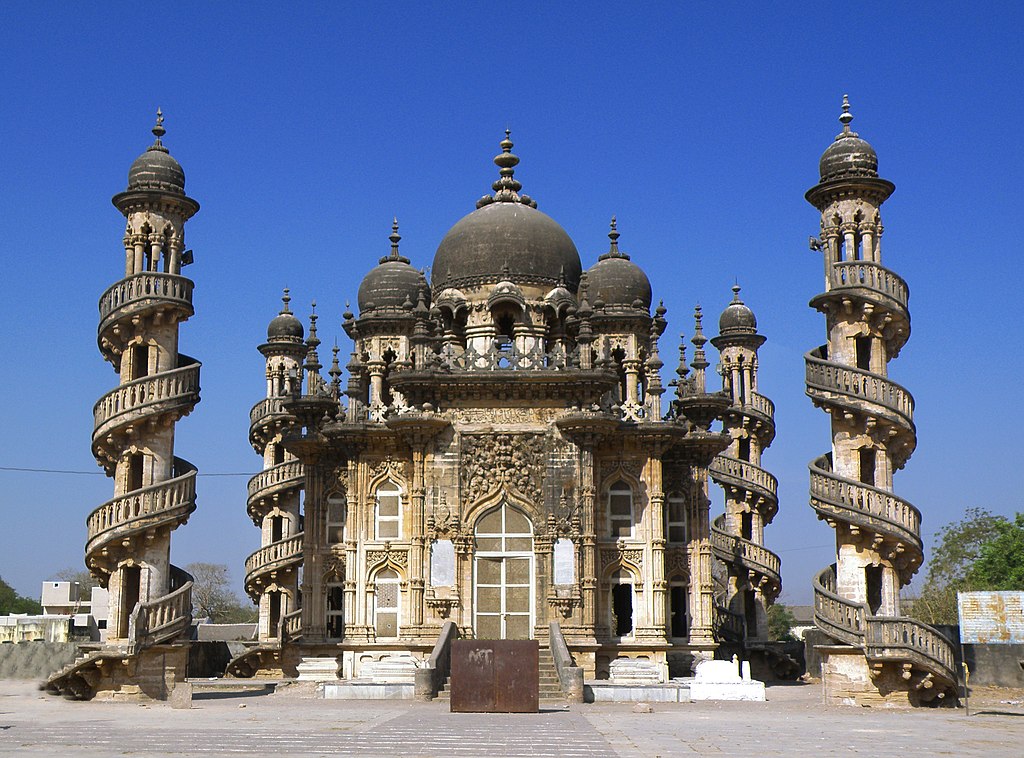
Now, to the meat of today's post. Despite my love of the west's medieval art and architecture, I have an intercontinental heritage. The achievements of imperial China, Japan, and Indonesia (my mum's home country) have not escaped my study by any means. Indeed, there's almost nothing I enjoy more than seeing the West and East come together in harmony. I therefore share with you some photos of Indo-Saracenic architecture, also sometimes called Indo-Gothic or Hindu Gothic. We have the British Raj to thank for bringing the Gothic revival to the valleys of India. That's not to say that the synthesis of Gothic with traditional Mughal architecture was wholly peaceful. After the rebellion of 1857, the Brits smashed quite a bit of the old Red Fort for no good reason. But in the aftermath, British architects sought to blend the Gothic revival (along with other European styles) with Mughal to harmonize the transition and legitimize their reign. Here are some examples:

Mohabbat Maqbara Palace, Junagadh (a mausolem)

Municipal Corporation Building, Mumbai (Bombay).

Mysore Palace. I believe it may still be an official residence of the maharajas of Mysore.


Velankanni Matha church. Designated a basilica by Pope John XXIII.


Lahore Museum (Pakistan)