Showing posts with label medievalism. Show all posts

Wednesday, March 11, 2015

In defense of indulgences, the buying thereof, and pardoners – and a resolution to restore such disciplines formerly held in disrepute

by J.T.M.G.


[We are all entitled to a little cheekiness, no?]

After putting our daughter to bed, Madame and I had a convivial time with a longtime friend, now a seminarian of the diocese, at the local public house Saturday evening last. (For those of delicate dispositions who might be given to scandal at any suggestions of merriment within the forty days of Lent, I remind them that the liturgical Sunday begins after First Vespers of Saturday evening.) Thereupon we resolved many pressing questions on matters theological and ecclesiastical, and a series of decrees will surely be posted on the Holy See’s website with all due haste, pending the papal rubber-stamp.

For today’s blog, I only bring up one brief remembrance of the conversation, wherein Madame asked, “one of the conditions for gaining a plenary indulgence is to pray for the Pope’s intentions. But what if the Pope’s intentions are evil?” My seminarian friend assured her that this prescription applies only to those intentions that are good. And, I lately discovered that modern technology now allows us to know exactly what those intentions are. The Holy See publishes the Pope’s monthly intentions for the year. We may, therefore, know that the two intentions for this month of March are “that those involved in scientific research may serve the well-being of the whole human person” and “that the unique contribution of women to the life of the Church may be recognized always”; and that our consciences may rest assured that God will transfer our prayers to more fruitful ends if, in fact, He prefers scientists to exploit creation at our expense, or for the state of womanhood to perpetually remain a thankless mode of existence.


What are indulgences for, anyway?

Heaven and earth shall pass away,
but political cartoons shall never pass away.
In grade school, we’re taught that the big, bad medieval Church got it in their heads to sell forgiveness of sins for six shillings to pay for their banquets of chestnuts and other such worthy expenditures. As Dr. Luther infamously attributed to Friar Tetzel, “As soon as the gold in the casket rings / The rescued soul to heaven springs”. This becomes doubly confusing for those of us who grew up under the Protestant rhetoric (which our European cousins probably believe has passed into the ages of myth, though it persists quite alive and well in various parts of the States) who know that papists indulge in every sort of vice and debauchery, with the full intent to confess it in church in the morning and do it all over again the next weekend. It’s a wonder no one in grade school or Protestant Sunday school ever asks: “why do the Romish whores even bother to buy indulgences if confession is free?” (One can deduce that confession is free, or else the weekly regimen of sin-confess-repeat would grow to be a monstrously expensive habit.) After all, even the 1-percenters among us would willingly undergo a full audit from the IRS every year if it meant they would never actually have to pay any taxes at the end.


The answer to the indulgence question is simple: the Catholic catechism teaches us that sin incurs two consequences from God, eternal and temporal. The punishment for mortal sin without any repentance at one’s final hour is eternal damnation. The sacrament of penance (or reconciliation, or confession; or, as the Modern Medievalist likes to say, “shriving”) lifts the sentence of damnation, but there yet remains the temporal consequence, an impurity of the soul which is washed either by acts of penance while still living on earth, or after death in purgatory. Everyone who goes to purgatory is saved, for they will all eventually pass through the pearly gates, though it’s traditionally understood to be rather less pleasant than the direct route. Of course, the expressway to heaven is fraught with its own inconveniences, such as dying immediately after baptism or while still a child, having one’s head severed by an ISIS thug with a boxcutter, or worst of all, having to die of old age while hashing out a life of heroic sanctity every day for decades on end. For the rest of us, purgatory it is. From the Latin word purgare, meaning “to purify” or “to purge”, purgatory is the name that the medievals gave to that place, or perhaps state, where souls that are not yet ready to fully withstand and partake in the Beatific Vision undergo penance for sins that they failed to make full satisfaction for during life.


I don't suppose EA will consider making this a trilogy...
The “true Christian” here will be quick to pounce with their Scriptural prooftext of choice about Christ’s sacrifice being sufficient for all mankind. The skeptic says the whole business of Christian redemption, whether Protestant or Catholic, is absurd if mass murderers (Hitler is a favorite in these sorts of discussions, but substitute Mao or George W. Bush as your politics dictate) can go on doing their dirty deeds and then go to heaven merely by professing faith in the Savior on their deathbeds. But the Catholic (and the Eastern Orthodox, though they use different terms) knows that, even if the mass murderer in question makes a sincere confession at the last rites, a life so conditioned to sin won’t find eternity with God as a humble servant of the divine will quite as thrilling as the satisfaction of knowing he could order the deaths of a thousand hapless subjects at random before breakfast. No, even we less ambitious sinners are conditioned to imagine heaven as a place where we all wear white robes and play the harp with naked babies, singing the same words of praise over and over again for all time. Quaint. Boring. There’s a reason why we can make a video game about Dante’s Inferno, while Paradiso ignored by all but graduate-level literature students.

So Saint Catherine of Genoa said, as medieval Italian mystics are wont to do,
“As for paradise, God has placed no doors there. Whoever wishes to enter, does so. All-merciful God stands there with His arms open, waiting to receive us into His glory. I also see, however, that the divine presence is so pure and light-filled – much more than we can imagine – that the soul that has but the slightest imperfection would rather throw itself into a thousand hells than appear thus before the divine presence. Tongue cannot express nor heart understand the full meaning of purgatory, which the soul willingly accepts as a mercy the realization that that suffering is of no importance compared to the removal of the impediment of sin.” (Treatise on Purgatory)

No, heaven is no place for us complicated folk with all our baggage about what ought to make a satisfying afterlife. And so, the Church, even in ancient times, understood that there was an intermediary condition of purifying the soul. As Saint Paul wrote,

“Now if any man build upon this foundation gold, silver, precious stones, wood, hay, stubble; Every man’s work shall be made manifest: for they shall declare it, because it shall be revealed by fire; and the fire shall try every man’s work of what sort it is. If any man’s work abide which he hath built thereupon, he shall receive a reward. If any man’s work shall be burned, he shall suffer loss: but he himself shall be saved; yet so as by fire.” (I Corinthians 3:11:15)

 
Dante's Purgatorio


Where did indulgences come from? A brief sketch

Exactly what happens in purgatory has long been a province of speculation for theologians, but somewhere along the way, the Church developed the idea that “time in purgatory”, or the degree of purifying to be endured there, could be docked down by doing penance or other pious actions here on earth. The early Church was already quite accustomed to performing massive amounts of penance that would be extreme by modern standards. Imagine confessing to masturbation and then being barred from receiving Communion for seven years. Nonetheless, these penances were imposed after confession, and not as a condition before being absolved of sin. The ancient Roman penitent who died one year into his penance wasn’t going straight to hell in a handbasket, and yet, his suffering on earth after absolution wasn’t for naught, either. It was to reduce the temporal consequences of sin. After the age of persecution ended, church councils and individual confessors gradually commuted these hardcore penances and substituted other acts of piety in their place. Many of the fathers themselves, such as Saint Gregory of Nyssa and Saint Basil, led the way in easing the penances of former times. (Catholic Encyclopedia, entry on Indulgences)

At last, in the millennium-long tradition of churchmen issuing penances of greater or lesser severity, Pope Urban II took it one step further: in the year of our Lord 1095, before some two hundred bishops at the council of Clermont, Urban called for a military intervention to seize the Holy Land in what would later be known as the First Crusade. And to sweeten the pot? A plenary indulgence: full satisfaction of all the consequences of sin (following confession) for anyone who would take up arms and make the pilgrimage to Jerusalem. It’s a tragedy that history has given us five or more radically different versions of the pope’s speech, so we may never get an idea of just how Urban expressed this idea. The most famous version, chronicled by Fulcher of Chartres years after the fact, has him say:
“All who die by the way, whether by land or by sea, or in battle against the pagans, shall have immediate remission of sins. This I grant them through the power of God with which I am invested.” (Medieval Sourcebook)
Pope Urban II addresses the Council of Clermont


Balderic, archbishop of Dol, recounts Urban’s words as an instruction to the bishops assembled:
“You, brothers and fellow bishops; you, fellow priests and sharers with us in Christ, make this same announcement through the churches committed to you, and with your whole soul vigorously preach the journey to Jerusalem. When they have confessed the disgrace of their sins, do you, secure in Christ, grant them speedy pardon.” (Medieval Sourcebook)


And, according to the Liber Lamberti, one of the decrees of the Council of Clermont was:
“Whoever for devotion alone, not to obtain honour or money, shall set out to free the church of God at Jerusalem, that shall be counted to him for all penance (pro omni penitentia).” (Robert Somerville, The Councils of Urban II, Vol. 1)


In 1187, following the disastrous Battle of Hattin which would result in the loss of Jerusalem to Salah ad-Din, Pope Gregory VIII called the Third Crusade. His bull, Audita tremendi, renewed the promises of a plenary indulgence:

“We promise full remission of their sins and eternal life to those who take up the labor of this journey with a contrite heart and a humble spirit and depart in penitence of their sins and with true faith. Whether they survive or die, they should know that they, after they have made a true confession, will have the relaxation of the penance imposed, by the mercy of almighty God, by the authority of the apostles Peter and Paul, and ours.”


Some authors add that this promise was extended also to those souls who were unable to take up arms but made a significant financial contribution.

The 13th century saw the rise of lesser indulgences issued by bishops for such events as the dedications of new churches, and just as quickly, church councils had to condemn their abuses. The fourth Lateran Council, held in 1215, declared that for abbots to grant indulgences at all was an abuse, as was the practice of bishops amping up their indulgences with extreme bonuses:

“Moreover, because the keys of the church are brought into contempt and satisfaction through penance loses its force through indiscriminate and excessive indulgences, which certain prelates of churches do not fear to grant, we therefore decree that when a basilica is dedicated, the indulgence shall not be for more than one year, whether it is dedicated by one bishop or by more than one, and for the anniversary of the dedication the remission of penances imposed is not to exceed forty days. We order that the letters of indulgence, which are granted for various reasons at different times, are to fix this number of days, since the Roman pontiff himself, who possesses the plenitude of power, is accustomed to observe this moderation in such things.” (Lateran IV, under 62. Regarding saints’ relics)


What’s this about years, you ask? Until the Vatican II reforms, indulgences that were not plenary (full) were typically parsed in terms of days, months, or years. By way of example, I name the indulgence of 100 days granted by Pope Saint Pius V (Quod a nobis, 9 July 1568) for those who would devoutly pray the Office of the Dead on specified days; at any other time, 40 days. This was admittedly a confusing situation since the language tends to suggest that gaining the indulgence would dock 40 or 100 days off of one’s sentence in purgatory. But no, what the Church means here is that the indulgence is equal to that of doing 40 or 100 days of old-school penance, as was formerly done in the early centuries of Christianity. And now, when we put it that way, spending a half-hour to pray the Office of the Dead suddenly sounds like a really good deal by comparison. For the curious, many more indulgences can be found in a book called the Raccolta (“collection”): an anthology of pious acts that have indulgences attached to them. After Vatican II, the old Raccolta was replaced by a new volume, with new rules, called the Enchiridion. More on that later.

The Jubilee of 1300
It’s vital to understand that, even from the beginning, indulgences were believed to flow directly from the Petrine office, for only the pope held the keys to unlock the heavenly treasury. Just as priests required jurisdiction from the local bishop to hear confessions, and bishops in turn required jurisdiction (even if implied) from the pope, so too did indulgences require papal authorization. And, it was the popes alone who issued the most potent of indulgences, the plenary: full remission of all temporal consequences of sin, without the need to specify days or years. Plenary indulgences were still rare in the High Middle Ages, being attached only to the loftiest of endeavors: the Crusades. The first non-crusader plenary indulgence was attached to the great Jubilee of 1300. In the spirit of the Old Testament’s law of Moses, which celebrated every 50th year with forgiveness of debts and manumissions of slaves (Leviticus 25), Pope Boniface VIII’s bull Antiquorum fida relatio granted “great remissions and indulgences for sins” for pilgrims who would visit the city of Rome and, particularly, the basilicas of Saint Peter and Saint Paul Outside the Walls. Popes have inaugurated jubilee years every half-century, and often more frequently, ever since, the most recent being the great jubilee of 2000 under John Paul II.

From the 1300’s onward, the business of indulgences gets truly interesting because it becomes just that: a business. Sure, apologists will rightly point out that you can’t strictly “buy” an indulgence; that indulgences are attached to the giving of alms to a charitable cause or other worthy endeavor. This is really semantics because, like it or not, a large part of the later medieval Church’s works were driven by the revenues generated by indulgences. The fantastic Gothic cathedrals with their towers reaching to the heavens and shrines studded with precious stones of every color didn’t all pay for themselves, after all. The difference between Luther and me is that I find the idea rather useful.

In order to raise money for the construction of a new cathedral, a bishop might have commissioned a number of quaestores: purveyors of indulgence certificates. Likewise, hospitals made regular use of quaestores to pay the bills, for this was the age of universal healthcare. Quaestores became the backbone of an economy that paid for the building and upkeep of schools, poor-houses, and so many other vital institutions of the medieval world. Even the building of bridges and highways, or the ransoming of poor Christians from slavery in the Moorish lands, was paid for by the “sale” of indulgences. In English, they were known as pardoners, and no account of this office is more complete than that of the Pardoner’s Prologue and Tale among Chaucer’s merry band of pilgrims. Chaucer’s Pardoner is a wretched man, a charlatan who prowls the countryside, hocking off relics made of pig bones to ignorant peasants, preaching from church to church, and passing round the plate at the offertory for his forged indulgence certificates from Rome, where the Pardoner has likely never even been.

400         Of avarice and of swich cursednesse
                  Of avarice and of such cursedness

 401         Is al my prechyng, for to make hem free
                  Is all my preaching, to make them generous

 402         To yeven hir pens, and namely unto me.
                  To give their pennies, and namely unto me.

 403         For myn entente is nat but for to wynne,
                  For my intention is only to make a profit,

 404         And nothyng for correccioun of synne.
                  And not at all for correction of sin.

 405         I rekke nevere, whan that they been beryed,
                  I care not a bit, when they are buried,

 406         Though that hir soules goon a-blakeberyed!
                  Though their souls go picking blackberries! (Geoffrey Chaucer, The Pardoner’s Prologue of the Canterbury Tales)


In all likelihood, this sort of huckster was indeed a common sight, rather than a mere caricature from a disaffected anti-clericalist. For as many licensed pardoners, there were just as many who acted completely without any authority whatsoever but their own. And while the majority of truly licensed pardoners were drawn from the clergy or religious orders, many, such as probably Chaucer’s Pardoner, were also laymen. And yet, even the dignity of religious life was no guarantee of truthful advertising. Years before the Canterbury Tales were published, Pope Boniface IX condemned both friars and secular clerics who went about absolving sins without even asking for contrition, absolving unfulfilled penances, and reconciling heretics to the Church, all the while proclaiming a false writ from Rome. A century prior, a council in Mainz, in 1244, decreed:

“The 'quaestores' claim to be provided with letters of authorization by the Pope and other prelates, and since many of the clergy cannot distinguish between genuine and fabricated documents, the council insists that no almsgatherer be admitted into any parish until his papers have been examined and their validity certified to in writing by the Ordinary of the diocese. Any infringement of this statute by the clergy will be followed ipso facto by three years' suspension. Those, however, who undertake to make collections without written episcopal sanction, are to be arrested by the secular authorities and handed over to the episcopal tribunal.” (The Church and Abuse of Indulgences, as seen in The American Catholic Quarterly Review, Vol. 46, p. 188)

 
And this is just one of countless examples of censures from the pardoners’ very inception up to the Reformation. Was it only greed that kept the medieval Church from shutting down the business of pardoning down entirely? Were they not, like our college fraternities today (with one story after another of lethal hazing, organized rape, drunk driving, and racist outbursts), a continual source of embarrassment and scandal? History’s most infamous quaestor of all would eventually herald the final death of the institution. Johann Tetzel of the Order of Preachers, actually a quite learned priest and preacher, as Dominican friars typically were, was assigned by Pope Leo X as commissioner of indulgences for all Germany in 1517. His particular goal was to raise money for the construction of the new Saint Peter’s Basilica in Rome, though half of the proceeds were claimed by the archbishop of Mainz to repay debts owed for his purchase of the office. Tetzel was rather aggressive in his marketing, and though it’s unlikely he ever actually said that rhyme which began “as soon as the coin in the coffer rings”, he nonetheless spread the error that an indulgence could be applied toward the souls of dead relatives without any contrition; an error rightly condemned both by Luther and Rome’s greatest theologian of the day, Cardinal Cajetan. But this only scratches the surface of the underlying issues that sparked the Reformation.

An authentic indulgence signed by Friar Tetzel himself
 
Here lie two of history’s greatest ironies. The first: Duke Frederick III, Elector of Saxony, whose protection alone saved Luther from capture and execution, was affronted by Tetzel in no small part because the friar was a competing interest. Frederick wasn’t a Protestant himself. Quite the contrary, he had amassed possibly the largest personal collection of purported relics in Christendom. They numbered 17,443 in 1518, and actually grew another two thousand while the Reformation pressed on. Tetzel never purveyed relics or indulgences in Wittenberg because he was forbidden by the Duke. Citizens of Wittenberg, though, did leave town to buy from Tetzel in neighboring cities and villages, and we can vividly imagine what Frederick would have thought of that. The second irony, by the way, is that these relics were housed in the “castle church” of Wittenberg, where the Duke had placed Luther as a preacher. The money Frederick made from the relics and indulgences is how Luther made his living as a young priest, and is even what paid for Luther’s doctoral studies.


A proposal for rebirth!

The Catholic Church, at the Council of Trent, finally abolished the office and function of quaestor itself, not merely the abuse thereof. A few years later, Pope Saint Pius V went further and forbade all financial transactions involving indulgences whatsoever. The practice of seeking and gaining indulgences continued on for a few centuries in a “purer” way, though with diminishing fervor. After Vatican II, the practice of indulgences, and purgatory itself, has suddenly been shelved as an embarrassing medievalism by virtually all churchmen on the face of the earth. Strangely, this is despite the chief mover of the Council reforms, Pope Paul VI, issuing a quite detailed explanation and defense of indulgences in Indulgentiarum Doctrina in 1967, which even “condemns with anathema those who maintain the uselessness of indulgences or deny the power of the Church to grant them” (really strong language for a man like Paul VI). Even Pope Francis has publically spoken about purgatory at least once.

In tandem with near universal ignorance of the purgatory doctrine is an ever-growing deficit in the Church’s revenues. The consequences have been severe: Catholic hospitals and universities are now for-profit institutions, barely connected to their religious origins and even less distinguishable from their secular counterparts in medicine and academia. What a contrast from the free healthcare given by the Poor Knights of the Hospital of Saint John, or the free tuition for students of the old universities (including, of course, Luther’s Wittenberg)… all supported in no small part by the sale of indulgences. One of the towers of Rouen Cathedral was called the tour de buerre, the “butter tower”, because its construction was funded by indulgences with permissions to eat butter during Lent, which in those days, as the eastern rites still maintain, was forbidden. But as I see it, at least the tower was raised at all. Its like hasn’t been raised in this country for a hundred years.

As I sat with Madame and my seminarian friend last Saturday, I observed that the media casts our current pope as the “pope of mercy”, as though he had invented the idea. But it would be better to say that the first pope of mercy, if such a one exists, was Urban II back at the Council of Clermont, calling that first crusade and promising full satisfaction of penance to all who took up the cross. Every vicar of Christ that ever issued a new indulgence can be described as a pope of mercy. For if purgatory is real, then indulgences, which all flow from the chair of Peter, are ultimately a gift from heaven. It’s tragic that nearly all Catholics are totally unaware of these teachings. Therefore, in the spirit of this blog, applying old-world solutions to new-world problems, I have some ideas to pass down to His Holiness, or anyone else in the Vatican who might be listening…..


Whereas, the Catholic Church has, even in our own time, reaffirmed as “a divinely revealed truth that sins bring punishments inflicted by God's sanctity and justice” (Paul VI, Indulgentiarum Doctrina) which is expiated either here on earth through penance or after death through purgatory;


Whereas, “the Church also in our days then invites all its sons to ponder and meditate well on how the use of indulgences benefits their lives and indeed all Christian society” (ibid.);


Whereas, despite the efforts of the postconciliar reform, the pursuit and even the knowledge of indulgences and the teaching of purgation after death have all fallen to dramatic lows;


Whereas, the Church in Rome is currently undertaking plans to jointly commemorate, with the Lutheran Church, the 500th anniversary of the Ninety-five Theses of Martin Luther, submitted to the archbishop of Mainz on October 31, 1517, which, in part, object to certain practices surrounding indulgences, some which were subsequently upheld as perfectly orthodox and praiseworthy by Pope Leo X and his successors to the present day;


Be it resolved that the bishop of Rome, the Pope himself, lead all other bishops of the world in example by proclaiming a Jubilee year for 2017, beginning on the 31st of October, to coincide with the birthday of the Protestant Reformation, with a plenary indulgence promising full remission of sins for various devotions and works of piety to be determined by said authorities, such as but not limited to celebrations of difference between our separated brethren:

·         the devout reading of Scripture (especially the seven deuterocanonical books and the epistle of James, whose canonicity Luther doubted);

·         the devout reading of King Henry VIII’s “Defense of the Seven Sacraments” (the same apologetic work against errors of Luther which earned him the title of Fidei defensor by Pope Leo X);

·         and the devout hearing of the sacrifice of the Mass (especially Masses celebrated in Latin, which Luther was quick to jettison).

Be it also resolved that, in order to more effectively spread the message of mercy, especially in those developed and secularized nations of the world which are ignorant or cold to the need for purgation, the disciplinary restrictions laid down by the Council of Trent be relaxed so that bishops may once again commission quaestores (or “purveyors”, or “pardoners”), duly licensed and formed to a right and proper conscience, to travel to the four corners of the earth, armed with the relics of the saints, to bring certificates of remission from the temporal consequences of sin to all believers who might desire them;

Be it also resolved that the apostolate of quaestor, in the spirit of the new evangelization, be open to any and all of the lay faithful, male or female, who might be called to spread the mercy of God in the form of indulgences, as they were in earlier, purer centuries of the Church;

Be it also resolved that the prohibition of Pius V, with respect to financial transactions and indulgences, be lifted so that holy mother Church may more fully enjoy the fruits of the new evangelization and be able to sustain herself in anticipation of future parish closings and expenses to be incurred by the possible relaxation of priestly celibacy.

Monday, August 19, 2013

My Sunday at a Russian Orthodox church


My girlfriend has been struggling for some time with the Catholic Church's current situation as a haven for banal liturgy, pedophilic clergy, and effeminacy (or so it would seem when one is frustrated). It's hard to blame her, as I sometimes feel embarrassed to be associated with the Roman church myself. The easy solution, you may think, is to recommend her to the local Latin Mass community, but her "brand" of medievalism shares Orthodoxy's consternation against the angel-on-a-pinhead-counting type of rationalization and legalism that has pervaded the Catholic world's intellectual circles since the age of scholasticism. True that these words don't mean anything to your average Catholic in the pew, but Latin Mass communities are practically built by eggheads whose idea of a good time is reading a commentary on Aquinas. Being an egghead herself, she does what most disaffected, liturgy-loving Catholics in her situation do: turn to the East.

This past Sunday morning, we visited a Russian Orthodox church in the outskirts of the city. "Tiny" would be an understatement, as it was established in a converted house well within a residential neighborhood. I don't think the congregation numbered above 20. And why the Russian church, as opposed to a larger Greek church in the city? Lauren is a bit of a Russophile and has some Russian ancestry. We both spent the summer reading Dostoevsky's The Brothers Karamazov too, a tome chock-full of Russian Orthodox themes. I also knew that the celebrating priest was an expert on the Sarum Use of the Roman Rite (which I've blogged about extensively last year) with many articles about it on the web, so I wanted to see him in person.


Modern Medievalism and Orthodoxy

First, what does this have to do with the theme of "modern medievalism"? The answer is simple: as much as the Roman church embodies the word "medieval" as we think of it today, the Orthodox do a much better job of bringing medievalism to the modern world than we westerners do. Every Latin Mass is "compromised", if you will, by the newfangled Gregorian calendar and its artificial Easter dating. Most are celebrated in the trappings of Rococo barbarism branded as traditional because, in the literal sense, they were still fashionable in the 1950's. Baroque music is at least as likely to be heard as plainchant. If the Roman liturgy is truly older than that of Saint John Chrysostom, as certain apologists claim, it's only by accident on the part of westerners. The Orthodox, on the contrary, seem hellbent on giving their believers the impression that they've stepped into a time warp peering back to the apex of Byzantium's hold on the Christian world.

Now that I've set the story, I'll narrate to you my thoughts as I entered the church and pondered what made our eastern brethren different from us.


Attending Divine Liturgy, step by step

We were ten minutes late, but the Divine Liturgy being as long as it is, they were just getting started. A lot of regulars showed up much later than we did. I'm told that the Orthodox are not given to punctuality, and many come in and out of the church throughout the Liturgy without batting an eye; already one point in their favor, in my book. Ten minutes in, and the congregation was only a little more than half what it would become later in the day. Also of note: when we entered, I observed that women and men had segregated themselves into opposing sides of the church. I split off from Lauren after that, but when some families came in, they stayed together on what I understood to be the "men's side", so perhaps I made up that rule in my head entirely based off of a coincidence. Moving on....

Aside from what I perceived to be sex segregation, the first thing that struck me when I walked in was that the entire nave and sanctuary of the church, all in what was perhaps some guy's living room once upon a time, still looked "churchier" than most Catholic churches I've been to. Icons decked out all sides, and the sanctuary was sectioned off by an impressive iconostasis (considering the surroundings). These were definitely not a people who were concerned about offending their Protestant neighbors' sensibilities. They would probably not think whitewashing their walls or getting rid of their fine vestments would make them any more humble than they already are. (After all, they were worshipping in a house like the early Christians, or like underground Catholics in China. I doubt they need any more reminders about their position in society.)

After what felt like something six times longer than our fore-Mass (here I mean the preparatory prayers, Kyrie, Gloria), a lector in cassock stepped from the choir in the back to the center of the nave to chant the Epistle in English. Another gentleman stood beside him, following the English version immediately with a re-chanting in Russian. The church didn't have a deacon, so the priest chanted the Gospel. This was the first time I got a good look at him. He was a hieromonk (the word easterners use to describe a monastic priest), and appeared in the flesh as I imagined all priests should: clad in the finest vestments a church can afford, with a great beard and unclipped hair, just as virtually all our depictions of Christ have it. I've never bought the idea that a western priest should shave just because that was the fashion during the late Roman Empire. Do we want a priest to be an alter Christus, or a mock Roman senator? Another argument I've heard is that a priest with long hair and a big beard would scandalize people. (Who, your grandmother?) But then, why wear a cassock outside of the church? Indeed, why bother with the Roman collar at all? In the first world of the 21st century, a Roman collar is going to scandalize a lot more people than a beard if for no other reason than because the collar has become the universal sign of the pedophile.

Bishop Nikon
After the gospel, the priest gave his sermon. A kind middle-aged guy who knew I was visiting and helped me follow along in a service book invited me to sit on a bench resting against the wall. As there were no pews and only a couple other benches beside the one I was sitting on, everyone else sat on the floor, Woodstock-style while the priest spoke. He wanted to expound upon a sermon of Bishop Nikon (Rklitsky's) on the Transfiguration and passed out printouts of that sermon to everyone (the following day was to be the feast of the Transfiguration in the old Julian calendar, which this church observes). The priest was very engaging and personable without having to resort to lame jokes, as one Latin Mass priest I know does. For a moment, I imagined I was really there with Peter, James, and John as Jesus revealed His divine nature to them. Most of the time, I can't wait for a sermon to be over, but I was sad when this priest ran out of things to say. 

Following the sermon, the priest began the "Litany of Fervent Supplication", which corresponds to the prayers of the faithful in the Novus Ordo Mass. Latin Mass purists may get irritated when I say that I believe restoring the prayers of the faithful was one of the (very few) legitimate improvements of the Novus Ordo. I use the word "improvement" loosely because intercessions used to exist in the Roman liturgy (and continue to exist in the famous intercessions of Good Friday), but I can't go so far as to say "restoration" because I don't think the early medieval West had middle-aged women in pantsuits rasp the prayers out from the lectern. A handful of western churches, such as my Anglican Use parish, pray them in a sensible manner with a deacon, but it's a needle-in-haystack situation. (For further reference, I posted an example of the intercessions, or "bidding prayers", that existed in pre-Reformation England near the end of this article.)

Anyway, I smirked when the litany used charmingly old-fashioned phrases like "again we pray for our great lord and father, His Holiness Patriarch Kirill" and for "pious kings and right-believing queens" as though any still existed. After that, the priest said "as many as are catechumens, depart". The Eucharistic portion of the liturgy hadn't even started yet, but if I had gone to a Roman Mass, it would already be well into coffee hour by now. I had gotten a little tired of standing and contemplated taking the liturgy's cue to leave, but I then resolved to restrain by pathetically short westerner's attention span and see it through to the end. I also concluded that as a validly baptized Christian, I wasn't really a catechumen by Orthodox reckoning, just a schismatic. And so I stuck around.

A word on the music: one of Lauren's beefs with the western church, which I heartily agree with, is what some call the "low Mass mentality". Don't get me wrong, I like low Mass... in its proper context. But when it was developed in the later Middle Ages, it was supposed to allow a monastic priest to celebrate an additional Mass for his own and other intentions, beside the conventual solemn Mass that he and his brothers all attended. Later on, during the Church's great missionary age, the low Mass was very useful for priests stuck by themselves in strange lands without the resources to recreate Notre-Dame in the middle of Indian territory, or say in Ireland when priests were on the lam during the penal days. And even today, low Mass is great for weekdays when the pious faithful want to get in and get out for a boost of holiness before the start of the work day. I get it, truly. But at no point was the low Mass ever supposed to replace the solemn Sunday liturgy. Every Sunday is a feast, and a feast implies singing. Somewhere down the line, we in the west have supplanted "festivity" with "obligation", so it's no wonder we want to punch our timecards at church as quickly as possible and get back to football season. 

So I was struck that at this tiny Divine Liturgy I was observing, attended more sparsely than even some weekday low Masses, everything was still sung from beginning to end. I'll hasten to add that the Divine Liturgy would probably take a long time even if it ever occurred to a priest to just recite the entire thing in the spoken tone. The choir was a mix of men and women singing the responses and other liturgical texts in harmony, but by no means dragging them out. They went through the Nicene Creed much faster than it would take us westerners to chant Credo I or III. I don't know if the Divine Liturgy has anything analogous to our long, melismatic Proper chants like the Gradual, but I didn't hear anything like that here. In truth, I was disappointed that I didn't hear anything like the deep all-male Russian chants you might find on YouTube with the droning, but I'm told those sorts of choirs are rare outside of Russia itself. Or perhaps it's just beyond this tiny parish's resources. Either way, the choir here seemed to exist just to lead the congregational singing. In America, though the schola I belong to actively tries to foster as much congregational singing as possible, sung Latin Masses tend to be showpieces for the choir as the congregation listens in admiration. (I've actually heard the line, "if you were at a symphony, you wouldn't climb into the orchestra pit to perform with the musicians, would you?")  

An iconostasis
The priest withdrew behind the iconostasis for the anaphora/Eucharistic prayer, and for at least part of it, he closed an additional screen so that you couldn't see even the top of his head. My mind wandered for a while so I don't recall all the details, but I think the entire anaphora was sung aloud. There was no silent Canon as we have in the old Mass. Later, Lauren remarked to me that in the west, after the Counter-Reformation, we seem to have discarded visual veiling in favor of verbal veiling. We got rid of the rood screens to appease Protestant objections, but retained the silence, and the Latin language, to preserve a sense of mystery. The east, I would venture to guess, didn't see the need for a silent Canon or any problem with the common tongue because they already had the iconostasis. In my opinion, it'd be great for the Mass to make use of all of the above, but according to Cardinal Newman, you might as well celebrate Mass in the sacristy if no one can see the action. Apparently, most traditional Catholics agree with the sentiment, so rood screens won't make a comeback anytime soon.

Communion eastern-style
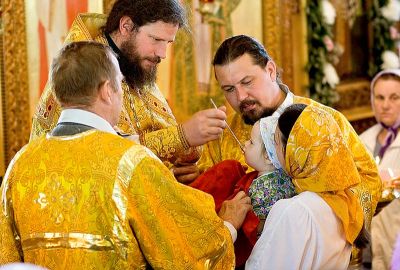
Naturally, just being a visitor, I refrained from Communion. Many people in attendance, who I assume are regulars, also refrained from receiving. I'm not sure if it's because this is normal for Orthodox churches the world over, or because the congregation is made up of "trads". (Nearly all the women also wore headcoverings like in trad Catholic churches, but not a mantilla in sight.) Again to the consternation of my friends who are 1962 purists, I admired the Divine Liturgy's use of both species and wished I could receive both in the context of the old Mass. The priest addressed the communicants by name, saying "the servant/handmaid of God, N., partaketh of the precious and holy Body and Blood of Our Lord and God and Savior Jesus Christ, for remission of sins and for life everlasting." 

An aeon later, after the dismissal, the priest informally spoke to the congregation about things like Russian traditions regarding Communion, the vigil for the Transfiguration to be held that evening, and about the current attacks on Christian churches in the Middle East. Finally, he asked if anyone had any birthdays or name days coming up. One guy did, so the whole church sang "God Grant You Many Years" or something similar. When that was done, everyone dispersed to either the "parish hall" (another room in the house) or to receive a blessing from the priest. The guy who helped me follow along in the service book invited me to receive a blessing from the priest along with everyone else, but for the same reason I decided not to make signs of the cross Eastern-style, I decided not to go up for fear of mucking things up. 

The fellow who had a birthday was, I think, also the choir director. He warmly welcomed me to the church and asked if I was a musician. I don't know what prompted him to ask since I didn't even sing the congregational parts, but I said I was, and he responded along the lines of, "if I had known, I would've invited you to join us in sightreading some of the parts." To which I replied, "thanks, but I'm not Orthodox." He continued, saying, "that's okay, I wasn't Orthodox when I began singing here, either." He then invited me to stay and eat lunch with the other parishioners. I would've taken him up on it if I didn't feel so awkward, but instead, Lauren and I left.


The ride home

Lauren enjoyed the Liturgy quite a bit, and I had a very positive experience about it and the community myself. In fact, if you've read up to this point, you might be wondering if I've thought of "going Dox" by the end of it all. In a word, no. And although I mused that I unwittingly tossed Lauren headfirst into Patriarch Kirill's clutches by indulging her with this visit, she actually came through it more comfortable with her Catholic identity. Although our proverbial pilgrimage to Moscow affirmed in both us everything we disliked about western spirituality, there was still something missing. Lauren iterated the four marks of the Church (one, holy, catholic, and apostolic) and said she believed the Orthodox came up short on the "catholic" part. After all, we visited a Russian Orthodox church, as distinct from a Greek or Serbian one. While it's true that the Roman Church also has eastern rites, and in the not-too-distant past also had ethnic Irish, Italian, Polish, and Korean parishes in America, these are all window dressing by comparison to the distinct ethnic character of the various Orthodox churches out there.

An Orthodox reading this will quickly object by saying that there's no ethnic requirement to joining the church. Indeed, I believe the priest at the church I visited was of Irish descent (just based on name and appearance; I didn't talk to him), and I'm led to believe that it's quite normal for Orthodox clergy in America to be of Anglo, Irish, German, or otherwise non-Eastern European origin. But still, just speaking personally as a non-Slav, I feel like even if I did have the urge to convert to Orthodoxy, I wouldn't feel completely integrated into the Orthodox world unless I went above and beyond, and became a cleric in the faith. Otherwise, I'd perpetually be a hanger-on, a token half-Anglo, half-Indonesian guy (if not the only half-Anglo, half-Indonesian guy in all of Orthodoxy). As a convert to the Roman church, while I do still feel like a bit of an outsider, this is more because I'm just a single person going to church without any family ties or little ones trailing behind me, rather than because of ethnicity. 

In spite of all the eye-rolling induced whenever I read about the latest media stunt or soundbite surrounding Pope Francis, or my general cynicism about anything related to Vatican politics, I have to admit that the bishop of Rome somehow still supports a unity and catholicity you just can't find anywhere else in Christianity. I can look at photos of Japanese people attending Mass in Nagasaki after the bombs fell and think it makes sense, but think it would be bizarre if it were a Divine Liturgy instead. I can be irritated as hell looking over photos of the Eucharist being tossed like candy at World Youth Day in Brazil, but still feel the event is somehow relevant to me because I'm Catholic. I can have absolutely nothing in common with the average pew-warmer at the Catholic parish down the street, but what happens at his Novus Ordo Mass still matters to me more than what happens at an aesthetically perfect solemn Mass at Saint Clement's Episcopal in downtown Philly (though they are more Tridentine than Puginesque, but I digress). Much as I'd like to ignore the daily doings of Francis, his office somehow ties the ordinary Joe Catholic pew-warmer's fate to mine more than that of the most zealous Anglo-Catholic medievalist.


A Western Orthodox world

If I could build my own church, it would look like the Sainte-Chapelle and have daily solemn Mass and Office in the Sarum Use with a rood screen, choir stalls in the sanctuary, Communion under both species, less scholasticism and legalism, and some odd combination of both married secular clergy and celibate canons; and somehow still have a very active role in social justice and ministering to the poor of the area. As a young male convert to Catholicism with just enough education to enjoy armchair pontificating and not enough to be wise and content with what I have, I have the bizarre daily temptation to re-imagine the Church as I want it to be. Lauren, being a more masculine thinker than most women (don't tell her I said that, but honestly, when was the last time you heard of a single young female who thought of converting to Orthodoxy because Catholicism is too effeminate?), sought solace in the East but came through with a reassurance of Catholicism's catholicity, despite itself.

My imaginary church will never exist under the auspices of Pope Francis or (probably) any of his successors in my lifetime. The closest it's ever come would be under the extremely niche communities of Anglo-Catholics (such as Saint Clement's, as I mentioned above) or in so-called Western Orthodox communities. The priest of the Russian Orthodox parish I visited is an expert on the Sarum Use and, I imagine, has celebrated it many times before if he doesn't now. These communities are havens for thinkers such as Lauren and myself, and I'm sure some of them even read my blog. 

This Western Orthodox bishop (?) is precisely what I imagine all western churchmen ought to look like

My last thought for this entry: if reincarnation were true, I'm pretty certain I would have been Henry VIII in a past life. No other historical figure so embodies the "if I could build my own church" sentence I wrote better than he. Contrary to popular belief, Henry didn't create the Church of England just because he was randy. Any other king in his position would have just taken Anne Boleyn as a mistress and carried on with life. But before Henry became king, he was a young man groomed for a career in the clergy while his older brother, Prince Arthur, was set to be king. Indeed, his father named his firstborn "Arthur" out of a belief that he, the first of a union between the feuding houses of York and Lancaster, would lead England to a new golden age just like the king of myth. Young Henry, some said, would serve the realm as Archbishop of Canterbury beside his elder brother. 

Henry VIII before he was fat
So when Arthur died and Henry became heir, it's no surprise that his background as a potential churchman shaped his approach to the kingship. Henry's piety led him to come to the Papal States' defense during the Italian Wars. With the aid of Saint Thomas More, he published the Defense of the Seven Sacraments against Luther and was named by the Pope a "defender of the faith". When the continuation of the Tudor line came into question, it wasn't enough for Henry to just take a mistress as any other king would have done. He had to have his union validated by the Church, and if the Church wouldn't acquiesce (and honestly, if Katherine weren't the Holy Roman Emperor's aunt, the annulment probably would have gone through), he would have to take matters into his own hands.

Still, for the average Englishman, nothing changed under Henry's Church of England at all. At most, he introduced the "for thine is the kingdom" doxology to the Lord's Prayer, but that was already in Eastern usage, not a Protestant innovation. Lutheranism was still condemned in Henry's church. So ironically, I don't see Henry VIII as a Protestant at all. He was instead, perhaps, the first Western Orthodox; for if every king had followed his example, the West would have broken into national churches while otherwise remaining completely apostolic. The Pope would have remained "patriarch of the west" but with no real power outside the see of Rome.

And therefore, every day in between brushing my teeth and flossing, I look into the mirror and ask myself, "have I become Henry VIII?" The answer remains no, and it's not just because I decided to lay off the enchiladas. No, friends. Lauren and I will remain where we are, loving the Roman church despite Her best efforts to eject medievalists to the dustbin of history. Apologies if I offended anyone in the process.


Sunday, May 26, 2013

A good week for medievalism, and thoughts on education

I've been remiss in posting, dear friends, but the world still turns whether or not I issue forth a new article every week. This week is especially good for the medievally minded, and here's why:

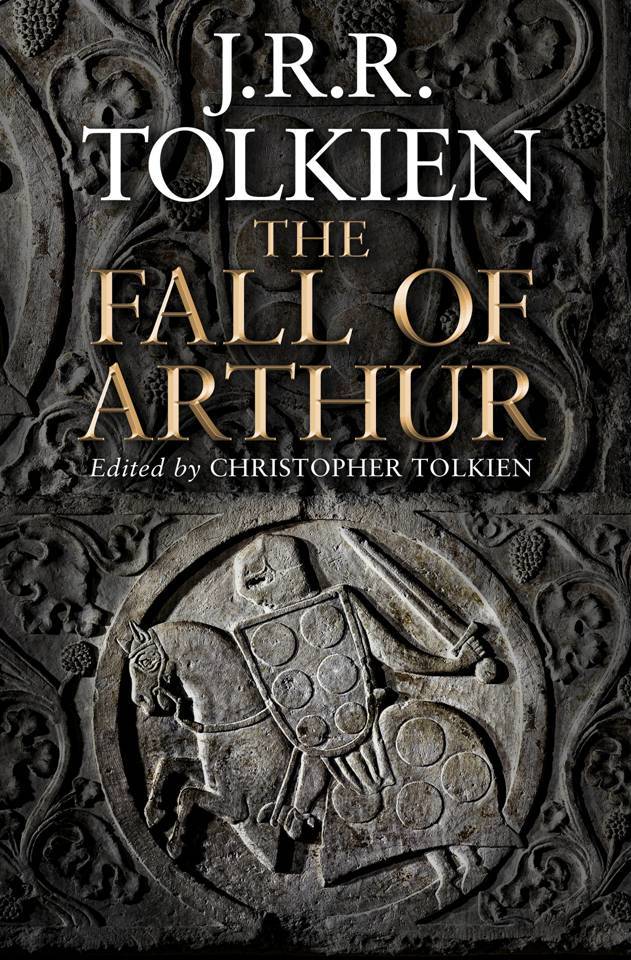
1.) J.R.R. Tolkien published a new book. The mastermind behind middle-Earth is starting to rival Tupac in posthumous contributions; this time, it's The Fall of Arthur, an unfinished epic poem giving us Tolkien's spin on the matter of Britain. I've not yet read it myself, but from what I know, Tolkien has dispensed with the Grail and the courtly love traditions, opting instead to give his audience a raw, more "English" approach to the legend of King Arthur and his war against the Saxon invaders of the early Middle Ages. I have full faith that his style won't bear any resemblance to that abortion starring Clive Owen. However, buyer beware: the poem only occupies a small portion of the book. The bulk is filled by notes and essays written by his son Christopher on "The Poem in Arthurian Tradition" and other such subjects. You'll be disappointed if you were hoping to pick up a fully-fleshed, or even half-fleshed work.


2.) Sir Christopher Lee will release his next metal album tomorrow on his 91st birthday. Talk about a prolific career: Lee, who is old enough to have fought in World War II (and did), already holds the record for the biggest filmography of any major actor ever. Aside from reprising his role as Saruman in the Hobbit films, he can also boast of being the oldest metal performer of all time. Tomorrow will usher the arrival of Charlemagne: The Omens of Death, a sequel to Lee's previous album (Charlemagne: By the Sword and the Cross).


A music video from Lee's previous album:


3.) For those of you who are fans of George R.R. Martin's A Song of Ice and Fire saga, HBO's Game of Thrones next episode (the following Sunday, as there is no episode scheduled tonight) is titled "The Rains of Castamere". If you've read the books, then you already know what's about to happen. If you've only been following the TV series...... well, gird your loins. Winter is coming.

"And so he spoke, and so he spoke, that Lord of Castamere but now the rains weep o'er his hall with no one there to hear."


In other news, I've been dwelling a lot on what really matters to the average American, and how to gain their attention. I never expected this blog to go viral, but my goal from the beginning has been to reach a relatively broad audience. If I can't go beyond the tweed jacket and pipe smoking crowd, then I've failed. The trouble is that I often feel completely out of touch myself. In my column a couple months ago, I already outlined how Pope Francis and I seemingly exist on two different planets, despite being of the same religion. Not long ago, I had the unpleasant experience of feeling like a dinosaur in my mid-20's when I was substituting for a high school class and the given assignment was to watch The Empire Strikes Back. No one in any of the classes that day had ever seen a Star Wars movie before, not even a nerdy kid in the back of the room to play the exception to the rule. It makes sense now, but at the time, it took me a while to wrap my head around the idea that an entire generation could miss out on what I took for granted to be a staple of pop culture. 

Now, obviously there's nothing to gain from being able to distinguish the various kinds of TIE fighters or AT walkers, but I learned a valuable lesson that day: the things which I assumed were part of a commonly shared American culture don't actually exist. I routinely ask students what sorts of movies they watch or games they play, and find that despite the fact that I'm not much older than them, my interests and theirs rarely ever coincide. The same can probably be said for the entire faculty at innumerable inner-city schools across the nation. Google for accounts from inner-city public school teachers and you'll find the same story everywhere: white, middle-class do-gooder seeks to change the lives of disadvantaged kids in poor areas, then experiences severe culture shock on his first day when he realizes it was nothing like his own school. All of a sudden, yesterday's bickering over the effects of Harry Potter on our kids seems ludicrous when you come across a whole classroom of high schoolers who are incapable of reading any of those books, even if they wanted to (they probably don't). Worried about helicopter parents intruding into every aspect of their adult children's lives? Instead, be thankful they have the time and energy to bother in the first place. There are countless schools where parental involvement is almost nonexistent because the parents have to work multiple jobs just to make ends meet. The children who have been saddled by generational poverty go on to have more children, and the cycle perpetuates itself. And since lower-class families reproduce at a higher rate than the affluent middle classes, it doesn't take a genius to figure out who will be inheriting America in 20 or 30 years.

The above statement, to be clear, is not a preamble to a racist or eugenicist rant about the direction our nation is going. Nor does it precede a patented 7-step solution based on what the medievals would have done, because (as members of a subsistence economy) they wouldn't have done anything. Public education is an entirely modern construct which requires a modern solution, if it can be fixed at all. I'm merely raising a question: in 30 years, what will be the ties that bind our western, American culture? Certainly not the civic religion of the Founding Fathers, those ancient dead white men who owned slaves and whose descendants stole half of Mexico. (It's already a usual sight for entire classrooms to remain seated and gab through the Pledge of Allegiance. I don't know why schools still bother with it.) Nor will it be Christianity, which continues its endless fracturing and commercialization at the hands of hack preachers. Shakespeare? He's already been the bane of high school students for generations, but I've spoken to students who were seniors and never exposed to the Bard at all because it wasn't relevant to achieving acceptable standardized test scores. (I was amused when one student thought I was British because of the way I speak, though I assure you my dialect is your average newscaster American.) To those certain "conservatives" who think education is useless if it doesn't gear people toward being a cog in the industrial workforce, I hope you're happy. At any rate, despite the current over-saturation of liberal arts graduates, the future doesn't bode well for the humanities, much less medieval studies in particular. Ironic that as we lose sight of our past, we're bound to resemble the world as Saint Gregory of Tours saw it, when in describing 6th century Gaul in The History of the Franks he said,

"With liberal culture on the wane, or rather perishing in the Gallic cities there were many deeds being done both good and evil: the heathen were raging fiercely; kings were growing more cruel; the church. attacked by heretics, was defended by Catholics; while the Christian faith was in general devoutly cherished, among some it was growing cold; the churches also were enriched by the faithful or plundered by traitors-and no grammarian skilled in the dialectic art could be found to describe these matters either in prose or verse; and many were lamenting and saying: 'Woe to our day, since the pursuit of letters has perished from among us and no one can be found among the people who can set forth the deeds of the present on the written page.'"

Tuesday, October 30, 2012

The Sarum High Mass: Mass of the Faithful

The previous articles in this series:

-The Use of Sarum: A Brief History, and Why It Matters
-The Sarum Low Mass: Mass of the Catechumens
-The Sarum Low Mass: Mass of the Faithful
-The Sarum High Mass: Mass of the Catechumens

At last, we come to the Sarum's summit: the Eucharistic sacrifice as seen in high Mass. This last comparison is short, though, because the rubrics for the Mass of the Faithful concern mostly the celebrant himself, and there are few differences between high and low Mass for him from the Offertory onward. The deacon and subdeacon, who may be said to be the "stars" of the Mass of the Catechumens, now step aside to humbly assist the priest as he fulfills his vocation upon the high altar.


The Offertory

As in the Mass of Trent, the Offertory begins after the celebrant says Dominus vobiscum, then Oremus. I said before that in a parish Mass, the Sarum rubrics place the bidding prayers "after the Gospel or Offertory". I placed my account of them after the Gospel, or after the Creed when the Creed is said. "After the Offertory" is a very awkward place for bidding prayers, but on closer thought, I offer the possibility that the rubric means after the Oremus. The reason? Because this was the place where the oratio fidelium, the prayers of the faithful, were made in Rome prior to the reforms of Pope Gregory the Great. This, at least, is the argument made by the Rev. Father Adrian Fortescue which can be found in the Catholic Encyclopedia's article on 'Liturgy of the Mass':

'The "Oremus" said just before the Offertory is the fragment of quite another thing, the old prayers of the faithful, of which we still have a specimen in the series of collects on Good Friday.'
And:
'At Rome the prayers of the faithful after the expulsion of the catechumens and the Intercession at the end of the Canon have gone. Both no doubt were considered superfluous since there is a series of petitions of the same nature in the Canon. But both have left traces. We still say Oremus before the Offertory, where the prayers of the faithful once stood, and still have these prayers on Good Friday in the collects. And the "Hanc Igitur" is a fragment of the Intercession.'
It may have been the case, then, that Sarum preserved this ordering, or at least the option of it.

Now, as the celebrant reads the Offertory sentence privately, the choir sings it. There are some days (ferial days in Advent and from Septuagesima to Easter) in which the Offertory has a verse and response, like in the Tridentine's Requiem Offertory or in the Offertoriale Triplex. However, the rubrics state these are not to be said outside of these days. (I see no reason why the verses can't be sung by the choir ad libitum to cover additional time, however, if they can be found in the Offertoriale or elsewhere.)

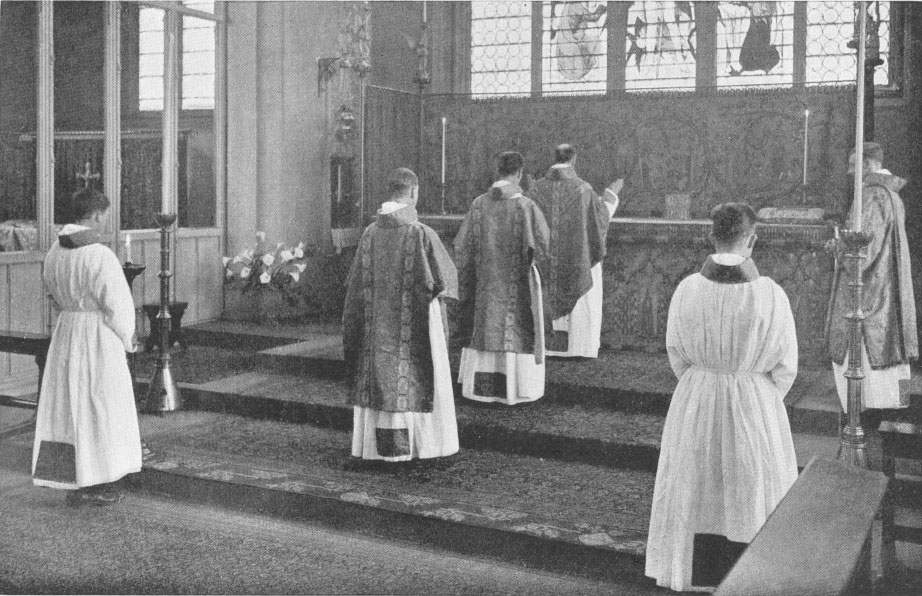
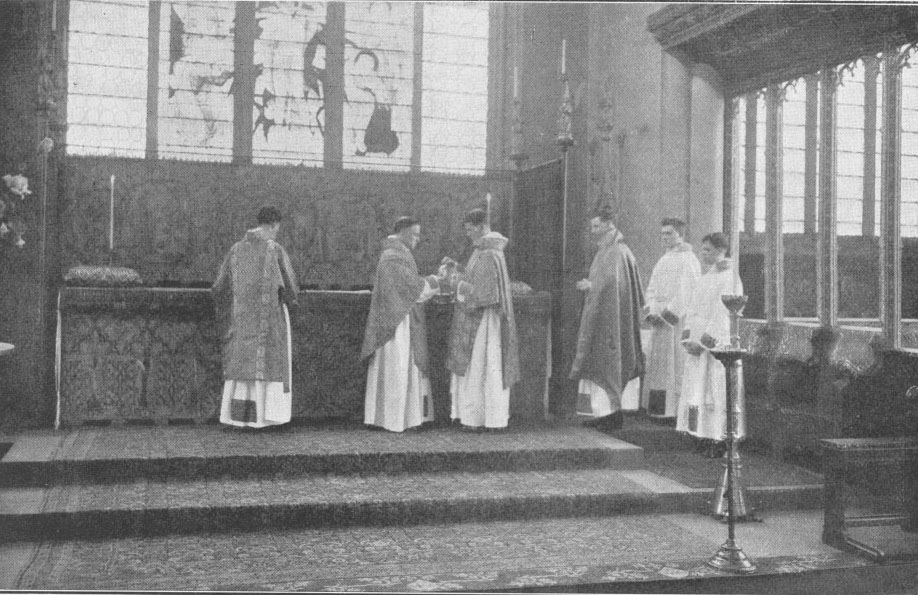
The usual position of the ministers when the celebrant reads from the middle, though I'm unsure about the northward-facing acolyte there.
The deacon presents the chalice and the paten with the Host to be consecrated to the celebrant, "kissing his hand each time". As in low Mass, the celebrant offers the Host and chalice at the same time with the prayer Suscipe, sancta Trinitas. After placing the gifts properly upon the altar, he receives the thurible from the deacon and censes the gifts "thrice, making the sign of the cross over it; then thrice round and on either side: then thrice between himself and the Altar". While doing so, he recites the prayer:

Dirigatur, Domine, ad te oratio mea, sicut incensum in conspectu tuo.
Let me prayer, O Lord, be set forth in Thy sight as the incense.

He then returns the thurible to the deacon, who, if the Creed has been said, censes him. The subdeacon brings the celebrant "the Text" to kiss, but I'm not sure what text is being referred to here; perhaps the Missal. While the celebrant steps to the right of the altar to wash his hands as at low Mass, the deacon is incensing the left of the altar "and the relics in order". The rubrics don't specify if the deacon ever censes the altar's right.

One of the acolytes is tasked with incensing the choir, differing with the practice of Trent which has the deacon do so. The order prescribed is for the acolyte to first cense the rulers, then the dean, then those on the "upper grade" of his stall on the north side. Then he censes the precentor and the upper grade on the south side. He then goes back and forth to cense the middle and lower grades of the stalls in what must have been a lengthy ritual. The subdeacon, meanwhile, follows the acolyte and presents the Text for each member of the choir to kiss after they've been censed. If the Creed has not been said, then the incensing of anything but the gifts upon the altar is omitted.

After the handwashing, the celebrant returns to the middle of the altar and continues as he would at low Mass, while his ministers assume their places behind him. As in Trent, he sings per omnia saecula saeculorum aloud at the end of the Secret and continues with the Preface.

The Canon

During the versicles of the Preface, the deacon gives the paten and humeral veil to the subdeacon, who holds the paten with the veil until the Lord's Prayer. At the Sanctus, if there are rulers, the rubrics instruct the choir to exit their stalls at the ringing of the bell and stand outside the first stalls in the center of the quire. They do not kneel, except on ferial days.

There are no instructions throughout the Canon which differ from low Mass, except that after the consecration, the cerofers assist the deacon with washing his hands, and toward the end, at per ipsum et cum ipso, "let the Deacon stand at the right of the Priest, having first washed his hands, and assist him in raising the corporals; and as he retires let him kiss the Altar and the right shoulder of the Priest."

As at low Mass, the priest extends his arms in a cross after the consecration of the wine.

From the Lord's Prayer to Communion

As the celebrant begins the Lord's Prayer with Præceptis salutaribus moniti, the deacon takes the paten from the subdeacon and stands to the celebrant's right, holding the paten uncovered with both hands, arms extended out. At Libera nos, the deacon hands the paten to the celebrant, kissing his hand. The celebrant makes a curious gesture here which I neglected to mention in the low Mass article. Taking the paten from the deacon, he kisses it, then holds it over his left, then his right eye before signing himself with it.

At the Kiss of Peace, the deacon receives the peace from the celebrant and gives it to the subdeacon. The deacon also gives it to the rulers of the choir, who then give it to their respective sides.

As with low Mass, there are no instructions in the Missals for the people's Communion. I've done a bit more research into this subject, and it seems that there are no surviving rubrics for administering Communion to the people in any book whatsoever; largely because by the end of the Middle Ages, it seems the common practice was for the laity to receive Communion only a few times a year, and in those cases, usually outside of Mass.

The Rev. Seán Finnegan, who was involved with the Sarum Candlemas liturgy at Oxford in 1997, wrote of their difficulties in handling precisely how to approach the people's Communion "accurately". I'll quote from his series of posts on this:
"This was one part of the ceremony where we really had to wing it. We had gleaned that the confiteor was said before Communion, because there is a record of one king of England saying it on his own before his coronation. So we gave the Sarum Confiteor to the Deacon to recite, as in the Roman Use. There was a lot of agonizing about whether we should have Ecce Agnus Dei and Domine non sum dignus, but we could find no evidence for either (which is not the same as it never existing) so in the end, though we printed it in the booklets, we omitted it in the ceremony, probably correctly, I think. The formula for Communion we had, from the order for the visitation of the sick: Corpus Domini nostri Jesu Christi custodiat corpus tuum et animam tuam in vitam æternam, it goes. We knew that there was the custom of the 'houselling cloth' —the long cloth you can see being used — in many places, and that unconsecrated wine was given after the host to cleanse the mouth. We had no formula for administering that, so the acolyte simply presented a chalice with the wine, saying nothing."
The houseling cloth, which is held under the communicant's chin to prevent dropping the Host, is still used at some Tridentine Masses I've attended in the past. Father Finnegan also mentions the interesting custom of administering unconsecrated wine to "wash down" the Eucharist. This may have been a remnant of the late medieval Church's transitional period, when it withdrew Communion via the Chalice from the people. Perhaps unconsecrated wine was still administered as a matter of habit. Other reasons given were that it made swallowing the Host easier, and that it prevented anyone from spitting out any small particle of the Host later on.

Illustration of Communion from the Coronation Book of King Charles V of France, c.1365. (I believe the Tridentine form doesn't allow a bishop to distribute Communion with the mitre on.)

From the ablutions to the end of Mass

At the ablutions, the rubrics have the subdeacon pour the water and wine into the chalice (a few sources contradict and have the deacon here). At the third and last ablution, all sources have the deacon pour the water. The subdeacon ministers to the celebrant in washing his hands, while the deacon folds up the corporals, places them in the burse, the burse over the chalice, and gives them to the acolyte (wearing the humeral veil), who returns them to the credence or shelf.

The subdeacon assisting with the ablutions.
All else follows as in the Mass of Trent, but after the dismissal, the Mass is truly ended. As with low Mass, there is no final blessing, and the Last Gospel is recited privately by the celebrant on his way back to the sacristy. (The medieval priest may have recited it at the altar, though, if he were in one of those churches that had no sacristy to speak of.) The choir remain in their places and proceed with None, or the appropriate Divine Hour, immediately after Deo gratias.