Thursday, September 13, 2012

The medievals and right-hand ring wearing


            In my article on white weddings, I cited a portion of the Sarum rite of marriage. One of the many customs in this rite that stuck out to me was that the groom is instructed to place the ring on the bride’s right hand. Now, of course, our current custom in America is generally to put the ring on the left hand, so I did some reading to figure out how we got from the right in the Middle Ages to the left in the 21st century.


            In England, the switch from right to left came at once, with the issuing of the Book of Common Prayer in 1549. Thomas Cranmer, first Protestant Archbishop of Canterbury, took advantage of Henry VIII’s death and the reign of the boy-king Edward to get rid of the Roman Mass entirely and impose his own ideas for worship across the island nation. The Book of Common Prayer instructed grooms to place the ring on the left hand from that point onward. I can’t find a single source explaining why this change happened. I do, however, know that the episcopal ring was everywhere prescribed to be placed on the right hand of a bishop to represent his marriage to his church. I saw one source stating that Saint Charles Borromeo, Archbishop of Milan during the Counter-Reformation, criticized the practice of wearing wedding rings on the right hand because it imitated the practice of bishops.

            Elsewhere, I’ve seen Eastern Orthodox sites claim that they’ve always worn rings on the right hand, and that the West has erred in switching to the left because the father in Christ’s parable about the prodigal son put a ring on his son’s right hand; therefore, the right hand is Biblical. Yet other sites claim that in some European countries such as Germany, wearing on the right hand is still customary, regardless of religion. In the Netherlands, apparently Catholics wear rings on the left while Protestants wear it on the right. The whole matter is terribly confusing, so I’ll have to chalk it up as a non-essential issue, though one who follows medieval custom will probably lean more toward favoring the right hand.

My kingdom for a horse! Re-evaluating Richard III


The Princes in the Tower, by Sir John Millais.

With the earthly remains of England’s last Plantagenet king, Richard III, seemingly discovered underneath a parking lot in Leicester and discussions brewing on how or where to reinter them, whether or not to have a state ceremony, we have a good opportunity to re-evaluate the man’s legacy. Today, Richard III, or “Dickon” as some called him, is known for usurping the crown and having his royal nephews imprisoned and murdered in the Tower of London. Richard was then killed on the field of battle at Bosworth, paving the way for his rival, Henry Tudor, to become crowned Henry VII, founder of the Tudor dynasty. Henry declared Richard to blame for the princes’ murders, and that was the end of the discussion.

The popular imagination on Richard has been informed almost entirely by Shakespeare’s play, which depicts him as a deformed hunchback with an insatiable thirst for acts of depravity. We can forgive the bard for taking artistic license, as being a propaganda minister for the Tudor dynasty was essentially in his job description. What’s more awkward is the fact that Shakespeare’s main source of inspiration was a work by my patron saint, Sir Thomas More, called The History of King Richard III (which you can read here). It was unfinished and never published, but on the surface, is a scathing attack on Richard’s brief reign. The History is definitely a product of the Renaissance: rather than dryly retell facts (or “facts”) as medieval chroniclers were wont to do, More revived a tradition of historiography founded by ancient Greeks and Romans such as Thucydides and Sallust. In this tradition, a Thucydidian historian is not concerned with presenting facts so much as he is with telling a moral story: how a civilization decays, and how to avoid the mistakes of fallen princes. It is as much drama as it is history, and the historian is expected to put full-blown speeches in the characters’ mouths at the appropriate times.

In this, More is a master storyteller, but it leaves the question of whether he intended it to be merely a story or not. For if it were intended to be a true retelling of history, and Richard III was not actually as bad a king as More suggests, then More was a Tudor propagandist of the highest degree, and therefore a liar. Sadly, a lot of “Ricardian” historians have, in fact, taken it upon themselves to absurdly slander the name of More in defense of Richard. But there is a third possibility: that More’s History is a satire. He was, after all, a master of wit, and his most famous book, Utopia, is an excellent example of the genre. This argument is made in chapter 12 of Jeremy Potter’s book, Good King Richard?: More Myth-making. Check it out here. It's definitely worth a read.

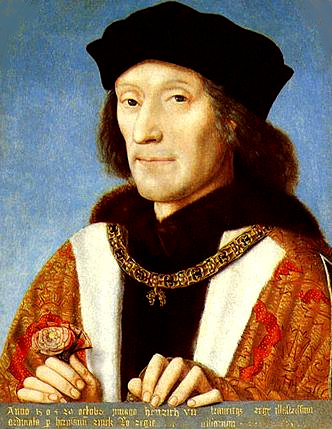
Henry VII, a royal jerk.
The points are these: first, that More had no reason to hate Richard. He was only seven years old during the Battle of Bosworth. In fact, Richard was known for his fairness in law even well into the Tudor years, and More, as a lawyer during the time he wrote the History, would no doubt have recognized that. On the contrary, More had a very good reason to despise Henry VII. In 1504, More was elected to Parliament. The same year, he led the opposition to one of King Henry’s bills which called for even more oppressive taxation. The bill didn’t pass, so Henry, in a fit of spite, sent More’s father, Sir John, to the Tower. More bailed his dad out for 100 pounds (which would be more like a hundred grand in today’s terms) and was expelled from Parliament until Henry VII’s death, so More wasn’t going to forget that anytime soon.

At the point where More would have to start writing at length about Henry VII’s deeds, he abandoned the work and left it unpublished. But the acts of tyranny that More placed on Richard III’s shoulders could easily be put on Henry as well. Potter argues that the History, in fact, makes Richard a safe stand-in for Henry. In any case, the whole History is an attack on tyranny itself, regardless of whether it comes from Plantagenet or Tudor hands. The most interesting observation I’ve seen so far about More’s History comes from this essay by Gerard Wegemer. He points out that no person in the city of London is called by More a “subject”. He invariably refers to them as “citizens” or “the people”. He refers to the aldermen of London as the “senate”, states that Parliament’s “authority in England is supreme and absolute”, and stresses how Richard needed to gain the support of the citizens of London because he required their consent to legitimately rule. I couldn’t stress enough how opposed this line of thought is to the entire Tudor line’s record of wholesale oppression and top-down authoritarian decrees. I suspect that when Henry VII’s mad son finally sent More to the chopping block, More was relieved to be free of the Tudor kings’ lunacies once and for all.

The Battle of Bosworth
As for what to do with Richard III’s remains, now that we (probably) have them… some Englishmen are saying he should be given a state burial at Westminster Abbey! Others, such as this blogger, say that as a Yorkist, he should be buried in the north at Leicester Cathedral. Though he was a king, perhaps even a decent one in some ways, I’m not sure he deserves a state funeral. Even if we could prove that Richard didn’t murder the princes in the Tower, they were still his responsibility to protect. Children, especially princes of royal blood, don’t just disappear from the Tower of London. And Richard didn’t do much to deny his involvement in their disappearance, either. 

What he does deserve, more than honors or scorn, is prayer. Richard’s body, after Bosworth, was originally taken in by some Franciscan friars and interred in one of their crypts. A perfect example of Christian mercy for a disgraced man. Here's something that none of the columnists and commenters have pointed out so far: Richard Plantagenet died in the faith of the Roman Church. It would be fitting if, rather than be taken in by Anglicans of any sort, his body were given to the care of some modern Franciscans or other monks and reinterred with a traditional Requiem Mass for the repose of his soul. In fact, I’m going to write to a number of Latin Mass communities in England and see if I can get a petition going.

Illustration of a Requiem Mass by Augustus Pugin.


And just for fun, watch this clip from the 1995 movie adaptation of Shakespeare's Richard III, set in a 1930's fascist Britain. Watch out for what McKellen's Richard says when his Jeep gets stuck.


Medieval films and the imagination


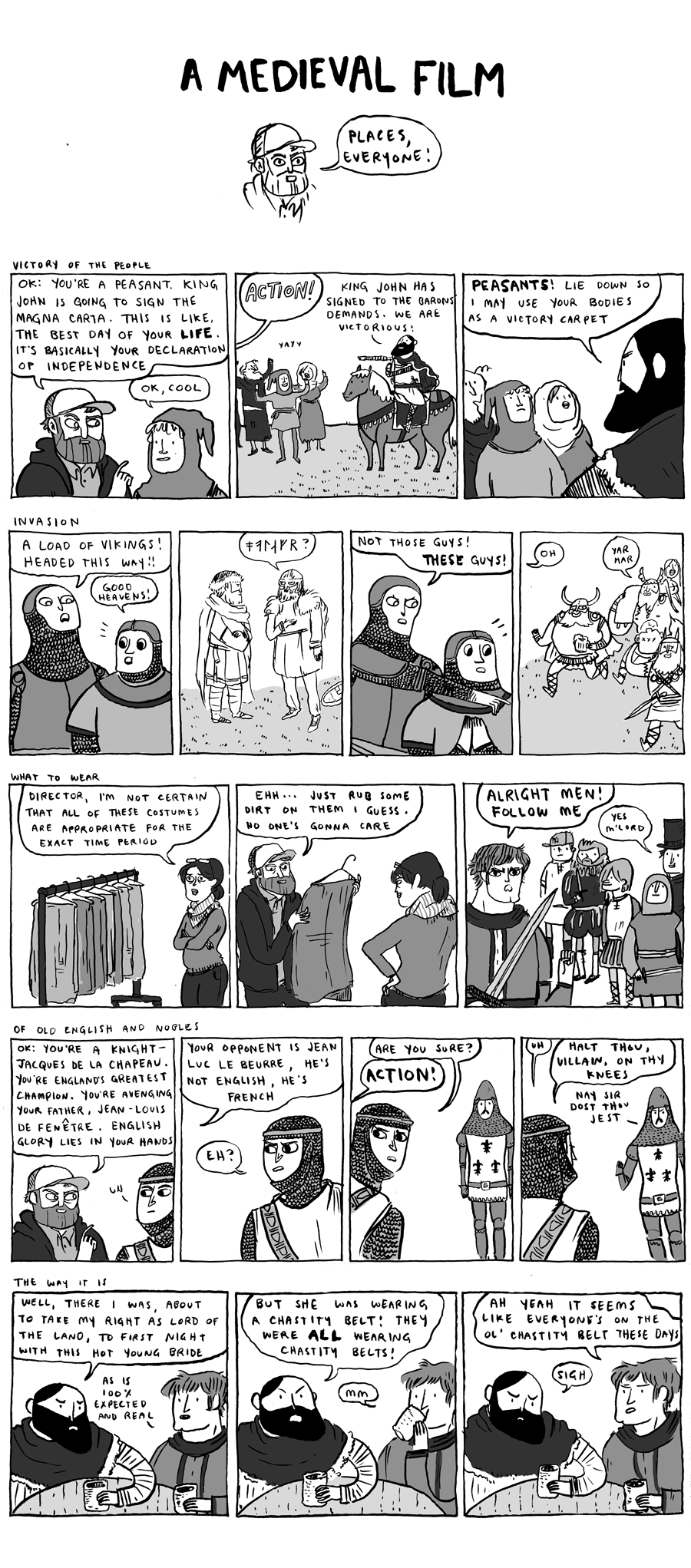
Kate Beaton is the queen of funny historical comic strips. This one (click here for a fuller view) is on the making of medieval films.


On the subject of historical inaccuracy in film, she has an interesting comment along the bottom:

“It's silly to think that movies aren't ‘important’ because they're entertainment, movies are the way most people come across with representations of histories they don't know much about! So I can't blame anyone for caring that they get the details right.”

            It reminded me of a friend who said to me, not long ago, that he hates whenever people dismiss a movie as being “just a movie”. The reason is because, whether we like it or not, film shapes the way we perceive our world, up to and including periods of history. For an archaic but fascinating perspective, read this article entitled "The Cinematograph and the Imagination". I found it in an old Jesuit periodical dated to 1915. Even with those old, jerky, soundless films the essayist must have referred to in his "experience" on the Titanic, I think he may have a point or two.

            I’d conclude this thought by saying that whether or not Vikings actually wore horned helmets is not that big a deal, but a movie that attempts to treat the medieval period seriously, while totally disregarding the customs and mores of that era (for example, Kingdom of Heaven’s openly agnostic hero preaching about religious liberty to a crowd of 12th century peasants), is a damnable piece of trash.

Sunday, September 9, 2012

Chanting "new" prayers


My lady-friend, who currently attends the Thomas More College of the Liberal Arts in New Hampshire, introduced me to a chant she recently heard when attending chapel there. It’s the prayer to Saint Michael the Archangel, set to a composition by a musician who works at the school. The same chant got a nod today in a post on the New Liturgical Movement. Here’s a recording of the chant below:


What makes this remarkable is that we’re applying old styles of music (in this case, Byzantine chant) to a relatively new prayer. It was originally composed by Pope Leo XIII and ordered to be prayed after all low Masses in 1884 as part of a set of prayers for the deliverance of Rome, which had been conquered by revolutionaries and converted into the capital of the new Kingdom of Italy not long before. (So that otherwise excellent opening sequence in the movie Gangs of New York which has Liam Neeson's character, "Priest" Vallon, reciting the Saint Michael prayer in 1840's-'50's New York City is anachronistic.) It is, therefore, a fine example of medievalism in action, and I heartily approve.

Another related example, by the way, would be the common prayer before meals (“Bless us, O Lord, and these thy gifts…”) set to a simple Gregorian chant, again featured on the New Liturgical Movement. I hope these all represent a moving trend away from the “low Mass mentality” toward a culture that embraces singing in prayer, even outside of the liturgy. I’d be really interested to see chant or choral settings of the Rosary prayers now.

"Wild Justice": did medievals think animals were rational beings?


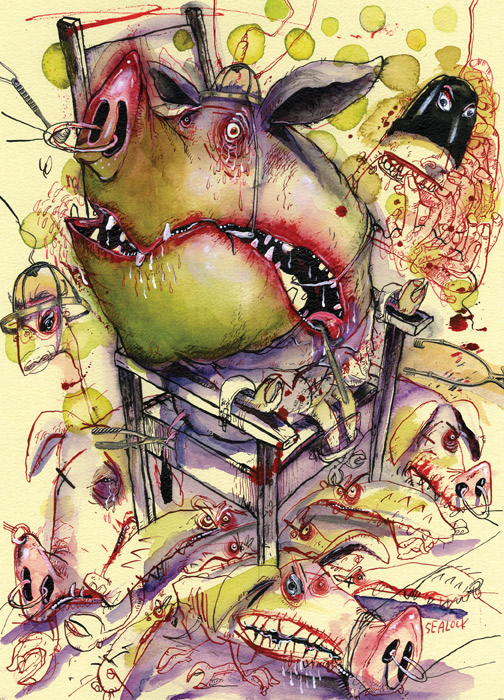
Today I read a fascinating and surprisingly lengthy article on Maisonneuve about the history of animals being tried and sentenced to death for murder or bestiality in the medieval justice system. I don’t have much to say on it, but the suggestion that the medievals placed man and animal on nearly the same footing is interesting, to say the least. Here's the link: Wild Justice, by Drew Nelles.

An excerpt:

Ever the opportunists, some lawyers built their careers by defending animals. A sixteenth-century French jurist named Bartholomew Chassenée made his name as the counsel to some rats who were accused, in an ecclesiastical trial in Autun, of decimating the area’s barley crops. Rats being rats, Chassenée could hardly rely on his clients’ sympathetic qualities to get them off the hook. So, like numerous lawyers before and since, he built his argument on technicalities: the defendants couldn’t be expected to appear in court, as Evans says, “owing to the unwearied vigilance of their mortal enemies, the cats, who watched all their movements, and, with fell intent, lay in wait for them at every corner and passage.”

Chassenée went on to a legal career of some renown, and is said to have defended animals in many other cases. He even published a treatise, De excommunicatione animalium insectorum, on the theology and legality of anathematizing animals, in which he cited Jesus’ command to burn “every tree that bringeth not forth good fruit.” “If, therefore, it is permitted to destroy an irrational thing, because it does not produce fruit,” Chassenée wrote, “much more is it permitted to curse it, since the greater penalty includes the less.” (Jesus’ anger at inanimate objects wasn’t unique. Ancient civilizations like Greece and China would “execute” guilty items like killers’ knives or fallen statues.)

But Chassenée’s biblical logic points to a frequent tension in ecclesiastical animal tribunals: neither the jurists nor the church could ever decide whether the vermin were Satan’s hordes or the earthly agents of a vengeful God. Lawyers defending the creatures typically argued that they were holy punishments, and therefore immune to the church’s retribution; indeed, in such situations, the rats and the church would presumably be on the same team. The church agreed or disagreed depending on which was more convenient—or more profitable. In one case, during a blight of locusts in France, a refreshingly straightforward decree ordered residents to pay “tithes without fraud” and “abstain from blasphemies” until God destroyed the pests. The case was called “The People versus Locusts.”