|
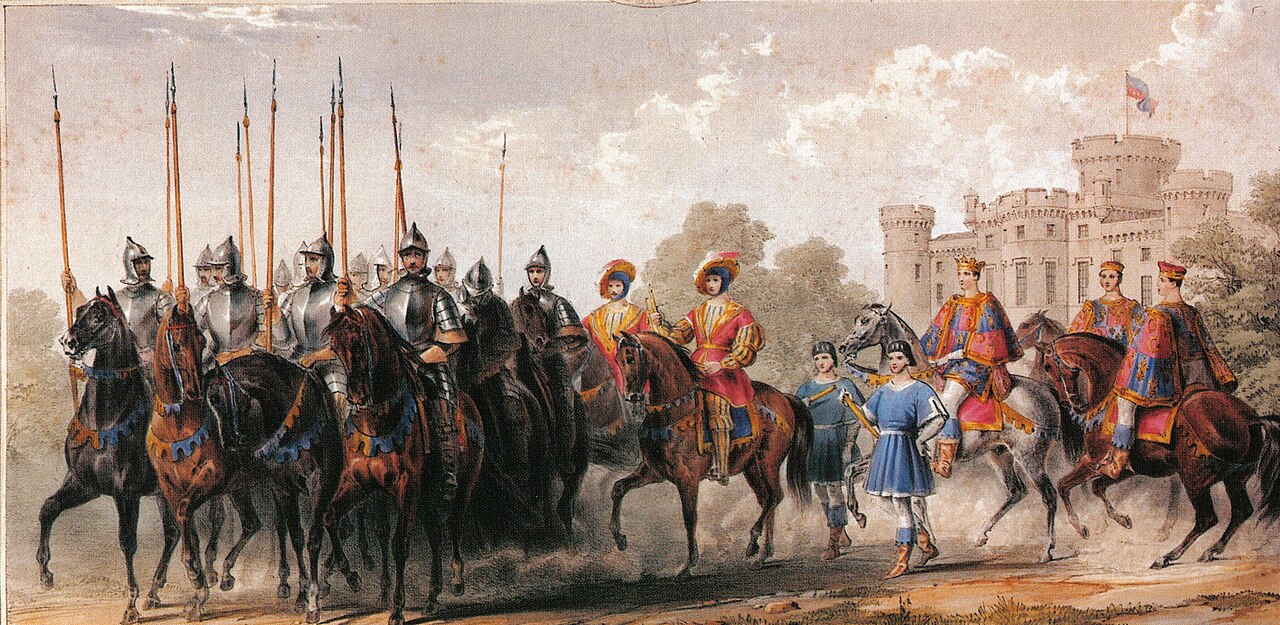
| The founding of the Order of the Star in 1351, an early and short-lived order of chivalry. These knights were the primary audience of Geoffroi de Charny's Book of Chivalry. |
From time to time, I like to read what people on the very opposite end of the political spectrum are thinking about any given subject and seriously try to understand their point of view. A couple of weeks ago, in the aftermath of the shooting at Umpqua Community College in Oregon, I peered over at an acquaintance's Facebook post on the subject and scrolled through the deluge of diagnoses on why America has become the land of the school massacre. Since everyone commenting on that thread, other than myself, was a radical leftist, the consensus was that Umpqua was a symptom of our nation's oppressive patriarchy and culture of white supremacy. If you're here on my site, chances are good that you share my skepticism of those conclusions; the hard facts force us all to agree, though, that whoever the shooter is or whatever his motive was, it will almost certainly be "his". 98% of the time, an American who goes berserk on an unarmed populace with a firearm will be male.
We seem to be so busy pointing the finger at something we don't like or understand, whether it be mental illness, race, or "gun culture", that we're missing the obvious: that we have a crisis of masculinity. Virtually every mass shooter is a young male who sees himself as a failure of some kind and has, therefore, decided to take his anger out on the society that booked him a one-way trip to involuntary celibacy, lousy employment, and unending pangs of inadequacy. Of course, I'm not the only person who's noticed (feminist columnists such as Soraya Chemaly certainly have). But where where they might prescribe that the only solution to ending our fears of being massacred in a public place is to destroy the idea of masculinity itself, I see just the opposite: that it's precisely the decline of "patriarchy" and the resulting void of duty, responsibility, and rites of passage that turn listless young men into monsters. The surest defense against cowards with guns is not legislation, but raising up a generation of men of virtue and courage to stand against them, as Chris Mintz did in Oregon.
 |
| You can order the book here on Amazon. |
Thankfully, as "there's nothing new under the sun", we can turn the pages of history and see what the wisdom of our ancestors has provided in similar times of crisis. In the middle of the 14th century, following France's humiliating loss to England at the Battle of Crécy in the Hundred Years' War, a French knight by the name of Geoffroi de Charny responded to his people's wavering faith in the worth of chivalry and knighthood by writing The Book of Chivalry. This comprehensive guide to a knight's code of conduct was hardly the only such manual of chivalry to have been penned in the Middle Ages, but Geoffroi's book is unique in being, so it seems, the only surviving guide to chivalry by an active knight. Other works passed down the ages were typically written by priests or monks, and while still valuable, tend to be heavy on theory, light on practicality; the warrior caste as idealized (or demonized) by the clergy.
 |
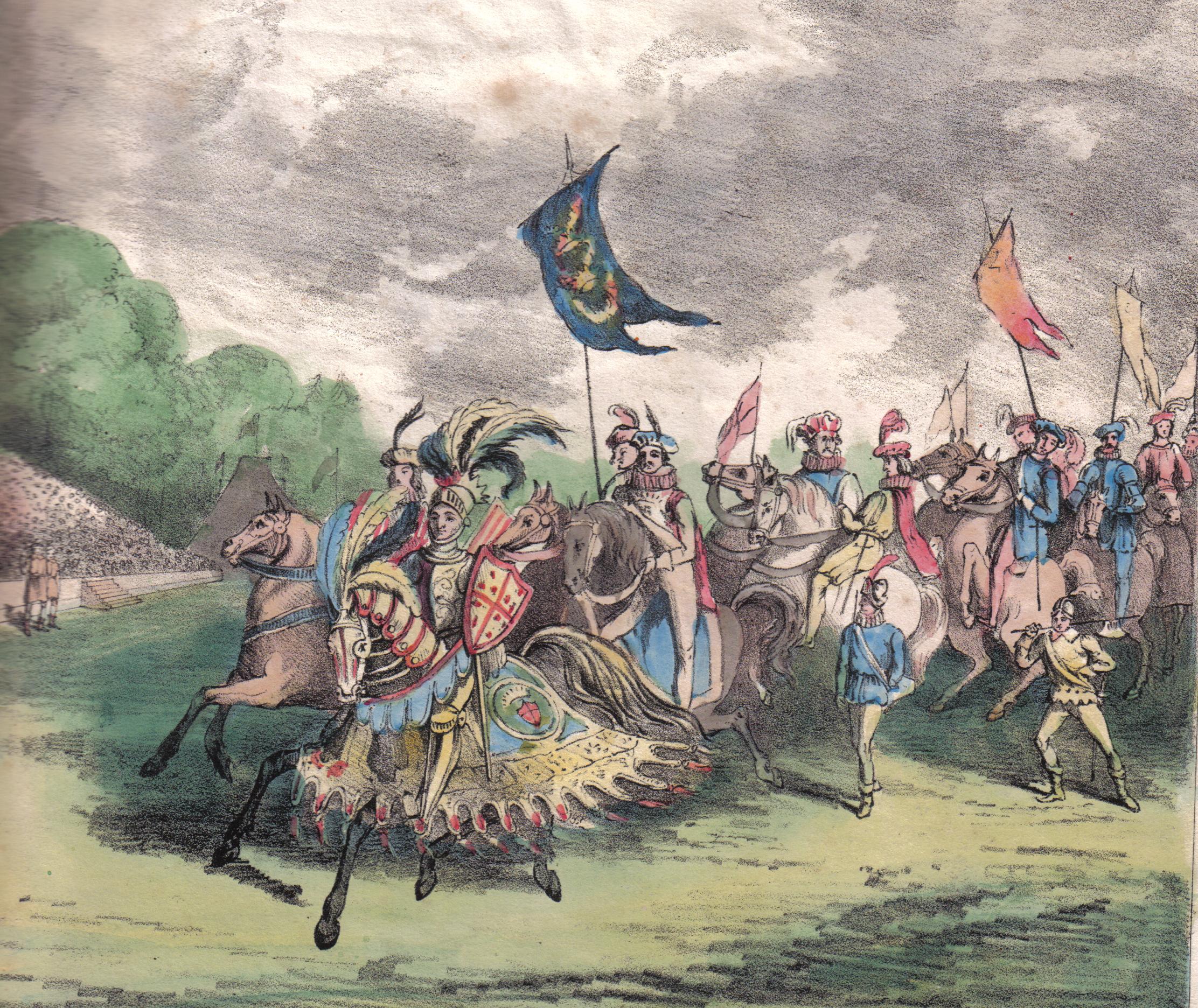
| King Philippe Auguste raises the Oriflamme |
Geoffroi was not just a real knight and veteran of battles, but was the medieval equivalent of a recruiting poster Marine. Once, when he was captured by the English, Geoffroi's captor actually released him, trusting him to go back home to raise money for his own ransom (which, as far as we can tell, Geoffroi actually did). Another time, he resolved a personal feud he had against one Aimery of Pavia, the English-appointed captain of Calais, by raiding Aimery's castle, kidnapping him, then beheading him for his betrayal. The way I describe it surely makes Geoffroi sound like a brute, but Geoffroi made a sharp distinction between personal and state violence; by targeting only Aimery and not attempting to seize the castle or the city of Calais, Geoffroi respected the truce between French and English forces at that time. And at last, no knight could ask for a more ballad-worthy death in combat than Geoffroi de Charny's. In 1356, at the Battle of Poitiers, King Jean II of France had assigned Geoffroi with bearing the royal standard: the Oriflamme. Not only was this one of the most prestigious battlefield duties (the Oriflamme was originally the banner of the Abbey of Saint-Denis and recurs frequently in literature as having mystical power, like a relic), it was also the most dangerous because it made the bearer a target. So Jean Froissart wrote:
"There Sir Geoffroi de Charny fought gallantly near the king. The whole press and cry of battle were upon him because he was carrying the king’s sovereign banner. He also had before him his own banner, gules, three escutcheons argent. So many English and Gascons came around him from all sides that they cracked open the king’s battle formation and smashed it; there were so many English and Gascons that at least five of these men at arms attacked one gentleman. Sir Geoffroi de Charny was killed with the banner of France in his hand, as other French banners fell to earth."
We know, then, that every word of the Book of Chivalry can be read with the weight of a man who turned words to deeds and went to his death to uphold his code, even while others around him dropped their banners and ran for their lives. I've studied Geoffroi's work over the past few weeks to see what can be useful to worthy men of all stations in 21st century life. It bears mentioning that "chivalry" meant something rather different in the 1300's than today. In common usage, we say "chivalry is (or isn't) dead" solely in reference to some courtesies toward women, but this has as much relation to medieval chivalry as a calendar of inspirational quotes has to the Bible. Geoffroi of Charny was writing about an unspoken ethos for men-at-arms, a "way of the warrior" every bit as encompassing as bushido was for the samurai of feudal Japan. Only a very small portion of the Book of Chivalry actually touches upon the proper treatment of ladies. Naturally, the many portions dealing with tourneys and medieval combat, while interesting, won't have much relevance for the average modern man, so I've decided to extract a few of the equally abundant general principles for conduct below:
On the enjoyment of food and drink
First, Geoffroi has a lot to say about his fellow knights' love of eating and drinking (he was, after all, a Frenchman), which he found gluttonous and dulls a man's readiness to action:
"In addition, the above-mentioned good men-at-arms teach that those who want to achieve honor should not set their minds on the pleasures of the palate, neither on very good wine nor on delicious food, for these delights are very out of place at a time when they are not to be had nor to be found at will, as is usually the case for those who want to seek such honor; and desire for such things makes it more difficult for them to endure, and their hearts and bodies find it less easy to bear the lean fare in food and drink which the quest for such honor requires. A man will be reluctant to risk death who has not learned this, and also a man is reluctant to abstain from such pleasures of eating and drinking who has become accustomed to them. One should take no pleasure in such delights; do not concern yourself with being knowledgeable about good dishes and fine sauces nor spend too much time deciding which wines are the best, and you will live more at ease."
At the same time, Geoffroi is neither an ascetic nor a priest describing the ideals of knighthood from an ivory tower. As with many other things, he says "everything in its place", including food, which a knight may enjoy so long as he avoids excess.
"But if it so happens that you find good food and drink, partake of them gladly and sufficiently but not to excess, for men of worth say that one should not live in order to eat, but one should eat in order to live, for no one should eat so much that he is too full, nor drink so much that he is drunk..... Thus one should not grow sluggish in this way, for the man who for his greedy gullet fails to make a name for himself, should have all those teeth pulled out, one by one, which do him so much damage as to lose him the high honor he might have acquired in his youth."
On games, gambling, and the proper pastimes of men
Geoffroi isn't much for games, but knows that young men will inevitably play them. He focuses instead on cautioning them not to bet high stakes, because when a man does, it no longer becomes play. Geoffroi also goes on to describe ball games as a women's sport that men have wrongly taken from them! Worthy men, rather, should be spending their leisure time on either war games or the arts of singing, dancing, and conversation. How radically the opposite of stereotypical masculinity today, and how odd to think that these words were said by a man who was no stranger to cutting heads from their shoulders!
"One should leave playing dice for money to rakes, bawds, and tavern rogues. And if you are determined to play, do not mind too much about winning, and do not stake too much of your money lest your game turn to anger. The situation is the same for real tennis; women have greatly suffered over this, for ball games used to be women's pastime and pleasure. Yet it should be apparent that the finest games and pastimes that people who seek such honor should tire of engaging in would be in the pastimes of jousting, conversation, dancing, and singing in the company of ladies and damsels as honorably as is possible and fitting, while maintaining in word and deed and in all places their honor and status. All good men-at-arms ought rightly to behave thus, for in such society and such occupations and pastimes worthy men-at-arms make a good start, for glances and desire, love, reflection and memory, gaiety of heart and liveliness of body set them off on the right road and provide a beginning for those who would never have known how to perform and achieve the great and honorable deeds through which good men-at-arms make their name.... Yet fine games are good when there is no anger, but when tempers rise, it is no longer play."
The only thing holding a man back from attaining honor is himself
We now speak of honor as a trait one innately has, but Geoffroi usually speaks of it as a thing that can be achieved by deeds. He also makes it clear that honor is not earned only by knights, but men of all classes or estates.
"Indeed anyone who wants to attain this high honor, if he retains his physical health and lives for long enough, cannot and should not be excused from achieving it, provided he be willing to do what is required and could do well if he does not hang back; and no one should be held to be excused, unless physically prevented, whether for lack of funds or of the will for it. Therefore, you should know for certain that there is no one who can or should excuse himself from performing well according to his station, some in relation to arms, others in relation to the clerical vocation, others in relation to the affairs of the world."
Wealth is no measure of personal worth
"Be sure that you do not despise poor men or those lesser in rank than you, for there are many poor men who are of greater worth than the rich."
A knight must still be cunning
Against the stereotype of the knight without any common sense or discretion, always charging headlong into danger, Geoffroi says:
"And be careful not to be too guileless, for the man who knows nothing, neither of good nor of evil, is blind and unseeing in his heart, nor can he give himself or others good counsel, for when one blind man tries to lead another, he himself will fall first into the ditch and drag the other in after him."
On debating with idiots
This bit is something I should probably take more heed of myself....
"Refrain from remonstrating with fools, for you will be wasting your time, and they will hate you for it."
On the value of true friends
"Do not put too much faith in people who have risen rapidly above others by good fortune, not merit, for this will not last: they can fall as quickly as they rise. And the aforementioned men of worth tell you that fortune tests your friends, for when it abandons you, it leaves you those who are your friends and takes away those who are not."
A warning to plutocrats: don't exploit the poor
"And above all refrain from enriching yourself at others' expense, especially from the limited resources of the poor, for unsullied poverty is worth more than corrupt wealth."
On the true purpose and function of rulers
What is the point of having a king? The modern cynic would say that medieval kings were merely the descendants of those soldiers of fortune who were best at hoarding land and commanding armed thugs to enforce their will. Our presidents, by contrast, are elected to follow the whims of the masses. Contrary to either of these perversions, Geoffroi had quite a different notion of rulership:
"Now, after all these questions and answers, we must come to the true explanation for the creation of such emperors, kings, and princes of great lands and peoples. You should know that at that time were chosen those who were seen to have good physique, strong, and well equipped to endure hardship of all kinds and to strive for the good government of their people, whether in time of war or of peace. These personages and these lords were not raised up to have great periods of rest nor great pleasures nor great delights, but to endure more and to strive harder than any of the others.... They were, therefore, chosen so that they should not despise any poor people, whether men or women, nor disdain to listen to them, and should treat them more benevolently than they would treat richer men, and as a result, many poor men, on account of their lack of financial means, have failed to achieve by their lengthy endeavors what by right they should have done. They were, therefore, chosen so that they should in no way use bad language nor curse in the name of Our Lord or that of the Virgin Mary or those of the saints, for the higher their rank the more they should make sure that God be feared, loved, served and honored in word and deed wherever they are. They were, therefore, chosen that there might be no idleness in them, lest they might not always devote all their thoughts and efforts to striving on behalf of themselves and their people."
Beware the "holier-than-thou"
This archetype as Geoffroi describes it is less and less prevalent the further we sink into a post-Christian world, but in place of God or gods, we have new idols and standards with which to scrutinize others: dieting, body shaming, fashion, parenting choices, to name but a few. Beware those who adopt airs of sanctimony (whether it has to do with religion or not) as a smokescreen to cover their own faults.
"Some may be held to be in a different way men of worth, that is those who give alms freely and like to be in church and attend mass frequently and say many paternosters and other prayers and fast in Lent and other recommended fasts. But perhaps there are in some of those men less obvious characteristics opposed to the good qualities mentioned above: for example, there may be concealed in their hearts greed or envy of others or hatred or ill will or many other things that detract from a great part of the good characteristics mentioned above. They are held to be men of worth for the characteristics which are apparent in them, but nevertheless one can do better as far as being a man of worth is concerned."
Good and Bad Reasons for Getting Married
Even in an age where marriage for wealth, titles, and position was the norm among men and women in Geoffroi's social circles, the good knight makes it clear that one who marries solely for material concern is attended by devils.
"Having considered the order of knighthood, it is appropriate to turn our attention to the order of marriage. There are three possible ways of entering into marriage. Some men and women marry when the man has no carnal knowledge of a woman, nor a woman of a man, and they do it more for love than for greed for riches, such a marriage is good in that provides heirs and saves the man and woman from sin. There are some who pay no regard to the person when entering into marriage, but do so out of greed for riches; in the case of those who marry more for gain than for any other pleasure, it is unlikely that any good will come of it, for indeed the devils must be at their wedding. There are some who are widowers, have children, are old, and marry more to keep themselves from sin than to have descendants, nor could they because of their age; these can live fittingly within the order of marriage. It is those who conduct themselves most properly in the order of marriage who live joyfully and pleasantly."
The Order of Priesthood
At last, since some of my friends are discerning a call to priestly service, I thought to post this section, although they might not find it very relatable in the modern Church. Geoffroi's idea of a priest's responsibilities is so far removed from what nearly all seminaries teach today that one can wonder if they're even talking about the same thing. A priest, in Geoffroi's mind, isn't supposed to have to do anything except sing their services, and this still (unlike marriage, knighthood, or religious life) can only be properly taught from a young age! He says nothing about spiritual counseling, community service, or politics whatsoever.
"We could also speak briefly of the worthiest order of all, that of priesthood. In this order, unlike those considered above in relation to entry when young, no one should enter it unless he learns as a youth his service, which he must study and know very well; for there are many who begin so young that they know nothing of it and have no understanding of it, and this can give rise to great dangers. There are also many who do have an understanding of it, but they do not conduct themselves as befits their office; it ill behooves them not to behave properly, in accordance with the worthy office which they have entered upon and which they have undertaken. But there are those who have set their minds to it and know and perform their service well and sing and chant devoutly and know how to behave in a manner befitting the noble estate of an ordained priest.... It is not for them to undertake other duties, and if they behave in this way, they act in keeping with their position as befits their office. They should not have anything to do except say their masses with diligence and devotion, and this office should suffice without learning any other."