I've
taken a short break from my ongoing series on Victorian neo-medievalism to read and
post some interesting gems from an art guide by my favorite designer of all
time, Augustus
Pugin (the Victorian Catholic architect who, among many other feats,
designed the Big Ben Clock Tower and the interior of the Houses of Parliament).
The
book, published in 1844, is called the Glossary of Ecclesiastical Ornament and Costume. Its
purpose is to serve as a guide for Catholic church designers, artists, and
craftsmen how the furnishings of a church should look, and exactly what they're
for. We're talking about vestments, chalices, altar cloths, statues,
inscriptions, and even wallpaper. There are bunches of wonderful illustrations
in the second half of the book, all drawn by the man himself. A book like this
would also be of great interest to a sacristan. If this sounds like your sort
of thing, it's available for download in .pdf or .epub right here (see the orange button on the left).
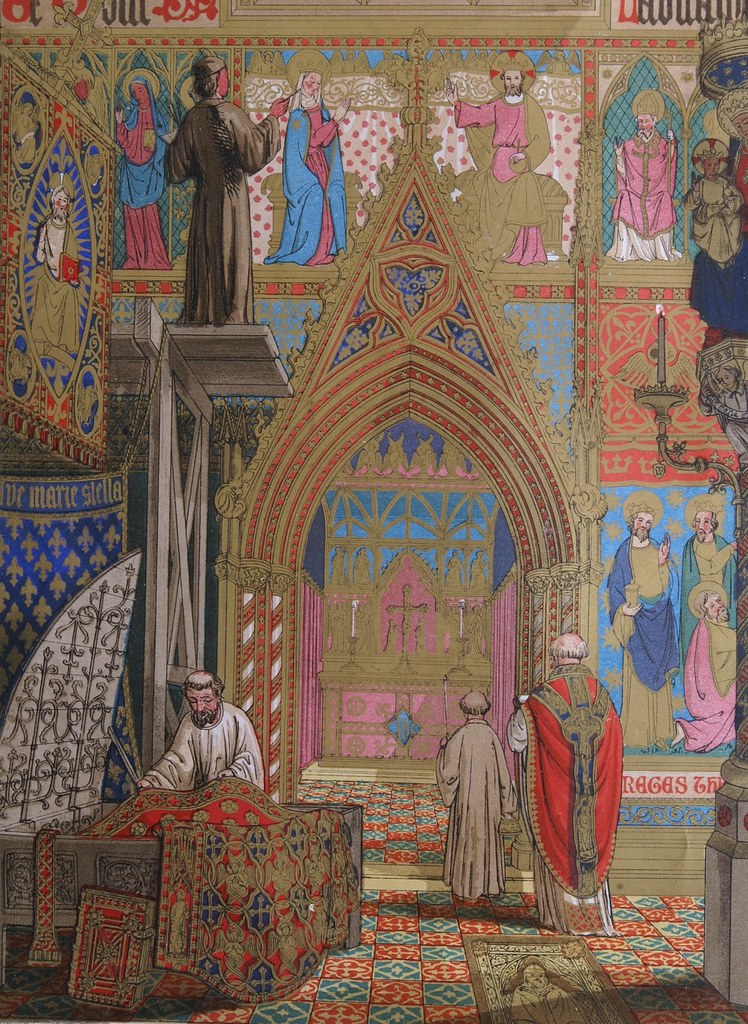 |
| A breathtaking cover page illustration by Pugin himself. |
The
first thing I noticed is from the cover, describing Pugin as "Professor of
Ecclesiastical Antiquities" at Saint
Mary's College, Oscott (currently a seminary in Birmingham, England). It's
amusing because Pugin himself never spent a day in college as a student.
Nonetheless, it takes only a few pages to see that Pugin, through self-study,
amassed a savant-like knowledge of Church history and liturgy.
Pugin
opens his text with an introduction on "Symbolism in Art". Lest you
ever accuse his churches and designs of being too vibrant or too ornate, he
sternly warns that:
"Every
ornament, to deserve the name, must possess an appropriate meaning, and
be introduced with an intelligent purpose, and on reasonable grounds.
The symbolical associations of each ornament must be understood and considered:
otherwise things beautiful in themselves will be rendered absurd by their
application."
Following
his introduction is a massive glossary of every imaginable thing you could find
in a church. For many of these entries, Pugin felt the need to supply them with
lengthy essays. For example, the entry on Chasuble,
the upper vestment worn by priests during the Mass. Fairly straightforward,
right? But Pugin has nine and a half pages to tell us all about this garment.
Much of it is spent lambasting the Roman, or "fiddleback" style that
was popular in his time and which has been revived in the vast majority of
traditional Catholic churches. My fellow trads would find the entry annoying,
but I believe he's right. He says:
"It
is surprising how soon the minds of the multitude are reconciled to changes,
when they are for the worse; and the clipping principle, in the course of
little less than two centuries has reduced the most graceful Vestment of the
Church into a most hideous shape, with a front resembling the body of a wasp,
and a back like a board, without a vestige of its ancient beauty or mystical
signification; nay more, not only have modern vestments been made in this
stunted and miserable form, but hundreds of ancient ones--ample and glorious--which
had escaped the ravages of harassing pursuivants, in secret recesses of the
Catholic mansions of England, have been actually cut and clipped in latter
times by the hands of the degenerate descendants of those very men, who in days
of greatest trouble and distress, had preserved alike intact the Vestments and
the Faith. The present forms of Chasubles are not only hideous, but they
destroy the meaning of many of the ceremonies of the Mass." (page 62, or
83 in Adobe)
And so
he goes on, for several more paragraphs. In the passage above, he was
referencing the practice of how Catholics in his time would actually cut up
old, flowing chasubles so they'd conform to the fiddleback style! I've seen
them; chasubles going back all the way to the High Middle Ages, cut
down to size; for myself on display at the Victoria & Albert Museum in
London. It was absurd.
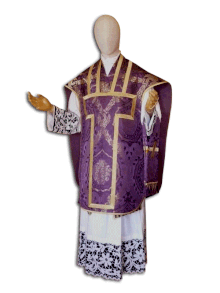 |
| The dreaded fiddleback! |
Pugin
also points out a very odd, but true, observation on the fiddleback chasuble:
the fact that you hardly ever see it in sculptures. In short, artists hate the
fiddleback:
"Every
artist is aware that the folds of drapery constitute its great beauty; the most
majestic mantle extended flat is unsightly. Ever since the chasubles have been
made of a stiff material, they have been avoided by sculptors and painters in
their works, and they invariably select the Cope instead, solely on account of
its folds, when, if the chasubles were made of the ancient graceful form, they
would afford the most beautiful combinations of folds." (footnote on page
63, or 84 in Adobe)
But
enough on that. Moving on in the Glossary, Pugin peppers this book,
which would normally be as dull as watching paint dry, with his own English
sense of humor. Whereas he normally has detailed descriptions of the liturgical
colors and what they represent, his entry for Purple merely reads,
"See Blue, and Red".
On his
entry for Dog, I seriously can't tell if he's being funny or not. It reads,
"Emblem of fidelity, and generally introduced at the feet of married women in sepulchral effigies, with that signification. It also signifies loyalty to the sovereign."
Other
entries are ridiculously obscure. Ever wanted to know how to dress a boy bishop
for Mass? See page 46. And what on earth is a pome? Pugin
explains:
"A
ball of precious metal filled with hot water, and placed on the Altar during
the winter months, to prevent danger of accidents with the Chalice, from the
hands of the priest becoming numb with cold."
Only in England, friends. Only in England....
One of
these obscure antiquities, which really ought to be revived, is the use of the herse
at funerals. No, not the funeral carriages, though those are nice, too. But
the herse was a frame for candles and heraldic devices, placed over a corpse
during the funeral rites. It can only be explained by a picture, which Pugin
the illustrator generously provides:

In the
entry for hoods, Pugin embraces his inner medievalist to the core in an
opinion that would warm the heart of any religious.
"Hoods:
are a most ancient covering for the head, and far more elegant and useful than
the more modern fashion of hats, which present a useless elevation, and leave
the neck and ears completely exposed."
Pugin fascinatingly also tries his hand at apologetics. Some of these entries
are genuinely edifying and deserve to be printed in pamphlets or posted on
Internet fora even today. I draw attention in particular to his entry on Images:
"No
sooner had the doctrine of the Cross triumphed over Pagan error, and the danger
of idolatry been removed by the overthrow and destruction of the idols themselves,
than the Church permitted the glorious art of sculpture, hitherto dedicated to
the illustration of error, to be exercised in honour of the true God and his
blessed Saints, and to contribute to the piety and devotion of the faithful, by
setting forth the most sacred representations, for their contemplation and
instruction. Although the fury of the early iconoclastic heretics had well nigh
stifled Christian sculpture in its birth, and the still more fatal destruction
caused by the Calvinistic and revolutionary iconoclasts of more recent times,
has defaced or destroyed many of its finest productions, the great churches of
Christendom yet exhibit most wondrous proofs of that the art of man, when
influenced by faith and devotion, could do, in embodying the Life and
Sufferings of our Blessed Lord, the lives of the Saints, and the glories of the
Heavenly Kingdom." (page 158, or 179 in Adobe)
Finally,
I'd like to touch on Pugin's entry for Chair. In it, he covers all kinds
ranging from the bishop's cathedra (throne), to the humble priest's sedilia. In
most trad chapels today, the sedilia is a sort of bench with three seats on an
equal plane: the priest in the middle, and the deacon and subdeacon (or
acolytes) to his sides. Pugin, however, revived the medieval use of niches in
the wall arranged hierarchically with the priest at the highest point, then the
deacon, then the subdeacon. Again, such a thing can't be envisioned without a
picture. There isn't one in the book, but I'll show you one he actually made at
the church of Saint Giles, Cheadle. (Full-size image here.)
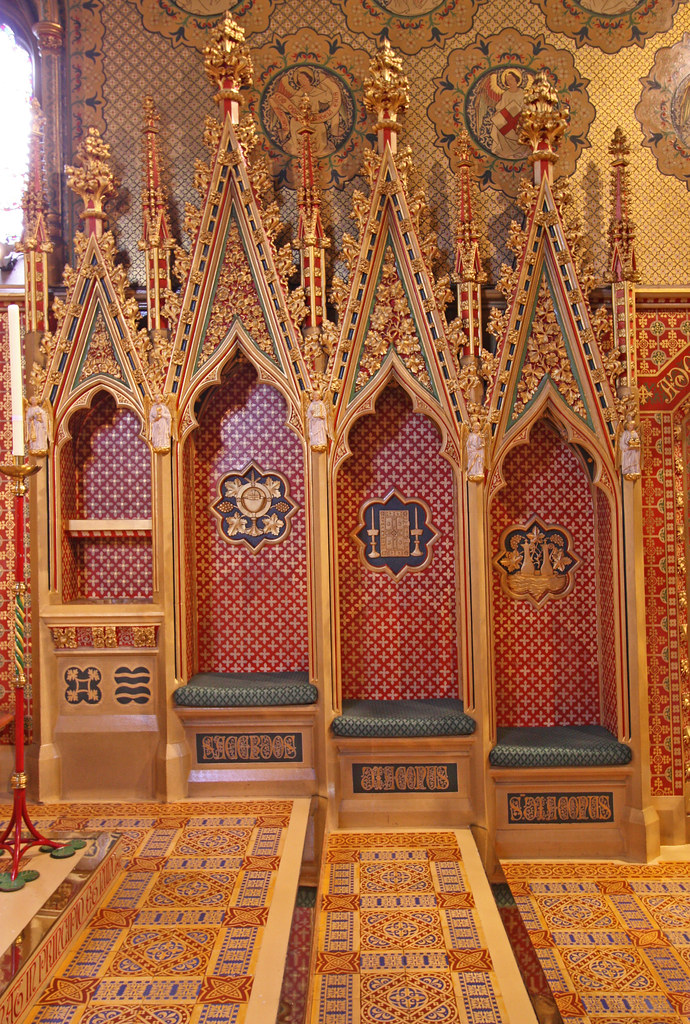
The
names of the orders are inscribed under each seat (sacerdos for priest, diaconos
for deacon, etc.). Each seat has symbols of his order as well. The
subdeacon has cruets, the deacon has a gospel book, and the priest has the
Eucharist. Pugin also incorporates function with form; the easternmost niche
has a credence shelf above (to hold the cruets, bowl, ewer, etc.) and a
sacrarium below (to safely wash vessels so that any remaining particles of the
Eucharist may settle in the earth). And to add further function, the seats are
conveniently arranged so that the priest, deacon, and subdeacon can go to and
from the altar without changing places to allow the priest in the middle.
Pugin,
in his typical medievalist manner, scorns the newfangled "Italian"
chairs used in most churches of his time (and in trad chapels today) as suited
more for saloons.
"These
sedilia or stalls, for the celebrant and assistants, were formerly to be found
in every foreign church; but the love of modern Italian design to which the
Catholic clergy of the last three centuries have been so lamentably addicted,
combined with the stiffness of modern vestments which rendered these seats
inconvenient, has banished them from all the ancient continental choirs, and in
lieu of them chairs of the most unsuitable description, fit only for the saloon
of an hotel, are frequently used." (page 58, or 79 in Adobe)
I’ll close this post with a few choice scans of artwork from the second half of
the book and this final thought: while I created this post mainly to share some
levity, this blog’s purpose is to show just how the ideas of the Middle Ages
are relevant to our needs, not obsolete. Pugin was accused in his lifetime of
being an “architectural bigot” for asserting that Gothic style (which he simply
called Christian architecture) was morally superior to other forms. He
responded that the medievals, through Gothic, actually fulfilled the ideals of
classicism more faithfully than the imitators of Greece and Rome and that their
style, formed entirely in a Christian age for Christian purposes, is timeless.
Therefore, I hope that if you who are reading this are a cleric, a sacristan, a
religious artist, or even just a humble server, you’ll add Pugin’s Glossary to
your collection and make use of it as a guide for how the Catholic Church ought
to look: not just for Pugin’s century, but for ours today.
 | |
| Some illustration of priestly vestments, based on medieval funeral effigies around Europe. |
 |
| An altar with a reliquary underneath, and curtains drawn back. |
 |
| Various patterns. |
 |
| An alphabet guide to Gothic lettering. |
 |
| Cope designed by Pugin for his own parish church, now at the V&A. (Rowan Williams wore a copy of it for the recent royal wedding, though with a Holy Ghost dove in place of Saint Thomas Becket's face.) |
 |
| A bishop's mitre designed by Pugin, based on one of the illustrations in the Glossary. I believe it's currently kept at Westminster Cathedral, London. |
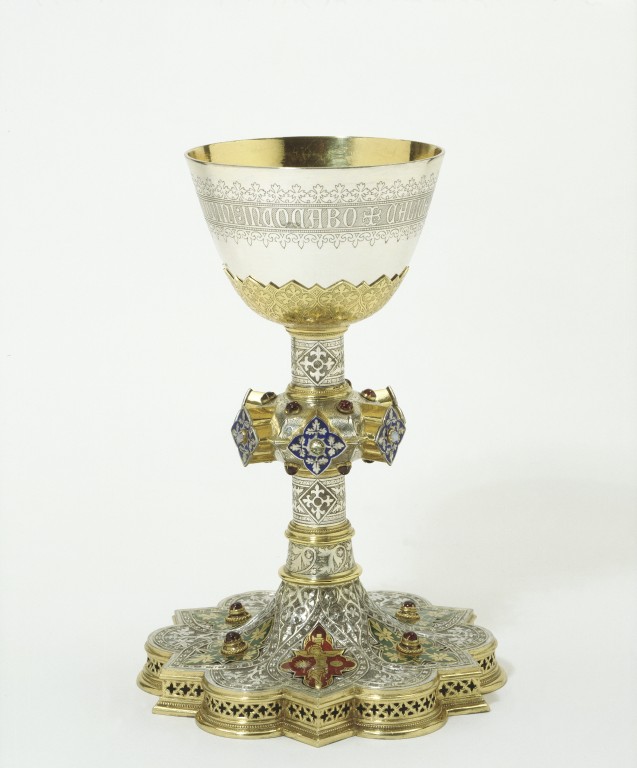 |
| Uber-Gothic chalice by Pugin, which I also saw at the Victoria & Albert Museum, London. |
 |
| Requiem Mass illustration at the very end of the Glossary. Note the ominous hooded monks. |